China Decoupling and the $23.6 Trillion Cost of Economic Security

Working across research, policy, and data-driven analysis, the Editorial Board ensures that published pieces reflect a consistent institutional perspective grounded in quantitative reasoning and long-term structural assessment.
Authored On
Modified
Decoupling from China could cost $23.6 trillion
Strategic dependence can make that cost economically rational
Security benefits must be measured alongside economic costs

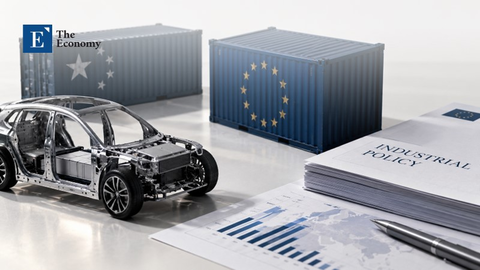
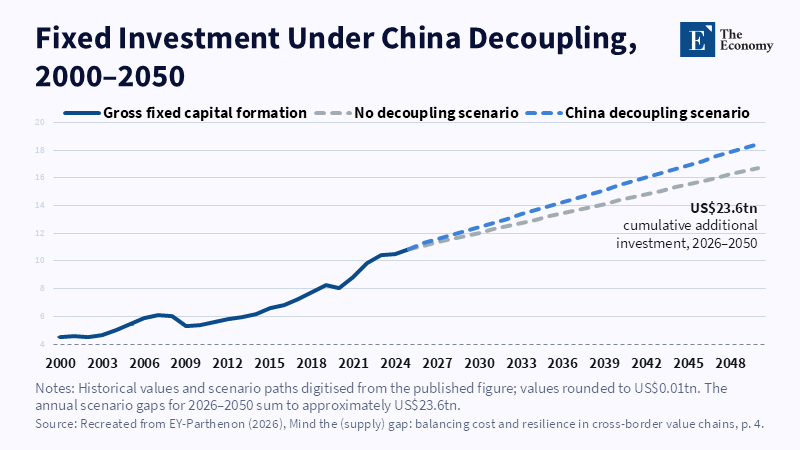
The $23,6 trillion was released in July 2026 as a warning to the West: the price the United States, the eurozone and the United Kingdom would pay by 2050 if they attempted to rebuild infrastructure, research, software and supply chains that currently depend on China, according to an analysis by consultancy EY-Parthenon published by the Financial Times. The number was presented as evidence of a suicidal cost, protectionism that punishes anyone who imposes it. But the account only counts one side of the transaction. It omits what that amount buys and why both Washington and Beijing have begun paying similar financial security bills at the same time.
What the $23.6 Trillion Bill Leaves Out
The EY-Parthenon study breaks down the amount into individual pieces that are worth considering separately. The United States will need $13.7 trillion, the eurozone $9.1 trillion and the U.K. about $800 billion, which equates to an investment of about $550 billion a year for the United States alone, almost as much as large American technology companies invest in data centers each year. The analysis also identifies the mechanism through which costs reach the consumer. Chinese products maintain a factory price advantage ranging from 20 percent to 100 percent over Western competitors, so any attempt to replace them raises prices in critical sectors of the European economy by 1 percent to 2.5 percent, enough to keep inflation above the targets of the European Central Bank and the Bank of England. In the United States, the Tax Foundation estimated that the 2025 tariffs cost the average household about $1,000, an amount that is directly incorporated into the family budget without ever appearing as a separate line on the bill.
The energy inverter is not an isolated case. The European Union had already opened an investigation into countervailing tariffs on Chinese electric vehicles in 2023, resulting in October 2024 in additional tariffs of up to 35.3 percent that vary depending on the manufacturer, after ruling that state subsidies had distorted competition in the European market. At the same time, the proposed Industrial Acceleration Act prioritizes domestic and low-emission products in public procurement in sectors such as batteries, electric vehicles and solar energy, while revisions to the Cybersecurity Act indirectly target suppliers such as Huawei and ZTE. Each of these measures was addressed separately in the public debate, as a technical competition or cybersecurity issue. Together, however, they form a coherent pattern of systematic exclusion that is not fully explained by any single argument.
The accuracy of these numbers is not in doubt. The problem lies in the way they are presented. The narrative around the $23.6 trillion treats them as a pure loss, as money that disappears without anything in return. A household that pays more for an energy inverter because it is not Chinese made does not lose the equivalent amount in a hole. He buys something, even if something does not appear on any invoice receipt. The economic theory of trade is right when it says that the party that protects its market pays the price. But this does not mean that the price is always wasteful. Fire insurance costs every year and the house rarely burns but no one considers the premium a waste of money. The same logic deserves to be applied to the exclusion of Chinese products from strategic sectors, where the stakes are not just cheaper components but the control of infrastructure on which the daily functioning of an economy depends.
When Exclusion Becomes a Security Investment
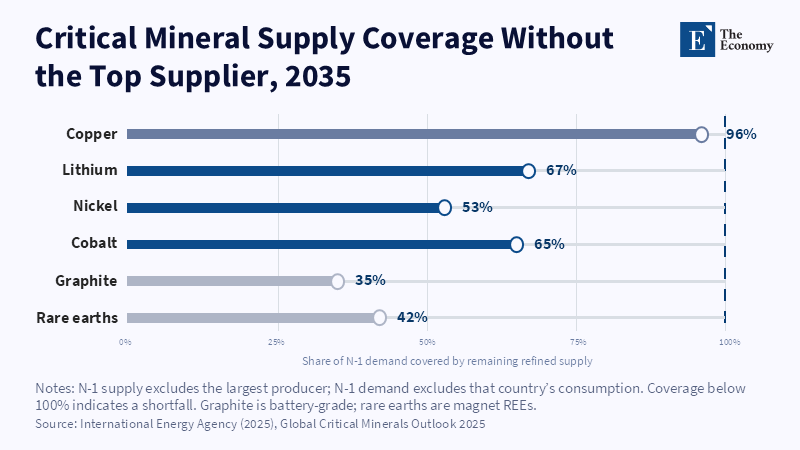
In May 2026, the European Commission excluded Chinese-made energy converters from renewable projects financed by EU funds, a decision that covers at least 14 gigawatts of new solar capacity, almost 20 percent of the Union's annual installed solar capacity. The world's top ten energy converter manufacturers, led by China's Huawei and Sungrow, control 71 percent of the global market according to a recent ranking by Wood Mackenzie, devices that connect solar farms, wind turbines and storage systems to the power grid and that, when equipped with remote update software, can theoretically be used to cut off the power supply to entire regions. US energy authorities had already identified unregistered communication devices inside Chinese inverters, a finding that sparked a new review of cybersecurity risk and led Washington to consider, in July 2026, similar restrictions on new models that need certification in the US market.
The logic behind this blockade is not just about a component of the electrical grid; It concerns the control of infrastructure at a time when the military balance in the Pacific remains unstable. U.S. analysts and lawmakers warned in the summer of 2026 that the removal of the Navy's last aircraft carrier from the western side of the Pacific leaves a window of opportunity for Beijing, just as the United States' weapons stockpiles have been worn out by simultaneous engagements in other regions of the world. In such an environment, reliance on Chinese equipment that could theoretically be disabled remotely undermines the basic function of national defense. Economic security in this context does not function as protectionism for the sake of a domestic sector but as a prerequisite for the rest of the national policy tools to make sense.
China and the West Are Following the Same Logic
The movement is not one-sided. In April 2026, China's National Development and Reform Commission ordered the cancellation of Meta's acquisition of artificial intelligence company Manus, a deal worth about two billion dollars that had almost reached the final stage of completion. Manus had already moved its headquarters to Singapore and had refused investment proposals from Chinese local governments precisely to distance itself from Chinese regulatory scrutiny. The Chinese authorities considered, however, that since the company's research and development core remained Chinese, its sale to Meta would amount to the export of technology that could be considered a risk to national security. Two of the company's three co-founders were banned from leaving the country amid the investigation.
The parallel with Western energy converters should not go unnoticed. Both sides invoke the same term, a technology leak or security risk, to block transactions that would be acceptable under purely commercial criteria. When two economic systems with opposing interests independently end up in the same policy tool, this is not evidence of a temperamental error on one side. It is an indication that something in the structure of world trade has changed enough that both sides consider it reasonable to pay the same cost. The selective exemption now works in sectors where dual-use technology, energy infrastructure and data are seen as equally strategic as military equipment, not just as a derogation from the free trade rule.
The standard is not limited to the United States, Europe and China. In 2016, the U.S. government blocked the acquisition of semiconductor company Lattice Semiconductor by Chinese-owned investment fund Canyon Bridge, citing the dual military and commercial nature of FPGA technology. In 2022, the German government blocked the sale of Elmos' factory to Sweden's Silex, a subsidiary of Chinese interests, fearing a leak of automotive semiconductor knowledge and on the same day ruled out a separate Chinese investment in semiconductor equipment company ERS Electronic. Earlier this year, the Japanese government intervened in the acquisition of machine tool maker Makino by investment fund MBK Partners, citing the company's importance to the domestic defense industry. Each case concerns a different country, a different industry and a different opponent but they all share the same excuse and the same mechanism. Financial security has become a universal policy tool, common to districts that otherwise disagree on almost everything else.
The Missing Accounting for Economic Security
For policymakers, the consequence is concrete. Any foreclosure measure must be accompanied by an explicit assessment of the security benefit it purchases, not just the costs it imposes. Institutions need accountability mechanisms like those already in place for fiscal policy, where every expenditure is accompanied by a cost-benefit analysis. The Regional Comprehensive Economic Partnership and the World Trade Organisation's trade reviews already provide some level of continuous and comparable information on the industrial structure of their Member States, an infrastructure that could be extended specifically to record economic security measures and their raison d'être. Without such a record, each individual measure may seem reasonable while their sum accumulates at a cost that no institution counts.
One expected objection is that this logic paves the way for unrestricted protectionism, with each industry claiming the label of safety to avoid competition. The objection is well-founded, and the Chinese data itself proves it. Research by the International Monetary Fund found that China's listed state-owned enterprises remain about 30 percent less productive than their private counterparts in the same sector, a gap that has remained stable for nearly two decades despite reform efforts. Undisciplined market protection often produces inefficiencies hidden behind the invocation of security. The conclusion is not a universal justification for every exclusion. It concerns the requirement that every exclusion prove the specific security benefit it produces, sector by sector, instead of invoking national security as a shield in general terms.
The $23.6 trillion remains real, as do the highest electricity tariffs in Europe or the thousand dollars per household in the United States. But the number ceases to function as an indictment against the West once it is recognized that it is buying something tangible, a degree of control over infrastructure that could be used against it and that the same logic guides Beijing when it blocks its own technology from Western hands. The question that deserves to concern the institutions is not whether it is worth paying this cost but whether it is paid with the right accuracy. Governments that want to take financial security seriously must build the missing accounts today, measuring the benefit just as carefully as the cost before the next lockout measure is added to a bill that no one reads in full.
This article reflects the analytical judgment of The Economy Editorial Board and does not constitute policy advice or the official position of any affiliated institution.
References
Financial Times (2026) Cutting China reliance would cost the west $23tn, research suggests. Financial Times, 13 July.
Griffin, O. (2026) '"Security Threat Concerns" Drive Parallel U.S.-EU Curbs on Chinese Inverters as China-West Trade Rift Deepens'. The Economy, 2 July.
Jurzyk, E.M. (2021) Resource Misallocation Among Listed Firms in China: The Evolving Role of State-Owned Enterprises. IMF Working Paper No. 21/75. Washington, DC: International Monetary Fund.
Nexstar Media Wire (2026) China May Soon Pose a Threat in Western Pacific, Lawmakers Warn. Nexstar Media Wire, August.
Reuter, M. (2026) '"Technology Leakage Risks" China Blocks Meta's Acquisition of Manus, Signaling Expanding Economic Security-Driven Regulatory Clampdown'. The Economy, 28 April.
Tax Foundation (2026) Trump Tariffs Tracker: Rates, Revenue, and Impact. Washington, DC: Tax Foundation.
Wood Mackenzie (2026) Global Solar Inverter Market Share Report 2026. Edinburgh: Wood Mackenzie.
Working across research, policy, and data-driven analysis, the Editorial Board ensures that published pieces reflect a consistent institutional perspective grounded in quantitative reasoning and long-term structural assessment.