How Dollar Stablecoins Are Reshaping Asia's Financial Hubs

Working across research, policy, and data-driven analysis, the Editorial Board ensures that published pieces reflect a consistent institutional perspective grounded in quantitative reasoning and long-term structural assessment.
Authored On
Modified
Singapore and Hong Kong's dollar pegs fit stablecoins naturally
Japan restricts issuance but absorbs liquidity institutionally
Southeast Asia's remittance workers drive bottom-up adoption

In 2025, stablecoin funds moving within Asia reached $12.5 trillion, with the Singapore to China route recording the largest trading volume globally. This figure does not come from speculative transactions on cryptocurrency exchanges, but from payrolls, supplier invoices, and trade settlements that are now processed through digital dollars instead of bank transfers. Over 99 percent of the global market capitalization of stablecoins remains pegged to the U.S. dollar, and Asia is not resisting this trend, it is directing it. Three economies, Singapore, Hong Kong, and Japan, are at the center of this shift, not because they copy the United States, but because their own monetary systems create natural ground for dollar stablecoins to take root.
Why Dollar Stablecoins Fit Asia’s Financial Hubs
This gathering is not accidental. Research by Tiger Research shows that the Asia Pacific region received approximately $2.36 trillion in cryptocurrency value in 2024, with stablecoins driving most of the settlement volume. 56 percent of financial institutions in Asia now actively declare themselves in operations with stablecoins, the highest percentage among all global regions, and in Southeast Asia in particular, 43 percent of cross-border interbusiness payments are now made through these tools. The U.S. GENIUS Act, enacted in July 2025, created a federal framework for payment stablecoins in the United States and gave greater regulatory clarity to issuers already circulating in Asia. Dollar stablecoins do not function here as a speculative product but as a payment infrastructure, which changes the way the numbers should be read.
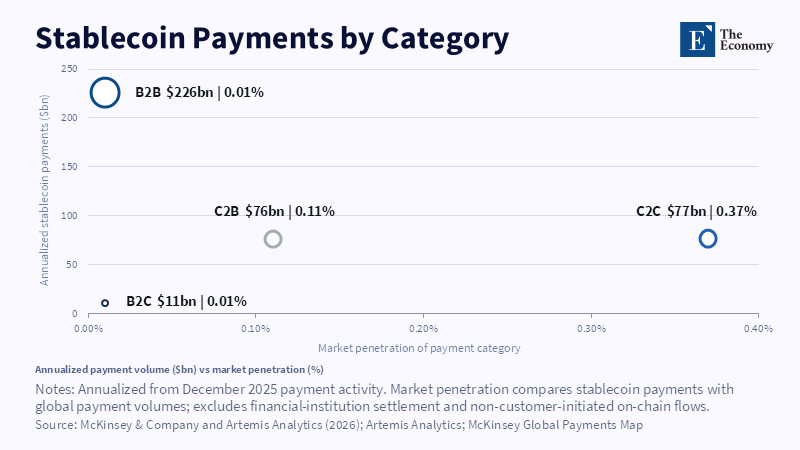
Economics explains this better than technology. Two of the region's largest financial hubs already operate with currencies closely pegged to the U.S. dollar, either through an official peg or a managed rate with a strong dollar weight. For Hong Kong and Singapore, a dollar stablecoin does not introduce new currency risk, it simply digitally transfers a relationship that already exists in the banks' books. Japan is in a different position. The yen is not tied to anything, and everyday consumers rarely convert savings into dollar tokens outside of specific business or investment needs. But the depth of the Japanese financial market, with one of the largest stocks of government bonds in the world, allows it to absorb new flows of dollar liquidity without shaking domestic monetary stability.
Singapore Bets on a Multi-Currency Stablecoin Market
The Monetary Authority of Singapore finalized the regulatory framework for stablecoins in August 2023, with full legislative implementation expected in 2026. The framework covers single-currency stablecoins pegged to either the Singapore dollar or any currency in the G10 group, including the U.S. dollar. Issuers are required to always maintain full reserve coverage, with monthly independent audits and annual audits, a minimum principal of one million Singapore dollars or 50 percent of annual operating expenses, whichever is higher, and redemption at face value within five business days. By early 2026, six to eight entities held primary payment carrier licenses or preliminary approvals, including StraitsX, Circle, Ripple Markets APAC, and Paxos Digital Singapore, which received a full license in July 2024 and is planning its own dollar stablecoin in 2026.
StraitsX remains the most mature player, with over $18 billion in cumulative on-chain trading volume through XSGD and XUSD, and with XSGD covering over 70 percent of the non-dollar stablecoins market in Southeast Asia. Singapore's choice to open the door to dollar and local currencies at the same time is not a neutral stance, it is a bet. If consumer demand shifts towards dollar products, as was the case with Ripple which extended its license to issue RLUSD in December 2025, the Singapore dollar risks losing ground in digital payments precisely because the regulatory framework does not put any barriers. The monetary authority's Project BLOOM experiment, which already connects Thailand to Singapore for real-time cross-border settlements through KASIKORNBANK, Orbix Technology and StraitsX, shows that the country prefers to lead the infrastructure rather than block it, with subsequent corridors to Indonesia, Japan, Taiwan and Hong Kong.
Hong Kong’s Dollar Peg Creates a Natural Gateway
The Hong Kong dollar remains officially pegged to the U.S. dollar through an exchange rate system that has kept the rate within a narrow zone for decades. This stability makes the terrain ideal for dollar stablecoins since the trading risk between the two coins is already minimal. The Stablecoins Act went into effect on August 1, 2025, requiring any entity issuing stablecoins on the ground, or stablecoins pegged to the Hong Kong dollar anywhere in the world, to hold a license from the Hong Kong Monetary Authority. The requirements include a minimum paid-up capital of HK$25 million, a liquid amount of at least US$3 million, and full reserve coverage always. Before the law went into effect, three participants tested the framework in a pilot stage since July 2024: a consortium of Standard Chartered, Animoca Brands, and HKT, a subsidiary of JD.com, and RD Technologies with its own HKDR token.
On April 10, 2026, the authority granted the first two licenses, to HSBC and Anchorpoint Financial, a consortium of Standard Chartered, Animoca Brands and HKT. Both bodies plan to issue stablecoins pegged to the local currency, not the U.S. dollar, which shows how carefully the city is trying to maintain the relativity of its own currency even while opening the door to technology. Another 36 applications remained under review in February 2026, a number that shows how much appetite there is from international banks and tech companies to access this market. The real test will not be how many dollar stablecoins officially launch from Hong Kong, but how quickly the already circulating dollar stablecoins, issued elsewhere, will flow through the city's banking and commercial channels thanks precisely to its fixed exchange rate.
Japan Opens the Door Without Loosening Control
Japan chose the least permissive route between the three economies. The revised Payment Services Act, with amendments in effect since June 2023 and further changes passed on June 6, 2025, classifies stablecoins as electronic means of payment under the direct supervision of the Japanese Financial Services Agency. Only three categories of entities are allowed to issue stablecoins payable at face value in local currency, licensed banks, trust companies, and licensed fund transfer service providers. The 2025 amendments also added a lighter subscription category for intermediaries and distributors and allowed trust-type issuers to hold up to 50 percent of their reserves in short-term government bonds instead of solely in deposits. The close connection with the existing supervisory framework explains why everyday citizens still see no reason to convert their savings into dollar stablecoins, the process necessarily goes through institutions that they either already trust or do not use at all.
Despite the conservative stance, the implementation progressed faster than many analysts expected. JPYC, the first fully regulated stablecoin pegged to the yen, was launched on October 27, 2025. Circle's USDC arrived in the Japanese market on March 26, 2025, through a partnership with SBI Holdings, making SBI VC Trade the first exchange to receive permission to trade a non-yen, non-bank stablecoin under the revised law. The country's three largest banks, MUFG, SMBC, and Mizuho, are working together through the Progmat platform for a yen stablecoin, with the regulator approving a trial implementation in November 2025 and a practical launch targeted for March 2026. The size of the Japanese government bond market allows institutional players to absorb dollar liquidity through regulated channels, even when retail demand remains limited.
Stablecoins Move Into Southeast Asia’s Real Economy
Beyond the three major hubs, Southeast Asia shows how dollar stablecoins are penetrating from the bottom up, through real needs instead of speculation. In Vietnam, about 7 to 8 percent of remittances now go through stablecoins, often purchased in over-the-counter transactions at a premium rate of 3 to 5 percent, while the country ranks fourth globally in Chainalysis' 2025 crypto adoption index. In the Philippines, where overseas workers send $35.6 billion to $38.3 billion annually, platforms like Coins.ph control 75 to 80 percent of peso-to-stablecoin conversion liquidity, with cryptocurrency holdings in the country reaching 22 to 23 percent of the population and with the country ranking ninth in the same index. Nearly 35 percent of freelancers' income across the Asia Pacific region is now paid in stablecoins, with 28 percent of these funds being spent almost immediately instead of being stored.
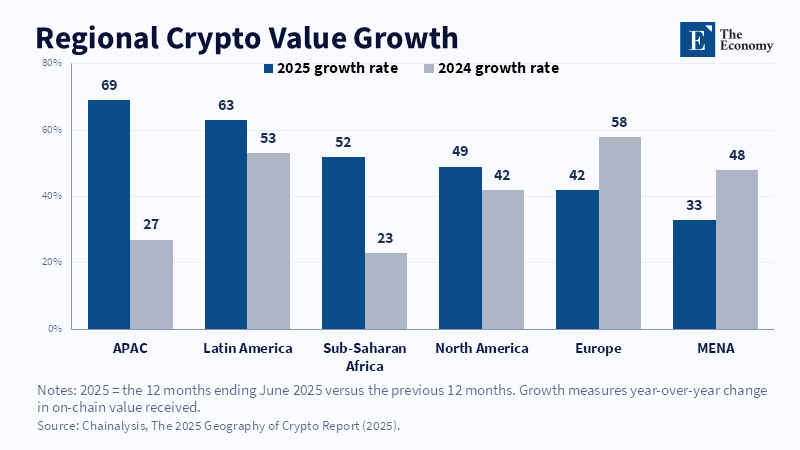
Indonesia saw stablecoin adoption grow 340 percent year-on-year, reaching $12.3 billion in trading volume in 2025, primarily as a hedge against rupee volatility, with the Singapore-to-Indonesia route moving around $45 billion annually. Thailand is moving more cautiously, with the local securities commission's TouristDigiPay pilot program allowing tourists to convert digital assets into baht for purchases without exposing traders to currency risk, while on the Bitkub exchange USDT remains one of the most active trading pairs. The totality of these examples confirms the initial observation: the $12.5 trillion in stablecoin flows recorded by Asia in 2025 is not a statistical anomaly; it is the imprint of an infrastructure that is already in operation. Singapore and Hong Kong offer the natural ground thanks to the peg of their currencies to the dollar, Japan offers the market depth that absorbs liquidity even when retail demand lags, and the wider region shows what happens when these channels open to real payment needs. Regulators who understand this dynamic early, rather than treating it as a side effect of cryptocurrencies, will determine who controls the dollar liquidity channels of the next decade.
This article reflects the analytical judgment of The Economy Editorial Board and does not constitute policy advice or the official position of any affiliated institution.
References
Chainalysis (2025) The 2025 Geography of Crypto Report. Chainalysis.
Circle (2025) Circle Strengthens Commitment to Japan with New Investment and Expanded USDC Access. Circle Internet Group.
Financial Services Agency of Japan (2025) Report by the Working Group on Payment Services System, etc. Financial Services Agency.
Hong Kong Monetary Authority (2025) Guideline on Supervision of Licensed Stablecoin Issuers. Hong Kong Monetary Authority.
Hong Kong Monetary Authority (2026) Annual Report 2025. Hong Kong Monetary Authority.
JPYC (2025) Japan’s First Yen-Denominated Stablecoin “JPYC” and Issuance and Redemption Platform “JPYC EX” Officially Launched. JPYC.
McKinsey & Company (2026) Stablecoins in Payments: What the Raw Transaction Numbers Miss. McKinsey & Company.
Monetary Authority of Singapore (2023) MAS Finalises Stablecoin Regulatory Framework. Monetary Authority of Singapore.
Paxos (2024) Paxos Introduces Global Dollar (USDG). Paxos.
Ripple (2025) Ripple Expands Scope of Payment Activities in Singapore for its Major Payment Institution License. Ripple.
SBI VC Trade (2025) Announcement of the Start of USDC Services for General Customers. SBI Group.
Securities and Exchange Commission, Thailand (2025) FAQ: TouristDigiPay Project. Securities and Exchange Commission.
Tiger Research (2026) 2026 Asia Stablecoin Market Overview. Tiger Research.
United States Congress (2025) Guiding and Establishing National Innovation for U.S. Stablecoins Act (GENIUS Act), Public Law 119-27. U.S. Congress.
Working across research, policy, and data-driven analysis, the Editorial Board ensures that published pieces reflect a consistent institutional perspective grounded in quantitative reasoning and long-term structural assessment.