Japan Defends Yen With US Treasuries as Collateral, Repeated Repo Refinancing Deepens Fiscal Strain

Siobhán Delaney is a Dublin-based writer for The Economy, focusing on culture, education, and international affairs. With a background in media and communication from University College Dublin, she contributes to cross-regional coverage and translation-based commentary. Her work emphasizes clarity and balance, especially in contexts shaped by cultural difference and policy translation.
Authored On
Modified
FIMA-based dollar funding network backed by US Treasuries
Simultaneous yen purchases and containment of a Japan-driven Treasury sell-off
Rising cost of defending the yen with each refinancing cycle
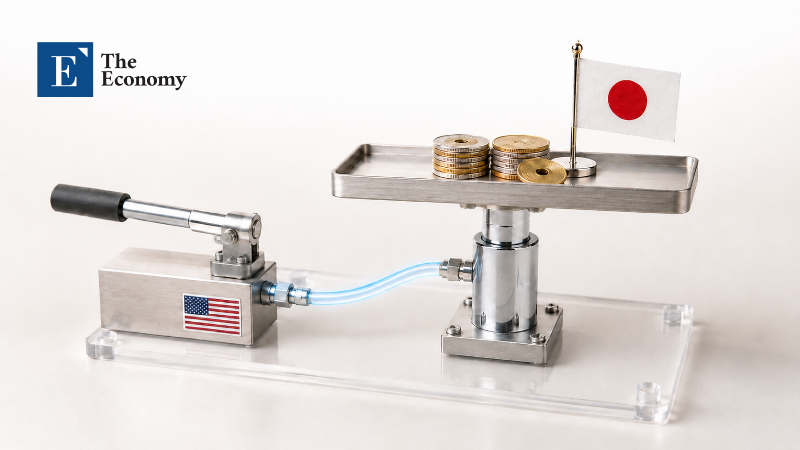
Japan has gained breathing room in its battle to defend the yen by borrowing dollars from the US Federal Reserve (Fed) without selling its holdings of US Treasuries. The arrangement bought time for both countries, allowing the United States to avert the market shock of Treasury sales while enabling Japan to secure intervention funds. Repeated reliance on short-term borrowing, however, will cause Japan’s interest and refinancing costs to snowball. Japan’s public finances now face the dual burden of supporting the yen and government bond yields, as the government pursues tax cuts projected to create an annual revenue shortfall of approximately $31.3 billion at a time when additional fiscal revenue is urgently needed.
FIMA Takes the Front Line as Preemptive Intervention Nears
According to Japanese financial publication Nikkei Asia on August 18, Japan’s Ministry of Finance and the Bank of Japan (BOJ) have recently established a dollar funding mechanism using the Fed’s Foreign and International Monetary Authorities Repo Facility (FIMA Repo Facility). Once the Ministry of Finance authorizes an intervention, the BOJ executes the transaction as the government’s agent, borrowing dollars against US Treasuries held in an account at the Federal Reserve Bank of New York and using the proceeds to purchase yen in the spot market. By eliminating the need to sell US Treasuries in the market, Japanese authorities can accelerate the timing of yen purchases.
US Treasury data show that Japan held $1.14 trillion in US Treasuries as of the end of May, the largest position worldwide. The figure represents the combined holdings of Japanese financial institutions and investors nationwide. Japan’s government-managed foreign-exchange reserves stood at $1.2871 trillion at the end of July, including $927.3 billion in securities. Goldman Sachs estimated that Japan’s $200 billion in liquid assets alone would provide sufficient capacity for another two or three interventions comparable in scale to the operation conducted in late July. The bank also said activating FIMA could theoretically allow Japan to mobilize $1 trillion in dollar-denominated foreign-exchange assets.
FIMA Shield Against US Treasury Sales
Japan is permitted to convert up to $60 billion of these foreign-exchange assets into intervention funds per day. That would cover the $53 billion in daily intervention conducted by Japan in late July, as estimated by the Financial Times (FT). Reaching Goldman Sachs’ estimate of as much as $85 billion over two days would require successive borrowings or the deployment of separate liquid assets. Transactions have maturities of either one day or seven days. Overnight transactions carry the Fed’s standing repo rate, while seven-day transactions are priced at the corresponding overnight index swap rate plus 0.25 percentage points. Because the mechanism uses collateral deposited in advance, authorities can immediately link a sharp exchange-rate movement with dollar funding.
The shorter preparation time required to obtain dollars could allow Japanese authorities to intervene sooner. The joint intervention conducted on July 31 began when USD/JPY approached 162.80. Japanese authorities did not designate a specific level as an official line of defense, but markets have regarded 162.80—where large-scale yen purchase orders emerged—as the trigger point for the previous intervention. With the FIMA funding channel now in place, Japanese authorities can swiftly deploy funds before USD/JPY reaches the previous trigger level of 162.80. When USD/JPY climbed to 159.17 on August 12, market attention shifted toward the 160 level. US financial publication Barron’s also raised the prospect of renewed yen purchases around that range, while premiums on short-dated yen call options began pricing in the possibility of earlier intervention.
A Test of Fed Independence
The prospect of intervention becoming a standing policy option has also intensified controversy over the boundaries of institutional authority. The FIMA-linked yen defense framework connects the foreign-exchange policy of fiscal authorities with the liquidity-provision function of central banks. In Japan, the finance minister has traditionally determined whether to intervene, while the BOJ has executed orders as the government’s agent. US foreign-exchange transactions have similarly been conducted through instructions from the Treasury to the New York Fed using the Exchange Stabilization Fund (ESF). Spot-market intervention by both countries follows procedures established under existing legal frameworks.
The controversy emerged as a dollar lending facility administered by the Federal Open Market Committee (FOMC) became incorporated into a government exchange-rate policy tool. US Treasury Secretary Scott Bessent recently said he would not hesitate to conduct another joint intervention with Japan and recommended that the Fed increase the FIMA lending limit. His argument rests on the substantial expansion of the global bond market since 2020, which he says warrants an adjustment of the lending ceiling to current market conditions. Authority to change the limit and transaction terms, however, rests with the FOMC. The Wall Street Journal (WSJ) said the use of an emergency facility created in response to the global dollar shortage in 2020 to defend the currency of a specific country would inevitably ignite debate over the Fed’s policy autonomy. Observers also noted the scarcity of precedent for a Treasury secretary publicly pressuring the Fed to overhaul its lending program.
The Treasury’s request has drawn particular scrutiny because FIMA directly affects the Fed’s balance sheet. When a FIMA loan is executed, the repo extended to a foreign monetary authority appears on the Fed’s assets, while bank reserves increase simultaneously. New dollar liquidity consequently enters the US financial system until the transaction matures. Concerns over such a liquidity expansion have intensified alongside internal Fed discussions about raising interest rates. The Fed kept its benchmark rate at 3.50%–3.75% last month, although three FOMC members called for a 0.25-percentage-point increase in response to inflationary pressure. Expanding dollar supply through a separate facility while retaining the possibility of a rate increase would heighten questions over the consistency of monetary policy. If the Fed accepts the Treasury’s recommendation, it would also have to explain how providing liquidity to support the yen aligns with its existing tightening stance.
Table 1. Market Impact of Japan-Driven US Treasury Sales and the Resulting US Fiscal Burden
| Category | Scale or Projection | Transmission Channel | Principal Impact |
|---|---|---|---|
| Foreign Sales of US Treasuries | $141 billion over one month (1.87% of foreign holdings) | Increased secondary-market supply → lower bond prices → higher Treasury yields | Average increase of 0.57 percentage points in Treasury yields (study estimates range from 0.25 to 1.01 percentage points) |
| Fiscal 2026 Net Interest Outlays | $1.039 trillion (3.3% of GDP) | Higher market rates → increased refinancing and new-issuance costs | Reduced federal fiscal capacity due to issuance at elevated rates |
| Net Marketable Borrowing From Private Investors | $739 billion from July to September $628 billion from October to December | Large-scale Treasury issuance coinciding with Japan-driven sales | Upward pressure on issuance yields required to secure investor demand |
| FIMA Expansion | Use of Japan’s US Treasury holdings as collateral | US Treasuries deposited as collateral in a New York Fed account to obtain dollar liquidity | Containment of Japanese Treasury sales and mitigation of the resulting yield shock |
The Achilles’ Heel of $40 Trillion in Debt
The US Treasury’s push to expand FIMA despite the controversy reflects growing concern over the US Treasury market. If Japan were to liquidate large volumes of its Treasury holdings to finance yen purchases, the additional supply would depress bond prices and drive yields higher. The US decision during the previous joint intervention to sell euros and purchase yen, coupled with discussion of expanding FIMA, was intended to contain the market shock from Japan-driven Treasury sales. FIMA effectively immobilizes Japan’s Treasury holdings as collateral in a New York Fed account, limiting their conversion into securities offered on the secondary market.
The Federal Reserve Bank of Kansas City estimated that Treasury yields could rise by an average of 0.57 percentage points if foreign investors sold $141 billion over one month, equivalent to 1.87% of their US Treasury holdings. Estimates across individual studies ranged from 0.25 to 1.01 percentage points. The figures support projections that a large-scale foreign sell-off could push Treasury yields higher by approximately 0.5 percentage points. Analysts also concluded that even a decline in purchases by foreign public-sector institutions would force the United States to depend more heavily on interest-rate-sensitive private investors to absorb Treasury issuance.
A yield movement of this magnitude would impose a substantial burden on the United States as it continues to borrow on a massive scale. Elevated issuance rates have already eroded US fiscal capacity. The US Congressional Budget Office (CBO) projects that federal net interest outlays will reach $1.039 trillion in fiscal 2026, equivalent to 3.3% of gross domestic product (GDP). Increases in market rates will inevitably feed into fiscal costs over time through the refinancing of maturing securities and new issuance. The US Treasury also plans net marketable borrowing from private investors of $739 billion from July through September and $628 billion from October through December. If Japanese sales coincide with this issuance schedule, the Treasury would have to offer higher yields to attract sufficient investor demand.
Japan Squeezed by a Dual Interest Burden
While FIMA absorbs the market shock from Japan-driven Treasury sales, Japanese authorities incur interest costs in proportion to the duration of their borrowing. The overnight FIMA rate matches the Fed’s standing repo rate of 3.75% per year. If Japan borrowed the full daily limit of $60 billion and maintained that balance for one year, its annualized interest expense would reach $2.25 billion. This represents the gross cost before accounting for interest income generated by the US Treasuries pledged as collateral. Calculating the actual net cost requires consideration of the collateral’s interest income, the FIMA borrowing rate and the duration of the loan. Consistent with the facility’s purpose as an emergency source of liquidity, the Fed designed FIMA pricing to remain above ordinary private repo rates. Interest costs will therefore accumulate as Japanese authorities extend their borrowing.
Japanese authorities use the dollars borrowed through FIMA to purchase yen in the spot market, requiring them to secure the spent dollar principal again one or seven days later. Repayment from remaining foreign-exchange reserves would reduce Japan’s dollar holdings and undermine the original objective of avoiding US Treasury sales. Preserving those reserves would require Japan to pledge its Treasury holdings again and refinance the existing loan. Each refinancing cycle incurs additional interest, causing the aggregate cost to rise as maturities are repeatedly extended. A renewed depreciation of the yen would also erode the impact of previous intervention and could require further borrowing to defend the targeted exchange-rate range.
Reducing Japan’s reliance on FIMA requires narrowing the US-Japan interest-rate differential that has driven yen weakness, but BOJ rate increases would raise the Japanese government’s debt-servicing costs. According to Japan’s Ministry of Finance, principal and interest payments on government debt in the fiscal 2026 general account totaled approximately $195.9 billion, representing 25.6% of all expenditures. Of this amount, approximately $81.8 billion was allocated to interest payments and related expenses. Increases in the policy rate feed into government borrowing costs with a lag through the refinancing of maturing securities and new issuance. With debt-servicing expenditure already accounting for more than one-quarter of the total budget, even a gradual rise in rates could place considerable pressure on fiscal management.
Tax Cuts Run Counter to Surging Debt-Service Costs
The proposed food consumption tax cut pursued by Japanese Prime Minister Sanae Takaichi could further weaken the revenue base. The Japanese government recently approved a plan to reduce the consumption tax on food from 8% to 1% for two years beginning in April 2027, with subsidies covering the remaining 1% burden. The resulting annual tax revenue shortfall is estimated at approximately $31.3 billion. The Takaichi administration has pledged to finance the tax cut without issuing deficit-financing bonds but has yet to present specific replacement revenue sources or spending reductions.
The absence of a concrete funding alternative has increased the likelihood that the fiscal burden of the tax cut will shift to government bond issuance. Oxford Economics forecast that the 10-year government bond yield could rise to approximately 3% by year-end if bonds financed half of the revenue loss. The projected 3% year-end threshold has already become an immediate market variable. On August 17, the 10-year Japanese government bond yield climbed to 2.93%, its highest level since 1996, leaving only 0.07 percentage points before reaching the government budget’s assumed interest rate. Interest-rate swap markets on the same day priced in an 80% probability that the BOJ would raise rates at its September meeting. If market rates become entrenched above 3%, the funding cost of new and refinanced government debt will exceed the level assumed in this year’s budget.
Siobhán Delaney is a Dublin-based writer for The Economy, focusing on culture, education, and international affairs. With a background in media and communication from University College Dublin, she contributes to cross-regional coverage and translation-based commentary. Her work emphasizes clarity and balance, especially in contexts shaped by cultural difference and policy translation.
- Previous “Wave of Izakaya Bankruptcies”: Japan Drinks Less as Shrinking Wallets, Fading Nominication Culture and Shifting Consumer Trends Deliver a Triple Blow
- Next China’s Homegrown Airliner Makes International Debut, but Western Certification and Technological Self-Reliance Hurdles Impede Challenge to Boeing-Airbus Duopoly
Similar Post