China’s Homegrown Airliner Makes International Debut, but Western Certification and Technological Self-Reliance Hurdles Impede Challenge to Boeing-Airbus Duopoly

Anne-Marie Nicholson is a fearless reporter covering international markets and global economic shifts. With a background in international relations, she provides a nuanced perspective on trade policies, foreign investments, and macroeconomic developments. Quick-witted and always on the move, she delivers hard-hitting stories that connect the dots in an ever-changing global economy.
Authored On
Modified
Homegrown Airliner Enters Global Aviation Supremacy Race
Engines and Avionics Remain Reliant on Western Technology
Decades-Long Campaign Inevitable Before Technological Self-Sufficiency
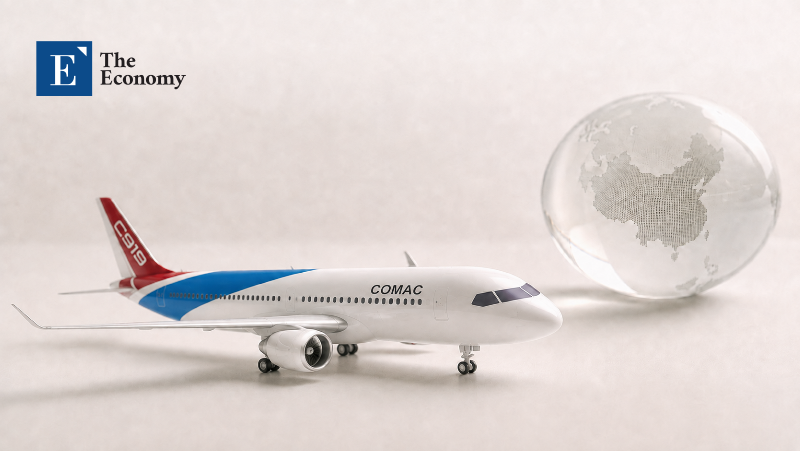
China has deployed its domestically developed passenger aircraft on an international route for the first time. The move represents a direct challenge to the commercial aircraft duopoly held by U.S.-based Boeing and France-based Airbus, yet the C919 has secured neither U.S. nor European type certification and remains dependent on Western supply chains for critical components, including engines and avionics. Engine localization poses the greatest obstacle to China’s aviation ambitions, requiring design and manufacturing capabilities alongside extensive operational records to validate safety and durability.
C919’s International Debut
According to China’s state-run Xinhua News Agency and other sources on August 18, a C919 passenger jet manufactured by state-owned Commercial Aircraft Corporation of China (COMAC) departed Beijing Capital International Airport on the afternoon of August 12 and arrived at Chinggis Khaan International Airport in Ulaanbaatar, the capital of Mongolia. Air China, the route’s operator, plans to operate one daily round trip. The airline had previously deployed the U.S.-made Boeing 737 MAX 8 on the route.
The C919 is China’s first domestically developed narrow-body passenger aircraft and was designed to compete with Boeing’s 737 and Europe’s Airbus A320. The first aircraft was delivered to China Eastern Airlines in December 2022 and entered commercial service the following May. A total of 40 aircraft had been delivered by June, with Air China, China Eastern Airlines, and China Southern Airlines operating the C919 on 58 routes connecting 25 cities. Cumulative passenger traffic reached 7.5 million this month, adding 2.5 million passengers in roughly three months after surpassing the five-million mark in May.
As China’s three major state-owned airlines expand their networks, the C919 is rapidly accumulating operational experience. Demand from state-owned carriers has sustained the production line, while domestic services have generated pilot-training expertise, maintenance experience, and aircraft operating data. The ability to maintain production at scale through domestic operations has provided China with the time required to pursue overseas certification and develop an indigenous engine. The C919 made its overseas air-show flight debut at the 2024 Singapore Airshow and has operated scheduled Shanghai–Hong Kong services since January last year. The Mongolian route carries heightened political symbolism for China’s aviation industry as the aircraft’s first scheduled passenger service to a sovereign country outside a Chinese special administrative region.
Certification Gap Blocks Entry into Advanced Markets
The selection of Mongolia as the C919’s first international destination reflected a combination of operating distance and regulatory conditions. Beijing and Ulaanbaatar are approximately 1,200 kilometers apart, equivalent to about 30% of the baseline C919’s 4,075-kilometer range, with a flight time of roughly two hours. The route offered favorable conditions for an inaugural overseas service because Air China already operated it and could readily manage the associated maintenance, parts, and ground-handling requirements. Mongolia is also a neighboring country with close aviation and diplomatic ties to China. Its authorities could grant operational approval based on the type certificate issued by the Civil Aviation Administration of China (CAAC).
The C919 has yet to secure type certification from the European Union Aviation Safety Agency (EASA) or the U.S. Federal Aviation Administration (FAA), effectively barring its entry into advanced markets. Consequently, an earlier purchase agreement covering 30 aircraft with Brunei-based GallopAir and other customers has yet to translate into substantive commercial operations. Many countries require passenger aircraft operated by their domestic airlines to hold EASA or FAA airworthiness certification, making approval from these agencies essential for expanding sales beyond China, according to the aviation industry.
Exacting Scrutiny from Design to Maintenance
The causes of the certification delay can be broadly divided into three categories: the potential need for further modifications to the aircraft’s design and systems integration; the burden of substantiating technology licenses and intellectual property (IP) rights for core components and software; and insufficient flight-testing and commercial operating data. Western regulators re-examine the entire process, covering aircraft design, components, software, manufacturing quality, and maintenance systems. Any item that fails to satisfy their standards can trigger additional testing and design changes.
Florian Guillermet, executive director of EASA, said in an interview with French industry publication L’Usine Nouvelle in April last year that European certification of the C919 was expected to take three to six years. The 7.5 million passengers carried in China constitute a commercial operating record and cannot replace the type-certification procedures required by Western regulators. China has therefore opted to expand the C919’s international network first among countries that accept CAAC certification, with the Mongolian route marking the first application of this regulatory pathway.
A Narrow Gateway to Overseas Markets
This indirect overseas expansion also reflects China’s long-term strategy to challenge the U.S.- and European-led order governing commercial aviation. Boeing and Airbus dominate the global passenger aircraft market, while FAA and EASA type certification has become the central benchmark determining aircraft exports and international operations. The wider industrial ecosystem—spanning engines, avionics, flight-control systems, maintenance, leasing, and insurance—has likewise been built around Western certification regimes.
Under this industry configuration, the C919’s overseas sales prospects are likely to hinge on whether it secures approval from the two agencies. Certification would enable access to U.S. and European markets while easing approval requirements in emerging economies with limited independent review capabilities. Airlines, lessors, and insurers use Western certification as a key benchmark when assessing aircraft safety, operational reliability, and residual value. Prolonged delays would likely confine COMAC’s export markets to countries that recognize CAAC type certification or grant aircraft-specific operating approvals.
China is therefore expected to accumulate operational experience in friendly countries across Southeast and Central Asia, beginning with Mongolia, and secure data for use in certification reviews. Data collected on overseas routes can substantiate aircraft defect rates, component service lives, maintenance intervals, and operational reliability under varying climatic conditions. China must also establish maintenance hubs, spare-parts supply chains, and pilot-training systems in export markets. The scale and credibility of its overseas operating data and local support networks during the remaining EASA review process will determine the C919’s capacity to expand its market reach.
Reliance on Foreign Engines and Other Core Components, with Safety Challenges Still Looming
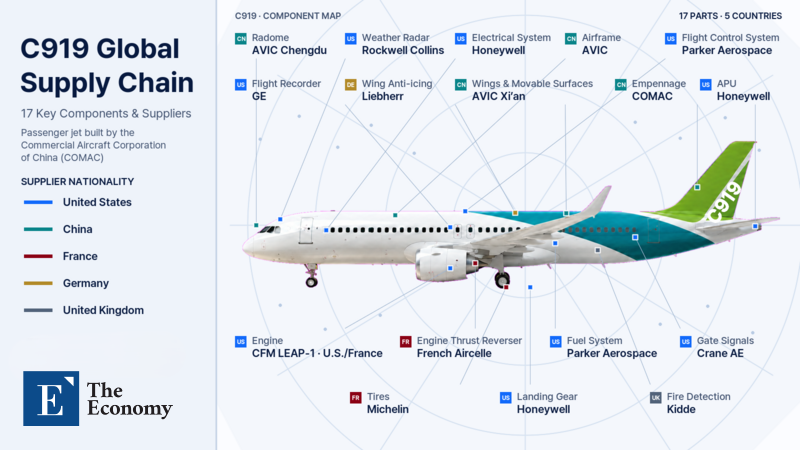
The localization of engines and other critical technologies remains the most formidable barrier to China’s aviation ambitions. The C919 is powered by the LEAP-1C engine produced by CFM International (CFM), a joint venture between U.S.-based GE Aerospace and France’s Safran. According to Bank of America (BofA), the C919’s major suppliers include 48 U.S. companies, 26 European companies, and 14 Chinese companies, underscoring the overwhelming weight of Western suppliers. U.S. aerospace companies including Honeywell and Collins Aerospace also provide avionics and other major systems.
The risks embedded in this dependency became tangible in May last year, when the U.S. government temporarily suspended export licenses for the LEAP-1C. The suspension disrupted COMAC’s assembly schedule, and exports resumed roughly two months later. Engines and electronic equipment incorporating U.S. technology will inevitably remain supply-chain vulnerabilities capable of constraining C919 production whenever U.S.–China tensions intensify. These supply-chain risks have also driven China to accelerate development of a domestically produced engine.
Commercial aircraft engines, however, require ultra-precision technology capable of simultaneously delivering thrust, fuel efficiency, durability under high-temperature and high-pressure conditions, and safety in the event of bird strikes or rotor failure. FAA engine airworthiness standards also prescribe detailed requirements for bird ingestion, rotor-failure containment, fire protection, in-flight restart capability, and endurance testing. Material cracking or combustion-control failures can lead to engine shutdowns, fires, and airframe damage, leaving an exceptionally narrow margin for error. This is a sector in which verification timelines cannot readily be compressed merely by expanding production facilities and headcount.
China plans to replace the LEAP-1C with the CJ-1000A under development by Aero Engine Corporation of China, although the engine remains in the testing phase. Since its establishment in 1974, CFM had accumulated more than 1.3 billion flight hours across its CFM56 and LEAP families by 2024. The LEAP itself entered commercial service in 2016 after eight years of development grounded in the design and maintenance expertise accumulated through the CFM56. Given the operational reliability CFM has established over half a century, China will likely require decades of validation before it can demonstrate safety and durability on par with Western manufacturers.
Anne-Marie Nicholson is a fearless reporter covering international markets and global economic shifts. With a background in international relations, she provides a nuanced perspective on trade policies, foreign investments, and macroeconomic developments. Quick-witted and always on the move, she delivers hard-hitting stories that connect the dots in an ever-changing global economy.
Similar Post