“Europe Must Defend Europe”: U.S. Launches Review of Military Presence in Europe, Accelerating Shift Toward “NATO 3.0”

Anne-Marie Nicholson is a fearless reporter covering international markets and global economic shifts. With a background in international relations, she provides a nuanced perspective on trade policies, foreign investments, and macroeconomic developments. Quick-witted and always on the move, she delivers hard-hitting stories that connect the dots in an ever-changing global economy.
Authored On
Modified
U.S. launches comprehensive review of European defense posture
European allies pressed to assume greater responsibility for conventional defense
Strategic focus shifts to the Indo-Pacific to counter China

The U.S. government has begun a comprehensive review of the posture of American forces stationed in Europe. The move simultaneously pressures European allies to accept reductions in the U.S. military footprint and assume a greater share of defense spending, effectively signaling that Washington is redesigning the NATO framework in which it has long served as Europe’s foremost security guarantor and transferring a larger burden of self-defense to European countries. The review appears to reflect Washington’s assessment that, amid the substantial military expenditure required to contain China and respond to Middle Eastern contingencies, there is less need to maintain a permanent force commitment in Europe, where Russia’s conventional threat has weakened.
Expanded European Defense Responsibilities
According to the Associated Press on July 29, U.S. Under Secretary of Defense for Policy Elbridge Colby said in a social-media post two days earlier that the Pentagon had initiated a “European posture review.” Colby described the review as “a practical process to transition, rapidly and irreversibly, to Europe taking primary responsibility for its conventional defense.” He added that the findings would accelerate NATO’s transformation into a stronger, fairer, and more sustainable alliance, emphasizing that the effort would advance the goal of fully restoring NATO’s character as a formidable fighting organization—what he termed “NATO 3.0.”
Colby also said the review would ensure that the posture of U.S. forces in Europe fully reflects the principles set out in the 2025 National Security Strategy (NSS) and the 2026 National Defense Strategy (NDS). The 2025 NSS stated that the United States must lead a “course correction” in a Europe facing “civilizational erasure,” while the 2026 NDS underscored the need for allies and partners to bear a “fair share” of defense costs.
Earlier, U.S. Defense Secretary Pete Hegseth said at a NATO defense ministers’ meeting in Brussels, Belgium, on June 18 that the U.S. military presence in Europe would undergo a new review over the following six months. Hegseth also said Washington would consult Congress, which has legally established a minimum threshold for U.S. troop levels in Europe, a remark widely interpreted as signaling an intent to reduce the American force presence in the region. He further warned that the U.S. contribution to NATO would depend on whether other allies met their defense-spending targets, stating that “if other allies do not urgently spend on defense, our contribution will be reduced.”
Revival of Trump’s Unfinished First-Term Drawdown Plan
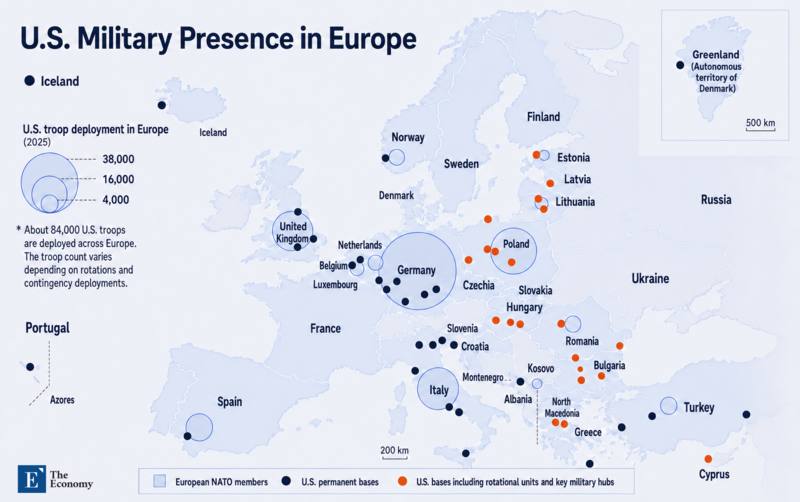
The Trump administration is seeking to reduce the scale of U.S. forces committed to Europe, arguing that Washington requires additional military resources to prepare for multiple simultaneous conflicts around the world. In July 2020, the first Trump administration announced plans to cut and redeploy 12,000 of roughly 36,000 U.S. troops stationed in Germany. The proposal called for some forces to return to the United States and others to relocate to European countries including Belgium and Italy, and emerged amid intensifying disputes with Germany over defense spending and trade with the United States.
The plan, however, was effectively suspended after the change in administration. The Joe Biden administration increased the U.S. force presence in Europe following Russia’s invasion of Ukraine in 2022, preventing the first Trump administration’s drawdown blueprint from being implemented. With the Russian threat rising sharply at the time, strengthening Europe’s defensive posture became a White House priority. Conditions have since changed. In May, the Trump administration proposed reducing the U.S. force presence in Germany by 5,000 personnel, setting a six-to-12-month timetable for completion. This has raised the likelihood that a restructuring of U.S. forces in Europe—previously confined to an announcement during Trump’s first term—will now translate into actual troop movements.
Germany Takes the Direct Hit, Raises Defense Spending by 28%
Germany, in particular, is expected to become a critical test case in the review. Roughly 36,000 active-duty U.S. personnel—the largest American deployment in Europe—are stationed in the country. Ramstein Air Base, U.S. European Command in Stuttgart, and the Grafenwöhr training area are core facilities underpinning Europe’s defense posture. U.S. bases in Germany are not confined to the European theater: they direct troop reinforcements and equipment transfers to the Eastern European front while serving as the logistical hub supporting operations in the Middle East and Africa. A reduction in the Germany-based force could therefore trigger cascading changes in U.S. overseas operations as well as weaken deterrence in Europe.
This is also why Germany is moving quickly to strengthen its own defense capabilities. Shortly after the outbreak of the war in Ukraine, Germany established a special defense fund worth approximately $115 billion and pursued an easing of fiscal rules to expand its defense budget. In April, it approved budget guidelines calling for defense spending next year to rise 28% from this year to approximately $121.4 billion. Germany thus became the first European country to push defense expenditures above $100 billion. The government also finalized budget guidelines for next year totaling approximately $623.5 billion, including infrastructure investment. As signals of a potential reduction in U.S. involvement in Europe have grown more frequent, Germany has begun reshaping a force structure long maintained on the premise of U.S. security guarantees.
Multi-Theater Strain Pushes Europe Down the Priority List
Washington’s rationale for considering a reduction of forces in Europe is clear. The United States must commit more capabilities to the Indo-Pacific to counter China, while remaining prepared for large-scale military responses in the Middle East. The burden of keeping troops and strategic assets tied down in Europe has become too great. U.S. inventories of personnel, munitions, and air-defense assets are not sufficiently ample to sustain comparable force levels across multiple theaters. The Trump administration’s effort to shift defense responsibilities to Europe is closely tied to these military and fiscal constraints.
The Trump administration believes Europe must share that burden. It judges that European NATO members possess sufficient potential to deter Russia. According to figures presented in the Pentagon’s 2026 NDS, the combined nominal GDP of NATO members excluding the United States stood at $26 trillion in 2024, dwarfing Russia’s $2 trillion economy. Germany’s economy alone is larger than Russia’s. The administration believes Europe can lead conventional defense if it converts this economic capacity into troops, munitions, air-defense networks, and long-range strike systems. Underlying that view is the belief that the United States has less reason to shoulder Europe’s conventional defense indefinitely. It seeks to overhaul a system in which U.S. taxpayers have borne the costs of European defense.
Cold War-Era U.S. Drawdown Plans Foundered
Debate in the United States over reducing forces stationed in Europe also surfaced during the Cold War. During the 1969 discussions on NATO force reductions, the Richard Nixon administration examined plans to sharply reduce the U.S. troop presence in Europe while increasing allied defense spending. Defense Secretary Melvin Laird proposed cutting U.S. forces in Europe to between 100,000 and 150,000 personnel. The plan aimed to increase allies’ defense burden and lower the defense budget from 9% to 7% of gross national product.
However, then-National Security Adviser Henry Kissinger opposed the proposal, arguing that reducing conventional forces could also weaken NATO’s deterrent power. His reasoning was that deterrence unsupported by credible warfighting capability would struggle to command confidence, and that weakened conventional defenses could force a U.S. president to choose between abandoning Europe and nuclear war. He also warned that abrupt troop adjustments could inflame political insecurity among allies and destabilize Europe’s balance of power. The drawdown plan was ultimately never implemented. In 1971, Senator Mike Mansfield introduced an amendment to cap U.S. forces in Europe at 150,000, but it was defeated in the Senate by a vote of 36 to 61.
Russia’s Weakening Strengthens the Case for European Self-Defense
Russia today, however, differs markedly from the Soviet Union of the Cold War era. The prolonged war in Ukraine has severely depleted Russia’s manpower, tank fleet, and artillery capabilities. Washington therefore believes Europe can counter Russia’s conventional threat if it expands its own military capacity. Europe’s rising defense expenditure has reinforced that U.S. assessment. At last year’s Hague summit, NATO members agreed to allocate 5% of GDP to defense and security by 2035: 3.5% for core military capabilities and 1.5% for military infrastructure, cyber defense, civil defense, and the defense-industrial base. Defense spending by European members and Canada in 2025 rose by roughly 20% in real terms from the previous year, exceeding $571 billion at 2021 constant prices.
That does not mean Europe’s anxieties will ease readily. Russia retains its nuclear forces, long-range missiles, and cyber and electronic-warfare capabilities. NATO Secretary-General Mark Rutte warned last year that Russia could threaten NATO territory within five years and that air-defense and missile-defense capabilities must be expanded substantially. The French military has likewise assessed that Russia is continuing to rearm despite absorbing losses and could emerge as a tangible threat on Europe’s eastern flank before 2030.
This is why Poland, the Baltic states, and Romania are particularly sensitive to U.S. troop reductions. The United States has already reduced some of the military assets it could mobilize for NATO in a crisis: the number of F-15-series fighters available for NATO missions has reportedly fallen by one-third to 99, while MQ-4 and MQ-9 unmanned aircraft have been halved to 12. Aerial refueling tankers and naval assets are also included among the capabilities slated for reduction. European countries may be able to replace some fighters and unmanned aircraft, but they cannot quickly substitute for long-range precision-strike capabilities, satellite intelligence, surveillance and reconnaissance, aerial refueling, strategic transport, and integrated command-and-control capacity.
German Defense Minister Boris Pistorius has also warned that a “dangerous capability gap” could emerge if U.S. assets are withdrawn before Europe has established a timetable for replacing them. The practical impact of a restructuring of U.S. forces in Europe will depend less on the overall number of personnel withdrawn than on the nature of the capabilities removed. The departure of intelligence, surveillance and reconnaissance, aerial-refueling, long-range-strike, and command-and-control assets could inflict a greater shock on NATO’s initial response capacity than reductions in combat units. If the pace of U.S. restructuring diverges from the speed of Europe’s military buildup, transatlantic deterrence is likely to pass through a prolonged and unstable transition.
Anne-Marie Nicholson is a fearless reporter covering international markets and global economic shifts. With a background in international relations, she provides a nuanced perspective on trade policies, foreign investments, and macroeconomic developments. Quick-witted and always on the move, she delivers hard-hitting stories that connect the dots in an ever-changing global economy.
Similar Post