“Will Russia Weaponize Uranium Too?” Export-Control Warning Puts U.S., EU, South Korean and Japanese Supply Chains on High Alert, Complicates Ukraine Aid Calculus
Oliver Griffin is a policy and tech reporter at The Economy, focusing on the intersection of artificial intelligence, government regulation, and macroeconomic strategy. Based in Dublin, Oliver has reported extensively on European Union policy shifts and their ripple effects across global markets. Prior to joining The Economy, he covered technology policy for an international think tank, producing research cited by major institutions, including the OECD and IMF. Oliver studied political economy at Trinity College Dublin and later completed a master’s in data journalism at Columbia University. His reporting blends field interviews with rigorous statistical analysis, offering readers a nuanced understanding of how policy decisions shape industries and everyday lives. Beyond his newsroom work, Oliver contributes op-eds on ethics in AI and has been a guest commentator on BBC World and CNBC Europe.
Authored On
Modified
Russia raises possibility of controls on enriched uranium exports
EU supply-chain risks come into focus as U.S. moves to exclude Russia
Import-dependent South Korea and Japan face mounting pressure over support for Ukraine
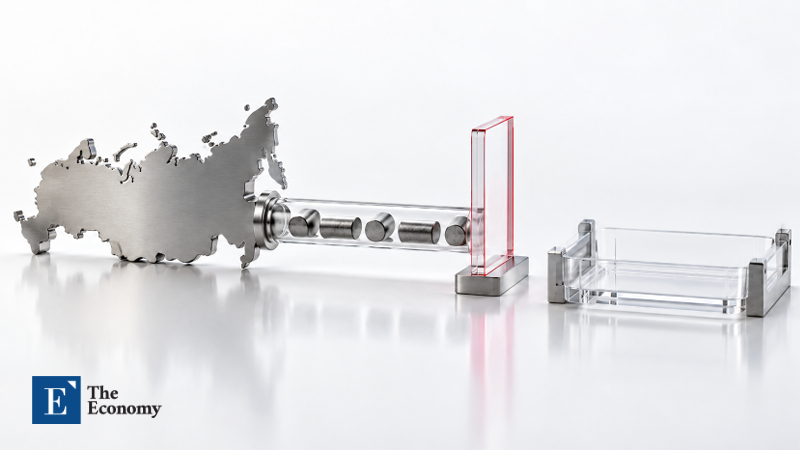
Concerns over the global uranium supply chain are intensifying. Russia, which holds an overwhelming share of the global uranium enrichment and conversion markets, has raised the possibility of restricting uranium and nuclear-fuel exports, stoking fears of cascading supply shocks across major economies, including the United States, Europe, South Korea and Japan. These energy supply-chain risks are expected to place additional pressure on South Korea and Japan, both of which have recently faced requests from Ukraine for air-defense support.
Russia’s Weaponization of Strategic Resources
According to a report published on the 12th (local time) by World Nuclear News, an outlet operated by the World Nuclear Association (WNA), citing a Kremlin report, Russian President Vladimir Putin formally called for a review of resource controls in response to Western sanctions in 2024. Speaking during a government videoconference at the time, Putin said, “They are restricting the supply of many goods to us, so perhaps we should also impose certain restrictions on them,” adding, “We should perhaps consider restrictions on certain commodities that we supply to the global market in large quantities, such as uranium, titanium and nickel.”
Putin’s remarks reflected Russia’s immense influence over the nuclear-fuel processing chain, including uranium conversion and enrichment. According to the WNA, the annual uranium enrichment capacity of Russia’s state-owned nuclear energy corporation Rosatom stood at 29.13 million separative work units (SWU) last year, accounting for approximately 43% of global capacity. That substantially exceeded the capacity of France’s Orano, at 7.5 million SWU, and the British-German-Dutch consortium Urenco, at 17.3 million SWU, making Rosatom the world’s largest enrichment supplier. Russia’s grip on the supply chain is also particularly strong in high-assay low-enriched uranium (HALEU) for advanced reactors, with Russia’s TENEX effectively the only company currently capable of supplying the fuel on a commercial scale.
EU Uranium Supply Chain Faces Disruption
If Putin’s proposed scenario materializes, countries around the world are expected to face significant repercussions. The European Union (EU), in particular, is likely to suffer an immediate shock from bottlenecks in its nuclear-fuel supply chain, given its considerable dependence on Russian facilities for uranium conversion and enrichment. According to the Euratom Supply Agency (ESA), Russia supplied 2,346 metric tons of uranium (tU), or 16%, of the natural uranium delivered to EU nuclear operators last year. In the same year, Russia’s state-owned Rosatom accounted for nearly 24.4% of uranium conversion services and Russia supplied approximately 22.6% of enrichment services.
The ESA assessed that it could take the EU several years to establish sufficient replacement capacity if Russian services were excluded. The European Commission likewise projected that new European enrichment facilities would not begin operating until 2027 at the earliest, while additional conversion facilities would be unlikely to enter full-scale production before the 2030s. Countries operating Russian-designed reactors face the risk of more direct disruption. Five EU member states—Bulgaria, the Czech Republic, Finland, Hungary and Slovakia—currently operate Russian-designed VVER reactors. Since the outbreak of the war in Ukraine, these countries have sought to diversify their supply sources by signing alternative nuclear-fuel contracts with non-Russian companies, but country-specific testing and safety-licensing procedures must be completed before the new fuel can be loaded into reactors.
U.S. Reduces Reliance on Russia
The United States has gradually removed Russian uranium from its nuclear-fuel supply chain since Russia’s invasion of Ukraine. This has been possible because its sources of uranium ore are relatively diversified and it has successfully secured inventories and contracted supplies of enriched uranium. The previous administration of Joe Biden sought to expand domestic uranium conversion and enrichment capacity while working with allies including the United Kingdom, France, Japan and Canada to establish a non-Russian nuclear-fuel supply chain. In Congress, Republican lawmakers introduced legislation to ban Russian uranium imports in 2022. The House of Representatives approved the bill in December 2023, followed by the Senate in April 2024, and then-President Biden signed it into law in May 2024.
The import ban took full effect in August 2024, although temporary waivers were granted through the end of 2027 to nuclear operators and other entities unable to secure alternative supplies immediately. The physical U.S. uranium supply chain therefore remains in a transitional phase as it adjusts to the new policy framework. According to the U.S. Energy Information Administration (EIA), the volume of uranium feedstock sent by U.S. nuclear operators to Russian enrichment facilities fell by approximately 38%, from 3.937 million pounds in 2024 to 2.425 million pounds last year. Nevertheless, the share of enrichment services purchased by the United States from Russia increased from approximately 20% to 26% over the same period.
Table 1. Country-Level Impact of Russian Uranium Export Controls
| Region or Country | Dependence on Russia | Expected Impact |
|---|---|---|
| EU | Russia supplies 16% of natural uranium, 24.4% of conversion services and 22.6% of enrichment services | Shortages of conversion and enrichment capacity; delays in certifying alternative fuel for Russian-designed reactors |
| United States | Continued reliance on Russian enrichment services despite ban on Russian uranium imports | Pressure to secure an alternative supply chain before temporary import waivers expire |
| South Korea | Imports all enriched uranium, with Russia accounting for 32% | Intensified competition for alternative suppliers such as France; higher procurement costs |
| Japan | Limited direct imports from Russia but constrained domestic enrichment capacity | Greater pressure to secure contracted volumes from Western enrichers; higher procurement costs |
East Asian Countries on High Alert
East Asian countries face the risk of significant disruption if Russia implements restrictions on uranium and nuclear-fuel exports. South Korea has nuclear-fuel processing capabilities but no commercial uranium enrichment facility, leaving it entirely dependent on overseas suppliers for enriched uranium. According to Korea Hydro & Nuclear Power, Russian material accounted for 32% of the enriched uranium supplied to South Korean nuclear power plants between 2020 and 2024, the second-largest share after France at 38%. If Russia blocks enriched-uranium exports, South Korea would have to replace existing Russian supplies with material from France and other countries. However, with Russian companies already controlling approximately 90% of global enrichment capacity, non-Russian facilities capable of filling the gap remain limited.
Japan is less directly dependent on Russian enriched uranium than South Korea. Of the approximately 133,000 kg of enriched uranium and related materials imported by Japan in 2024, virtually none originated in Russia. France supplied 94,451 kg, or approximately 71%, while the United Kingdom supplied 36,412 kg, or around 27%. This reflected Japan’s efforts to reorganize its procurement structure around Western enrichment companies following Russia’s invasion of Ukraine. Japan’s domestic enrichment capacity, however, remains limited. Japan Nuclear Fuel Limited’s (JNFL) Rokkasho enrichment plant currently has a licensed annual capacity of 450 tSWU, but only 75 tSWU of new centrifuge capacity has entered commercial production. If Russia restricts enriched-uranium supplies, enrichment demand from the United States, the EU and South Korea could become concentrated among French and British suppliers, sharply intensifying competition for available volumes. Reduced Russian supplies would strain spare capacity at Western facilities, increasing Japan’s procurement costs and the difficulty of securing contracted volumes given its limited domestic enrichment capabilities.
Risks Surrounding Ukraine Support Mount
These energy supply-chain risks could increase the burden on South Korea and Japan as they weigh support for Ukraine. Both countries have recently received repeated requests from Ukraine for air-defense assistance but have remained cautious about directly supplying lethal weapons. After a large-scale Russian airstrike in July prompted Ukraine to call on countries to provide air-defense systems and interceptor missiles, South Korea’s Ministry of Foreign Affairs said the government’s position against supplying lethal weapons to Ukraine remained unchanged. The $100 million comprehensive assistance package pledged by South Korea to Ukraine that same month was likewise concentrated on humanitarian assistance, recovery and reconstruction. Ukrainian President Volodymyr Zelensky subsequently named South Korea and Japan in an interview released last month as he renewed his request for air-defense support. The South Korean government, however, reaffirmed that overseas transfers of defense equipment must comply with domestic law and drew a line under the issue by stating that cooperation would remain focused on nonmilitary support.
Japan has maintained a similar stance. In May, Japan contributed $14.66 million to NATO’s Prioritized Ukraine Requirements List (PURL), but the funding was allocated exclusively to the procurement of nonlethal equipment. Ukraine subsequently cited Japan’s defense-production capabilities directly as it explored potential cooperation involving Patriot missiles, and last month formally requested that Japan supply Patriot interceptors. The Japanese government nevertheless maintained that it was not considering the direct provision of lethal weapons. Japan revised its Three Principles on Transfer of Defense Equipment and Technology and their implementation guidelines in April this year to broaden the range of weapons with lethal capabilities eligible for export, but direct exports to countries at war remain prohibited in principle.
Oliver Griffin is a policy and tech reporter at The Economy, focusing on the intersection of artificial intelligence, government regulation, and macroeconomic strategy. Based in Dublin, Oliver has reported extensively on European Union policy shifts and their ripple effects across global markets. Prior to joining The Economy, he covered technology policy for an international think tank, producing research cited by major institutions, including the OECD and IMF. Oliver studied political economy at Trinity College Dublin and later completed a master’s in data journalism at Columbia University. His reporting blends field interviews with rigorous statistical analysis, offering readers a nuanced understanding of how policy decisions shape industries and everyday lives. Beyond his newsroom work, Oliver contributes op-eds on ethics in AI and has been a guest commentator on BBC World and CNBC Europe.
Similar Post