U.S. Treasury Buybacks Fuel ‘Price Manipulation’ Suspicions, Long-Term Bond Sell-Off Deepens as Policy Credibility Erodes

Siobhán Delaney is a Dublin-based writer for The Economy, focusing on culture, education, and international affairs. With a background in media and communication from University College Dublin, she contributes to cross-regional coverage and translation-based commentary. Her work emphasizes clarity and balance, especially in contexts shaped by cultural difference and policy translation.
Authored On
Modified
Prolonged Iran war reignites oil-price and inflation concerns
Rising war costs and federal debt fuel long-term Treasury sell-off
Eroding policy credibility deepens turmoil in U.S. Treasury market
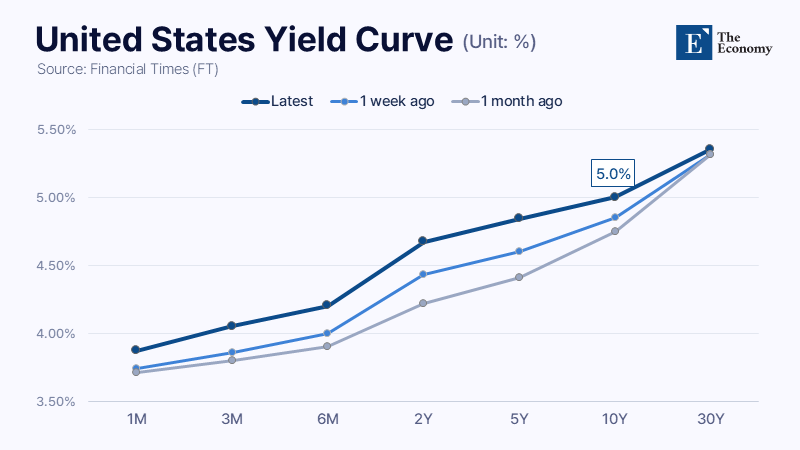
The global bond market has entered another period of high-rate turbulence after the yield on the benchmark 10-year U.S. Treasury note breached 5%. As the prolonged Iran war drives renewed volatility in oil prices and inflation, mounting war costs and accumulated federal debt have prompted investors to demand higher compensation for holding long-term government debt. The U.S. Treasury has responded by expanding its buyback operations in an effort to contain yields, but the move has fueled concerns that the government is seeking to manage interest rates directly, further straining policy credibility. With the U.S. neutral interest rate also trending higher, long-term yields may struggle to return to their previous levels even after the shocks from the war and inflation subside.
10-Year U.S. Treasury Yield Breaches the Formidable 5% Threshold
According to electronic trading platform Tradeweb, the 10-year U.S. Treasury yield surged to 5.012% as of 10:21 a.m. Eastern Time on the 14th, local time. The figure was 0.029 percentage points higher than in the previous session. Because bond yields and prices move in opposite directions, the rise in yields signifies a decline in Treasury prices. The 5% level is widely regarded as a psychological resistance threshold in financial markets, suggesting that investors are moving ahead of the U.S. Federal Reserve’s upcoming policy-rate decision. The 10-year yield last exceeded 5% on October 23, 2023, when it reached an intraday high of 5.02%. It also traded above 5% in 2007, immediately before the global financial crisis.
The resurgence of inflation concerns in the United States is widely regarded as the primary driver of the latest increase in yields. Oil-market volatility intensified after the United States and Iran resumed airstrikes around the Strait of Hormuz and Yemen’s Iran-aligned Houthi rebels extended their threats to the approaches to the Red Sea. Dow Jones said, “As concerns mount that persistently high energy prices could delay disinflation, markets are pricing in the possibility of additional Federal Reserve tightening more aggressively.”
The mounting fiscal burden generated by the prolonged Iran war has also pushed yields higher. U.S. Secretary of Defense Pete Hegseth told Congress in July that cumulative war costs had reached $37.5 billion, while a recent report by the Pentagon’s inspector general cited shortages of advanced munitions and bottlenecks in replenishment production. War spending has been layered on top of federal debt that has already surpassed $40 trillion and a fiscal deficit exceeding 6% of gross domestic product (GDP). Investment-grade corporate bond issuance in September is also projected to reach a record $215 billion, inevitably driving up the term premium demanded by long-term bondholders.
Prospect of Further Rate Increases Deters Long-Term Bond Buyers
Market participants broadly agree that these conditions are unlikely to dissipate in the near term. While the 2007–2009 global financial crisis ushered in the era of ultra-low interest rates, market participants say today’s conditions may represent a “normalization” toward pre-crisis levels or a return to an era of persistently high rates. Investors are consequently reluctant to purchase long-term bonds because yields could rise further.
As bond yields continue to rise, the U.S. government’s fiscal deficit is deteriorating further. Even before this year’s increase in rates, interest payments on Treasury debt had claimed a steadily growing share of the federal budget. Nearly $1 out of every $5 in federal revenue, or 20%, now goes toward interest on Treasury debt. Over the past 50 years, federal interest costs have averaged approximately 2.1% of GDP. According to the Congressional Budget Office (CBO), the figure is expected to reach 3.3% this year and 4.6% by 2036. Those projections assumed a 10-year Treasury yield of 4.1%, but the rate has since risen to approximately 4.7%. An increase of just 0.1 percentage points above the projected rate would add $379 billion to net interest costs.

U.S. Treasury Deepens Policy Uncertainty in Bid to Rein In Long-Term Yields
As rising long-term yields increase the federal government’s interest burden, the U.S. Treasury has recently expanded its Treasury buybacks. The move, however, has heightened turmoil in the U.S. Treasury market by fueling concerns that the government is intervening in the price-discovery process. After the 30-year Treasury yield surged to 5.34% on the 19th of last month, the Treasury doubled the amount of long-term securities repurchased per operation from $2 billion to at least $4 billion. In a revised schedule released on the 9th of this month, it set the buyback cap for securities with maturities of 10 to 20 years at $6 billion per operation. The 30-year yield fell to approximately 5.18% immediately after the initial announcement, but the calming effect proved short-lived, while the second measure elicited little market response. This reflected a growing consensus that government purchase orders alone cannot suppress yields when fiscal conditions and Treasury issuance requirements remain unchanged.
The principal concern among market participants is the erosion of policy predictability. The U.S. Treasury has traditionally managed its issuance and buyback plans in a “regular and predictable manner,” but last month it abruptly revised its purchase volume only two weeks after announcing the scheduled buyback program. Buybacks worth several billion dollars are unlikely to transform supply-demand dynamics in the $32 trillion U.S. Treasury market, but the move established a precedent that the government may alter transaction terms in response to interest-rate levels. If a measure ostensibly intended to stabilize supply and demand is perceived as an intervention designed to manage market prices, policymakers themselves could become another source of uncertainty in Treasury valuations.
Alongside doubts about policy credibility, the rise in the U.S. neutral interest rate is also discouraging purchases of long-term bonds. In May, the Bank of Canada raised its estimated range for the U.S. nominal neutral rate from 2.25–3.25% to 2.50–3.50%. The Federal Reserve Bank of San Francisco estimated last month that the U.S. real neutral rate was approximately 1.5%, implying a nominal neutral rate of roughly 3.5% after incorporating the Federal Reserve’s 2% inflation target. One interpretation is that expanding artificial intelligence (AI) investment has lifted productivity and potential growth, increasing the level of interest rates the U.S. economy can withstand. A higher neutral rate constrains the Federal Reserve’s capacity to cut rates and slows the recovery in long-term bond prices. This suggests that long-term yields may struggle to return to the low levels of the past even after the shocks from the war and inflation recede.
Disconnect Between Stable Short-Term Liquidity and Surging Long-Term Yields
Although the scope for declines in long-term yields has narrowed, the short-term funding market has shown no signs of a liquidity shortage. The Federal Reserve has therefore concluded that banking-system reserves remain ample and suspended Treasury-bill purchases intended to manage reserves for a second consecutive month. The Federal Reserve Bank of New York plans to conduct no reserve management purchases (RMPs) from the 15th of this month through the 14th of next month, acquiring only $15.6 billion in Treasury bills to reinvest principal payments from maturing assets. The RMP program, launched at $40 billion per month last December, was reduced to $25 billion in April and $10 billion from May through July, with additional purchases set at zero since last month. The decision reflects the assessment that short-term funding markets can function smoothly without additional liquidity injections.
As of the 9th, banking-system reserves stood at $3.04 trillion, exceeding both the $2.85 trillion recorded at the end of last year and this year’s average of $3.01 trillion. The Secured Overnight Financing Rate (SOFR) has also remained at or below the Interest on Reserve Balances (IORB) rate over the past month, supporting the Federal Reserve’s assessment that the short-term funding market requires no additional liquidity.
The continued sell-off in long-term bonds despite ample banking-system liquidity runs counter to the conventional dynamics of the bond market. Abundant market liquidity typically expands financial institutions’ capacity to purchase bonds and places downward pressure on Treasury yields. This time, however, a stable short-term funding market has coincided with persistent selling of long-term debt. The divergence reinforces the interpretation that investors are demanding a higher term premium as doubts intensify over fiscal discipline, inflation control and the management of the Treasury market.
Long-Term Yield Strategy Omits Adjustments to War Spending
The Treasury’s decision to accelerate the expansion of its long-term bond buybacks has consequently drawn criticism. Because buybacks are powerful stabilization instruments that are most effective during periods of acute financial-market distress, many market participants argue that raising the purchase cap as soon as fiscal concerns began to affect bond prices was premature. Concerns have also emerged that a more severe market shock would force the Treasury to deploy correspondingly larger purchases and stronger policy measures. The Treasury has officially described the increase as support for liquidity in long-dated securities, but investors remain unconvinced that government buying alone can offset the underlying fiscal burden.
Some critics argue that the government should have reassessed its spending priorities before expanding the buyback program. Financing war costs through new borrowing while using buybacks to suppress long-term yields creates a direct conflict between a fiscal policy that increases the supply of Treasuries and a debt-management policy intended to support their prices. Slowing the pace of defense spending or reducing other expenditures could have signaled a commitment to restoring fiscal discipline by lowering issuance requirements. With the CBO identifying rising net interest costs as a major driver of future deficit expansion, the Treasury’s next quarterly borrowing plan and demand at long-term debt auctions are set to become critical tests of policy credibility.
Siobhán Delaney is a Dublin-based writer for The Economy, focusing on culture, education, and international affairs. With a background in media and communication from University College Dublin, she contributes to cross-regional coverage and translation-based commentary. Her work emphasizes clarity and balance, especially in contexts shaped by cultural difference and policy translation.
Similar Post