[Offshore Finance] Can Offshore Finance Survive Global Tax Transparency? The New Geography of International Capital

Working across research, policy, and data-driven analysis, the Editorial Board ensures that published pieces reflect a consistent institutional perspective grounded in quantitative reasoning and long-term structural assessment.
Authored On
Modified
Tax transparency ended secrecy but offshore fund centres kept growing
China now taxes residents’ offshore trusts at a 20% rate
Compliance costs favour Cayman, Singapore and Luxembourg over smaller centres

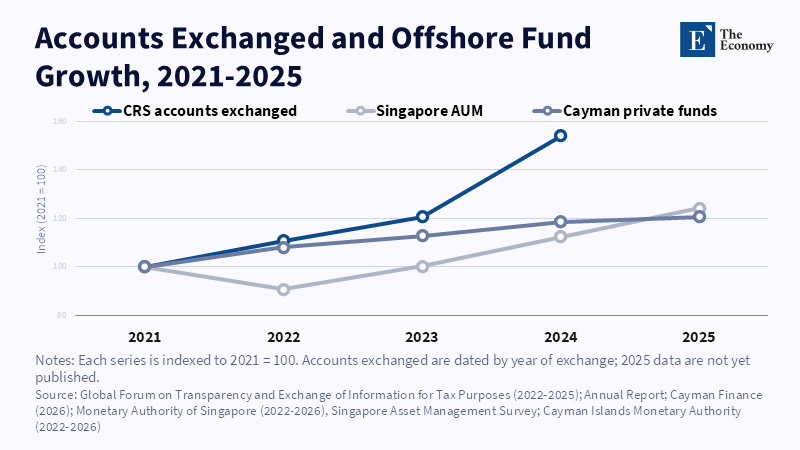
The OECD Global Forum on Transparency and Exchange of Information for Tax Purposes reported that in 2024 tax administrations across the world exchanged information on 171 million financial accounts containing almost €13 trillion in aggregate value. By conventional wisdom, offshore centres should be dead by now. They are not. Cayman had 30,598 investment funds at the end of 2025 and its number of private funds has grown by 40% since 2020. Global tax transparency has killed the relationship between the location of booked assets and taxes paid on those assets, which is a slightly less impressive and more fascinating achievement than destroying offshore finance as a whole: a Cayman fund can be tax neutral and its investors can all be paying taxes on it in their home jurisdictions. In 2026, China provided the ultimate test for this dynamic.
China Taxes Settlors on Offshore Trust Income
Over the course of about a year and a half, the Chinese tax authority hardened its stance on the taxation of offshore trusts. Within a 48-hour window on March 25th and 26th, 2025, the Hubei, Shandong, Shanghai and Zhejiang tax bureaus released examples of Chinese residents who did not report overseas income. Then, in January 2026, the State Taxation Administration invited Chinese residents to self-report overseas income from 2022-2024, reminding them that through the Common Reporting Standard it had access to financial information on Chinese residents in over 100 countries and territories. The last step came on the 24th of July 2026. In Announcement No. 21 of 2026, the Ministry of Finance and the State Taxation Administration declared that when a Chinese resident moves assets into an offshore trust, it would be deemed a disposal of those assets and taxed at 20% on the gain. Income generated by the trust and by any offshore companies controlled by the trust will also be taxed to the settlor each year regardless of whether it is distributed. Announcement No. 15 was released in conjunction with that, placing some of the responsibility on the trustee. The self-declaration deadline was the 22nd of October 2026.
What is interesting about this is who is being taxed. Neither Cayman nor the British Virgin Islands has begun taxing its trusts. China is taxing its own residents on the income from a foreign trust that they could have left untaxed for an indefinite amount of time in the past. The legal vehicle remains. The deferral of taxes is gone. A founder who placed company shares into a trust before listing on the Hong Kong or New York stock exchanges may start to wonder whether the structure is worth it after tax. It may be if succession is important and the founder wants the children to have control over the company after the founder passes. It may be if the aim is to shield assets from creditors or to raise capital on foreign stock exchanges. There are a few other reasons the family's lawyers may argue are more important than the others. Some of these trusts will be dissolved and others will self-report and carry on as normal, adding the 20% tax as a running cost, how the mix splits will show how reliant the offshore world was on secrecy.
Tax Neutrality Outlives Financial Secrecy
There is one thing that may fly under the radar when discussing global tax transparency: the tax neutrality of a fund. While discussing China's taxation of its residents, it is easy to forget that the fund is a tax-neutral vehicle and that the investors should be paying taxes on the income they generate in their home country. A fund that pools investors from Japan, America and Germany will want to be domiciled somewhere that doesn't add another layer of tax on top of what each investor pays at home. If it didn't, there would be double taxation or something lost in foreign tax credits between the three countries. Cayman Finance states that Japanese institutional investors have over $645bn allocated overseas. About 80% of that is through funds domiciled in Cayman. These investors are highly regulated and don't have anything to hide from Japan's National Tax Agency.
Something similar shows up in the trend of household wealth offshore. The EU Tax Observatory's Global Tax Evasion Report 2024 estimated that households held 10% of global GDP in financial wealth in tax havens before 2013. Most of this was not declared. That number was roughly the same in 2022 but only 27% of it was not taxed, which is 3.2% of global GDP. This means tax evasion offshore by households fell by a factor of about three between 2013 and 2022. The wealth stayed offshore; the owners just declared it.
Another purpose of offshore vehicles is to help companies raise money. A paper written by economists from Harvard, Stanford, the University of Chicago and Columbia in 2021 discovered that American national accounts underreported U.S. investor exposure to Chinese companies by nearly $600bn. This was because those companies raised money through entities in places like Cayman. Many Chinese companies that are publicly traded are Cayman companies by law. Taxing Chinese founders does not remove the need for offshore listing vehicles, or foreign investor preference for a company law based on English common law and the courts that come with it.
Pillar Two Barely Reaches Funds and Trusts
The OECD's Pillar Two was supposed to put an end to tax havens years ago by implementing a 15% minimum tax rate on all companies with consolidated revenue of €750 million or more. It only affects companies and not individuals, meaning that if there is a fund at the top of the group, it would not be taxed under the GloBE rules. This means that much of private wealth and fund management would fall outside of the scope of Pillar Two. In 2023, the EU Tax Observatory had already calculated that, with the loopholes created while drafting the minimum tax, 50% of the expected revenue would be lost. In January 2026, the OECD/G20 Inclusive Framework released the Side-by-Side package, which allows US-parented groups to be excluded from the Income Inclusion Rule and Undertaxed Profits Rule for fiscal years beginning on or after the 1st of January 2026, meaning that only local top-up taxes will apply to them where countries have implemented them.
This will hurt some jurisdictions if they rely on multinationals booking profits because a 0% tax rate simply hands that revenue to another country that can collect a top-up tax, which is why some jurisdictions have implemented local minimum taxes to avoid this. Pillar Two won't have much of an impact on private equity firms in Cayman or trusts in Singapore. The bigger gap in the new transparency regime is the U.S. economy. The U.S. does not participate in the Common Reporting Standard and uses its own FATCA law to collect data on its citizens abroad. Many press reports have quoted bankers and lawyers in the financial sector on Chinese clients looking to move their money to the U.S. from Singapore and Hong Kong. There is no data to support this claim yet. Accounts held in a reporting jurisdiction would also have already been reported to China's State Taxation Administration.
Global Tax Transparency Has Not Shrunk Offshore Finance
By the looks of the data, it is still growing. Singapore saw assets under management grow from S$6.07 trillion to S$6.7 trillion from the end of 2024 to the end of 2025. That's a 10.1% growth. They also had net inflows of S$376bn, which was 29% higher than the previous year. About 76% of those assets came from outside of Singapore. Singapore only introduced Variable Capital Companies (VCCs) in 2020 and now has 1,406 of them with 3,443 sub-funds. Luxembourg had net assets of €6.199 trillion for undertakings for collective investment at the end of 2025, which is 6.52% more than the previous year. Cayman had 17,722 private funds and 12,876 mutual funds at the end of 2025. Cayman funds managed $16 trillion in total assets at the end of 2024, with net asset values of $9.1 trillion. All of this has been happening while global tax transparency is at its highest.
The data on companies with no apparent substance does show a decline. The British Virgin Islands had 31,134 new companies formed in 2025, which is the highest they have been since 2021, compared to 77,022 companies formed in 2007. The number of active companies at the end of 2025 decreased to 356,256, due to more strike-offs than new companies. A business that mainly sells anonymity will see a decline once that anonymity is no longer there.
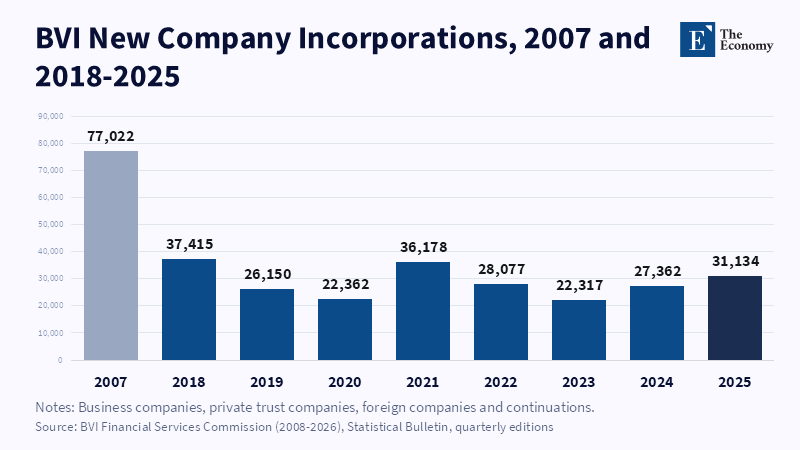
Some conclusions can be drawn from the data currently available, rather than from what may happen. The data shows that offshore finance has continued to grow in jurisdictions that provide a high level of supervision and that fewer companies with no substance are being formed than in 2007. It cannot be concluded that any of this wealth will return to the home country or that Chinese wealth will start flowing into the US. With Singapore's data coming from the end of 2025, no changes to these numbers will show until the next survey, which is likely to come out in the summer of 2027. That offshore finance will die as soon as there is global tax transparency, though that doesn't seem to be the case. The data on household wealth offshore shows that it has stayed constant while the money being declared has increased. Cayman private funds have increased by 40% over the last 5 years as well.
Compliance Costs Favour the Largest Offshore Centres
More regulation means more cost to operate, whether that be for a fund manager or a trustee. Trustees in Singapore will need to continue to meet their CRS requirements and ensure that their clients are meeting the requirements laid out by Announcement No. 15, as well as ensure there is economic substance in their clients' structures. Cayman and the British Virgin Islands have been requiring economic substance since 2019 and the British Virgin Islands has required companies to file a copy of their register of members since the 1st of January 2025. There will be some jurisdictions that will see less business because of this. The more expensive jurisdictions to be in will win because they already have the infrastructure to support all of these new regulations. The Global Forum currently has 116 jurisdictions that automatically exchange information and another 13 that have agreed to do so by 2028.
Fund managers will have less of a reason to choose a specific jurisdiction over another if they all become regulated. The reason they would choose a certain location is if the vehicles are accepted by their institutional investors and their regulators. Singapore and Hong Kong can be expected to advertise their ability to comply with China's new regulations, which will be another selling point to Chinese families who will now have to pay 20% on the gains from their trusts. China may find it hard to enforce its rules on people who have taken the bait and moved their money to the US. Smaller offshore jurisdictions can also be expected to shrink, as there will be fewer companies providing services in these locations, which will allow the bigger ones to make more money off of the remaining clients.
With 171 million accounts being reported to tax bureaus across the globe, global tax transparency has not killed offshore finance because the need for a tax-neutral fund is still there and jurisdictions that provide a high level of supervision have flourished. It will be interesting to see if the U.S. can attract Chinese money that may leave Hong Kong and Singapore. Currently, there is no data to back that up. Singapore's next survey will show whether anything has changed, since it will cover 5 months of China's new rules.
The views expressed in this article are those of the author(s) and do not necessarily reflect the official position of The Economy or its affiliates.
References
Alstadsæter, Annette, Godar, Sarah, Nicolaides, Panayiotis and Zucman, Gabriel (2023) Global Tax Evasion Report 2024. Paris: EU Tax Observatory.
British Virgin Islands Financial Services Commission (2026) Statistical Bulletin: Fourth Quarter 2025. Road Town: Financial Services Commission.
Cayman Finance (2026) Cayman fund registrations increase 40% since 2020. George Town: Cayman Finance.
Cheng, Yu (2026) ‘China urges residents to report overseas income’, China Daily, 20 January.
Commission de Surveillance du Secteur Financier (2026) Global situation of undertakings for collective investment at the end of December 2025. Luxembourg: CSSF.
Coppola, Antonio, Maggiori, Matteo, Neiman, Brent and Schreger, Jesse (2021) ‘Redrawing the map of global capital flows: The role of cross-border financing and tax havens’, The Quarterly Journal of Economics, 136(3), pp. 1499-1556.
Global Forum on Transparency and Exchange of Information for Tax Purposes (2025) Global Forum Annual Report 2025. Paris: OECD Publishing.
IFC Review (2025) ‘China’s multiple regions conduct tax audits on personal offshore income’, IFC Review, May.
Ministry of Finance of the People’s Republic of China and State Taxation Administration (2026) Announcement on Individual Income Tax Matters Concerning Offshore Trusts, Announcement No. 21 of 2026. Beijing: Ministry of Finance.
Monetary Authority of Singapore (2026) Singapore Asset Management Survey 2025. Singapore: Monetary Authority of Singapore.
OECD (2021) Tax Challenges Arising from the Digitalisation of the Economy: Global Anti-Base Erosion Model Rules (Pillar Two). Paris: OECD Publishing.
OECD/G20 Inclusive Framework on BEPS (2026) Global Anti-Base Erosion Model Rules (Pillar Two): Side-by-Side Package. Paris: OECD Publishing.
State Taxation Administration (2026) Announcement on Administration Matters Concerning Individual Income Tax on Offshore Trusts, Announcement No. 15 of 2026. Beijing: State Taxation Administration.
Working across research, policy, and data-driven analysis, the Editorial Board ensures that published pieces reflect a consistent institutional perspective grounded in quantitative reasoning and long-term structural assessment.