[Arctic Maritime Strategy] Russia's Arctic Military Strategy: Defending the Northern Sea Route

Working across research, policy, and data-driven analysis, the Editorial Board ensures that published pieces reflect a consistent institutional perspective grounded in quantitative reasoning and long-term structural assessment.
Authored On
Modified
Russia’s Arctic forces protect nuclear deterrence, not shipping
July 2026 air defense withdrawals revealed Moscow’s real priorities
China uses the route but will not defend it

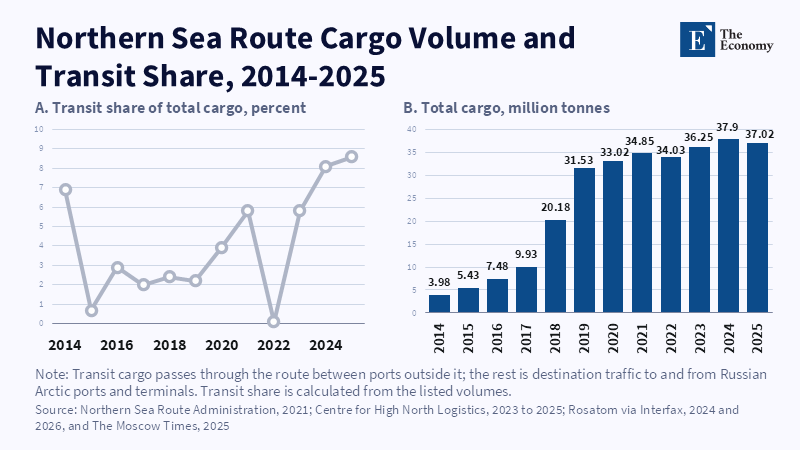
Rosatom counted 37.02 million tonnes moving through the Northern Sea Route in 2025. That was a step down from the record 37.9 million in 2024 and well short of the 44.2 million tonnes that Rosatom was projecting at the end of 2024. Against the 80 million tonnes that Putin's 2018 decree demanded for 2024, the route moved less than half. On that same coastline, Russia has extended airstrips on Kotelny Island, placed radars on Wrangel Island and announced an air defense garrison at the mouth of the Lena River. Russia's Arctic military strategy is moving faster than the Northern Sea Route can move product. The gap between those two lines is the best place to start reading Russia's strategy in the Arctic.
The Northern Sea Route will move enough cargo to justify military spending. But Russia has had reasons to put military assets in the Arctic for longer. They needed something further east of the Kola Peninsula to protect their submarine bastions. Their vast Siberian coastline was neglected by the military after the fall of the Soviet Union. Russia wanted something more to back up its claim that the Northern Sea Route waterways are Russian Internal Waters. All of these would put missiles and radars on the coast even if not a single ship made it to China. The cargo will allow them to create a civil reason to put money into the route through Rosatom. The military hardware will be placed where they want to project deterrence. When Russia had to decide where to leave some of its military assets undefended in July of 2026, this was evident. The arrival of China will muddy this assessment but not change it.
More Sensing Than Defense in the Eastern Arctic
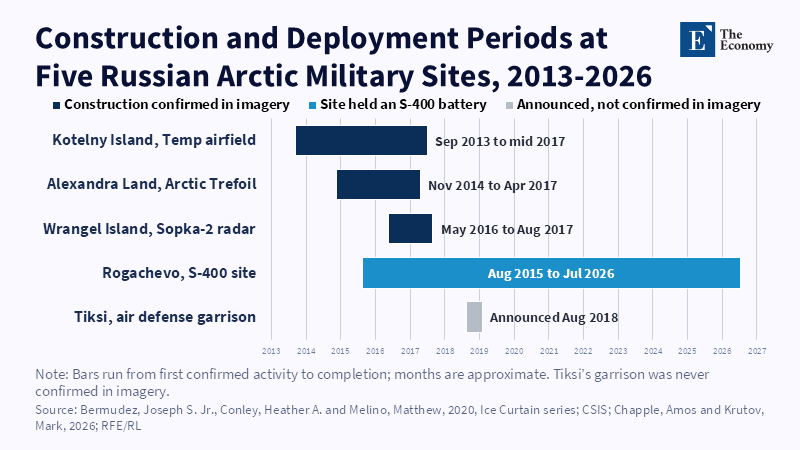
West of the Kara Gate, Russia has turned the Arctic into a nuclear fort. The U.S. Intelligence Community assessed in its 2026 Annual Threat Assessment that Russia has two-thirds of its second-strike nuclear capability on the Kola Peninsula and 7 Ballistic Missile Submarines. This has been widely known. Further east, the military posture weakens and shifts. On Kotelny Island in the New Siberian Island group, there is a military installation called Northern Clover that overlooks the Sannikov and Dmitry Laptev Straits. CSIS has assessed satellite imagery of Kotelny Island and found Bastion-P Missile systems and Pantsir-S1 air defense systems on the Island. The runway for the Temp Airfield was extended in 2024. On Wrangel Island and Cape Schmidt, the confirmed assets are Sopka-2 radars. These track aircraft and ships, help with civilian aviation and provide weather data to those traversing the Northern Sea Route.
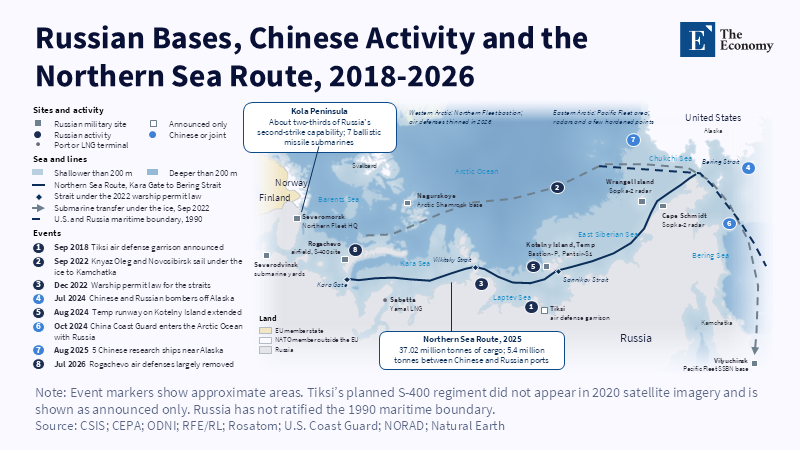
On the Laptev Sea Coast at Tiksi, promises outpace capabilities. The Commander of the Northern Fleet announced in 2018 that a new garrison of Air Defense forces would be at Tiksi in 6 months. Modular barracks and a mess hall appeared for an anti-aircraft missile regiment. They stated that they would be receiving S-400s as well. CSIS was unable to find any S-400s in satellite imagery of Tiksi in 2020. Nor did they see the other 11 buildings that were planned. To this day, it is unclear if Tiksi will receive S-400s. Wrangel Island produced the opposite problem: a widely shared 2025 U.S. article claimed Russia was building on territory some Americans regard as their own, a claim CEPA called debunked on historical and factual grounds. What can be confirmed in the Eastern Arctic is a sensing capability with some hard points. It's not a defensive coast.
The East is also controlled by the Pacific Fleet. After the Leningrad Military District was re-established in 2024, the Northern Fleet returned to protecting Russia's strategic assets on Kola and the Western and Central portions of the Northern Sea Route. The Pacific Fleet is based out of Vladivostok and has its Ballistic Missile Submarines based in Vilyuchinsk on Kamchatka. The Northern Sea Route has military significance to the Pacific Fleet. In 2022, the Borei-class Knyaz Oleg and Yasen-class Novosibirsk transited under the ice from the Barents Sea to Kamchatka. They covered 5,500 NM and participated in Umka-2022 in the Chukchi Sea. The Pacific Fleet now has 3 Boreis. The Northern Sea Route provides the Navy a path to move strategic submarines without having to transit foreign waters. There is no correlation to container prices.
Russia's Arctic Military Strategy Puts the Bastion First
When a country can't defend everything, where do they choose to put their assets? In July of 2026, satellite imagery showed that Russia had removed approximately 60% of its S-300s and S-400s from where they were positioned prior to 2022. Many of them were moved to protect Moscow and oil refineries from Ukrainian drones. A 6 July 2026 satellite image showed a missile site near Rogachevo on Novaya Zemlya. It has been a missile site since at least 2015 and was left almost empty. The positions that defended the Submarine shipyards in Severodvinsk for many years were also removed. Air defenses stayed around Russia's missile silos and strategic bomber bases. The Norwegian Institute for Defence Studies concluded that Russia does not expect a major attack in the North. That choice shows what the Arctic garrisons were really for: protecting the nuclear deterrent.
Russia's ground forces show the same pattern. After losing manpower to Ukraine, Russian land forces on Kola had fallen to a fifth of their prewar strength by 2023, according to Norwegian intelligence. Submarines, Surface Ships and long-range air defense and Electronic Warfare were not affected. The Norwegian Service predicted that in 2026 Russia will have 3 Severodvinsk-class multi-role submarines and 3 Frigates with Tsirkon Missiles. Russia approved its Naval Strategy through 2050 in 2025. It plans to spend 8.4 Trillion Rubles on naval shipbuilding in the next 10 years. Russia's Arctic Brigades were sent to Ukraine. Their task included protecting coastal facilities and helping ships on the Northern Sea Route. Russia's nuclear deterrent was left alone. They will protect their nuclear deterrent first. Deny their enemies access to their coast second. Protecting Commercial shipping on the Northern Sea Route is a distant third.
CSIS identified that Russia wanted a staging ground for power projection into the North Atlantic in 2020. CEPA now sees Russia pulling back and focusing on Near Sea Control around the Bear Gap. There isn't much power projection happening in the Eastern Arctic, only some bomber flights to Alaska and fleet exercises such as Finval between the Chukchi and Bering Sea. Russia can use its cruise missile submarines to threaten NATO shipping, according to the Norwegian Service. But Russia hasn't built a power projection capability on the coast of the Northern Sea Route.
Using the Northern Sea Route to Pay for Military Assets
The economic argument is valid. Russia believes the Arctic is responsible for 7% of its GDP, 11% of exports and over 80% of its natural gas. The Northern Sea Route will move exports from Yamal and other Oil facilities in the Arctic. There is also an increase in shipping through the route. The Centre for High North Logistics has counted 103 transits through the Northern Sea Route in 2025, 15 of them by container ships. As of September 2026, they have already seen 104 transits. Their scenario puts 2026 near 150 transits and above 4.5 million tonnes of cargo. This is insignificant compared to the Suez Canal but it's a trend. Rosatom expects the Northern Sea Route to see a 14% increase in cargo in 2026.
Where Russia built military assets on the Northern Sea Route says more than how much product is moving. Kotelny Island, Wrangel Island, Tiksi and the reopening of about 50 Russian Military bases in the Arctic were planned and mostly built before 2020, when product on the route was minimal. Russia also began creating the laws that would allow it to control the waterways in the Northern Sea Route. In December 2022, Russia passed a law that allows it to control the internal waters of the Northern Sea Route. They can require foreign warships to request 90 days in advance to travel through their waterways and only allow one ship at a time. In 2024, Putin placed all of Russia's Maritime and Arctic interests under a Maritime Collegium headed by Patrushev. This gives the FSB Coast Guard and Rosgvardia more control over ports and waterways. Russia is using the Northern Sea Route as a civilian term to describe its military strategy in the Arctic. They are also using Rosatom to fund some of these efforts and the radars on the coast will help direct civilian planes as well.
Some may argue that Russia has a reason to defend its economy in the Arctic because it already has a thriving economy there of icebreakers, LNG terminals and Oil Platforms. Russia will continue to put radar and rescue stations on the coast to help with that. But that argument falls apart in 2026, when Russia stripped air defenses near the Northern Sea Route while keeping those around its missile sites. Russia also has to defend its claim that the waterways are internal waters. Article 234 of the Law of the Sea Convention covers ice-covered areas. In 2025, the Arctic Yearbook published that, with climate change, the Northern Sea Route may no longer meet this requirement. There was even a ship that transited the route without an icebreaker in September of 2023. So if Russia wants to defend its claim that the waterways are internal, they need to keep a military presence.
China Will Use the Northern Sea Route but Will Not Defend It
China will continue to move cargo through the Northern Sea Route. In September 2026, the CEO of Rosatom stated that China-Russia shipments accounted for 5.4 million tonnes of the 37.02 million that moved on the Northern Sea Route in 2025. That cargo moved on 23 container voyages and Chinese carriers plan more than 30 in 2026. China and Russia created a joint development plan for the Northern Sea Route in Harbin in October of 2025. In December 2025, China unveiled a design for a nuclear-powered cargo and passenger icebreaker able to break 2.5 meters of ice. The design of the nearly 30,000-ton ship received approval in principle from the classification society RINA. Russia currently is the only country that has nuclear icebreakers. If China gets one, it will be able to break the Russian Monopoly on the Northern Sea Route.
There has been some military cooperation between Russia and China. In July of 2024, 2 Chinese H-6 bombers and 2 Russian Tu-95s flew over the Bering and Chukchi Seas. This was the first time Chinese bombers had entered the Alaskan air defense identification zone and the first time the two air forces had flown from the same Russian base. China also sent its Coast Guard to the Arctic for the first time in 2024 to patrol with the Russian Border Service. The U.S. Coast Guard spotted 5 Chinese Research Vessels in or near U.S. waters in August of 2025, including the icebreaker Xue Long 2. CEPA believes that Russia will use China to help it project power in the Pacific Arctic. This will help draw U.S. forces towards Alaska and the Aleutians.
Russia's security services remain wary of China. An FSB document obtained by the New York Times in 2025 stated that China is "the enemy" and could be spying on Russia through mining and universities. Both countries also want different things out of the Northern Sea Route. China has stated that they are a Near-Arctic State in its 2018 policy. It also supports freedom of navigation for all countries on Arctic shipping routes. Russia passed a law in 2022 that will allow it to deny foreign navies the ability to travel through the Northern Sea Route straits. China wants to use the route as it pleases. Russia wants to control who uses the route. Publicly reported joint patrols have stayed in the Bering Sea, away from the Northern Sea Route straits.
What the U.S. Can Realistically Do in the Arctic
The U.S. cannot match Russia's Arctic geography. Russia has over 24,000 km of Arctic coastline, 53% of the Arctic Ocean's total and 42 icebreakers, 8 of them nuclear. The U.S. is trying to catch up. In July of 2026, the Coast Guard finalized contracts with Bollinger Shipyard for 4 Arctic Security Cutters. These will cost around 2.2 billion dollars. They also awarded Rauma Marine Constructions two more Arctic Security Cutters. These will cost around $1.1 billion. The first of these ships won't arrive until 2028. The Heavy Polar Security Cutter won't arrive until 2030. NATO's Arctic Sentry will continue to provide some deterrence in the North. But it's mainly just an umbrella over countries doing their own exercises, such as Norway's Cold Response.
The U.S. should continue to monitor Russia's and China's activity in the Bering and Chukchi Seas. The U.S. could sail a ship through the Vilkitsky or Sannikov Straits. This would challenge Russia's 2022 Law. CEPA doesn't recommend this, as it could escalate tensions more than it's worth. The U.S. should continue to sail in Russia's Exclusive Economic Zone. The 2022 Law doesn't address it. The Congressional Research Service said that the Pentagon is looking to coordinate its Commands in Europe, North and the Pacific. This could help with the U.S. presence in the Arctic. More sanctions on projects like Arctic LNG two are likely. This will hinder the economy on the Northern Sea Route.
Russia will continue to move more product on the Northern Sea Route, as Rosatom has projected and more Chinese ships will use the route. Russia's military presence will not grow at the same rate. In July of 2026, Russia pulled air defense launchers off Novaya Zemlya and Severodvinsk but kept them around its missile silos. That is where Russia's focus is in the Arctic. The gaps this opened are real but probably temporary. Russia has announced plans to expand its northern ground forces and air defense batteries can return to Rogachevo quickly. The U.S. won't have its first cutter until 2028.
The views expressed in this article are those of the author(s) and do not necessarily reflect the official position of The Economy or its affiliates.
References
Associated Press (2024) ‘Chinese and Russian bombers patrolling off Alaska raise concerns about growing military cooperation’, Associated Press, 25 July.
Bouffard, Troy J., D’Angelo, Gennaro, Gundry, Gabrielle F., Pitts, Travis R., Price, Stephen F. and Roberts, Andrew F. (2025) ‘Russian ambitions to control freedom of navigation and Arctic access: refined data challenging Moscow’s Northern Sea Route claims’, Arctic Yearbook 2025. Akureyri: Northern Research Forum.
Boulègue, Mathieu (2026) Frontline Arctic: The Evolution of Russia’s Military Posture in a Changing Arctic. Washington, DC: Center for European Policy Analysis.
Centre for High North Logistics (2026) Overview of NSR Transit Voyages as of September 30, 2026. Bodø: Nord University.
Chapple, Amos and Krutov, Mark (2026) ‘Russia strips Arctic air defenses as Ukraine war strains military’, Radio Free Europe/Radio Liberty, 14 July.
Congressional Research Service (2026) Russia’s Arctic Military Posture: Considerations for Congress, R49487. Washington, DC: CRS.
Conley, Heather A. and Melino, Matthew (2020) The Ice Curtain: Russia’s Arctic Military Presence. Washington, DC: CSIS.
Interfax (2026) ‘Rosatom expects cargo traffic along Northern Sea Route to rise 14% in 2026: CEO’, Interfax, 1 September.
Maritime Executive (2026) ‘U.S. finalizes contract for six Arctic Security Cutters’, The Maritime Executive, July.
Norwegian Intelligence Service (2026) Focus 2026. Oslo: Norwegian Intelligence Service.
Office of the Director of National Intelligence (2026) Annual Threat Assessment of the U.S. Intelligence Community. Washington, DC: ODNI.
The Moscow Times (2025) ‘Northern Sea Route shipping falls short of Russia’s 2024 target’, The Moscow Times, 10 January.
The New York Times (2025) ‘Secret Russian intelligence document shows deep suspicion of China’, The New York Times, June.
Working across research, policy, and data-driven analysis, the Editorial Board ensures that published pieces reflect a consistent institutional perspective grounded in quantitative reasoning and long-term structural assessment.