[Arctic Maritime Strategy] The Economics of Russia's Northern Sea Route: A New Trade Corridor or an Energy Export System?

Working across research, policy, and data-driven analysis, the Editorial Board ensures that published pieces reflect a consistent institutional perspective grounded in quantitative reasoning and long-term structural assessment.
Authored On
Modified
Hydrocarbons are 83 percent of Northern Sea Route cargo
Shin and Kim find shorter distance rarely beats Suez on cost
Korean and Japanese yards face sanctions exposure, not a boom
Of the 37.9 million tonnes of cargo Rosatom says moved along the Northern Sea Route in 2024, around 3.1 million went from one end to the other. Around one tonne every 12. The other 11 either went from Russian Arctic fields, terminals and ports or left Russia as LNG, oil or ore destined for foreign customers who did not complete the full length of the route. This did not change much in 2025, with a reduction of 2.3% to 37 million tonnes and an increase in transit to 3.2 million tonnes. Moscow and Beijing pitch a trade route to Europe from Asia that saves weeks of sailing time when compared to Suez. The numbers tell the story of Russian energy leaving through Yamal LNG and oil fields with a small seasonal amount of transit trade and Korean/Japanese shipbuilding questions.
What the Northern Sea Route Actually Carries
Gekon, a Russian consultancy, found that 83% of the Northern Sea Route cargo in 2025 was hydrocarbons. LNG is by far the biggest commodity and most of it is from one producer. Novatek exported 20.4 million tonnes of LNG from its Yamal LNG facility in 2025, down 7% from last year’s record but still above its rated capacity. Meaning that one facility represents more than half of Russia's tonnage through the Northern Sea Route. Gazprom Neft is exporting oil from the Novoportovskoye oil field. As Gekon chief Mikhail Grigoryev notes, it has declined steadily. Bulk decreased by more than 60% and coal to Murmansk declined by 29%. Containers went through 321,000 tonnes for the year, according to Gekon. Rosatom's number is closer to 400,000. There is a significant difference when it comes to the container numbers.
Most of the cargo that can be considered transit is between Russia and China. The Centre for High North Logistics says 2.9 million tonnes out of 3.07 million tonnes went to China in 2024 with 18 trips of crude making up 1.89 million tonnes. None of the 97 transits started and ended outside of Russia. 41 of those transits were in ballast. The number of transits in 2025 was 103 and roughly 3.2 million tonnes. Tankers were once again the largest type of ship, with only one international voyage from Asia to Europe. Rosatom CEO Alexei Likhachev says that 5.4 million tonnes went between Chinese and Russian ports. This makes up close to 15% of all cargo through the route.
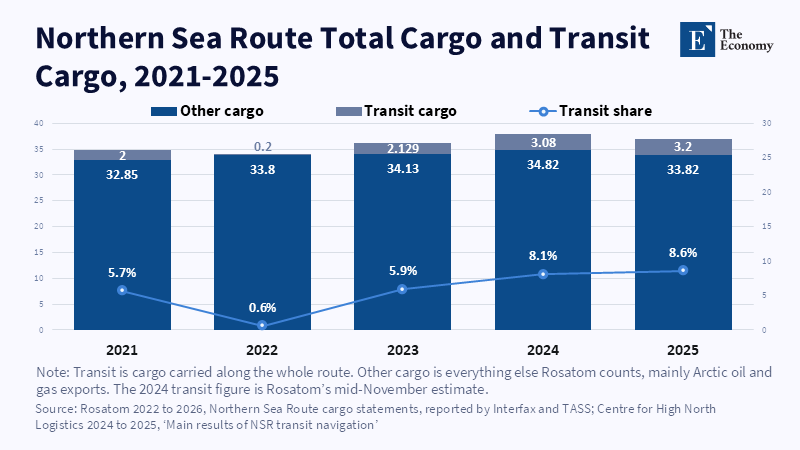
There has been an increase in transit in 2026, and the route starts to look like it could become a trade corridor though it will still be marginal. 104 transits are confirmed to have carried an estimated 3.7 million tonnes as of the 30th of September. The centre expects around 150 transits by the end of the navigation period. Carrying over 4.5 million tonnes. 22 Eastbound voyages by tankers have carried around 2.1 million tonnes. Mainly crude from Murmansk, Primorsk and Ust-Luga. 13 Bulk carriers have carried 1.1 million tonnes East and 27 west, mostly to reposition. Alexandros Itimoudis from Container News calculates that crude and bulk still make up 86% of the cargo through the route. Only four vessels have transited from Asia to Europe. Three container ships and one bulk carrier, the Nan Xin 27, as of the end of September last year there was one.
Shorter Sailing, Costlier Voyage
For the right ports, the distance is shorter. Li Xiaobin from Ningbo-Zhoushan said the Istanbul Bridge, a Chinese-owned container ship, would take 18 days from Ningbo to Felixstowe. Compared to over 40 days through Suez. The ship arrived in 20 days after being delayed two days by weather in Norway. The company said to the South China Morning Post that their route cost more per container. Comparing the fuel and crew costs of a 4,900 TEU ship to one of the massive container ships running Asia-Europe, the distance is less of a draw.
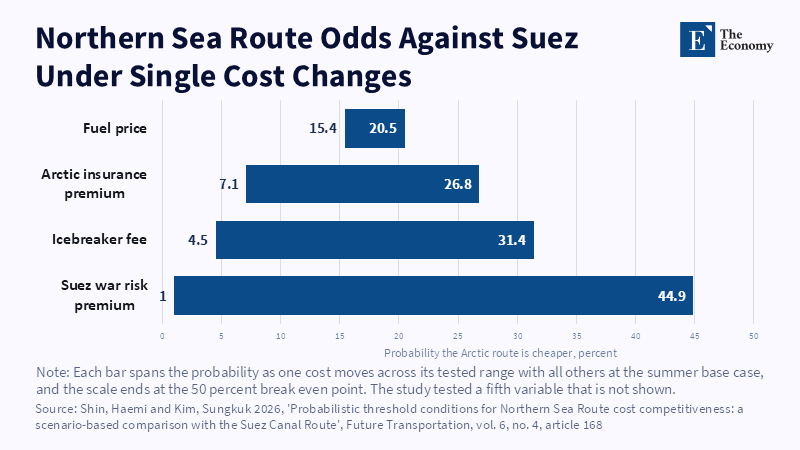
A paper by Haemi Shin and Sungkuk Kim from Mokpo National Maritime University simulated the costs of a container ship from Shanghai to Rotterdam. Using Monte Carlo simulations, they found that 18.1% less distance was outweighed by the cost of icebreakers, insurance and politics. They simulated the cost of icebreakers at $450,000 compared to the canal charge at around $300,000. In their model, the Northern Sea Route was only cheaper 16.6% of the time. This fell to 1.4% in winter and rose only to 23.5% with eased geopolitics. They conclude that multiple variables would need to be reduced for the Northern Sea Route to be cheaper most of the time.
One factor that does not show up in the numbers above is reliability. Container ships buy on a schedule. Sea Legend has been able to maintain its weekly departures of 8 this year and has transported over 14,000 TEU on 7 ice-class ships, according to Itimoudis. It stopped departing early this season due to ice, so currently, container ships can operate on the route from August to October. This creates a situation where the buyer of that cargo needs to find another option to Suez or the Cape for 9 months of the year. So it competes with rail and air freight, not Suez.
Arctic LNG 2, Chinese Buyers and Sanctions
Setting transit aside, there are two projects that Novatek is running on the Northern Sea Route and the customers that will buy that cargo, Yamal LNG, are making money. Arctic LNG 2 is not and it has been sanctioned by the U.S. since November 2023. There have been 41 cargoes of LNG from Arctic LNG 2 to PipeChina in Guangxi. This amounts to 2.6 million tonnes since the first delivery in August 2025. PipeChina is also building a new terminal in Shandong to receive these cargoes. As of now, China is the only customer with CNPC and CNOOC owning parts of the project and Chinese companies providing the vessel services.
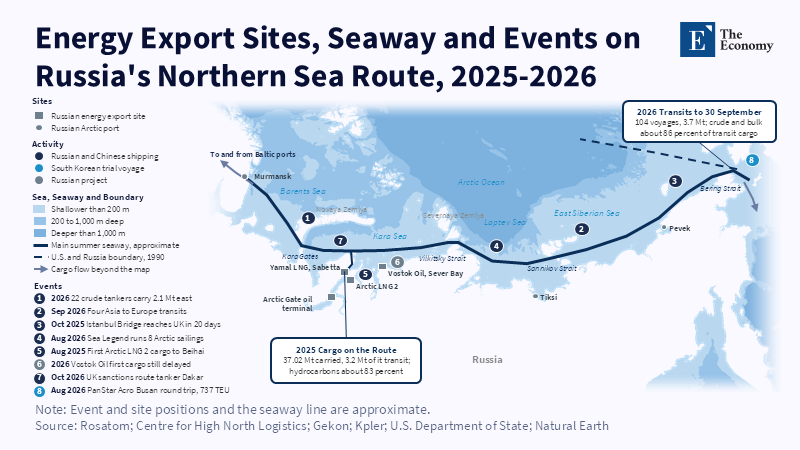
There are other forms of cargo that the Northern Sea Route will need. Sanctions have played a part. Rosneft's new oil field, Vostok Oil, is not expected to come online until 2026. Its operator was sanctioned by the US in January 2025. Grigoryev believes there will be no growth in the Northern Sea Route in 2026. Rosatom's chief executive sees growth of 14% in 2026. Whether or not the Baltic oil fields continue to send oil North will decide the growth. Ice, fuel costs and reliability will also impact whether it becomes cheaper. Itimoudis points out that much of the oil moving east is from the Baltic. This has increased sanctions enforcement and attacks. In October 2026, the UK sanctioned 12 more shadow fleet ships, including the 22-year-old Dakar, which was on its way through the Northern Sea Route.
Northern Sea Route Exposure for Korean and Japanese Shipbuilders
South Korea has already suffered from its ventures into the Arctic. In 2022, DSME, now Hanwha Ocean, cancelled an $872 million order for 3 Arc7 Icebreaking LNG Carriers when Sovcomflot failed to meet its payments due to sanctions. In 2024, Samsung Heavy Industries had its contracts terminated by Zvezda. It was building 10 Arc7 LNG Carriers and 7 Shuttle Tankers and Zvezda is demanding repayment of an advance of $800 million plus interest. It is fighting the case in Singapore. Japan also suffered losses in 2024 when Mitsui O.S.K. Lines cancelled its orders for 4 ice-class ships. That had an invested value of ¥105 billion, which is around $687 million. There will be a loss if these ships are sold, as there is not much demand.
Korea has more opportunities on the route if there are enough ships transiting. The Panstar Acro departed from Busan in August 2026 and is the first Korean commercial vessel to travel the route. It made port calls in Felixstowe, Rotterdam and Gdansk before returning to Busan in 50 days. The company was looking to carry around 1,300 TEU. However, it only had 737. Korean President Lee Jae-myung has put a focus on Arctic shipping with the aim of providing a service in 2030 that will help Busan become a port going North. The port will have to compete with other Chinese ports for cargo. So, it will be more advantageous for Busan to provide additional services such as bunkering and repairs. Or become one of the first ports if there is more traffic through the Bering Strait.
The Northern Sea Route will affect Japan, though it will not be a big focus of its shipbuilding sector. Imabari took a 60% stake in Japan Marine United in January and became the 4th largest shipbuilder. It will also have some exposure to the Arctic through Mitsui and JOGMEC's Japan Arctic LNG, which owns 10% of Arctic LNG 2, while MOL's carriers no longer carry its gas. Japan should monitor Arctic shipbuilding and prepare for potential upsides if the Northern Sea Route becomes more popular.
Why Suez Keeps Its Lead
When the Red Sea was being attacked, there were many more ships travelling around the Cape of Good Hope. Reducing the amount of traffic that went through Suez. Osama Rabie, the chairman of the Suez Canal Authority, said that the Canal made $4.67 billion in revenue in the fiscal year ending in June 2026, a 23% increase on last year. There was also a 10% increase in transit and 22% in tonnage though this was lower than the record $9.4 billion in fiscal 2022/23. The canal had 1.25 million tonnes of cargo in one day in 2024; the number of containers that went through the Northern Sea Route in 2025 was lower than in one day. Shin and Kim also added Red Sea disruptions to their model. Finding that with higher insurance on the Suez route the Arctic route's chance of being cheaper rose only to about 45%.
There will continue to be a market for Northern Sea Route trade but with Russia controlling access and China providing most of the ships, it will be limited. Rosatom controls access to the route in 28 different sections, as Itimoudis points out, with NewNew looking to transport 1.2 million tonnes in 2027 with 2 sailings a month. This is only 1 day’s worth of cargo that goes through Suez. If Rosatom is correct, the route will grow 14% this year and there are 4.5 million tonnes of transit cargo. Total tonnage would then be about 42 million, which means that 1/9th of the tonnage is transiting the route. However, most of this is oil moving from Russia to Asia. The route has yet to carry more cargo that leaves Asia and arrives in Europe; as of the end of September, there have been 4.
The views expressed in this article are those of the author(s) and do not necessarily reflect the official position of The Economy or its affiliates.
References
Centre for High North Logistics (2025) Main results of NSR transit navigation in 2025. Bodø: Nord University.
Delaney, Siobhán (2025) ‘“Eighteen days to Europe”: China opens first Arctic shipping route, Busan faces test as new maritime corridor’, The Economy, 24 September.
Energy Intelligence (2026) ‘Russia’s Yamal LNG exports down 7% in 2025’, Energy Intelligence.
Helme, Peeter (2026) ‘37 million tons instead of 80 million: Russia’s Arctic shipping dream hits reverse’, Euromaidan Press, 10 February.
Humpert, Malte (2026) ‘Northern Sea Route transits surpass 2025 total as Arctic shipping gains momentum’, gCaptain, 19 October.
Interfax (2026) ‘Rosatom expects cargo traffic along Northern Sea Route to rise 14% in 2026, CEO’, Interfax, 1 September.
Itimoudis, Alexandros (2026) ‘Explainer: NSR record shows a new trend’, Container News, 21 October.
Lee, Joyce (2026) ‘South Korea completes Arctic-Europe commercial voyage’, Reuters, 11 October.
Reuter, Matthew (2026) ‘China, invited by Russia’s icebreaker “love call,” may open the market blocked for Korea in China’, The Economy, 13 October.
Reuters (2026) ‘China lines up second LNG terminal for sanctioned Russian cargoes, sources say’, Reuters, 22 June.
Rosatom State Atomic Energy Corporation (2025) Rosatom Annual Report 2024. Moscow: Rosatom.
Schneider, Stefan (2025) ‘Japan accelerates shipbuilding consolidation, targeting U.S. Navy demand and the Arctic route’, The Economy, 21 November.
Seatrade Maritime (2024) ‘MOL Russian LNG charters hit sanctions trouble’, Seatrade Maritime, 31 October.
Shin, Haemi and Kim, Sungkuk (2026) ‘Probabilistic threshold conditions for Northern Sea Route cost competitiveness: a scenario-based comparison with the Suez Canal Route’, Future Transportation, 6(4), 168.
Working across research, policy, and data-driven analysis, the Editorial Board ensures that published pieces reflect a consistent institutional perspective grounded in quantitative reasoning and long-term structural assessment.