“Divided by Tariffs, United in the Arctic”: China-Russia Alignment Draws North America Together as U.S. and Canada Drill to Accelerate Bering Sea Interceptions

Siobhán Delaney is a Dublin-based writer for The Economy, focusing on culture, education, and international affairs. With a background in media and communication from University College Dublin, she contributes to cross-regional coverage and translation-based commentary. Her work emphasizes clarity and balance, especially in contexts shaped by cultural difference and policy translation.
Authored On
Modified
Multi-domain force integration through Operation TUNDRA MERLIN shortens detection and engagement timelines
China and Russia’s Arctic expansion aligns security interests, sustaining NORAD operational coordination
Narrowing surveillance gaps and building a persistent response network strengthen northern North American deterrence
The United States and Canada have launched joint military exercises near Alaska despite their tariff dispute. The move comes as China and Russia accelerate the development of Arctic shipping routes and extend the operational reach of their strategic bombers and coast guard vessels into the Bering Sea. Although Canada is shifting the center of gravity of its trade and defense cooperation toward Europe, the prevailing assessment is that it cannot replace the surveillance and interception architecture linking U.S. forces in Alaska with the North American Aerospace Defense Command (NORAD). As the Arctic emerges as a strategic theater where Chinese and Russian economic and military cooperation converge, U.S.-Canadian security coordination is expected to deepen independently of their bilateral trade tensions.
Operation TUNDRA MERLIN North of Dutch Harbor Tests Rapid-Response System
According to U.S. naval affairs publication USNI News on the 21st (local time), the United States and Canada have been conducting Operation TUNDRA MERLIN from the 18th through the 22nd in waters 100 nautical miles north of Dutch Harbor to test a rapid threat-response system. For the exercise, the two countries deployed U.S. Air Force F-35 stealth fighters and airborne warning and control system (AWACS) aircraft stationed at bases in Alaska, launching a multi-domain integration exercise in which targeting data are shared in real time.
Military approaches toward the Alaska Air Defense Identification Zone (ADIZ) have been detected frequently this year. On February 19, NORAD detected two Russian Tu-95 bombers, two Su-35 fighters and one A-50 airborne early-warning aircraft entering the Alaska ADIZ, prompting the rapid deployment of F-16, F-35 and E-3 formations. On March 4, two Russian Tu-142 maritime patrol aircraft were also identified, and interceptors were scrambled to complete a tracking mission.
The exercise focuses on linking air, surface and subsurface forces through a single multi-domain network to shorten the time required from target detection to the allocation of joint strike assets. Through simulated maritime engagements, the two countries will verify whether targeting information collected by long-range sensors is transmitted in real time to the U.S. Air Force and U.S. Coast Guard (USCG), as well as Royal Canadian Navy and Royal Canadian Air Force units. Under the operational concept, an E-3 Sentry monitors a broad expanse of airspace, disseminates the tactical picture and coordinates fighter movements, while Alaska-based F-35s use their sensor-fusion systems to identify targets precisely before immediately moving into engagement positions.
Maritime maneuvers were conducted in tandem to offset the limited endurance of air assets. The U.S. Coast Guard cutter USCGC Munro and the Royal Canadian Navy vessel HMCS Max Bernays completed a preliminary joint transit, while USCGC Stratton departed Dutch Harbor to join the exercise area. Surface vessels provide persistent surveillance in waters beyond the reach of land-based radar, maintaining continuity in target tracking.
Bering Sea: Arctic Logistics Hub and Military Front Line
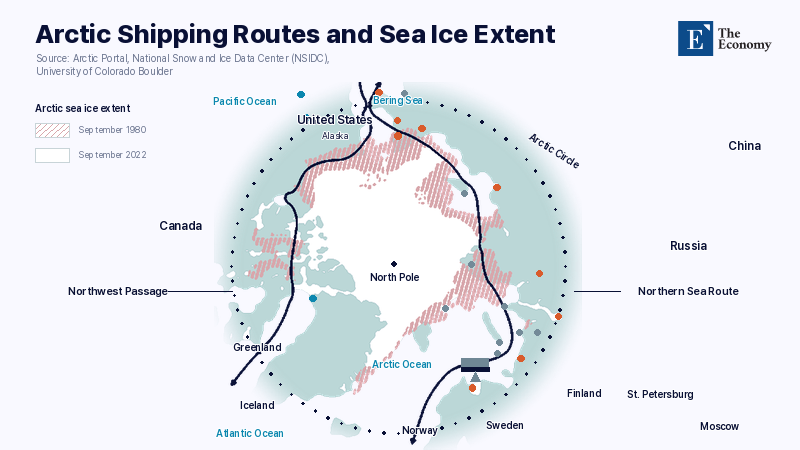
The Bering Sea is both a strategic gateway to the Arctic Ocean and the front line of continental North American defense. The practical shipping routes available after passing through the Bering Strait divide into the Northern Sea Route, which follows Russia’s Siberian coast toward Norway and Northern Europe, and the Northwest Passage, which crosses the Canadian Arctic Archipelago before opening into the North Atlantic. The Northern Sea Route is heavily dependent on Russian icebreaker and port support, as well as transit authorization, while the succession of narrow and shallow straits along the Northwest Passage imposes severe constraints on the reliable operation of large vessels.
A substantial gap nevertheless remains between diminishing Arctic sea ice and regular commercial navigation. In a navigational warning updated in April, the Arctic Council and the Arctic Regional Hydrographic Commission (ARHC) cautioned that large parts of Arctic waters have not been surveyed to modern standards and that multiyear ice and gaps in digital communications could undermine the reliability of electronic navigational charts. Ports capable of providing emergency repairs, refueling and rescue services are scarce, while seasonal fluctuations in sea ice make it difficult to establish firm sailing schedules, rendering increases in insurance premiums and vessel operating costs unavoidable. Shipping companies and national navies alike can formulate reliable operational plans only after accumulating long-term hydrographic, meteorological and ice-condition data and conducting trial voyages and polar exercises.
The readiness burden for military operations is even greater than for commercial shipping. Arctic military outposts can become operationally effective only when ports, runways, fuel-supply networks, long-range radar and satellite communications are established together, while experience operating joint forces in extreme cold and under communications disruptions is also indispensable. While Russia concentrates icebreakers, ports and military bases along the Northern Sea Route and China expands logistics and energy cooperation with Moscow, Canada, which administers the Northwest Passage, must contend simultaneously with sparse northern infrastructure and a vast surveillance domain. Because Canada’s ability to respond independently without U.S. bases and surveillance assets in Alaska remains limited, Operation TUNDRA MERLIN is also intended to build the two countries’ experience operating forces in polar environments and secure the data needed to establish a persistent surveillance and interception network.
China-Russia Arctic Cooperation Becomes Institutionalized
China and Russia have been laying the groundwork to strengthen their economic control over Arctic shipping routes since the late 2010s. In 2017, Chinese President Xi Jinping proposed that Russia join China in building a “Polar Silk Road” through cooperation on the Northern Sea Route, and Beijing formally incorporated the initiative into its first Arctic policy white paper the following year. A plan to establish a subcommittee on Arctic shipping-route cooperation was also included in the two countries’ 2024 joint leaders’ statement. After the protocol establishing the body was signed in August of that year, its inaugural meeting was held in November, activating an intergovernmental consultative channel to discuss navigational safety, higher cargo volumes and logistics-network construction.
Following the launch of the intergovernmental body, joint ventures proliferated in commercial shipping and field research. In June 2024, Russian state-owned enterprise Rosatom and Chinese companies agreed to establish a joint venture with the goal of constructing vessels and operating a year-round container route linking Chinese and Russian ports. The number of voyages by Chinese shipping companies along the Northern Sea Route that year was estimated to have nearly doubled from the previous year. Earlier this month, two researchers from Russia’s Arctic and Antarctic Research Institute boarded the Chinese icebreaking research vessel Xuelong 2 to conduct the two countries’ first joint field observation of sea ice. The recorded sea-ice concentration, type, size and thickness, along with snow depth and atmospheric conditions, will be used in the design of ice-going vessels and assessments of navigability along individual routes.
Russia holds the authority to turn Arctic shipping routes into a source of revenue. In 2018, the Russian government designated Rosatom as the Northern Sea Route’s infrastructure operator. Vessels transiting the route must obtain prior authorization from Russian authorities even if they do not call at Russian ports or receive icebreaker escorts. If freight volumes from South Korea and Japan bound for Europe via the Bering Strait increase, Russia could leverage its permitting authority to turn icebreaking, pilotage and navigational support into long-term revenue streams. Rosatom has also unveiled a plan to recover the government’s infrastructure expenditure by imposing separate cargo-transport charges if annual freight volumes on the Northern Sea Route reach 109 million tons by 2030.
Chinese and Russian Bombers and Vessels Converge on Bering Sea, Pressuring North America’s Northern Defense Line
While Chinese-Russian economic cooperation has advanced around sea-ice observation and shipping-route operations, military coordination has expanded its operational reach along northern approaches to North America. Joint Chinese-Russian strategic bomber patrols began in 2019, with two Chinese H-6 bombers and two Russian Tu-95 bombers entering the Alaska ADIZ together for the first time in July 2024. NORAD said at the time that the aircraft remained in international airspace and were not regarded as a direct threat, but the operation was followed in September of that year by a formation transit through the Bering Sea involving two Chinese coast guard vessels and two Russian border guard vessels. Although the two countries said the operation did not target any third country, the extension of joint flights and maritime patrols from the East Sea and East China Sea into the Chukchi Sea and Bering Sea suggests that the Arctic strategy pursued over the past nine years is becoming intertwined with military operations.
This Arctic geography, where commercial shipping corridors overlap with military avenues of approach, imposes a distinct defense burden on the United States and Canada. In its 2024 Arctic Strategy, the U.S. Department of Defense assessed that Russia had secured a “clear avenue of approach” through the Arctic toward the U.S. homeland, identifying the Northern Fleet on the Kola Peninsula and submarine-launched ballistic missile forces as major risk factors. Strategically, unlike trans-Pacific approaches, the Arctic axis places Alaska and northern Canada on the first line of defense, compressing the time available to detect bombers, submarines and long-range missiles and decide whether to intercept them. The Canadian government has likewise stated that it must prevent the Arctic from being used as an avenue of attack against North America and is jointly advancing over-the-horizon radar, satellite-surveillance networks, F-35s, long-range air-to-air missiles and a cloud-based command-and-control system through its NORAD modernization program.
U.S. and Canada Close Ranks Under Chinese-Russian Arctic Pressure
Escalating tariff disputes with the United States had prompted speculation that Canada could shift the center of gravity of its foreign and security policy toward Europe, but Ottawa has little choice but to maintain military coordination with Washington as Chinese and Russian moves to dominate Arctic shipping routes place direct pressure on North American security. The Canadian government has entered into a Security and Defence Partnership with the European Union (EU) and joined the $170 billion Security Action for Europe (SAFE) program, but the cooperation centers primarily on defense supply chains, joint production and export-market expansion. In an address to the European Parliament on the 17th, Canadian Prime Minister Mark Carney also distinguished closer ties with the EU from the concept of a “third bloc” competing with the great powers. His remarks were widely interpreted as drawing a line against the prospect that closer alignment with Europe would lead to a severing of Canada’s security relationship with the United States.
Canada is moving most rapidly to strengthen its ties with Europe in trade and industrial policy. According to the U.S. Congressional Research Service (CRS), the U.S. share of Canadian merchandise exports fell from 77% in the first half of 2024 to 68% in the first half of this year. Canada responded to U.S. tariff pressure with retaliatory duties of up to 50% on $19.9 billion worth of imports and immediately welcomed the EU’s first-ever proposal to grant “associate member state” status. Efforts are also underway to reduce dependence on U.S.-made equipment in the defense sector, but diversifying procurement sources and restructuring North America’s defense command network are fundamentally different undertakings.
NORAD operates as a permanent binational command in which U.S. and Canadian officers jointly conduct aerospace warning, aerospace control and maritime warning missions through the same command network. The U.S. Department of Defense suspended its participation in the Permanent Joint Board on Defense (PJBD), established in 1940, in May, citing Canada’s inadequate implementation of its defense commitments, but the PJBD’s role has centered on high-level policy advice. The two countries subsequently finalized a strategic framework in July establishing joint priorities for Arctic military capabilities before launching Operation TUNDRA MERLIN this month. The fallout from bilateral tensions has therefore remained concentrated in policy-consultation channels, while the surveillance and interception network in the Arctic theater has continued to operate.
The Arctic’s geographic conditions are also cited as a factor deepening the two countries’ mutual dependence. Canada requires U.S. forces deploying from Alaska as well as U.S. space- and air-surveillance intelligence, while the United States must also use northern Canadian airspace, bases and local surveillance data to detect Russian threats far from the U.S. mainland. European-made weapons can broaden Canada’s defense-supply options, but they cannot replace the real-time joint engagement procedures required in the Bering Sea and Arctic Ocean. Data integration with U.S. systems and joint engagement procedures are expected to feature prominently among the evaluation criteria in the performance requirements for the early-warning, maritime-surveillance and interception assets Canada procures in the future.
Siobhán Delaney is a Dublin-based writer for The Economy, focusing on culture, education, and international affairs. With a background in media and communication from University College Dublin, she contributes to cross-regional coverage and translation-based commentary. Her work emphasizes clarity and balance, especially in contexts shaped by cultural difference and policy translation.
Similar Post