AI Labor Displacement and the Next Great Economic Divide

Working across research, policy, and data-driven analysis, the Editorial Board ensures that published pieces reflect a consistent institutional perspective grounded in quantitative reasoning and long-term structural assessment.
Authored On
Modified
AI could weaken low-wage countries' traditional economic advantage
Research capacity and institutions will shape who benefits
Fiscal resilience depends on where AI-generated income remains

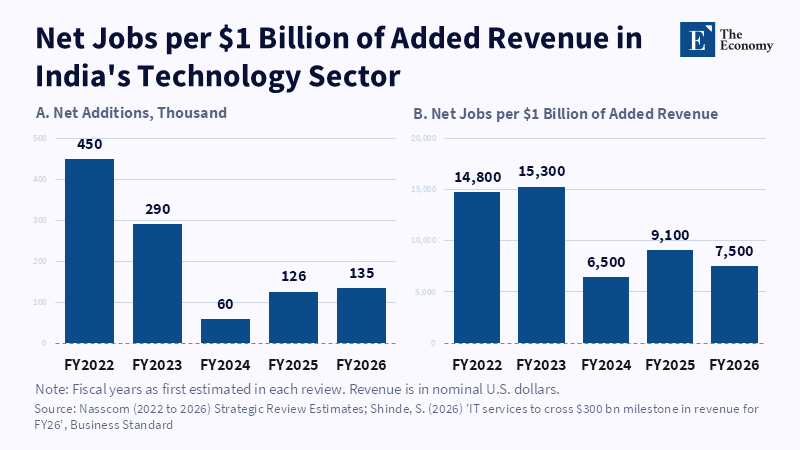
India's tech industry was able to generate approximately 14,800 net jobs for every additional billion dollars of revenue in FY 2022. In FY 2026, that number dropped to around 7,500, according to Nasscom. These technologies came to Bangalore, Stuttgart, Seoul, and Hanoi all at roughly the same price point from 2023-2026. However, data suggests otherwise. Countries that built a wage differential over 40 years can see that eliminated in 10. They can't build a research base in 10 years that took them 40 years to create. That differential may determine whether countries gain or lose jobs and become wealthier or poorer after AI labor displacement.
Revenue No Longer Leads To More Jobs
For the past 30 years, the software and services industry has been able to grow by employing more people. Companies would employ large numbers of junior workers to support a few seniors on each account and grow by hiring more people. India's IT services industry was built on this formula. It hasn't collapsed, and the number of employees still grew by 2.3% to reach 5.95 million. But the top 5 companies lost a net of 7,389 employees in FY 2026. They hired 12,718 in the year prior. The Indian Council for Research on International Economic Relations surveyed 651 companies and found that 65% have reduced hiring since implementing AI. 55% have reduced hiring for entry-level positions and 82% have seen no change at senior levels.
If a firm can do 5x the work with the same number of people, there isn't going to be 5x the demand. A bank isn't going to have 5x the IT budget because software is cheaper. If demand elasticity is 0.5, then employment would decrease to 45% of its initial value. This is happening in the UK, with KPMG reducing its graduate hiring by about 33%. In the US, the Stanford Digital Economy Lab found that employment of 22- to 25-year-olds in AI-exposed jobs was 19% below the trend in less-exposed jobs by mid-2026.
Danish data goes against these findings by showing that there is no average effect on wages or hours of more than 2% through 2024 but when companies stop hiring, it doesn't show up in the wages of those employed; it shows up for those who weren't hired. The BLS found that 66.1% of Americans who lost their long-term jobs between 2023 and 2025 found work again by Jan 2026. Only 49% of those who switched full-time jobs were making the same amount of money they used to. This number was around 62% 2 years ago. In the accelerated scenario, the percentage of unemployed Americans after AI labor displacement increases from 34% to 48%.
Robots Will Help Countries With Higher Wages
Manufacturing will be less affected because it's harder to replace people with hands than with words. Robots will become cheaper when total costs per hour are considered. There are costs associated with robots that are not immediately apparent, such as capital costs, implementation, maintenance, people to oversee them and downtime. If these engineering estimates are correct, robots will be cheaper than labor at $78/hr in 2026. That number will drop to $11/hr in 2029 and $3.80/hr in 2036. An hour of work costs 45.0 EUR in Germany and 47.9 EUR in the Netherlands in 2025. Workers in Vietnam earned a base salary of $273/month in 2023. This means the Netherlands, Germany, Sweden and the US will see robots cheaper than labor in 2029. China will see this in 2034 and Vietnam and India not until after 2040.
Table 1. Labor Costs and First Year of Sustainable Robotic Production by Economy
| Economy | Labor Cost, $ per hour | First sustainable year, baseline scenario | Savings Per Hour with 80% Automation in 2036, $ |
|---|---|---|---|
| Netherlands | 54.13 | 2029 | 38.65 |
| Germany | 50.85 | 2029 | 36.14 |
| Sweden | 48.70 | 2029 | 34.49 |
| USA | 48.62 | 2029 | 34.42 |
| Czech Republic | 22.37 | 2029 | 14.27 |
| Poland | 21.58 | 2029 | 13.66 |
| Japan | 20.16 | 2029 | 12.57 |
| Mexico | 5.79 | 2033 | 1.53 |
| China | 4.81 | 2034 | 0.78 |
| India | 2.81 | After 2040 | 0.00 |
| Vietnam | 2.28 | After 2040 | 0.00 |
Note: Labor costs are observable, with different reference years per country. The first sustainable year and savings are scenario estimates.
China added 354,000 robots to its manufacturing lines in 2025. That's 59% of all robots added globally. EU robot installations fell 11%. However, these numbers don't show how much money is being saved by replacing humans. If Chinese wages are factored in, it will save them less than it will save European countries. There have been some trials done with 2 Figure 02 humanoid robots at BMW in Spartanburg. They have been working for 11 months and have logged over 1250 hours. No information has been released about failure rates or how much it costs. Germany lost 42,300 jobs in the auto industry last year due to the switch to EVs, Chinese cars and high energy prices. Robots are not the cause of Germany losing jobs right now but if they lose their engineering capability before robots become efficient, they will have no path back.
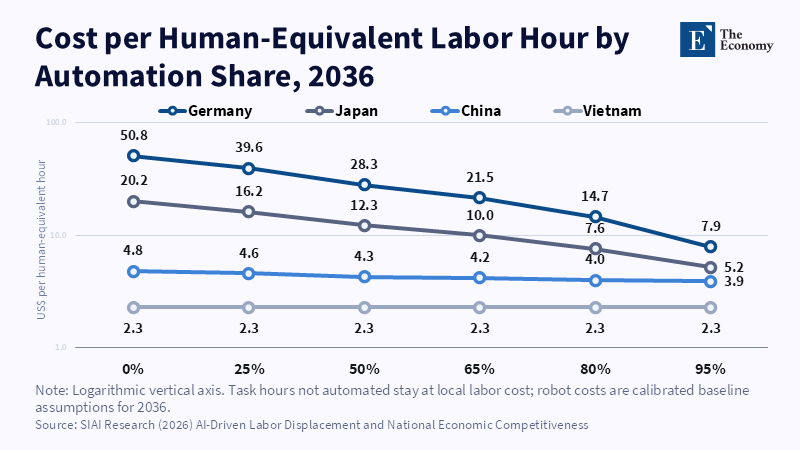
In 2036, if 80% of tasks are automated, the cost of human-equivalent work will decrease from $51/hr to $15/hr in Germany. Vietnam's cost would remain near $2.30/hr. The difference between the two countries will go from 22:1 to 6.5:1. Low wages will still have an advantage but it will be about two-thirds smaller.
Countries that are close to where companies want to build factories will become more attractive because of lower costs to transport engineers and access to energy and parts. Once factories move closer to home, countries will see an increase in GDP and capital gains but not as many jobs. Countries that are developing are already seeing effects from automation. A study by Solidaridad Bangladesh, Bangladesh Labour Foundation and BRAC University found that employment in the garment industry decreased by 30.58% after new technology was introduced. Vietnam has increased its manufacturing share of GDP from 18.8% to 24.3% from 2005 to 2024. India has decreased from 16.0% to 13.1%. If countries haven't started growing their manufacturing sectors, they may never have the chance.
It Takes Decades To Build Talent And Institutions Determine How It Is Used
Once robots take over labor-intensive jobs and AI takes over brain-intensive jobs, there will be a shortage of people who can work on improving these systems. It takes time to build that skill set. South Korea increased its R&D spending from 2.05% to 4.94% of GDP from 2000 to 2023 but its GDP per worker has stayed at 63% of the US since 2010. Japan has decreased from 71% to 56% of the U.S. The US scored 465 on PISA math, which is below the OECD average of 472 but they still have some of the best researchers and companies in the world because a large portion of its workers are from other countries. Vietnam scored 469 on the PISA exam and has a lower number of students going to college. There is only so much a university can fix if students weren't taught properly in elementary and middle school.
It takes an estimated 20 years to build a workforce that is capable of doing research. And another 20 years for them to create a system that can use that research. So looking at who is in high school and college right now helps show who will be doing advanced research in 2036. AI will allow more people to learn more information but if they don't know the basics, they won't know when something is wrong. So AI could further increase the differential between countries with research capabilities and those that don't. Where that talent is used depends on a country's institutions. Katalin Karikó left Hungary in 1985 with $1,200 hidden in her daughter's bear. She was demoted 4 times while working at the University of Pennsylvania and won a Nobel Prize in 2023. A country that can produce a physicist who can create a fusion power plant needs to have investors who understand how valuable that is and labs to test their work. This is what having a good innovation ecosystem means.
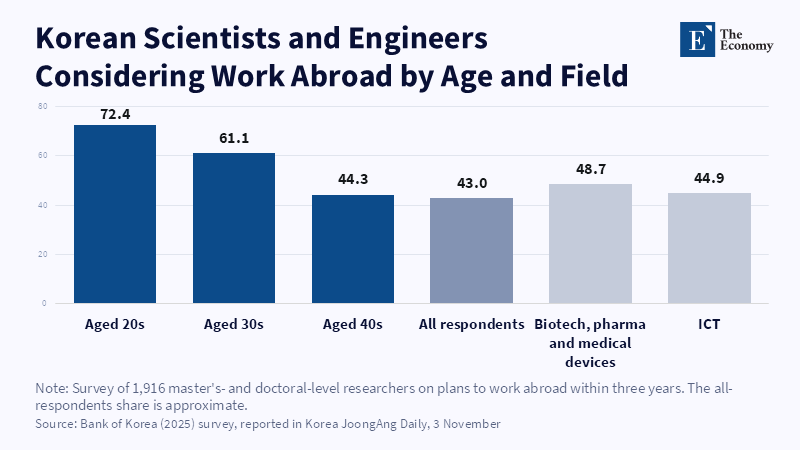
People will follow those institutions. A survey by the Bank of Korea found that 62% of Koreans who work in science and engineering in their 20s and 30s will consider working abroad within the next 3 years. Koreans who work abroad make an average of $366,000 at their peak, versus $127,000 in Korea.
With the ability to work remotely, an engineer in Seoul can work for a company in California. So countries can lose out on the work their employees can do but keep the employee. But research and work still have to happen in physical locations. The Netherlands created a package worth €2.51 billion to help the region of Eindhoven in March 2024. There are things governments can do to improve their institutions faster than schools. In the reform scenario, the share of displaced workers without employment falls from 48% to around 24%. Debt in Germany would be 10.4 percentage points of GDP lower in 2036 under reform than without it. There is only a small sample of evidence to back this up, but it's something to consider.
How Will Governments Pay For It All?
There will be a cost at the end of each of these. Governments will have to find a way to help those workers who are displaced by AI but their main source of income will suffer from this as well if a company has 10 developers that make $100k each and replaces them with 2 developers that make $300k. Its payroll will decrease by 40%. Income taxes, using the example progressive tax schedule, will only decrease by 15%. Total income could be higher in advanced countries than if AI didn't exist but if one of those developers left the country, tax receipts would decrease by 57.5%. Having workers leave will be the downfall of progressive countries. HM Revenue and Customs reported £13.6 billion ($18.16 billion) in tax liabilities from non-domiciled and deemed-domiciled taxpayers for the 2024-2025 tax year. This was a 9% increase, and these numbers ended before the changes that happened in April 2025. So there is still more data to come on whether wealthy people are leaving Britain.
Countries with higher welfare states will suffer more from this. Income taxes and social security accounted for 64.8% of taxes collected in Germany and 63.5% in the US in 2023. Mexico only collected 34.6% from these sources. Countries with low wages will have an even harder time. They will have less tax revenue and will have to pay for models and machines that they don't own. Relative to the no-AI path, debt-to-GDP rises by 14.1 percentage points in Mexico and 11.2 in Vietnam in the accelerated scenario. Germany sees an increase of 4.0 percentage points. Robert E. Litan wrote a proposal for the US government to help those who are displaced by AI in October 2026. His plan would cost about $60 billion a year or about 0.2% of U.S. GDP. This plan has some backing from a smaller program that the US has done in the past but it only pays out to those who find work. If only the cost of income for those who don't find work were considered, it would cost 0.77% of US GDP by 2036 in the accelerated scenario.
Every billion dollars of revenue will create half as many jobs as it used to. Governments will have to decide if they want to help their workers find new jobs after AI labor displacement. But they will have to figure out if their country can afford to help. There are many factors that will come into play. How fast jobs disappear, whether robots bring manufacturing back to their country, whether they can educate people to work in these new industries and whether they will stay in their country. It remains to be seen how many people can find similar jobs after being displaced and how much income will stay in their country from AI. There are steps that can be taken to improve a country's institutions that can start taking effect within the next decade. The question is which countries take action.
This article is based on an original research article published by The Economy Research. For the original version, please refer to The Next Great Economic Divide, Driven by AI: Manufacturing, Employment and National Wealth.
The views expressed in this article are those of the author(s) and do not necessarily reflect the official position of The Economy or its affiliates.
References
Bangladesh Labour Foundation, Solidaridad Network Asia and BRAC University (2024) Assessment of Technological Transition in the Apparel Sector of Bangladesh and Its Impact on Workers.
Bank of Korea (2025) Understanding the Drivers of STEM Talent Outflows and Their Policy Implications. BOK Issue Note 2025-31.
Brookings Institution (2026) Litan, R.E., A Detailed, Affordable Plan for Transition Insurance in the AI Era.
HM Revenue and Customs (2026) Statistics on Non-domiciled Taxpayers in the UK.
Indian Council for Research on International Economic Relations (2026) AI and Jobs: This Time Is No Different.
International Federation of Robotics (2026) Five Million Robots Now Operate in Factories Globally.
Lee, K. (2026) [AI and Workforce] AI Adoption and the Changing Value of Human Work. SIAI Research.
Lee, K. (2026) [AI and Workforce] Talent and National Capability: Formation, Mobility, and Retention. SIAI Research.
Lee, K. (2026) [AI and Workforce] Workforce Policy for AI Transition, Skills and Economic Security. SIAI Research.
The Economy Editorial Board (2026) ‘Artificial Intelligence and Public Debt: Why Growth Is Not Enough’, The Economy AI Review.
The Economy Editorial Board (2026) ‘How AI Can Change the Economics of Reshoring Manufacturing to Europe’, The Economy AI Review.
US Bureau of Labor Statistics (2026) Worker Displacement: 2023–2025. Washington, DC: US Department of Labor.
Working across research, policy, and data-driven analysis, the Editorial Board ensures that published pieces reflect a consistent institutional perspective grounded in quantitative reasoning and long-term structural assessment.