The Next Great Economic Divide, Driven by AI: Manufacturing, Employment and National Wealth
Published
Keith Lee*
*The Economy Research, 71 Lower Baggot Street, Dublin 2, Co. Dublin, D02 P593, Ireland

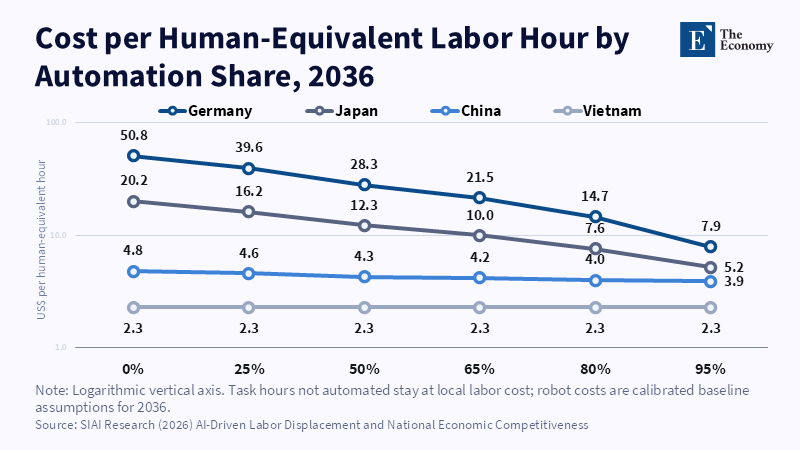
The debate about AI and jobs tends to focus on how many jobs will disappear, while where the profits will land and where the losses will go is the question that will matter the most. In India's IT services sector, net positions per additional billion dollars in revenue dropped from around 14,800 in 2022 to around 7,500 in 2026 and in the U.S., youth in occupations exposed to AI are being hired less than their counterparts in occupations that are less exposed. Growth ceases to create jobs by default since the markets they are absorbed in will not grow by the same factor as productivity. In manufacturing, cost estimates show that physical AI will become favorable to labor costs in Western Europe and the U.S. first. With automation at 80%, Vietnam has a labor cost advantage of 22 to 1 over Germany that drops to about 6.5 to 1. Building advanced human capital takes decades and cannot be bought with tools; institutions can evolve faster and will decide where the human capital works. The tax base is not solely based on how many people are employed but on where the income and the income holder are located. Concepts like salary insurance that were proposed by Brookings in October 2026 rely on getting employed and having enough revenue, both of which this technology can undermine.
Introduction - Where the Gains and Losses of AI Will Land
There are many debates surrounding AI and jobs. How many jobs will be lost is the main takeaway most people draw from these discussions but where will the profits go and who will take the losses, is what will define the outcome. From 2023 to 2026, the same tools became available in Bangalore, Stuttgart, Seoul and Hanoi. They became available at similar price points and yet these locations could be economically further apart in 10 years than they were in the past generation. Workers displaced by AI will not affect countries equally. A wage advantage that took 40 years to build can be taken away in 10 years, while a research base that took 40 years to build cannot be bought in 10. This is what this article is based on.
This article will follow along the lines of the research paper published by SIAI Research. It will use some of their estimates.[1] It begins in the white-collar labor market, then moves to how physical labor can be moved and the value of advanced human capital and the competition for it. Finally, it comes to who will foot the bill. Each topic is explored with real-life cases visible today. Some will contradict the simplified narrative.
Part I: AI Will Start Taking White-Collar Jobs
For the last 30 years, the software industry and many professional services have operated under the assumption that as revenue grows, staff will grow. Firms hired more people to sell more hours, whether that be consulting, auditing or software development offshore. They staffed their projects with a base of young people and a few senior leaders on top, then grew by adding the next set of young people. There is no industry that has grown by this formula more than India's IT services, where the gap between an engineer in Bangalore and New Jersey created a national industry, which is why India is the first example here.
NASSCOM reports show this relationship is starting to weaken. In fiscal 2022, India's tech industry grew 15.5% to roughly $227 billion USD and created approximately 450,000 jobs.[2] In fiscal 2026, the industry was projected to grow by 6.1% to $315 billion and create 135,000 jobs net.[3] Dividing these gives a rough estimate of jobs per additional billion in revenue: about 14,800 jobs per billion in 2022 and about 7,500 jobs per billion in 2026. These numbers are not exact and are being done in nominal dollars and 2022 saw a boom after the pandemic, so the ratio isn't very significant and in 2023 it went the other way, but the trend over the last 3 years is hard to ignore.
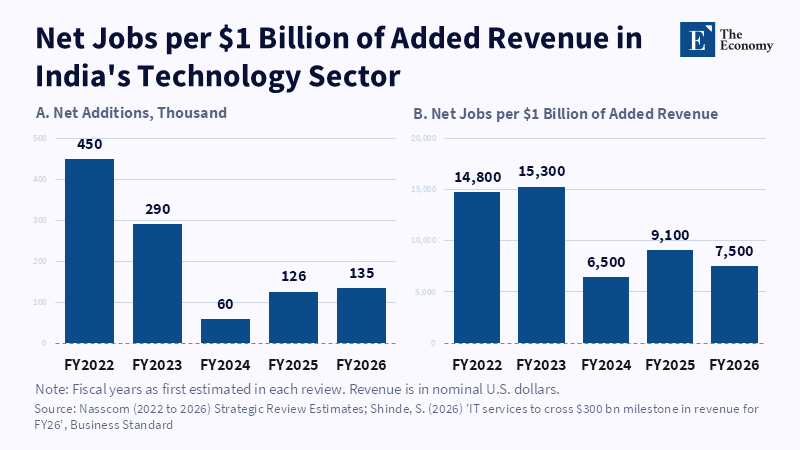
India's software industry has not collapsed and there are 4 things to note. Jobs are still being created in this industry, just at a lower rate, growing by about 2.3% last year to 5.95 million. Hiring has decreased drastically and turned negative in the biggest companies. In fiscal 2026 the top 5 IT services companies saw a net loss of 7,389 jobs, while they gained 12,718 in the previous year.[4] There are productivity gains being reported by the companies themselves. In a study by the Indian Council for Research on International Economic Relations of 651 companies and OpenAI, 65% of companies reported they hired fewer people after implementing AI and 55% reduced the number of entry-level positions, with 82% reporting no changes at the top and only 27% expected their headcount to decrease.[5] The last is the drop in jobs per revenue, which can go unnoticed for years while the industry grows.
Tata Consultancy Services is an example of these factors being difficult to tell apart. Their headcount dropped from 607,979 to 584,519 in fiscal 2026, while their revenue in USD dropped 0.5% and 2.4% in constant currency.[6] Demand played a role here, at the very least. Their CEO said that they would be cutting around 12,000 jobs due to skills not aligning, not due to productivity gains from AI. It is reported that most of these were mid- to senior-level executives.[7] Causality cannot be determined from one company, but this shows what it looks like when people who know how to do one thing can no longer be moved to do another.
Why aren't more jobs created as revenue grows? There is only so much market for what these companies sell. If a company can make 5x as much with the same number of employees, they will not sell 5x as much. No bank or insurance company is going to increase its IT budget by 5x because software has become cheaper. There is a limited market for these products at any given price point. In the simplified framework of the accompanying paper, if productivity increases 5 times and demand elasticity is 0.5, employment ends up at 45% of its original level. Most businesses that buy from IT services will be more like this scenario than someone buying a product that became cheaper. Once there is competition, it becomes clear who keeps their employees. The company that is most efficient can keep all its employees and others will see a decrease in revenue and therefore jobs. Overall, there will be fewer jobs in that industry.
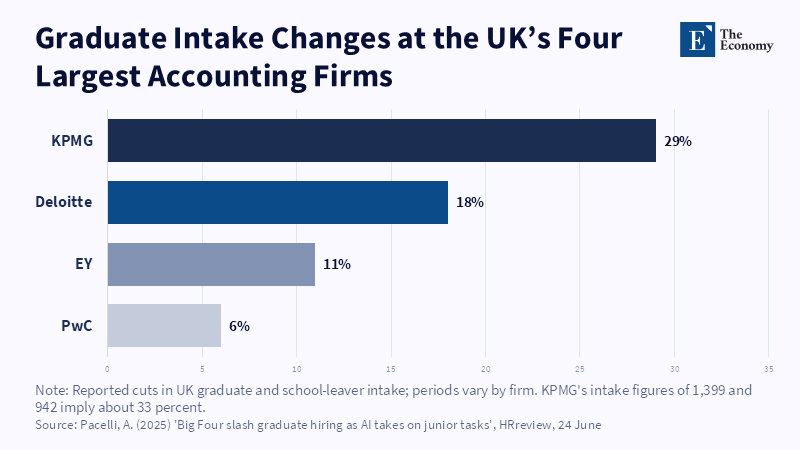
This can be seen outside of India as well. The top 4 audit firms in the UK have decreased their graduate hiring. KPMG decreased by 29% and Deloitte, EY and PwC decreased by 18%, 11% and 6%, respectively, while also facing a recession in their consulting business and opening overseas locations.[8] In the US, the Stanford Digital Economy Lab found that those who were 22-25 in 2026 had lower employment in jobs exposed to AI than those who weren't by 19%. They found this was because companies were not hiring as many of them and there was no gap in experienced workers.[9] In Denmark, administrative data show the opposite, with confidence intervals that rule out effects above 2% in earnings and hours worked through 2024.[10] These don't conflict as much as it may seem. If companies are hiring less, the ones who were not hired will feel it first.
The effects on people are judged by what happens to them once they lose their job. According to the Bureau of Labor Statistics, 66.1% of Americans who lost long-held jobs from 2023 to 2025 found employment by January 2026. Of those who found another full-time job, about 49% were making the same or more. That number was around 62% two years ago.[11] This is before any major loss of jobs due to AI. Studies have shown that once people lose their jobs, the ones who are downskilled to a lower-paying job see the biggest impact on their income.[12] A 50-year-old project manager who is laid off from his outsourcing company will be competing for a shrinking job pool, with companies not hiring as many as before. As that pipeline shrinks, there will be fewer jobs for people like him. Many will find themselves on a gig economy platform or working in service below their education if they find a job at all. In the accelerated scenario from the accompanying paper, the number of Americans who are unemployed after being displaced increases from 34% to 48%, while another group of people will be downskilled. This is just a scenario and should not be taken as fact, but the idea that someone who lost a job this year will have a similar one next year looks unlikely.
Part II: AI Will Be Favorable to Higher Labor Costs First
Everything discussed so far is computer work. Manufacturing will take longer to replace because it is harder to automate human hands than human words. So this is the focus here. Manufacturing with robots will be judged by how much it costs per unit of useful work, not on how cool a demo looks. Capital costs, time to get online, maintenance, human supervision, downtime and reliability will all play a factor. Even if a robot can cut things for free, it still costs something. Based on the assumptions published in the accompanying paper, human labor becomes more expensive than using a robot at around $78 per hour in 2026, dropping to $11 in 2029 and $3.80 by 2036. This is based on projections of reliability that are not yet proven.
Which countries will cross this line first is interesting because technology is usually assumed to flow from the wealthy countries to the poorer ones. The cost of an hour of labor in Germany was 45.0 Euros and 47.9 Euros in the Netherlands in 2025.[13] JETRO found that in 2023 Japanese subsidiaries in Asia paid an average monthly wage of $576 in China and $273 in Vietnam.[14] So if a factory in Germany can replace one of its employees, they are saving significantly more than a factory in Vietnam, which means Western Europe has the most to gain from using robots to do work. Estimates show that the Netherlands, Germany, Sweden and the U.S.. will become cost-effective to use robots in 2029, along with the Czech Republic, Poland and Japan at around $20-$22 an hour. Mexico will follow in 2033 and China in 2034. Malaysia, Thailand, Indonesia, India and Vietnam will not be cost-effective until after 2040. China installed 354,000 industrial robots in 2025, which is 59% of the world total, while the EU installed 11% fewer robots in 2025 than the previous year.[15] There are many factors that go into these numbers, but they don't show how much labor is being saved per robot installed and with China's lower wages, each robot saves much less. Companies in Europe are waiting for systems that are ready to go on a production line.
Table 1. Labor Costs and First Year of Sustainable Robotic Production by Economy
| Economy | Labor Cost, $ per hour | First sustainable year, baseline scenario | Savings Per Hour with 80% Automation in 2036, $ |
|---|---|---|---|
| Netherlands | 54.13 | 2029 | 38.65 |
| Germany | 50.85 | 2029 | 36.14 |
| Sweden | 48.70 | 2029 | 34.49 |
| USA | 48.62 | 2029 | 34.42 |
| Czech Republic | 22.37 | 2029 | 14.27 |
| Poland | 21.58 | 2029 | 13.66 |
| Japan | 20.16 | 2029 | 12.57 |
| Mexico | 5.79 | 2033 | 1.53 |
| China | 4.81 | 2034 | 0.78 |
| India | 2.81 | After 2040 | 0.00 |
| Vietnam | 2.28 | After 2040 | 0.00 |
Note: Labor costs are observable, with different reference years per country. The first sustainable year and savings are scenario estimates.
Germany's car industry is a great example of this not being a factor yet. They have lost 42,300 jobs or 5.8%, in one year to have 691,500 employees in the first half of 2026, the lowest they have been since 2005. All of Germany lost 144,100 jobs in manufacturing.[16] This was not caused by robots. There are many factors at play, like the change to EVs and Chinese competition. Germany is losing jobs to these factors before it can be competitive again with automation, which will be dangerous if automation can't take over where its workforce left off.
There is still a long way from demo to production line. BMW placed 2 Figure 02 robots in their Spartanburg factory for 11 months, where they logged over 1,250 hours and placed over 90,000 metal components. There was no public data on how well these robots performed or how they failed.[17] BMW then placed Hexagon AEON robots in Leipzig in December of 2025 for their first test run, with more being implemented in April of 2026 and a pilot phase to begin in the summer.[18] Hyundai has announced that they will begin placing their Atlas robots to place parts in their Georgia factory in 2028 and begin to put parts together in 2030, with each process being validated individually.[19] All of these are small tests that are being run. The robots available today are not good enough for a production line. They will take time to mass-produce them and nobody knows how they will perform in a real-world scenario, which is why 2028-2029 is used here as the estimated time for robots to begin taking over in the industrial space. The simulation does not rely on this year and the 2036 results change little with varying arrival times.
Where will companies decide to build their factories if these cost curves hold? In a factory in 2036 that has 80% of its hours automated, Germany drops from around $51 per equivalent man-hour to around $15. Vietnam will remain at about $2.30 because a robot is not cheaper than their workers at this point. Vietnam will go from having a 22-to-1 cost advantage over Germany to about 6.5 to 1. With 95% automation, this number drops to 3.5 to 1. Their advantage will not be gone but will be greatly diminished. Once the gap is small enough, other factors will play a larger role in where a company decides to locate: engineers that are nearby, reliable electricity, vendors, customers, tariffs and transportation, most of which favor older industrial areas. When manufacturing comes back, more products and capital come back, not jobs. Germany should not expect to have the same number of employees it once did when its car factories come back.
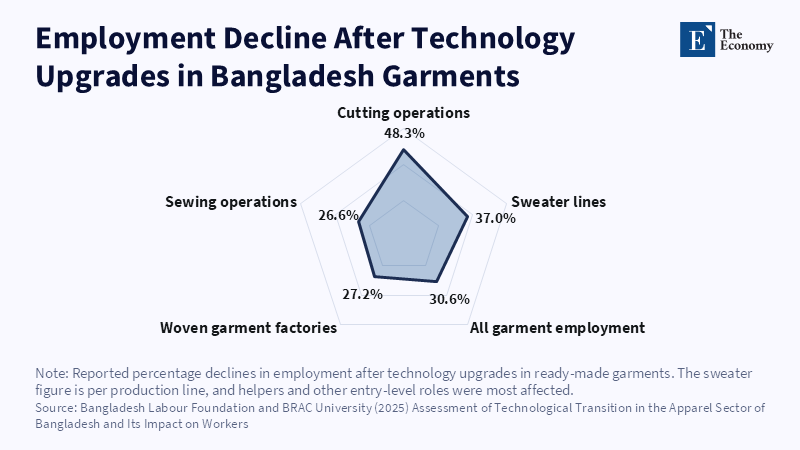
Countries that are developing will suffer from this change as well. There is no need to wait for humanoids to see the effects of automation on jobs. A study by Solidaridad Bangladesh, Bangladesh Labor Foundation and BRAC University showed that workers in Dhaka, Gazipur and Narayanganj saw a decrease of 30.58% after implementing new technology in their garment factories. Cutting lost 48.34% of jobs and sewing lost 26.57% of jobs, with helpers and other entry-level positions hit hardest.[20] This study is not large enough to make any real conclusions, but the effects on jobs are clear. Another study looked at Mexico and found that when the U.S. implemented robots,itsr local labor markets saw a decrease in employment, specifically among those who operated machines at a low skill level. Exports also decreased during this time.[21] On a global scale, the results are mixed. One study found that as wealthy countries automated their production, they saw an increase in trade with poor countries, both importing and exporting to them but saw their exports to the wealthy countries decrease. Overall, the study found that the South tends to prosper in its model.[22]
The fear is not that all poor countries will lose jobs to automation, but that the ladder out of poverty will get shorter. Manufacturing allowed people to leave farming and work in the city and progress to higher-paying jobs. Vietnam has seen its manufacturing increase from 18.8% of its GDP to 24.3% from 2005-2024. India has gone from 16.0% to 13.1% over the same time frame.[23] A country that is at the level Vietnam is can still benefit from this technology. If they haven't begun this journey, they may find automation taking those jobs before they get there, just as young developers in India are seeing with AI and software.
Part III: Human Capital That Takes Decades to Build
As robots take over jobs that require manual dexterity and AI takes over jobs that require basic cognitive ability, there will be a shortage of humans who can operate these robots and build new AI models. This is where a country's schooling and research will determine how much wealth it can keep in its country. Advanced human capital is defined here as someone who can do science, math or engineering at an advanced level and produce new ideas.
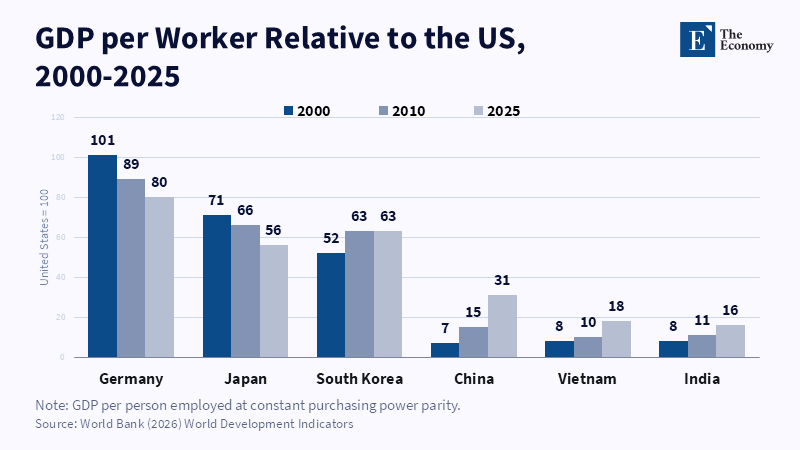
There are many ways to measure a country's research capabilities and human capital. National numbers show that Korea has increased its research and development from 2.05% of its GDP to 4.94% from 2000 to 2023. China has grown from 0.88% to 2.58% over the same time frame and Germany from 2.39% to 3.15%. The U.S. currently stands at 3.45%. Productivity has changed as well over this time. Germany has seen its GDP per employee drop from 101% of the U.S. on a PPP basis to 80% in 2025. Japan has dropped from 71% to 56% over the same time frame. Korea has increased from 52% to 63% and China has increased from 7% to 31%.[24]
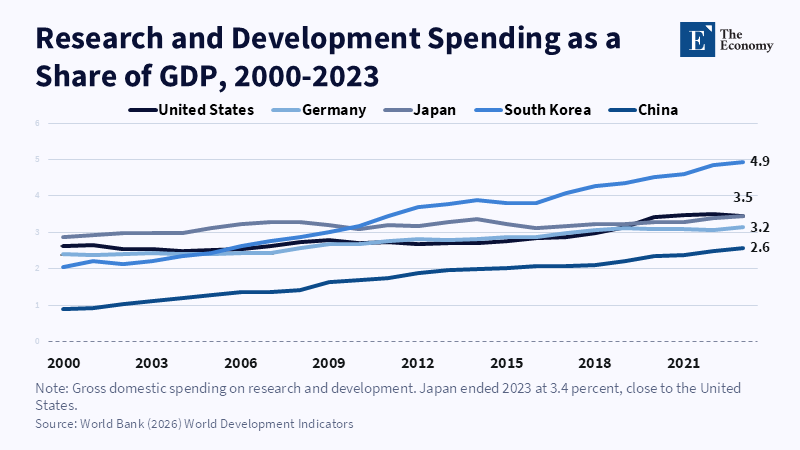
Japan and Korea are both very advanced in manufacturing technology but see lower productivity in other areas of their economy. So they have a high amount of research but can't translate it into economic gains. Korea has the highest research intensity in the sample and its GDP per worker has not moved since 2010. The U.S. has a PISA score of 465 in math, which is below the OECD average of 472, but has the best research institutions and tech companies in the world.[25] Part of this is because of the people they are able to train from other countries, which Part IV covers.
There is a common theme across all these countries. They have built on top of what came before them. Having a great research institution is only half of what makes it great. It needs others around it who have done the work before: manufacturers of equipment and companies that can employ someone with a PhD and investors that know how to value them, all of which Western Europe, the U.S. and Japan have been able to accomplish over generations, although Western Europe has not had the pipeline to get to scale from research as quickly. China has been trying to build this in a shorter period. A group of researchers from Stanford and the Hoover Institution looked at the 223 authors that worked on DeepSeek's core papers. They found that almost all were trained in China and over half never left the country to study or work. Most of those who worked in the U.S. came back.[26] They were able to do this after years of training people in engineering and having a massive industry at home to support them.
There is a misconception that training more people produces more researchers. Korea has a higher education enrollment rate of over 100% according to the World Bank. Vietnam is much lower but its 15-year-olds scored 469 on PISA in math, which is 4 points higher than the U.S. Enrollment shows how many people are in the classroom. Universities can't teach students what they should have learned in elementary and high school, which is why there are such large gaps in people's basic education. Anyone who has taught students who came to college without knowing math knows this takes more than a year or two to catch them up, no matter how fast the teaching. A rough assumption is that it takes about 20 years to develop a researcher who can work in these fields and 40 to have them in a productive work environment. These numbers are approximate, but the people who will be doing research in 2036 are already in high school or older.
Could AI speed this process? Having access to these tools will help people learn. There is a benefit to this in technical jobs that require a base of knowledge but without the basics, there is little way of knowing when a model is wrong, which is what advanced training teaches. These models will continue to get better, but it will take children the same amount of time to learn math. If AI can help those who already know these skills, it will only increase the gap between countries that can research.
Part IV: Where Will the Best Talent Work?
Katalin Karikó left Hungary in 1985 when her job was taken from her. She and her family left the country with $1,200 hidden in her daughter's teddy bear.[27] After moving to the US, she struggled to find funding for her research and was demoted four times.[28] She eventually moved to BioNTech and shared the Nobel Prize in Physiology or Medicine in 2023 for her work on mRNA. This story is often told about one woman and her perseverance, but it can also be told about institutions. She had two institutions that did not want to fund her or help her reach her potential and it was a company in another country that helped her achieve her goals.
There are many people who have stories like this and did not make it to the top. A physicist who can build a new energy technology, such as a fusion power plant, needs investors who can understand the work, labs that can help test it and people who can tell if the physicist is good. If those things aren't around, years of a career are lost. Companies will invest in whoever they think is best and not the person who is. At some point that person will move to a country that can evaluate what they are doing. A country can't recognize its best if it doesn't have many. These people are only useful when they can be used in an economy, which is determined by the institutions around them, or innovation ecosystem readiness.
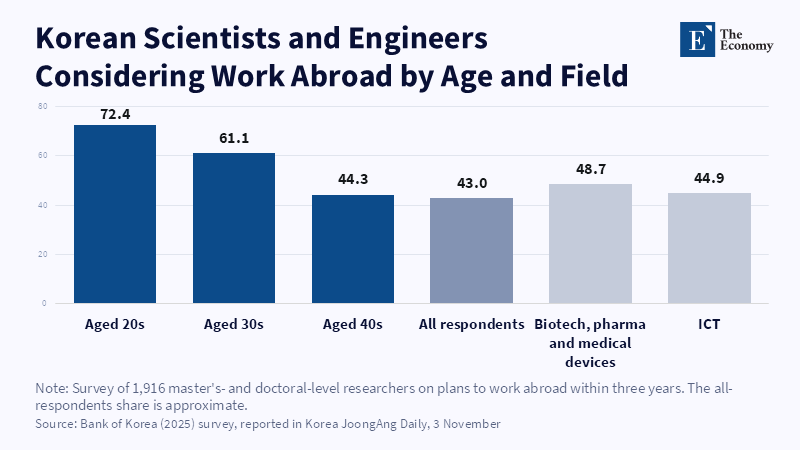
People will follow these institutions. A study by the Bank of Korea in November 2025 found that 62% of Koreans with a master’s or PhD in science or engineering in their 20s and 30s were thinking of working abroad in the next 3 years. Two-thirds of those who wanted to work abroad cited money as a reason. Koreans who work overseas reach peak average incomes of $366,000, against $127,000 at home.[29] This is happening in a country that spends the most on research in the sample. MacroPolo found that 47% of top AI researchers in 2022 received their undergraduate education in China and only about a fifth of researchers of Indian descent work in India.[30] When these people leave a country, the country isn't just losing a salary; it is losing the companies, patents and students they will create.
Countries have started to act on this. The U.S. has started charging $100,000 for new H-1B visas. China has opened its K visa for foreigners who can help with science and technology and Canada's PM has publicly said they want to help those who are affected.[31] This will be costly for the country that has benefited the most from other countries educating their workforce.
With remote work, this change can happen without people having to leave. Someone in Seoul can now work for a company in California. Countries can lose the value of their talent while the people stay at home. There will still be things that require humans to be on site for research and production. The Netherlands showed this in March 2024 with a 2.51 billion euro package for housing, transportation and schooling for engineers in the Eindhoven area, to keep ASML investing in the country.[32] There is no remote work solution for that. This also plays a role in taxes. Someone can stay at their job and move their money and IP to another country.
Institutions can change faster than schools, which is the biggest takeaway from this article, but it will be difficult to accomplish. Take 2 countries that are similar in human capital in 2026, where one changes its institutions to allow for research and the other doesn't. In the model, they can increase their institution quality by 3/4 of a standard deviation in 10 years. The number of people displaced and not working drops from about 48% to about 25% in advanced economies. This assumes stronger demand as well in the reform scenario. Institutions help research, but not as much as expected. The cross-country regressions found that institutions predicted more income from IP in one specification, but they did not raise the productivity of research. In 2031, this will show in where companies are founded and where people can find their first job. By 2036, it will show in national debt, with Germany being 10.4 points lower and Vietnam 7.9 points lower in debt in the reform scenario than in the weak adaptation scenario. This is the only lever that a government can pull during this time and 10 years is a demanding horizon for it.
Part V: Who Will Pay for This
Every step above has come down to one thing, paying for it. When workers lose their jobs, the state is going to need the money when most of their income will be diminished. However, when there are fewer workers, tax revenues are not automatically less. SIAI's AI and Tax series explains that fiscal risk comes less from fewer workers than from changes in the composition, timing, location and jurisdiction of the tax base.[33] If ten workers who make $100,000 each are replaced with two workers who make $300,000 each, payroll decreases by 40% but on an indicative scale, income tax decreases by only 15%. As workers become more productive and fewer in number, they can raise tax revenue per worker. In the simulation, advanced economies' tax revenues are higher than the no-AI baseline in all cases due to higher output.
This is on the assumption that both of those workers stay. If one leaves, the same scale shows a drop of 57.5%. When income is mobile, that's where the progressive state breaks down. These numbers need to be read with caution from both sides. A study done in the Journal of Economic Perspectives showed that the wealthy can respond significantly to taxes when they are not tied to a location. However, they caution that not all demographics respond in the same manner.[34] In the UK, non-doms and deemed doms owed a total of £13.6 billion in taxes for the 2024 to 2025 year, an increase of 9%, as reported by HM Revenue and Customs.[35] These numbers end before the change in April 2025, so the reaction is not yet known. Britain's public discourse has run ahead of the data here. Governments will need to account for fewer people paying personal tax, without assuming they will all leave the country.
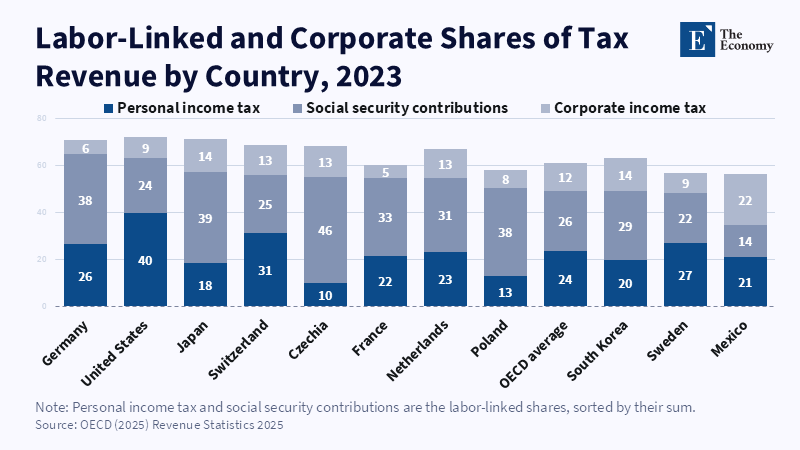
The bigger the welfare state, the bigger the problem. Germany and the U.S. raised 64.8% and 63.5% of their tax revenue from personal tax and social contributions, respectively, in 2023, while Mexico raised only 34.6%.[36] So Germany is more at risk, but it will be able to tax more if it can keep profits in the country. Low-income countries will be at risk of a relentless math problem: not many to tax, little ownership of the technology and having to pay for models and robots that live elsewhere. In the accelerated scenario, tax revenue comes in 3% to 7% lower than the no-AI baseline in China, India, Vietnam and Mexico. Debt as a percentage of GDP will increase by a median of 14.1 points in Mexico and 11.2 points in Vietnam, compared to 4.0 points in Germany and decreasing slightly in the U.S.
Robert E. Litan's paper to the Brookings Institution in October 2026 shows how conventional policy will struggle to function if labor markets are different. It suggests wage insurance, helping with retraining and tax credits for those who can take entry-level positions. It would cost around $60 billion dollars a year, or roughly 0.2% of U.S. GDP.[37] It's well thought out and wage insurance has evidence behind it from a smaller U.S. program. The main benefit is that they will only pay someone if they find a job. If people can get back to work, it makes sense to pay them in this manner. If they can't, then fewer people will be paid and the bill will come out of decreased tax revenue. In the accelerated scenario, helping only people who are unable to find work would cost around 0.77% of U.S. GDP by 2036. It is another method, but it shows how large this can get.
Table 2. Change in Public Debt and Income Support until 2036 by Scenario
| Economy | Debt, Scenario A | Debt, Scenario B | Debt, Scenario C | Income support, Scenario A, % of GDP |
|---|---|---|---|---|
| USA | −2.0 | −8.6 | −12.9 | 0.77 |
| Germany | +4.0 | −2.6 | −6.4 | 0.85 |
| South Korea | +0.2 | −4.9 | −7.6 | 0.80 |
| China | +8.6 | +1.1 | −3.4 | 0.95 |
| India | +9.5 | +3.9 | +0.9 | 0.57 |
| Vietnam | +11.2 | +5.5 | +3.3 | 0.65 |
| Mexico | +14.1 | +6.0 | +2.7 | 0.98 |
So the question is not only whether to help those who will be affected by AI, but whether economies will be able to pay for it. This depends on all the steps above. How fast are jobs lost and do robots bring production home? Were the people who will build the next wave of businesses educated in the country and will they stay? There will be many factors that come into play when deciding if AI will benefit or hinder an economy, from what machines can do to what humans can do and how much governments are able to retain. Countries that already combine high labor costs, deep research bases and institutions able to keep their best people are likely to cover much of the cost of displacement out of higher output, while economies that grew on cheap labor may face job losses, weaker revenue and rising debt at the same time. That sets the order for policy. Before committing to wage insurance or any wider income support, governments need to know how many displaced workers actually find comparable work and how much of the income AI creates stays taxable at home, and institutional reform is the one lever that can begin to show results within the decade. It remains to be seen which countries will excel at all of these.
References
[1] SIAI Research (2026) AI-Driven Labor Displacement and National Economic Competitiveness: Physical Automation, Advanced Human Capital, Institutional Capacity, and Fiscal Sustainability, 2026-2036. SIAI Research Working Paper Series. Schindellegi: Swiss Institute of Artificial Intelligence.
[2] Outlook Business (2022) 'IT revenues grow fastest in a decade to $227 billion in FY22, says Nasscom', Outlook Business, February.
[3] Shinde, S. (2026) 'IT services to cross $300 bn milestone in revenue for FY26', Business Standard, 24 February.
[4] Indo-Asian News Service (2026) 'Top IT firms' hiring turns negative as headcount falls over 7,000 in FY26', IANS, 25 April.
[5] Indian Council for Research on International Economic Relations (2026) AI and Jobs: This Time is No Different. New Delhi: ICRIER.
[6] Tata Consultancy Services (2026) Q4 2025-26 Fact Sheet. Mumbai: TCS.
[7] Business Today (2025) 'TCS slashing jobs this year: CEO Krithivasan says AI isn't why 12,000 employees will be let go', Business Today, 28 July.
[8] Pacelli, A. (2025) 'Big Four slash graduate hiring as AI takes on junior tasks', HRreview, 24 June.
[9] Brynjolfsson, E., Chandar, B. and Chen, R. (2026) Canaries in the Coal Mine? Six Facts about the Recent Employment Effects of Artificial Intelligence. Stanford Digital Economy Lab working paper, revised 12 August.
[10] Humlum, A. and Vestergaard, E. (2026) Still Waters, Rapid Currents: Early Labor Market Transformation under Generative AI. Washington, DC: Brookings Institution, 6 October.
[11] U.S. Bureau of Labor Statistics (2026) Worker Displacement: 2023-2025. News release, 27 August. Washington, DC: U.S. Department of Labor.
[12] Huckfeldt, C. (2022) 'Understanding the scarring effect of recessions', American Economic Review, 112(4), pp. 1273-1310.
[13] Austrian Federal Economic Chamber (2026) Labour costs: EU comparison. Vienna: WKO, based on Eurostat labour cost data.
[14] Japan External Trade Organization (2024) Asian Manufacturing Wages Analysis, Survey of Japanese-Affiliated Companies. Tokyo: JETRO.
[15] International Federation of Robotics (2026) Five Million Robots Now Operate in Factories Globally. World Robotics 2026 press release, 24 September. Frankfurt: IFR.
[16] Clean Energy Wire (2026) 'German car industry sheds 42,300 jobs in a year amid Chinese competition', Clean Energy Wire, 14 August, reporting Federal Statistical Office data.
[17] Humanoids Daily (2025) 'Figure retires the F.02: battle-scarred robots, 30,000 BMWs and hard lessons learned', Humanoids Daily, November, reporting Figure AI's post-deployment report.
[18] Hexagon Robotics (2026) BMW Deploys the Humanoid Robot AEON in Production Sites in Germany. Press release.
[19] Repairer Driven News (2026) 'Hyundai showcases humanoid at CES, plans 30,000 units by 2028', Repairer Driven News, 7 January.
[20] Business and Human Rights Centre (2025) 'Bangladesh: report finds automation in RMG sector cuts workforce by 30%', 3 January, reporting Solidaridad Bangladesh, Bangladesh Labour Foundation and BRAC University, Assessment of Technological Transition in the Apparel Sector of Bangladesh and Its Impact on Workers.
[21] Faber, M. (2020) 'Robots and reshoring: evidence from Mexican labor markets', Journal of International Economics, 127, 103384.
[22] Artuc, E., Bastos, P. and Rijkers, B. (2020) Robots, Tasks, and Trade. CEPR Discussion Paper 14487. London: Centre for Economic Policy Research.
[23, 24] World Bank (2026) World Development Indicators. Washington, DC: World Bank.
[25] OECD (2023) PISA 2022 Results, Volume I: What Students Know and Can Do. Paris: OECD Publishing.
[26] Zegart, A. and Johnston, E. (2025) Policy Implications of DeepSeek AI's Talent Base. Stanford, CA: Stanford HAI and Hoover Institution, 6 May.
[27] Carnegie Corporation of New York (2024) Katalin Karikó: Great Immigrants Honoree. New York: Carnegie Corporation.
[28] CNBC (2023) 'Nobel Prize winner Katalin Karikó on being demoted and perseverance', CNBC, 6 October.
[29] Korea JoongAng Daily (2025) 'Pay, conditions causing two-thirds of young Korean professionals to look overseas: BOK', Korea JoongAng Daily, 3 November, reporting Bank of Korea survey data.
[30] MacroPolo (2024) The Global AI Talent Tracker 2.0. Chicago: Paulson Institute.
[31] Roll Call (2025) 'Countries try to lure foreign talent after Trump's H-1B visa fee hike', Roll Call, 9 October.
[32] Government of the Netherlands (2024) The Netherlands to Invest €2.5 Billion to Strengthen Business Climate for Chip Industry in Brainport Eindhoven. News release, 28 March.
[33] Lee, K. (2026) [AI and Tax] Labor Income, AI Rents and Fiscal Erosion. SIAI Research. Schindellegi: Swiss Institute of Artificial Intelligence.
[34] Kleven, H., Landais, C., Muñoz, M. and Stantcheva, S. (2020) 'Taxation and migration: evidence and policy implications', Journal of Economic Perspectives, 34(2), pp. 119-142.
[35] HM Revenue and Customs (2026) Statistics on Non-domiciled Taxpayers in the UK. Official statistics, updated 30 July. London: HMRC.
[36] OECD (2025) Revenue Statistics 2025. Paris: OECD Publishing.
[37] Litan, R.E. (2026) A Detailed, Affordable Plan for Transition Insurance in the AI Era. Washington, DC: Brookings Institution, 30 October.