AI Advertising and the Economic Cost of Algorithmic Fairness

Working across research, policy, and data-driven analysis, the Editorial Board ensures that published pieces reflect a consistent institutional perspective grounded in quantitative reasoning and long-term structural assessment.
Authored On
Modified
The first ChatGPT ad audit linked exposure to lower incomes
Fairness constraints on ad delivery carry measurable revenue costs
Transparency and research access should come before allocation rules

OpenAI let users know when it started running ads for ChatGPT Free and Go tier users in the US on 9 February 2026. The company assured users that the ads would never affect the responses the model gave and would always appear with a sponsored tag under the response. After 8 months, the first audit of who these ads are being shown to has arrived, and the results give both sides of the AI advertising debate some satisfaction. After creating 91 sock puppet accounts and logging over 3,600 ads, a team publishing through Brookings found that accounts in lower-income zip codes were shown ads more often and in larger quantities. Accounts that received ads clustered around $60k in local income, while accounts that received none peaked nearer $80k. There was no detectable difference by race, and no evidence that ads appeared on any of OpenAI's sensitive topics. The recommendations that followed, more independent research and early regulation, leave open the question of whether this is a market failure.
Findings From the First Audit of ChatGPT Ads
The research was done using sock puppet accounts. This is a common tool used when auditing websites, where researchers create fake users and log in to see what ads they are shown. The accounts were created between January and March 2026 and spanned the Black, Hispanic and white communities. They were also separated into lower, middle and upper income brackets, with at least 9 accounts in each race and income combination. Each account was accessed from a zip code with matching characteristics, so location was the proxy for race and income. Each day, the accounts asked questions that could plausibly trigger an ad and questions on topics, such as mental health, where OpenAI stated it would not display ads. Most of the ads appeared on questions about products, health and fitness, and food. Asking for the best streaming service to watch sports on brought up an ad for one, and a request for a pad thai recipe brought up an ad for DoorDash.
The income result was the main finding, but the study has limitations. Only 53 of the 91 accounts were shown in ads. The authors stated that, because of the sample size, their finding of no difference between races may not hold. The same applies to the income finding. About a month into the study, none of the accounts were being shown ads, which the authors believe meant OpenAI detected them. The study therefore offers only a glimpse of how this feature will develop over the next few years. Since the accounts were newly created, they also had no chat history and no memories for the system to draw from. Location was the only information available, so a gradient by local income is close to what such a system would be expected to produce. It is still a finding and the first step to understanding the issue.
Why Chatbot Ads Raise Different Risks
The authors of the study believe there are dangers in chatbot ads that were not present in previous forms of advertising. Chatbots have a friendlier way of talking, and with the ability to remember past conversations, they can become more targeted to each user. Many people trust their chatbot with personal information and may trust the ads it shows them as well. The author pointed to Facebook, where repeated investigations found its ads were delivered in discriminatory ways, and change came only after a legal settlement imposed third-party oversight. They argue for third-party monitoring of AI chatbots and limits on deceptive advertising from the start. The concern is valid because OpenAI states that with personalized ads turned on, the current conversation can be used to select an ad.
The Economy's analysis of chatbots and search goes into more depth on this topic and explains how chatbots can be a more harmful form of algorithmic curation than search. Since only one answer is given, the user has no ability to compare other results. In a country like South Korea, which has adopted a portal-first way of searching, this can become very dangerous. The same reasoning applies to ChatGPT's answers, though not to its ads. As long as the ads do not affect the answer given to the user, the risk is contained. OpenAI has stated that advertisers cannot influence its rankings or what its model says. So long as that holds, a ChatGPT ad is comparable to an ad shown beside a Google search, even though search and AI often disagree on what to surface. OpenAI has to keep advertisers away from the model, and continuous independent monitoring has to confirm it.
How Delivery Systems Allocate Ad Inventory
There is a limited amount of ad space and even less attention to be gained from it, which is why delivery systems are used to show ads to the users who will give the most value. An advertiser wants an ad shown to someone who will click on it and then make a purchase from that click. The campaign is then judged by return on advertising spend, what it earned compared with what it cost. Delivery systems will rank one ad over others if they generate the most revenue for them, and they also want the ad to be relevant to the users who see it. To spread a budget over the course of a day, the problem can be written as a Bellman equation: the value of the remaining budget at time t equals the best value available from the next impression plus the discounted value of the budget left after spending on it. Production systems usually approximate this with a Lagrangian budget pacer or a contextual bandit. SIAI's analysis of algorithmic targeting argued that these systems should be held to measurable outcome thresholds when ads reach protected classes in areas such as housing, without labelling the optimization itself as segregation.
Adding another constraint to this problem cannot raise revenue and usually lowers it. Requiring ads to reach equal shares of different demographics limits which users the system can choose, and the loss from that constraint can be calculated from its Lagrange multiplier. Evidence on how high that cost is, and who bears it, points in more than one direction. When a career ad for STEM jobs was tested, men were shown it about 20% more often than women. Women who saw the ad were actually more likely to click on it, but female impressions cost more in the auction, so a cost-minimizing system shifted delivery toward men. Researchers at Northeastern University, the University of Southern California and Upturn also found that neutrally targeted job and housing ads on Facebook were skewed by gender and race through optimization alone. Ads for recruiting students showed a similar pattern, with Meta delivering some for-profit college ads to a larger share of Black users than comparable public university ads. These delivery systems can be efficient but not always fair.
AI Advertising Remedies Carry Different Costs
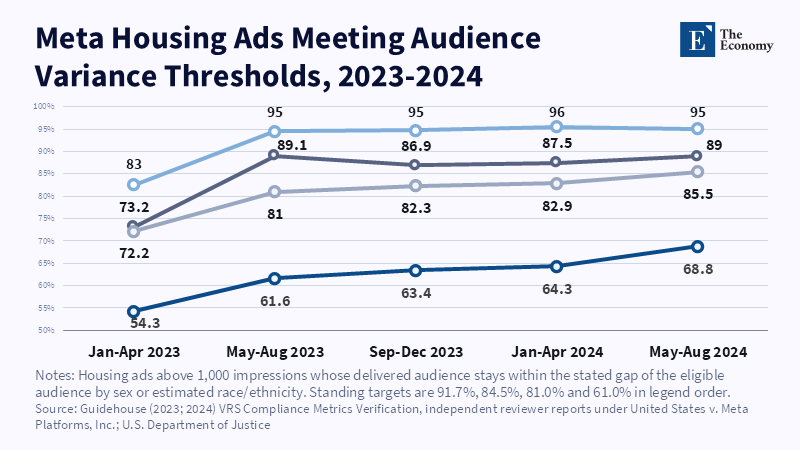
There are many ways to address this issue, and some cost more than others. Limiting how ads are displayed adds a constraint to the problem, and as noted above, that loses money. Advertisers lose by reaching fewer of the users most likely to respond, and platforms lose by selling fewer ads at full value. Users of the free version of ChatGPT may also lose out if advertising pays for less of the service. This has been done before for housing. After a settlement with the Justice Department, Meta built a system to keep the demographic gap between the eligible audience and the people who actually saw most housing ads within 10% of the total. It also had to accept an independent reviewer to check compliance. Since fair housing law treats access to a housing ad as access to a protected opportunity, the reason for that rule is clear. The same case is hard to make for a rule that stops companies from showing a food delivery ad to lower-income users.
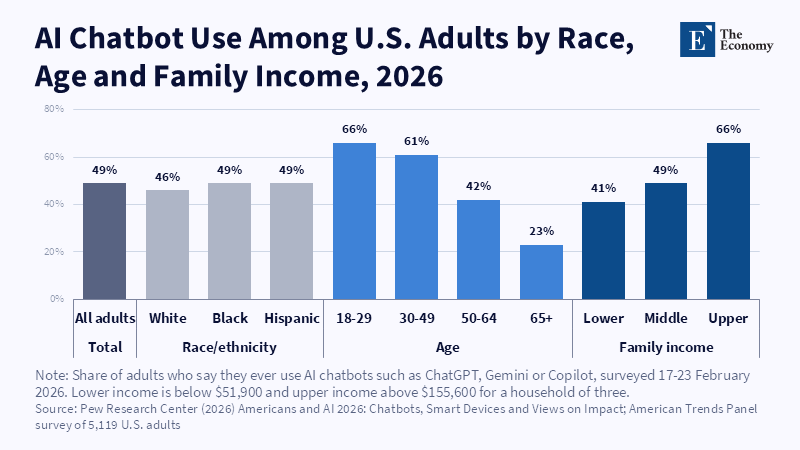
Transparency and research access can also address the problem. Giving researchers access to these systems would reveal whether companies are discriminating against certain demographics, at a lower cost to companies than a constraint on their objective. Companies should also be required not to mislead users with ads. If users trust their chatbot with personal information, companies should not be allowed to exploit that trust by showing them false information. Some may argue that this will not stop companies from discriminating, but the Facebook case shows that it can. Without researchers examining Facebook's ads, the targeting of certain demographics would never have come to light. Research access into ChatGPT might likewise show whether credit ads are reaching lower-income users on worse terms, an area where fair lending law already bars discrimination on protected characteristics.
Market Failure or Efficient Sorting?
Calling this a market failure requires more data. If users in lower-income areas are clicking on these ads and buying from them, the pattern looks more like efficient allocation than a market failure, since those users may simply want these products more than users in higher-income areas. If they are not converting at a higher rate and are only cheaper to reach, the pattern resembles the STEM experiment, where delivery followed cost rather than interest. Paired tests can separate the two by running two similar ads and changing one thing about them. That would show whether the platform is showing more ads to lower-income users or whether advertisers are targeting them. The type of product matters too. A meal kit ad is of little concern, but a high-cost product or a credit offer is a reason to worry.
More research should come before regulating AI companies. If the research shows that these companies are discriminating against certain demographics, rules to prevent it can follow, provided they address that harm and their efficiency cost is known. For now, the record shows only that accounts in zip codes with a local income near $60k were more likely to be shown in ads than accounts in zip codes near $80k.
The views expressed in this article are those of the author and do not necessarily reflect the views of The Economy, its Editorial Board, or any affiliated institution.
References
Ali, M., Sapiezynski, P., Bogen, M., Korolova, A., Mislove, A. and Rieke, A. (2019) ‘Discrimination through optimization: How Facebook’s ad delivery can lead to biased outcomes’, Proceedings of the ACM on Human-Computer Interaction, 3(CSCW), Article 199.
Friedler, S., Lurie, E. and Metaxa, D. (2026) ‘Understanding the beginning of advertising on ChatGPT’, TechTank, Brookings Institution, 26 October.
Guidehouse (2024) VRS Compliance Metrics Verification. Report prepared for the U.S. Department of Justice under United States v. Meta Platforms, Inc., 30 October.
Imana, B., Korolova, A. and Heidemann, J. (2024) ‘Auditing for racial discrimination in the delivery of education ads’, Proceedings of the 2024 ACM Conference on Fairness, Accountability, and Transparency (FAccT ‘24). New York: ACM.
Lambrecht, A. and Tucker, C. (2019) ‘Algorithmic bias? An empirical study of apparent gender-based discrimination in the display of STEM career ads’, Management Science, 65(7), pp. 2966-2981.
McGowan, E. (2025) ‘Chatbots are not search: Algorithmic gatekeeping and generative AI in education policy’, The Economy, 20 October.
McGuire, C. (2025) ‘Algorithmic targeting is not segregation: Fix outcomes without breaking the math’, The Economy, 15 November.
OpenAI (2026) Ads in ChatGPT. OpenAI Help Center.
Pew Research Center (2026) Americans and AI 2026: Chatbots, Smart Devices and Views on Impact. Washington, DC: Pew Research Center, 17 June.
U.S. Department of Justice (2023) ‘Justice Department and Meta Platforms Inc. reach key agreement as they implement groundbreaking resolution to address discriminatory delivery of housing advertisements’, Office of Public Affairs, 9 January.
Working across research, policy, and data-driven analysis, the Editorial Board ensures that published pieces reflect a consistent institutional perspective grounded in quantitative reasoning and long-term structural assessment.
Similar Post