How AI Can Change the Economics of Reshoring Manufacturing to Europe

Working across research, policy, and data-driven analysis, the Editorial Board ensures that published pieces reflect a consistent institutional perspective grounded in quantitative reasoning and long-term structural assessment.
Authored On
Modified
AI and robotics weaken Europe’s old labour-cost disadvantage
Rheinmetall and MSC’s Mangalia deal tests reshoring in shipbuilding
China’s robots and Europe’s electricity prices limit the gains
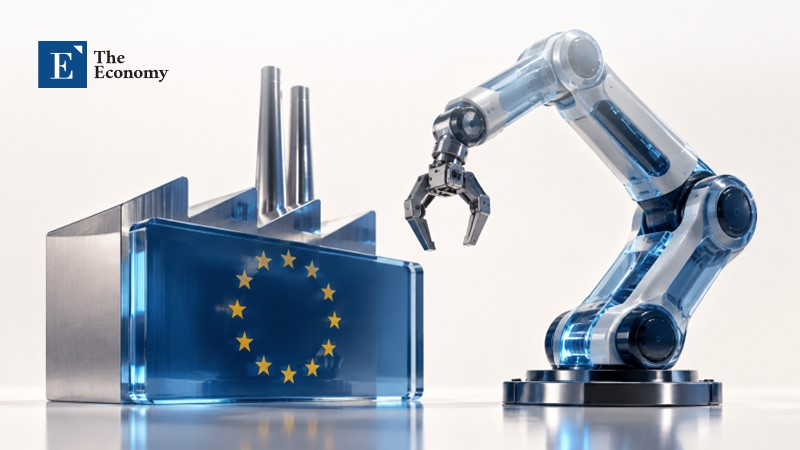
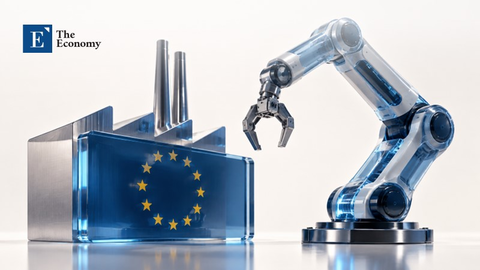
When Daewoo formed a joint venture at the Mangalia shipyard in Romania in 1997, the yard went on to produce over 200 ships in the following 10 years. The yard sits on the Black Sea just south of Constanta and was constructed in 1976. As of June 2024, it was in the possession of an insolvency administrator, and it was declared bankrupt in April 2026. In October 2026, Rheinmetall and Swiss-based Mediterranean Shipping Company won the shipyard at auction for a combined bid of 138 million euros. The deal had not closed by late October, and Damen Holding, the yard's principal creditor, is contesting the court decision that allowed the lower auction price. The yard will be used as a dual-use shipyard for both military and commercial shipping. While not a lot of money when compared to defence spending in Europe today, it goes to show what reshoring manufacturing to Europe may look like in the future. For the past 40 years, reshoring manufacturing from Asia was always going to be about how cheap labour was in these countries. With the emergence of AI and robotics in manufacturing, this equation is changing and Europe has the opportunity to see how far it can go.
An Ageing Workforce Makes AI a Productivity Necessity
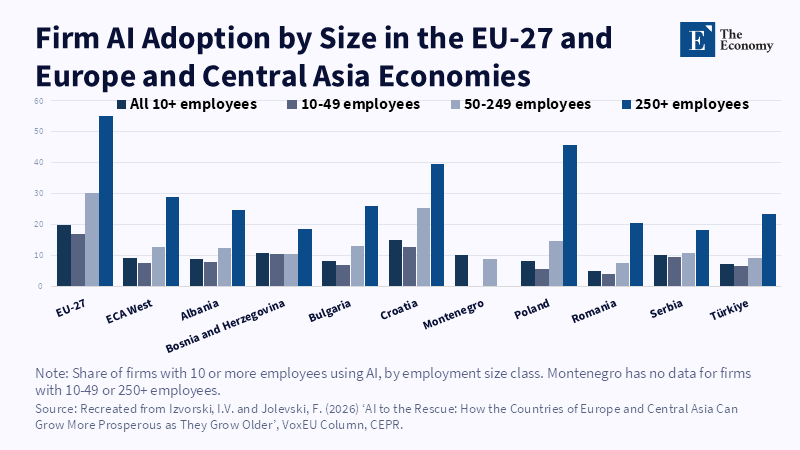
In the World Bank's most recent Europe and Central Asia Economic Update, and in a CEPR column co-written by its regional chief economist, the focus is on using AI to help with the ageing population problem. With growth in the region's developing economies forecast to slow to 2.2% in 2026 from 2.6% last year, they identify labour shortages as a limiting factor. One fifth of workers in the region hold jobs meaningfully exposed to AI. Most of these workers are young and highly skilled. Fewer than one in ten firms use AI, about half the EU share, and for the most part in very basic applications. The World Bank economists believe that the bigger problem in the coming years is underutilisation of AI.
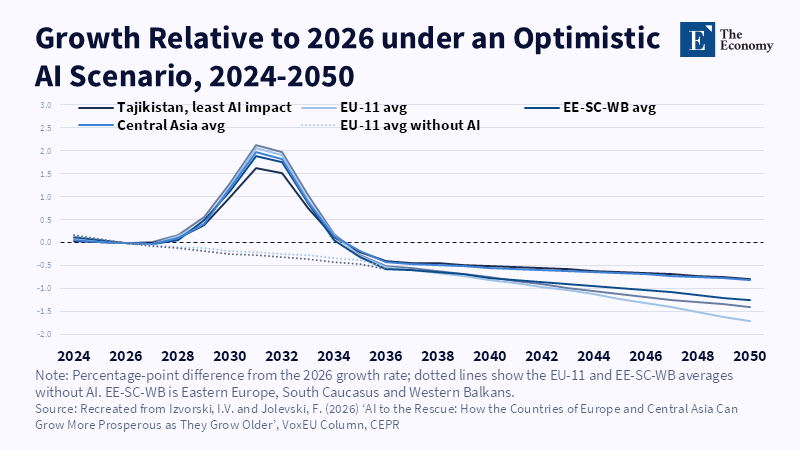
With the European population ageing, the number of workers will decrease. According to Eurostat's EUROPOP2023 projections, the EU's working-age population will decrease from 63.9% of the population in 2022 to 54.4% by 2100. This is a loss of 57.4 million people between the ages of 15 and 64. Eurostat's newer projections, published in April 2026, put the EU population in 2100 lower still, at 398.8 million. Much of the pressure will come over the next decade as the baby boomer generation retires. So one way to look at AI is as a means to maintain output with fewer workers. However, there is another argument that can be made here that the World Bank does not explore in depth. If firms can produce more with fewer workers, unit labour costs will go down, making it more competitive to produce goods in Europe.
Labour Costs Drove Offshoring, and AI Can Shrink Them
In 2024, Eurostat calculated the average labour cost per hour across the EU to be €33.5. In the industry sector, it was €33.9. According to Destatis, labour costs in German manufacturing were €48.30 per hour in 2024, about 43% higher than the EU manufacturing average of €33.70. Labour costs are one of the many reasons why Europe has lost out on producing consumer goods, clothes, tools, and ships to countries in Asia since the 1990s. Access to markets in China and cheaper logistics via container ships also played a role, but labour costs were often the deciding factor.
If firms can reduce the number of workers needed to produce a product, they can reduce the labour cost per unit, which means that labour costs will become less of a factor when deciding where to produce goods. Factories already have robots, but what AI brings to the table is the ability to work with more variations, through quality control with machine vision, production planning and reduced programming time for robots. This suits the goods that European manufacturers produce in lower quantities and that require more skill to produce.
Mangalia Tests Whether Shipbuilding Can Return to Europe
Shipbuilding is one industry where it will be very hard to compete with Asia. According to Clarksons Research, China produced 53% of ships in 2024 by CGT. South Korea came in at 28% and Japan at 12%. Europe only made up 4%, while China took 69% of all new orders in 2025 by deadweight tonnage according to China's Ministry of Industry and Information Technology. Europe's remaining shipyards are strongest in cruise ships and military vessels, not the commercial tonnage that was once built in Europe.
With Rheinmetall buying the Mangalia shipyard, it is combining its new division, Rheinmetall Naval Systems, the former Naval Vessels Lürssen, with a shipyard that has 3 dry docks capable of fitting ships up to 360x60 meters. Romania's labour costs were €13.6 per hour in 2025 compared to the EU average of €34.9. With the Romanian government ordering 4 naval vessels, this will allow the shipyard to have some orders on the books. With MSC owning part of the shipyard, it can be used for commercial ships as well as repairs on MSC's current fleet. Rheinmetall has stated it will expand and upgrade the shipyard as well as improve production conditions, which could include robotic welding and AI in production planning, although no such plan has been published. Will this make the shipyard competitive with Asian shipyards? That question remains open.
One factor to consider is that Romanian labour costs are on the rise. According to Eurostat, labour costs increased 14.2% in 2024 and 10.6% in 2025 in local currency. So a yard competing only on labour costs would see that advantage decrease as time goes on.
Asia's Robots and Cheap Power Limit Europe's Advantage
The argument against this is that Asia also has access to robots and AI. In 2025, China installed 354,000 robots, accounting for 59% of all robots installed worldwide, while EU installations fell 11%. So if everyone has access to the same technology, then Europe's advantage decreases. Once labour costs are no longer a big part of the production cost, other factors will come into play, such as logistics and energy costs. Europe can compete on some of these fronts, but energy costs are not something it can compete on at the moment.
According to BloombergNEF, industrial electricity prices in the US averaged $110 per MWh and in China $89 per MWh in 2025. German companies paid $226 per MWh. The International Energy Agency forecast that electricity prices for energy-intensive industries in the EU would be on average double those of the US and 50% higher than China in 2025. This is an increase from 2019, when prices in the EU were 50% higher than the US and 20% higher than China. Oxford Economics estimates that energy costs made up 8.1% of the value added in EU manufacturing in 2025. This is lower than the 8.9% seen in 2022 but higher than pre-energy crisis levels. So replacing labour with robots and AI will add to electricity use, which increases exposure to these prices.
Reshoring Manufacturing Favours Labour-Heavy, Low-Energy Industries
There will be many industries that can be reshored to Europe, starting with those that use a lot of labour but not as much energy. Another group is industries that have a benefit to being closer to home. Defence is one that comes to mind, as well as rail and other mechanical industries. The World Bank also flagged concentrated automotive exports as a vulnerability in some of the region's economies. Rheinmetall has a facility in Medias, Romania, that it has been operating since 2024. Korean defence companies are also moving production to Europe. With Germany stepping up to take a more leading role in Europe's defence and manufacturing, more companies could move their production to Central and Eastern Europe.
The key to all of this is having the skills and data infrastructure to support these factories. The World Bank identified a lack of basic and managerial skills, as well as data that is not integrated and interoperable. With fewer than one in ten firms in the region using AI, and about one in five across the EU, there is still a long way to go. But with the ageing population, Europe has to find a way to produce more with fewer workers. The Mangalia shipyard will test whether reshoring manufacturing to Europe is possible with AI and robotics. China will also continue to install robots at a rapid pace. Whether Europe can close that gap remains to be seen.
The views expressed in this article are those of the author and do not necessarily reflect the views of The Economy, its Editorial Board, or any affiliated institution.
References
BloombergNEF (2026) Industrial electricity price comparison, 2019 to 2025. Unverified title, taken from secondary reporting; confirm before publishing.
Clarksons Research (2025) 2024 Global Shipbuilding Review. London: Clarksons Research.
Destatis (2025) Labour costs in Germany 2024. Wiesbaden: Federal Statistical Office.
Eurostat (2023) Population projections in the EU: EUROPOP2023. Luxembourg: Eurostat.
Eurostat (2026) EU hourly labour costs ranged from €12 to €57 in 2025. Luxembourg: Eurostat.
International Energy Agency (2025) Electricity Mid-Year Update 2025. Paris: IEA.
International Federation of Robotics (2026) World Robotics 2026. Frankfurt: IFR.
Izvorski, I.V. and Jolevski, F. (2026) ‘AI to the rescue: How the countries of Europe and Central Asia can grow more prosperous as they grow older’, VoxEU, 30 October.
Ministry of Industry and Information Technology of China (2026) 2025 shipbuilding industry statistics. Beijing: MIIT.
Oxford Economics (2026) Don’t blame carbon costs for European industry’s woes yet. Oxford: Oxford Economics.
Rheinmetall AG (2026) Rheinmetall to take over the Mangalia shipyard in Romania. Düsseldorf: Rheinmetall AG.
World Bank (2026) Europe and Central Asia Economic Update, October 2026: Making AI Work: Jobs, Firms, and Productivity. Washington, DC: World Bank.
Working across research, policy, and data-driven analysis, the Editorial Board ensures that published pieces reflect a consistent institutional perspective grounded in quantitative reasoning and long-term structural assessment.
Similar Post