AI and the Danish Labour Market: Hiring Slows Before Jobs Go

Working across research, policy, and data-driven analysis, the Editorial Board ensures that published pieces reflect a consistent institutional perspective grounded in quantitative reasoning and long-term structural assessment.
Authored On
Modified
Danish AI adopters fell 9% below their own employment trend
Small firms and young graduates absorbed most of the shortfall
Results match SIAI models predicting slower hiring under calm aggregates

Within three years, the percentage of Danish businesses reporting some use of AI rose from 15 percent in 2023 to 59 percent in 2026, with most of the increase coming from generative AI tools for writing text and code. Despite this speed, unemployment and overall employment showed no change attributable to the new technology. The picture changes when the Danish labour market is looked at month-by-month and business-by-business. Companies that started using AI in 2023 were in September 2025 about 9 percent below the employment trajectory they would have had if they had continued at their previous pace, compared to those that did not.
These companies continued to grow, simply slower than their pre-adoption trajectory suggested and the difference was concentrated in hires that did not take place in small businesses and in high-exposure positions, where new graduates typically enter the market. Such an effect fits comfortably within the range that analytical models for AI and work had described, with the caveat that the way a position is classified as exposed still remains a weak tool.
What the Danish Labour Market Registers Recorded
Danmarks Nationalbank linked Statistics Denmark’s official survey on IT use, which covers private non-financial companies with at least ten employees, to the monthly employer and employee registers that record every salary payment in the country. The link was based on a detail that would easily go unnoticed. Eurostat removed the AI questions from the European survey in 2022, while the Danish statistical office continued to ask them and thanks to this continuity it was possible to identify the companies that used AI for the first time in 2023. Each such business was compared month by month with companies in the same three-digit industry that did not report use and the employment of each was measured against its own trend, as projected by the 2020 and 2021 data. 2022 was deliberately kept out of the trend assessment and acted as a check, in which future users moved at the same pace as the rest.
After adoption, the gap gradually widened. At the end of 2024, employment in companies that adopted the technology was about 6 percent below their trend compared to those that did not and in September 2025, the last month with available data, the gap had reached 9 percent. A second group, companies that started in 2024, followed the same path with a one-year delay and reached about 7.5 percent below their trend at the end of 2025, which excludes the possibility that the finding is due to some general shock of 2023. Central bank researchers point out that adoption is not random and that technology and personnel decisions are likely made together, so the results are read as comparisons rather than pure causal effects. Many of the comparison companies themselves began using AI in 2024 and 2025, which makes the measured gaps rather conservative.
Small Businesses and Young Graduates Carry the Burden
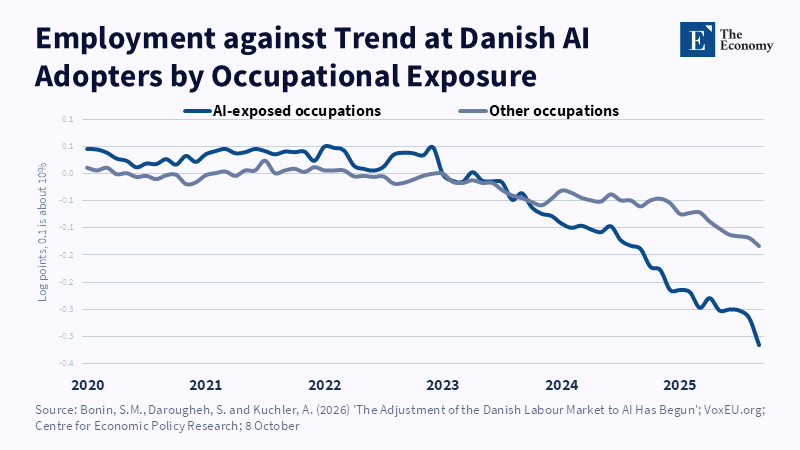
The decline was not evenly distributed among jobs. Occupations in the top quartile of the generative AI exposure index by Edward Felten, Manav Raj and Robert Seamans were about 27 percent below the trend at the end of 2025, compared to about 12 percent for the rest of the occupations and the decline was concentrated in workers under 30 and university graduates. The mechanism went through recruitment. The stock of newly hired people was steadily shrinking, while those with long seniority stayed in their positions even longer than before. Young graduates have been hit harder than any other group without being targeted by companies themselves, simply because they are more likely to start their careers in high-exposure occupations and a company can change who joins its workforce without touching those already working there.
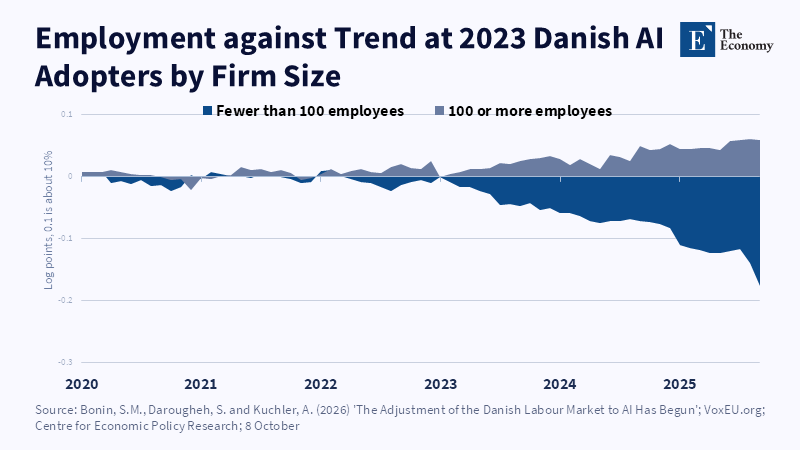
The distinction by size is even more pronounced. Among 2023 adopters with fewer than 100 full-time employees, employment was about 16 percent below the trend at the end of 2025, while among adopters with 100 or more there was no decline, only a small and statistically insignificant increase. Fast-growing small companies that adopted the technology expanded almost like their counterparts that did not, which places the gap in the median and below it, far from the assumption that the effect is caused by a few companies that collapsed. The explanation put forward by the economists at Danmarks Nationalbank concerns financing, as the lag is mainly found in small businesses that already had high leverage before adoption and what is spent on installing and adapting the technology is missing from the budget that would otherwise go to a new employee, perhaps the first graduate the company would hire that year.
A Semi-Closed Market and a Blunt Exposure Index
Denmark is a peculiar testing ground. The model of flexicurity, with low layoff costs, high job turnover, generous unemployment insurance and active employment policies, allows a company to simply stop hiring without having to lay off anyone. The market is also semi-closed. The common Nordic labour market, which has been in operation since 1954, allows young Danes to look for work in Sweden or Norway and those who settle there are taken off the Danish registers, so a graduate who did not find his first job in Copenhagen and eventually worked in Malmö never appears in Danish unemployment statistics. The overall picture is also complicated by the concentration in a few sectors. The exposed sectors, starting with IT, lost employment in relation to their trend, but most of this loss did not come from the companies that had adopted the technology, since IT had more businesses shrinking anyway than other sectors.
The second problem is measurement. A business is recorded as an AI user when it answers positively to a survey question, without distinguishing between one company that tried a copywriting tool and another that reorganized its entire workflow. The exposure of occupations is measured by a number per occupation and the SIAI’s analysis of the AIOE index showed how crude this approach can be, with medical secretaries and secondary school teachers only 0.027 points apart, while about two-thirds of the former’s tasks can be done by artificial intelligence versus about one-fifth for the latter. When the same data is scored by different language models, the percentage of American occupations that are characterized as particularly exposed ranges from 2.7 percent to 51.5 percent. With annual accounting data in place of monthly registers, the same Danish exercise gives confidence intervals of around minus 8 percent to plus 5 percent, which do not allow any conclusions and even the monthly data inherit the ambiguity of the indicator that decides which occupation counts as exposed.
Danish Findings Stay within the Limits of the Models
The results from Denmark hardly come as a surprise to anyone who has followed the analytical frameworks published by SIAI in the fall of 2026, which start with tasks rather than entire occupations. AI takes work away from some tasks and adds demand to others within the same profession and a single exposure index adds the two forces together into a number that eliminates them. In the analysis processed by SIAI based on Liminal Capital’s research, American employment-weighted labour is divided into 32 percent substitution tasks, 15 percent complementarity tasks and 53 percent tasks that technology does not touch. Substitution work is growing 3.3 percentage points per year slower than untouched work and complementary work is growing 3.3 points faster; because the two forces are moving in opposite directions, the overall figures remain calm. Adjustment, according to the same framework, passes through hiring and falls on young people, with hires of 22 to 25-year-olds in the most substitutable quartile falling by a third without a corresponding drop in jobs that technology cannot replace.
A second SIAI framework explains why the same country may show zero effect on one level and a net loss on another. The value of human labour is judged there in three successive filters, the technical capability of the model, the cost of controlling and integrating it into the workflow and the demand for the final product. Anders Humlum and Emilie Vestergaard, linking surveys of 25,000 Danish workers of eleven exposed occupations to administrative registers, found no significant effect on wages or working hours, while users themselves reported savings of only 2.8 percent of their time. In the United States, the Stanford Digital Economy Lab’s payroll data showed the employment of 22- to 25-year-olds in the most exposed occupations about 19 percent below the level they would have had if they had moved like their peers in less exposed positions. Those who are already employed do not lose income while entry is narrowing, a combination that the Danish registers recorded in an additional detail: the size of the business, which neither framework had explicitly isolated.
Why Small Companies Are Cutting Entry Slots First
The decision model published by SIAI on how businesses build capability in AI provides a plausible answer to the question of size. Training existing staff, hiring a specialist and outsourcing all have transition costs that are paid at the beginning, while the benefits come later and in the scenario of a customer service center with 20 employees no alternative outweighed maintaining the existing workflow over a 12-month horizon. A small company with high borrowing can’t afford to wait two years to recoup the investment and the cheapest adjustment left to it is deferred hiring. Eurostat data used by the same study show the asymmetry from another angle, since only 6.23 percent of small European businesses recruited or tried to recruit ICT specialists compared to 51.87 percent of large ones, while 17.21 percent of small ones provided ICT training to their staff compared to 72.62 percent of large ones.
The most serious objection holds that young people in exposed occupations were losing ground before the launch of ChatGPT, so the decline could be due to the 2022 interest rate cycle or the post-pandemic recovery and simply coincide in time with the technology. For Denmark, the data does not support this reading. Each company was measured against its own previous trajectory, 2022 passed the out-of-sample check and the 2024 cohort repeated the same pattern a year later, which a general macroeconomic shock would hardly produce in two consecutive groups. In the SIAI two-margin framework, neither margin predicts the evolution of employment between 2015 and 2019 or between 2019 and 2021, and timing controls on interest rates leave the effect intact. In the study by Seyed Mahdi Hosseini Maasoum and Guy Lichtinger, with resumes and job listings for about 62 million employees at 285,000 U.S. companies, the employment of new entrants in companies that adopted generative AI fell by 7.7 percent in the six quarters after the first quarter of 2023, without affecting senior management.
Small businesses that adopted AI in 2023 employ less than 2 percent of Denmark’s workers, so even a 16 percent gap equates to a few tenths of a percentage point of total employment, spread over more than two years. No sectoral or overall statistic can identify something so small and without the monthly registers the signal would not be visible at all. The Danish case leaves a specific measurement need, recruitment flows by age, by type of task and by company size, which Statistics Denmark was able to offer because it did not stop asking when Eurostat stopped. Businesses in 2023 used tools much more limited than today’s and with adoption at 59 percent the simple question of whether a company uses AI no longer separates one firm from another. Whether the effect will go up from small to large companies or from entry positions to mid-level ones is not yet shown in any dataset.
The views expressed in this article are those of the author(s) and do not necessarily reflect the official position of The Economy or its affiliates.
References
Bonin, Simone Maria, Darougheh, Saman and Kuchler, Andreas (2026) AI Adoption and Firm Size: Employment Effects in Monthly Administrative Data. Danmarks Nationalbank Working Paper No. 223. Copenhagen: Danmarks Nationalbank.
Brynjolfsson, Erik, Chandar, Bharat and Chen, Ruyu (2026) Canaries in the Coal Mine? Six Facts about the Recent Employment Effects of Artificial Intelligence. Revised August 2026. Stanford, CA: Stanford Digital Economy Lab.
Eurostat (2025) ICT Specialists: Statistics on Hard-to-Fill Vacancies in Enterprises. Statistics Explained. Luxembourg: Eurostat.
Felten, Edward, Raj, Manav and Seamans, Robert (2023) ‘Occupational Heterogeneity in Exposure to Generative AI’, AEA Papers and Proceedings, 113, pp. 282-287.
Hosseini Maasoum, Seyed Mahdi and Lichtinger, Guy (2025) Generative AI as Seniority-Biased Technological Change: Evidence from U.S. Résumé and Job Posting Data. SSRN Working Paper 5425555.
Humlum, Anders and Vestergaard, Emilie (2026) Still Waters, Rapid Currents: Early Labor Market Transformation under Generative AI. NBER Working Paper No. 33777, revised March 2026. Cambridge, MA: National Bureau of Economic Research.
Lee, Keith (2026a) AI Adoption and the Changing Value of Human Work. SIAI Working Paper. Schindellegi: Swiss Institute of Artificial Intelligence.
Lee, Keith (2026b) How Firms Build AI Workforce Capability. SIAI Working Paper. Schindellegi: Swiss Institute of Artificial Intelligence.
Swiss Institute of Artificial Intelligence (2026) ‘Artificial Intelligence and the Job Market: Jobs Created and Lost at Once’, Executive AI Brief, 7 October. Schindellegi: Swiss Institute of Artificial Intelligence.
Verschuere, Benjamin and Cameron, Angus (2026) Hiding in the Mean. SSRN Working Paper 7195359.
Working across research, policy, and data-driven analysis, the Editorial Board ensures that published pieces reflect a consistent institutional perspective grounded in quantitative reasoning and long-term structural assessment.
Similar Post