Merger Review Misses the Supply Chain Costs of Acquisitions

Working across research, policy, and data-driven analysis, the Editorial Board ensures that published pieces reflect a consistent institutional perspective grounded in quantitative reasoning and long-term structural assessment.
Authored On
Modified
Buyouts lift supplier sales but squeeze margins in downturns
Nexperia’s ownership fight threatened Europe’s car production lines
Merger review rarely examines effects across the whole value chain

When a buyout fund buys a manufacturer, or an industrial group absorbs a firm one step up its supply chain, the filing submitted for merger review describes two companies and the market they share. The suppliers who ship to the target every week, the rival producers who buy from those same suppliers and the governments whose factories rely on the output rarely appear in that file. They absorb the consequences b, sometimes years after the deal is closed and usually without any say in it.
Merger control in most jurisdictions is organized around one test. Authorities ask whether the combined firm will gain enough market power to raise prices, cut output or shut out rivals, and they answer it with market shares, overlaps and the likely reaction of customers. Vertical theories of harm exist, and some agencies do examine whether a merged firm could deny competitors an input. Yet the review tends to stop at the edge of the relevant market, while the effects of a change in ownership travel along supply chains that run well past it, through suppliers' order books and capacity plans, into the costs of firms that took no part in the transaction, and occasionally into the trade relations between states.
Buyouts Lift Supplier Sales, Then Squeeze Margins When Demand Falls
A European Central Bank working paper published in May 2026 follows what happens to firms that sell to companies bought by private equity. It draws on Belgian firm-to-firm transaction records, which capture small private suppliers that commercial databases tend to miss, and compares suppliers of buyout targets with similar suppliers whose customers were not acquired. Across the post-buyout period, the first group does better. Sales run around 8% higher and employment around 4% higher over the years after the buyout, and most of that gain comes from extra demand, as the newly owned firms expand and buy more from the suppliers they already use.
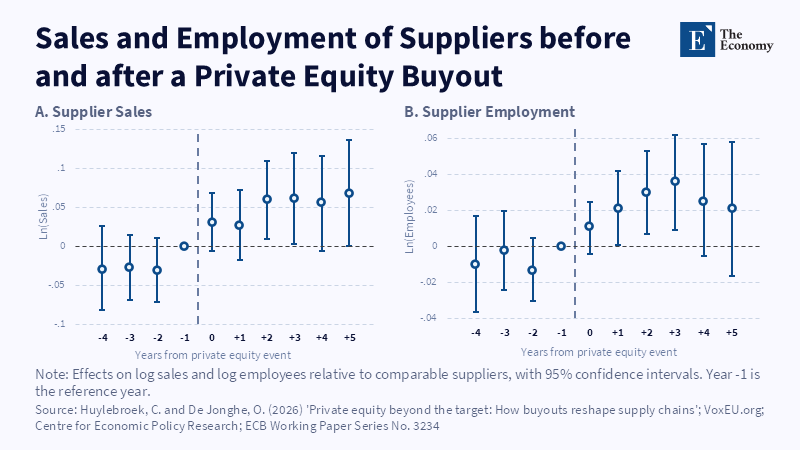
Downturns reverse much of this. When the economy weakens, the advantage fades and suppliers cut their markups by around 8%, as fund owners push harder on price and rearrange their supplier base to save costs. Firms that sell easily replaceable inputs, or that operate in crowded industries, take the heaviest pressure, particularly when the buyer is a large and experienced fund, and buyout-backed companies are more likely to drop suppliers altogether in these periods.
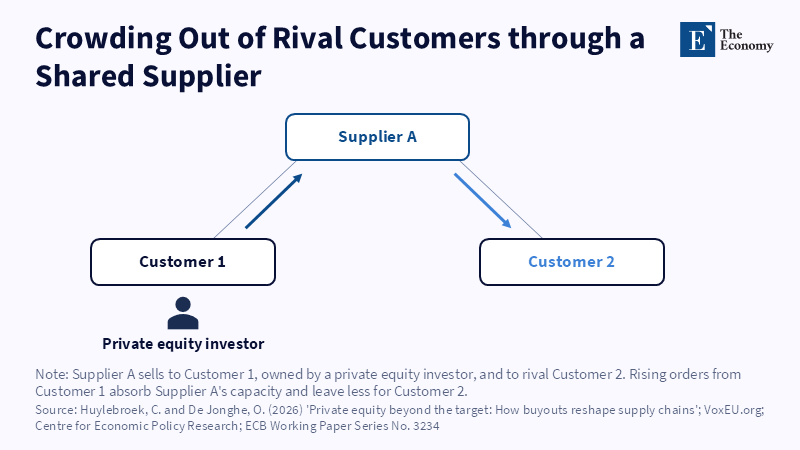
The third result reaches furthest. As buyout-backed firms take up more of a supplier's capacity, competitors that depend on the same supplier get crowded out. A rival with no part in the deal, one that a competition authority would treat as unaffected or even as a winner from a less concentrated market, can lose access to capacity it had counted on. The authors suggest that regulators could use publicly disclosed supplier information to map links between buyout targets and their competitors before approving transactions, a modest proposal on paper that would still require a different kind of review from the one most agencies run.
Nexperia Turned an Ownership Dispute into a Car Industry Supply Shock
The Nexperia dispute runs on a different mechanism, though it starts from the same place: a change in who owns a firm that many others depend on. Nexperia is a chipmaker headquartered in Nijmegen whose shares have been held indirectly by China's Wingtech Technology since 2019. It does not make advanced semiconductors. Its chips go into switches, steering controls and other basic vehicle systems, and a single car can contain hundreds of them.
On 30 September 2025, the Dutch Minister of Economic Affairs invoked the Goods Availability Act for the first time since 1952, citing concerns that the company's chief executive had moved product assets, funds, technology and knowledge to a foreign entity. The order let the ministry block or reverse board decisions on the company's assets, intellectual property, operations and staff. In a separate procedure, the Enterprise Chamber of the Amsterdam Court of Appeal suspended the chief executive, appointed a temporary director with a decisive vote and transferred all but one of the company's shares to a trustee. Pressure from Washington had come first. Wingtech was already on the U.S. export control list; a rule extending those restrictions to subsidiaries put Nexperia's exemption in doubt, and the U.S. Commerce Department reportedly told Dutch officials in June that replacing the chief executive was close to a condition for keeping it.
Beijing responded by halting exports from Nexperia's plants in China. The European Automobile Manufacturers' Association said in mid-October that car makers and suppliers had been told Nexperia could no longer guarantee deliveries, and that existing stocks could run out within weeks, leaving production lines with nothing to run on. The Alliance for Automotive Innovation, which represents General Motors, Ford and other U.S. manufacturers, issued a similar warning. China lifted the export ban on 9 November following a US-China trade arrangement, and the Dutch government suspended its order on 19 November, citing constructive talks with Chinese authorities.
The suspension did not close the matter. The order was suspended rather than revoked; Nexperia still had to notify the government of any transfer of production assets or intellectual property, and the court's provisional measures stayed in place, so the fight over who runs the company moved into the courtroom. China's Ministry of Commerce called the suspension a first step and said the root of the disruption would remain until the order was withdrawn in full.
Nothing here resembles a buyout fund leaning on a supplier's margins. What connects the two cases is where the costs landed. Volkswagen held no stake in Wingtech's purchase of Nexperia and still faced the prospect of stalled lines because of a dispute over control of a firm further up its supply chain, set off by decisions in Washington, The Hague and Beijing that came years after the acquisition was completed.
Bolt-Ons and Vertical Integration Move Risk Along the Supply Chain
Private equity makes these spillovers easy to observe because the strategy is spelled out. A platform company is bought, smaller firms are bolted on, purchasing is centralized and supplier contracts are renegotiated with an exit date in mind. Each step changes the bargaining position of whoever sits on the other side of the purchase order. Industrial conglomerates that buy upstream or downstream businesses work through the same channels, often for reasons that have little to do with market share in the narrow sense. A manufacturer that acquires a component maker gains control over how that component maker allocates scarce capacity, and in a shortage the in-house customer tends to be served first, while outside buyers, the acquirer's own competitors among them, wait or look for another source if one exists.
Ownership also decides how a firm is treated when governments intervene. Nexperia's exposure to U.S. export controls came through its parent, and once Wingtech was listed, a rule aimed at subsidiaries put the Dutch company itself in question. Any firm acquired by a buyer from a jurisdiction caught up in sanctions, export restrictions or retaliation takes on part of that buyer's political exposure, and its customers inherit some of it too.
Supplier dependency is the most direct of these channels, measured by how many of the target's suppliers rely on it for a large share of their sales and how many of its customers have no second source. Capacity allocation matters because a merged group can redirect output toward its own plants. Bargaining power shifts when a buyer pools purchasing across several acquired firms, as the ECB paper documents in downturns. Bottlenecks form wherever one plant or one country produces most of an input, and the geopolitical exposure attached to them follows the nationality of the owner at least as much as the location of the factory, which is how a chip made in Guangdong ended up at the center of a dispute between Beijing and The Hague over a company registered in Nijmegen.
Merger Review Was Built to Measure Power Inside One Market
Competition agencies already have tools that touch these issues. The EU's 2008 non-horizontal merger guidelines cover input and customer foreclosure, where a merged firm cuts rivals off from suppliers or buyers. The European Commission's draft of new merger guidelines, published on 30 April 2026 and open for consultation until 26 June, goes further by listing resilience and security of supply among the non-price parameters a merger can damage. The same draft leans toward clearance, though. It treats scale and resilience as efficiencies merging firms can argue in their favor, keeps market power as the organizing concept and admits resilience only within the existing test of a significant impediment to effective competition, with final adoption expected around the end of 2026 or early 2027. Foreign investment screening deals with national security on a separate track, run by different officials asking different questions.
The analysis still runs from the merging parties outward. Foreclosure theories ask whether the merged firm would have the ability and the incentive to harm rivals, and they seldom reach the case of a fund owner squeezing suppliers through a recession, or of a third firm losing capacity because a shared supplier has been absorbed by someone else's growth. The effects the ECB study measures surface years after clearance and are spread across many small firms, none of which would have objected at the notification stage. Nexperia's troubles came from the identity of its owner and the political response to it, which is screening territory, and the damage still arrived as a supply shock in an industry the screening process was never looking at.
Widening the review of the value chain has costs of its own. Agencies would need supplier network data that most of them do not hold, although the Belgian study shows such data can be assembled. Filing burdens would grow, and resilience could become an elastic argument, used to block deals on political grounds in one case and to wave through consolidation in the name of European champions in another. A broader test might make review slower and less predictable without making it more accurate.
Value-Chain Risks Still Sit Outside the Approval Decision
No review can foresee every consequence of an acquisition, and a standoff that turned on decisions taken in three capitals six years after the deal would have been hard to predict in 2019. Some effects are easier to anticipate. The ECB paper finds that downturn pressure falls hardest on suppliers of replaceable inputs in competitive markets, and that crowding out runs through shared suppliers, both patterns that could be checked against transaction data before a deal closes. A pre-merger question about how many suppliers depend on the target for a large share of their sales, or how many of its customers have no second source, would settle little on its own. It might still show where a deal concentrates risk among firms that never appear in the filing.
Whether competition agencies should carry out that work, or leave it to investment screening, industrial policy and the firms themselves, is an open matter. Brussels has made room for resilience arguments, so far mostly as reasons to approve. How often those arguments end up being turned toward the suppliers and rivals who bear the costs of a transaction will depend on the first cases decided under the new guidelines.
The views expressed in this article are those of the author(s) and do not necessarily reflect the official position of The Economy or its affiliates.
References
Brennan, A. (2025) ‘US-China tensions spill over to Europe: Beijing’s Nexperia export curbs put global auto industry on alert’, The Economy, 17 October.
Cyprus Mail (2026) ‘Private equity boosts suppliers but downturns bring cost pressures, study finds’, Cyprus Mail, 18 October.
European Commission (2008) ‘Guidelines on the assessment of non-horizontal mergers under the Council Regulation on the control of concentrations between undertakings’, Official Journal of the European Union, C 265, 18 October.
European Commission (2026) Draft Merger Guidelines for Public Consultation. Brussels: European Commission, 30 April.
Government of the Netherlands (2025a) Update on Invoking Goods Availability Act (Wbg), 6th of November 2025. The Hague: Ministry of Economic Affairs.
Government of the Netherlands (2025b) Update on Invoking Goods Availability Act, 19 November 2025. The Hague: Ministry of Economic Affairs.
Houthoff (2026) ‘Unpacking the EU’s Draft Revised Merger Guidelines’, Houthoff Insights, 9 July.
Huylebroek, C. and De Jonghe, O. (2026a) The Supply Chain Spillovers of Private Equity Buyouts. ECB Working Paper Series No. 3234. Frankfurt am Main: European Central Bank.
Huylebroek, C. and De Jonghe, O. (2026b) ‘Private equity beyond the target: How buyouts reshape supply chains’, VoxEU.org, Centre for Economic Policy Research.
Lu, K. (2025) ‘Dutch “suspension” fails to resolve Nexperia control dispute’, Jiemian News, November.
Mondaq (2025) ‘Emerging FDI dynamics: Recent developments concerning Nexperia’, Mondaq, 2 December.
TechRepublic (2025) ‘Netherlands pauses move to seize Chinese-owned chipmaker Nexperia’, TechRepublic, 19 November.
Working across research, policy, and data-driven analysis, the Editorial Board ensures that published pieces reflect a consistent institutional perspective grounded in quantitative reasoning and long-term structural assessment.