Middle-Market Private Equity: Returns, Scale and Manager Selection

The Economy Markets Editorial Board is a multidisciplinary group of researchers, analysts and sector specialists covering the structure and evolution of global professional and institutional markets. Its work examines competitive landscapes, market positioning, buyer choice and the forces reshaping industries across advisory services, capital markets, wealth management, healthcare and other specialist sectors.
The Board also contributes to The Economy’s ranking research, where its members assess firms, institutions and market participants using structured research, sector evidence and comparative analysis. This combination of market research and ranking coverage gives the Board a continuing view of how competitive positions develop within individual industries and how firms differentiate themselves as markets evolve.
Through The Economy Markets, the Board translates this research into accessible analysis of market structure, competitive dynamics and institutional change, complementing The Economy’s rankings, Wiki profiles and broader research coverage with a comparative view of the markets in which ranked organisations operate.
Authored on
Modified
U.S. middle-market deal value reached $410.7 billion in 2025
Smaller funds outperform but manager dispersion remains wide
Scale, liquidity and operational execution now matter more

In 2025, the value of private equity transactions in the middle market of the United States reached $410.7 billion, the highest level since 2021, through approximately 4,018 transactions. It shows that a segment of the market that was traditionally considered secondary to mega funds is evolving into a key pillar of raising and placing capital. The middle market generally includes companies with enterprise values of roughly $250 million to $2 billion, although definitions vary across data providers and strategies. At a time when the cost of capital remains elevated and exits are delayed, the question of whether the middle market maintains its competitive advantage becomes particularly important.
Defining the Private Equity Middle Market
The middle market covers businesses with very different operating profiles. The segment is commonly divided into lower, core and upper middle-market tiers depending on the size of the transaction. The lower middle market comprises smaller companies, often family-owned or founder-led, which need significant operational support to establish an institutional structure. The core middle market brings together more mature businesses with a proven business model looking for capital and strategic guidance for the next stage of growth. The upper middle market, finally, reaches the limits of large cap, with more complex operations and a focus on industry consolidation and preparation for exit.
What differentiates the middle market from large transactions is not just size but the way value is created. In large transactions, the emphasis often falls on financial engineering and industry consolidation, while in the middle market, operational interventions have emerged as a primary driver of performance, limiting the role of leverage to a secondary factor. Operational infrastructure is often professionalized after acquisition, including finance functions, reporting systems and leadership teams capable of supporting the next phase of growth.
Why Smaller Funds Have Outperformed
Data from WTW analysis shows that funds with assets below $5 billion have consistently recorded stronger returns in terms of both internal rate of return and total value to paid-in capital across multiple fund vintages from 2010 to 2021. Beyond individual vintage differences, the broader trend remains favorable to smaller structures.
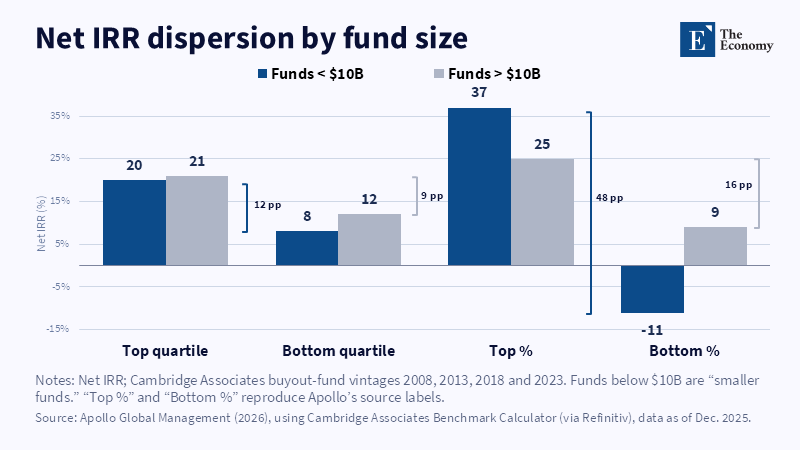
The explanation is closely linked to how value is created. Smaller companies rely less on borrowing than larger ones, with their performance coming more from profit margin growth and operational improvement than from financial leverage. In an environment of higher interest rates for longer, reliance on leverage turns into a disadvantage, as debt servicing costs erode net returns. At the same time, the dispersion of returns increases as fund size decreases, which highlights the importance of selectivity and expertise when choosing a manager, since not all smaller funds achieve equally strong results.
Why Scale Matters More in Today's Market
Despite the historical data, Apollo's analysis argues that the traditional middle-market advantage is becoming less reliable. Competition for quality targets has widened, with more managers, lenders and intermediaries vying for the same limited core of companies, while global buyout dry powder now exceeds $1 trillion. Leverage and multiple expansion, which historically accounted for around 59% of returns between 2010 and 2022, no longer work the same way, since higher borrowing costs limit the margin for error.
Slow exits compound the pressure. Distributions as a percentage of net asset value remain below 15% for the fourth consecutive year, a record period of delayed liquidity. In this environment, a barbell-style portfolio is proposed in Apollo's analysis, combining a core of large, more resilient managers with a smaller segment of specialized middle-market managers that possess genuine differentiation. Simply spreading capital across multiple funds in the same category, with no real skill differentiation, tends to produce returns closer to the market median rather than outperformance, shifting the focus from fund size to the quality of manager selection.
Why Europe's Middle Market Is Regaining Attention
The fragmented structure of the European market, which was previously seen as an obstacle, now acts as a competitive filter for investors with local expertise. CVC's analysis argues that differences in regulation, languages, political structures and local markets can limit the ability of generalist capital to scale effectively while creating valuation opportunities that are less common in the more integrated U.S. buyout market. Europe's lower middle market, with a large population of family businesses and lower institutional capital intensity, remains relatively less covered by institutional investors.
The interest of international investors in the region is increasing significantly. According to PitchBook's forecasts, U.S. investors are expected to account for about one quarter of European private equity deal count in 2026 as transatlantic capital flows continue to strengthen. For investors able to manage the complexity of the region, the valuation discount seen in Europe increasingly looks like a relative value opportunity rather than a structural market weakness.
Outlook for Middle-Market Private Equity
Improved sentiment was reported in S&P Global Market Intelligence's October 2025 webinar following interest rate cuts by the Federal Reserve, although uncertainties around tariffs and labor costs remain. Private equity firms continue to seek quality targets with strong operational leverage and capable management teams, while the continued influx of dry powder is expected to fuel further M&A activity.
Table 1. Middle-Market Private Equity at a Glance
| Market Signal | Verified Evidence | Implication |
|---|---|---|
| U.S. activity | $410.7B across about 4,018 deals in 2025 | Activity remains historically strong |
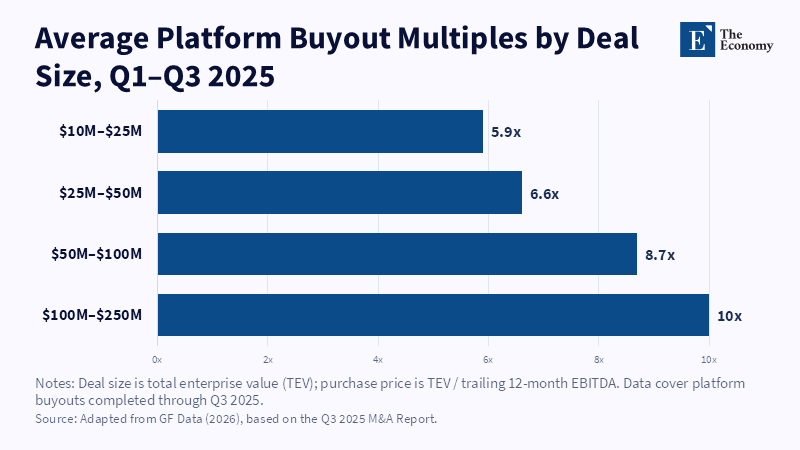
| Entry pricing | 5.9x to 10.0x EBITDA across $10M to $250M TEV | Larger platforms command higher multiples |
| Buyout dry powder | More than $1T globally | Competition for quality assets remains high |
| Liquidity | Distributions below 15% of NAV for four years | Exit pressure remains elevated |
| European competition | U.S. investors forecast near 25% of 2026 deal count | Transatlantic competition is increasing |
In S&P Global Market Intelligence's webinar, participants described the adoption of artificial intelligence as an additional differentiator, with companies using it for operational efficiency, particularly in customer service and marketing, without a broad reduction in headcount having yet been observed. The main conclusion remains close to the starting point of the analysis: the middle market continues to accumulate a significant volume of capital and opportunities but mere exposure to this segment is no longer sufficient to ensure outperformance. Manager selection, geographic diversification and understanding where operational value is actually created are becoming central to underwriting and portfolio construction.
This article reflects the analytical judgment of The Economy Markets Editorial Board and does not constitute business advice or the official position of any affiliated institution.
References
Apollo Global Management (2026) Beyond the Middle Market: Private Equity Investing for a More Demanding Regime. 6 May.
CVC (2025) Why Europe Offers a Strategic Private Equity Advantage.
GF Data (2026) The Size Premium Returns to 2.8x: How Employee Ownership Helps Smaller Platforms Compete. 27 January.
Lai, E. (2026) ‘Who is gaining share as US investors pile into Europe?’, PitchBook, 13 February.
PitchBook (2026) 2025 Annual US PE Middle Market Report. 13 March.
S&P Global Market Intelligence (2025) ‘Trends Shaping the Middle Market M&A Landscape in 2025 and Beyond’, 5 November.
Seely, T. and Buyse, P.-J. (2026) ‘Four reasons to choose mid-market private equity’, WTW, 4 June.
The Economy Markets Editorial Board is a multidisciplinary group of researchers, analysts and sector specialists covering the structure and evolution of global professional and institutional markets. Its work examines competitive landscapes, market positioning, buyer choice and the forces reshaping industries across advisory services, capital markets, wealth management, healthcare and other specialist sectors.
The Board also contributes to The Economy’s ranking research, where its members assess firms, institutions and market participants using structured research, sector evidence and comparative analysis. This combination of market research and ranking coverage gives the Board a continuing view of how competitive positions develop within individual industries and how firms differentiate themselves as markets evolve.
Through The Economy Markets, the Board translates this research into accessible analysis of market structure, competitive dynamics and institutional change, complementing The Economy’s rankings, Wiki profiles and broader research coverage with a comparative view of the markets in which ranked organisations operate.
Similar Post