Trump Tariff Shock Deepens Dollar Slide, Global Capital Shifts to Euros and Yuan as Borrowing Costs Mount

Authored on
Modified
Prolonged U.S. High Rates Drive Up Dollar Borrowing Costs
Sovereign and Corporate Funding Shifts Toward Euros and Yuan
Cracks Deepen in Dollar-Centric Global Financial Order
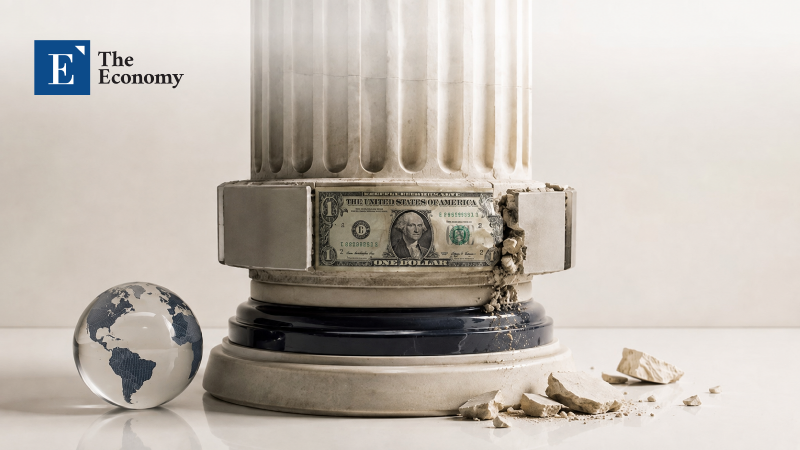
Cross-border bank credit has surged worldwide, while cracks are widening in the dollar-centric system of international financing. As elevated U.S. interest rates drive up dollar borrowing costs, governments and companies have broadened their funding channels into euros and yuan, while central banks have increasingly diversified their reserve assets across currencies. The simultaneous decline in U.S. equities, Treasuries and the dollar following the tariff shock unleashed by the Donald Trump administration has also eroded the safe-haven premium attached to dollar assets. A prolonged decline in overseas demand would leave the United States contending with higher Treasury funding costs, diminished seigniorage revenue and mounting fiscal pressure.
Surge in Euro Borrowing by Companies and Sovereigns
According to the Bank for International Settlements’ (BIS) report, “International Banking Statistics and Global Liquidity Indicators,” released on Aug. 6 local time, the outstanding balance of cross-border bank loans and bonds worldwide—collectively classified as cross-border bank credit—reached $39.5 trillion in the first quarter of this year. The figure represented an 11% increase from a year earlier. Total cross-border claims, including loans, deposits, bonds and financial derivatives, rose by $2.1 trillion to $47.6 trillion, marking the largest volume of global capital flows since the COVID-19 pandemic.
The most striking development in the latest data was a signal that the dominant funding currencies are undergoing a changing of the guard. Governments and companies worldwide have traditionally relied primarily on the U.S. dollar for cross-border transactions. In recent years, however, euro borrowing has expanded far more rapidly than dollar borrowing. Euro-denominated foreign-currency lending increased 12% year over year to approximately $5.89 trillion in the first quarter. Dollar-denominated foreign-currency lending rose 7.3% to $14.7 trillion.
The euro’s share of the global foreign-currency lending market climbed from 22% in the third quarter of 2022 to 28% in the first quarter of 2026. As the Federal Reserve’s prolonged high-rate policy increased the interest burden on dollar borrowing, borrowers diversified their funding channels toward euros, which offered comparatively lower financing costs or more favorable transaction terms.
South Korean Government Expands Euro-Denominated Bond Issuance
The South Korean government has also increased the share of its euro funding. In June 2025, the government issued approximately $1.62 billion in euro-denominated Foreign Exchange Stabilization Fund Bonds. It was the first euro issuance in four years since 2021 and the government’s first dual-tranche transaction combining three-year and seven-year maturities. Orders reached approximately $21.87 billion, more than 13 times the issuance amount.
In July this year, the government increased the issuance to approximately $1.96 billion, setting another record high. The spreads on the three-year and seven-year tranches were 10 basis points and 28 basis points over the euro mid-swap rate, respectively, down 15 basis points and 24 basis points from the previous year. Following its dollar-denominated Foreign Exchange Stabilization Fund Bond issuance in February, the government established a benchmark in the euro market and exhausted its full $5 billion foreign-currency bond issuance ceiling for this year. It also secured approximately $808 million three months ahead of the maturity of the relevant bonds in October.
Table 1. Expansion of Global Cross-Border Credit and Diversification of Funding Currencies
| Category | Key Indicator | Change and Key Features |
|---|---|---|
| Cross-border bank credit | $39.5 trillion | Up 11% year over year |
| Total cross-border claims | $47.6 trillion | Increased by $2.1 trillion, reaching the highest level since the COVID-19 pandemic |
| Euro-denominated foreign-currency lending | Approximately $5.89 trillion | Up 12% year over year |
| Dollar-denominated foreign-currency lending | $14.7 trillion | Up 7.3% year over year |
| Euro share of foreign-currency lending | 28% | Up 6 percentage points from 22% in the third quarter of 2022 |
| South Korean government’s euro-denominated Foreign Exchange Stabilization Fund Bonds | Approximately $1.62 billion in 2025 → approximately $1.96 billion in 2026 | Record issuance volume; three-year and seven-year spreads of 10 basis points and 28 basis points, respectively |
| Singapore’s euro-denominated bond issuance | Approximately $102.8 billion | Highest January-to-July 18 total since 2014 |
| Canada’s yuan refinancing | $3.5 billion | Chinese dollar loan converted into yuan, with projected annual interest savings of $215 million |
| Outstanding offshore yuan financing by Chinese institutions | More than approximately $474.3 billion | Quadrupled over the past five years |
| Hong Kong dim sum bond issuance | Approximately $41.9 billion | More than doubled year over year between January and April 2026 |
Yuan Refinancing Expands Amid China’s Low-Rate Offensive
Currency diversification among emerging economies first became visible in eurobond market data. According to Bloomberg, euro-denominated bonds issued by emerging-market governments and companies reached approximately $102.8 billion as of July 18, 2025, the highest level for the comparable period since 2014. Sovereign issuance had already surpassed the full-year total for 2024 by that point. Poland and Romania raised approximately $24.24 billion, while South Korea, China and Chile also entered the eurobond market in succession.
The shift toward yuan financing has also accelerated. Supported by Chinese lending and payment networks, the yuan has made inroads into developing countries’ refinancing markets. In October 2025, Kenya converted a $3.5 billion dollar-denominated railway construction loan from the Export-Import Bank of China into yuan. By replacing a floating-rate dollar loan with lower-cost yuan financing, the Kenyan government estimated that its annual interest burden would decline by $215 million. According to the Financial Times (FT), Panama also used a loan originally denominated in Swiss francs and equivalent to $2.4 billion to reduce its financing costs by more than $200 million, while Colombia considered refinancing its dollar- and peso-denominated debt into lower-interest-rate currencies.
China’s low interest rates have provided a direct pricing incentive for the yuan’s internationalization. Outstanding offshore yuan loans, deposits and bond investments held by Chinese financial institutions quadrupled over five years to more than approximately $474.3 billion. Yuan-denominated dim sum bonds issued in Hong Kong’s offshore market through April this year totaled approximately $41.9 billion, more than double the amount recorded during the same period a year earlier. According to the FT, proprietary yuan issuance by U.S. banks, including Goldman Sachs, also reached a record high of approximately $6.63 billion.
Reserve Currency Reallocation Erodes the Dollar Premium
The diversification of borrowing currencies is prompting central banks and private investors to rebalance their currency holdings. Central banks, companies and households that accumulated dollar assets as protection against dollar appreciation have begun factoring holding costs into their calculations. Although prolonged high U.S. interest rates have raised yields on dollar-denominated bonds, exchange-rate volatility and currency-hedging costs have also increased.
According to the International Monetary Fund (IMF), the dollar accounted for 56.77% of global foreign-exchange reserves at the end of last year. That was more than 15 percentage points below the 72% recorded in 2001. The euro accounted for 20.25% and the yuan 1.95%, while the share of other currencies more than doubled from its 2021 level to 6.13%. In the BIS foreign-exchange market survey conducted last year, the dollar was involved in 89.2% of all foreign-exchange transactions. The euro accounted for 28.9% and the yuan 8.5%. The market shift is consequently unfolding through the currency composition of new financing. As euro- and yuan-denominated bond issuance accumulates, yield curves across maturities, collateral pools and investor bases deepen, reducing funding costs for subsequent issuers.
Return of the U.S. Risk Premium
Dollar interest rates and the dollar’s value generally do not maintain a uniform inverse relationship. Higher interest rates often raise expected returns on dollar assets, attracting capital inflows and strengthening the currency. Recently, growing concern over U.S. fiscal sustainability and policy credibility has pushed up long-term yields, disrupting this established dynamic. The 30-year U.S. Treasury yield climbed to around 5.1%, its highest level since 2007, while the term premium on long-term bonds surged to 1.56%, the highest since 2013. The dollar nevertheless faced downward pressure. Rising rates shifted from a yield signal enhancing investment appeal into compensation for U.S. fiscal and policy risks.
The dollar’s weakness despite high interest rates reflects deteriorating confidence in U.S. fiscal and monetary policy. At last month’s Federal Open Market Committee (FOMC) meeting, a majority of members called for an immediate rate increase, yet the benchmark rate remained unchanged. The United States and Japan also conducted their first coordinated foreign-exchange intervention in nearly three decades to support the yen, while the U.S. government publicly endorsed a stronger yen, fueling expectations of further dollar weakness. With tariffs, fiscal deficits and inflationary pressure converging, the “Sell America” trade—marked by rising bond yields and a falling dollar—is also regaining momentum.
Tariff Shock Breaks the Dollar’s Established Formula
Trump’s trade policy triggered the shift. On April 2 last year, which the administration designated “Liberation Day,” the Trump administration announced a reciprocal tariff plan imposing a 10% baseline levy on nearly all imports, supplemented by additional country-specific rates. After China and other major trading partners signaled retaliatory measures, concerns over economic contraction and rising inflation spread simultaneously across capital markets. According to the National Bureau of Economic Research (NBER), the Standard & Poor’s 500 Index fell by more than 11% immediately after the tariff announcement, while the 10-year U.S. Treasury yield jumped approximately 50 basis points between April 4 and April 11. The European Central Bank (ECB) found that the dollar also declined during the same period, producing an unusual market pattern in which U.S. equities, Treasuries and the currency were sold off concurrently.
The tariff shock also eroded the safe-haven premium assigned to U.S. assets. Markets judged that the tariffs would pressure corporate earnings and consumption while exacerbating the U.S. fiscal burden and inflation. Speculative capital positioned for dollar strength before the reciprocal tariff announcement subsequently shifted to net short positions, while Asian investors rapidly increased the hedging ratio on their dollar assets. Equity prices recovered after the tariffs were suspended for 90 days, yet the convenience yield on U.S. Treasuries and the dollar’s risk-aversion function failed to return to previous levels. Repeated tariff announcements and reversals established a precedent in which U.S. policy uncertainty was priced into Treasury yields and exchange rates as an additional cost.
Direct Blow to U.S. Public Finances
The costs facing the United States if its reserve-currency premium disappears would far exceed the scale of exchange-rate fluctuations. In a model assuming the complete disappearance of foreign demand for dollar-denominated safe assets, NBER researchers estimated that U.S. seigniorage revenue would decline annually by an amount equal to 1% of gross domestic product (GDP). The dollar’s real value would fall by 8.8%, while U.S. real interest rates would rise by 0.9 percentage points. Dollar-denominated bonds that U.S. investors would need to absorb would amount to 50% of GDP, while the present value of national wealth losses would reach $33 trillion, exceeding annual U.S. GDP.
Repeated tariff announcements and reversals, controversy over the Fed’s independence and widening fiscal deficits reduce the convenience yield on dollar assets and raise refinancing costs for U.S. Treasuries. According to the ECB, outstanding U.S. Treasury debt totals $30 trillion, twice the level recorded in 2018. The erosion of reserve-currency status is unfolding as overseas investors gradually retreat from the longstanding practice of accepting lower yields to purchase U.S. Treasuries. As U.S. policy uncertainty begins to translate into market interest rates, the government’s interest expenses and fiscal burden continue to accumulate each time Treasury debt reaches maturity.
Similar Post