[Market Intelligence] Competitive Discovery in Technology Advisory 2026: Who Buyers Find, Whom AI Recommends, and Which Firms the Market Is Learning to Associate with the Work

The Economy Markets Editorial Board is a multidisciplinary group of researchers, analysts and sector specialists covering the structure and evolution of global professional and institutional markets. Its work examines competitive landscapes, market positioning, buyer choice and the forces reshaping industries across advisory services, capital markets, wealth management, healthcare and other specialist sectors.
The Board also contributes to The Economy’s ranking research, where its members assess firms, institutions and market participants using structured research, sector evidence and comparative analysis. This combination of market research and ranking coverage gives the Board a continuing view of how competitive positions develop within individual industries and how firms differentiate themselves as markets evolve.
Through The Economy Markets, the Board translates this research into accessible analysis of market structure, competitive dynamics and institutional change, complementing The Economy’s rankings, Wiki profiles and broader research coverage with a comparative view of the markets in which ranked organisations operate.
Authored on
Modified
Ten firms capture roughly half of observed search and AI discovery
Tier I dominates, but search and AI disagree on many challengers
For half the market, claimed capability travels further than outside recognition
A technology advisory firm can be capable enough to win the work and still be invisible enough never to receive the invitation. That is the uncomfortable starting point of The Economy’s new Market Intelligence study of 89 firms across AI and data implementation, digital transformation and enterprise technology advisory. The rankings establish the market boundary. The investigation begins where the rankings end: when a buyer asks a non-branded question, which firms actually enter consideration?
This article publishes selected findings from the full Market Intelligence report and supporting dataset. The research covers 90 ranking positions, 30 frozen Google searches, 24 frozen prompts tested across ChatGPT and Gemini in three repetitions, 300 coded Google results and 1,440 coded AI mentions. It is not a second ranking and it does not claim to measure delivery quality. It measures a more immediate commercial fact: who is likely to be found before credentials, chemistry or price can be assessed.
An 89-Firm Market Becomes A Ten-Name Shortlist
The research universe combines Advisory Ranking’s 2026 lists for:
Together, they contain 90 positions and 89 unique firms; Slalom is the only firm appearing in two categories.
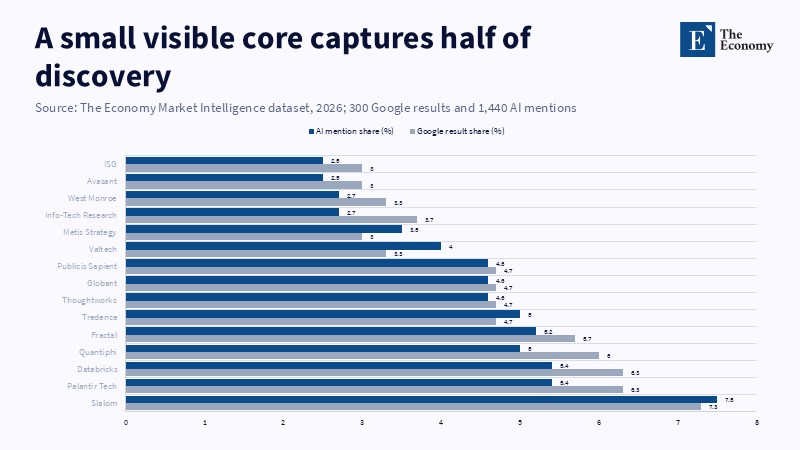
Yet the discovery market is much smaller than the institutional market. The ten most visible firms account for 54.0% of coded Google results and 51.2% of coded AI mentions. The top five alone take 31.7% and 28.5%, respectively. Palantir Technologies, Databricks, Thoughtworks, Globant and Publicis Sapient reach complete eligible coverage across both search and AI in the study.
The result is not winner-takes-all, but it is harsh. Buyers may begin with a market of nearly ninety plausible providers and experience it as a recurring group of fewer than fifteen. Every firm outside that visible core is competing twice: first to enter the shortlist and only then to win the mandate.
Tier Helps. It Does Not Decide.
Tier I firms possess a decisive discovery advantage. In AI and data implementation, Tier I records mean Google visibility of 91.6% and mean AI discovery of 96.2%, compared with 28.5% and 31.2% for Tier II. In digital transformation, the gap is wider: 93.4% and 97.3% for Tier I, against 14.3% and 22.3% for Tier II. Enterprise technology is more open, with Tier II firms collectively taking 42% of observed Google attention and 47% of AI mentions within that category.
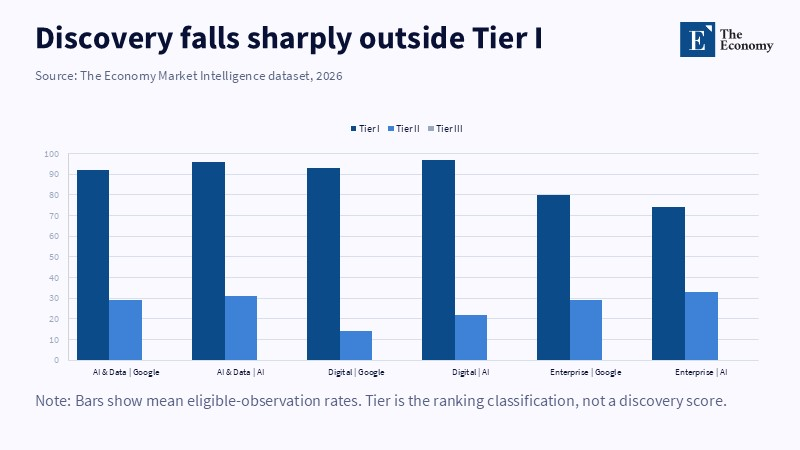
The exceptions are where the competitive intelligence becomes valuable. Slalom is Tier II in AI and data implementation but records 95.7% Google visibility and 100% AI discovery across its eligible panel, a footprint that looks nothing like an ordinary Tier II firm. In enterprise technology, UpperEdge reaches 58.3% Google visibility and 44.4% AI discovery, while Oresys is materially stronger in AI than in Google.
This is why the report does not turn the original ranking into a ceremonial summary. Published position is useful context, but discovery shows whether that standing survives contact with the systems that increasingly assemble a buyer’s first list.
Search And AI Agree On The Elite, Then The Market Fractures
The visible leaders are reinforced by both channels. Below them, Google and AI often produce different markets. Metis Strategy records 75.0% Google visibility but 94.4% AI discovery. Tredence records 73.7% and 92.3%. In the other direction, Info-Tech Research Group reaches 91.7% in Google but 72.2% in AI.
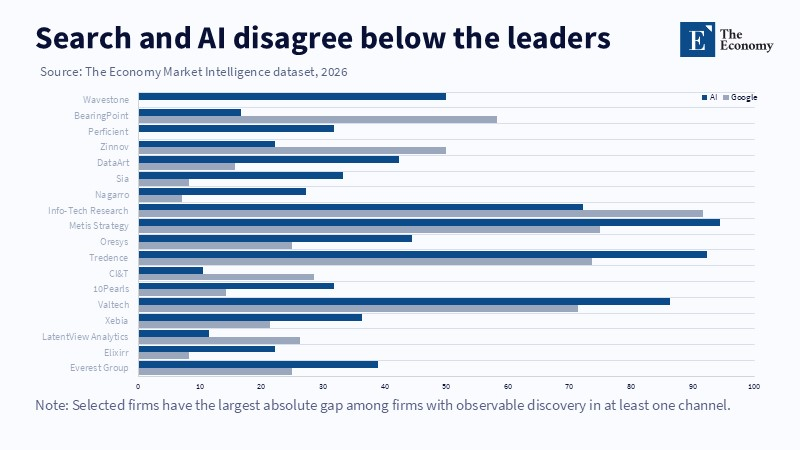
The disagreement is more dramatic among challengers. Wavestone is absent from its eligible Google panel but appears in 50.0% of eligible AI runs. BearingPoint shows the reverse pattern, with 58.3% Google visibility and 16.7% AI discovery. DataArt is also AI-led, while CI&T is search-led.
Table 1: Selected Discovery Patterns From The Full 89-Firm Dashboard
| Firm | Published tier | AI | Observed pattern | |
|---|---|---|---|---|
| Palantir Technologies | Tier I | 100.0% | 100.0% | Reinforced leader |
| Slalom | Tier I / Tier II | 95.7% | 100.0% | Outperforms its lower category tier |
| Metis Strategy | Tier I | 75.0% | 94.4% | AI-led |
| Info-Tech Research Group | Tier I | 91.7% | 72.2% | Search-led |
| UpperEdge | Tier II | 58.3% | 44.4% | Visible challenger |
| Wavestone | Tier II | 0.0% | 50.0% | Strongly AI-led |
| BearingPoint | Tier II | 58.3% | 16.7% | Strongly search-led |
| DataArt | Tier II | 15.8% | 42.3% | AI-led |
A firm testing only Google can conclude it is weaker than the market perceives it. A firm testing only one AI system can reach the opposite error. Even ChatGPT and Gemini disagree below the leaders: LatentView Analytics is materially stronger in Gemini, while Oresys and UpperEdge are stronger in ChatGPT. Discovery is not one channel, one model or one stable answer.
The Market Has Not Learned Half The Claims
The most provocative result is not the leader table. It is the identity gap. Of 89 firms, 45 are more visible in their own positioning than in outside discovery. Thirty-seven are broadly aligned and seven are only partially discovered. Each of the three categories contains exactly fifteen claim-heavy firms.
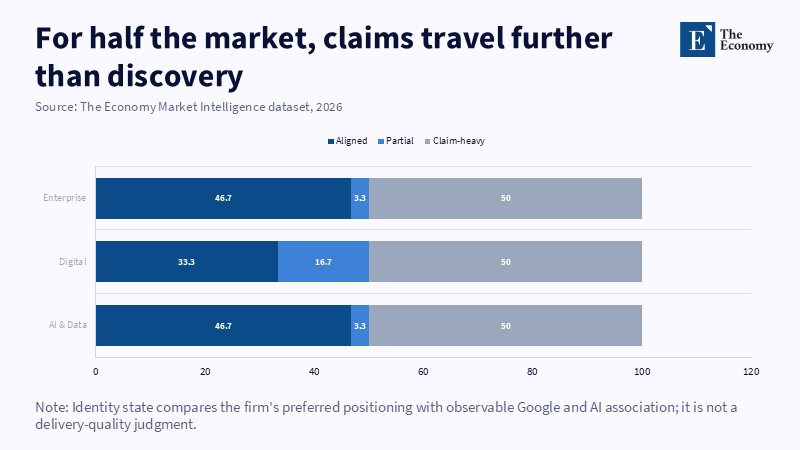
This does not mean that the claims are false. It means the market cannot retrieve them consistently. A firm may have experienced practitioners, credible mandates and a carefully written website, yet fail to become associated with the problem when the buyer searches without using its name. Capability that remains trapped inside owned channels is commercially silent.
That creates a dangerous management illusion. Existing clients and branded visitors can make a firm feel visible while new buyers do not encounter it. Publishing more content will not necessarily solve the problem. The missing ingredient may be clearer category association, stronger named-expert authority, independent reinforcement, better problem language or evidence that competitors have already made easier to retrieve.
What The Full Market Intelligence Report Shows
This public article shows four exhibits and eight selected firm rows. The full Market Intelligence report contains the complete 89-firm dashboard, the full leader and divergence tables, ChatGPT-versus-Gemini comparisons, claimed-versus-discovered identity states, buyer-intent patterns, rank divergence, six-market geographic analysis and the underlying methodology used to keep denominators comparable.
For a firm named in the research, the commercially important question is not whether the market is concentrated. It is where that specific firm sits inside the concentration: which channel carries it, which problems retrieve it, which rivals appear beside it, whether its intended identity travels beyond its own website, and whether its published standing is reinforced or contradicted by discovery. Those answers require the full firm-level matrix, not a public excerpt.
For access options and commercial terms, see the Market Intelligence Access Structure or contact The Economy Markets Editorial Board at [email protected].
This article presents selected findings from The Economy Market Intelligence and is intended as a summary of the underlying competitive market scan. The complete report contains the full analysis, methodology, charts and firm-level comparative tables. Structured data access is also available for institutions requiring the underlying comparative dataset.
References
Ranking News — Advisory Desk (2026a) ‘Top 30 AI & Data Implementation Advisory 2026’, Advisory Ranking, April 2026.
Ranking News — Advisory Desk (2026b) ‘Top 30 Digital Transformation Advisory 2026’, Advisory Ranking, April 2026.
Ranking News — Advisory Desk (2026c) ‘Top 30 Enterprise Technology Advisory 2026’, Advisory Ranking, April 2026.
The Economy Markets Editorial Board (2026) Competitive Discovery in Technology Advisory: Who Buyers Find, Whom AI Recommends, and Which Firms the Market Is Learning to Associate with the Work. The Economy Market Intelligence, 2026 Edition.
The Economy Markets Editorial Board is a multidisciplinary group of researchers, analysts and sector specialists covering the structure and evolution of global professional and institutional markets. Its work examines competitive landscapes, market positioning, buyer choice and the forces reshaping industries across advisory services, capital markets, wealth management, healthcare and other specialist sectors.
The Board also contributes to The Economy’s ranking research, where its members assess firms, institutions and market participants using structured research, sector evidence and comparative analysis. This combination of market research and ranking coverage gives the Board a continuing view of how competitive positions develop within individual industries and how firms differentiate themselves as markets evolve.
Through The Economy Markets, the Board translates this research into accessible analysis of market structure, competitive dynamics and institutional change, complementing The Economy’s rankings, Wiki profiles and broader research coverage with a comparative view of the markets in which ranked organisations operate.
Similar Post