How AI Is Reshaping Retail Due Diligence for Private Equity

The Economy Markets Editorial Board is a multidisciplinary group of researchers, analysts and sector specialists covering the structure and evolution of global professional and institutional markets. Its work examines competitive landscapes, market positioning, buyer choice and the forces reshaping industries across advisory services, capital markets, wealth management, healthcare and other specialist sectors.
The Board also contributes to The Economy’s ranking research, where its members assess firms, institutions and market participants using structured research, sector evidence and comparative analysis. This combination of market research and ranking coverage gives the Board a continuing view of how competitive positions develop within individual industries and how firms differentiate themselves as markets evolve.
Through The Economy Markets, the Board translates this research into accessible analysis of market structure, competitive dynamics and institutional change, complementing The Economy’s rankings, Wiki profiles and broader research coverage with a comparative view of the markets in which ranked organisations operate.
Authored on
Modified
AI shifts retail discovery toward shopping missions
Customer control increasingly determines where retail profits accumulate
Consumer specialists gain relevance as AI standardizes operations

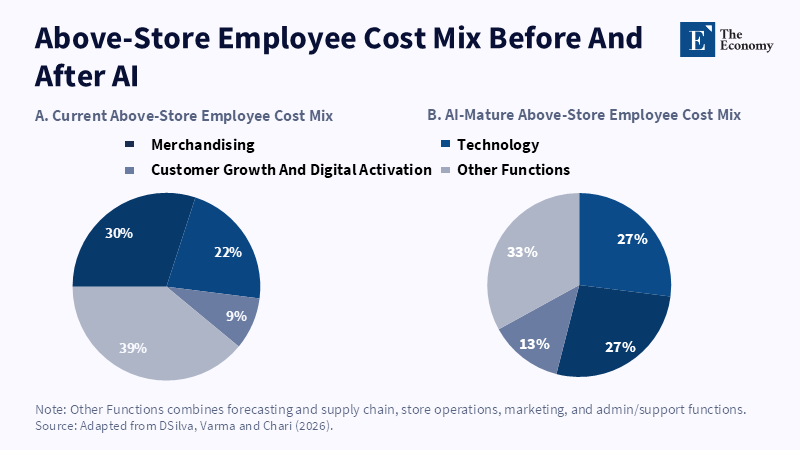
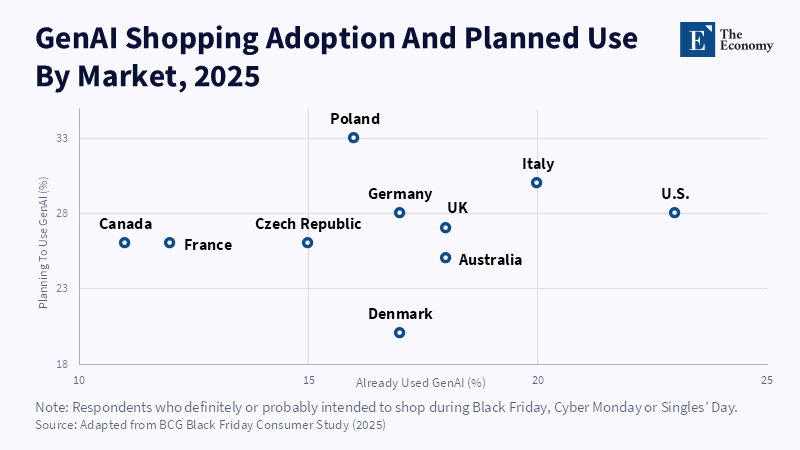
In retail organizations with mature AI integration, above-store organizational productivity is expected to increase by over 30%, whereas total employee costs are reduced by about 10%, according to an analysis by Boston Consulting Group published in February 2026. The figures point to a broader reallocation across the retail value chain. Consumers are no longer searching for individual products in the traditional way of browsing shelves or categories. They are looking for solutions to specific “missions”, such as renewing a winter wardrobe or organizing a children’s party. Interfaces that better understand the context, constraints and consumer preferences take precedence over those that rely on static categorizations. Digital channels, especially AI assistants will become the default research space before considered purchases, while the physical store will become a space of confirmation and service rather than discovery.
AI Redistributes Retail Profit Pools
The gains are unevenly distributed. Retailers that act as a destination, i.e. those that the consumer is looking for directly, will retain healthier margins and leverage their proprietary data for loyalty, personalization and advertising revenue. In contrast, evaluation retailers, i.e. those that depend on traffic through AI platforms, will face margin pressure as they compete on cost, execution speed and visibility to buying agents.
At the same time, traditional sources of differentiation, such as promotions, replenishment and demand forecasting, are increasingly standardized by algorithms and cease to be a real competitive advantage. That means that is shifting toward distinctive customer value propositions, smart rules that shape algorithms and human critical thinking capable of identifying market gaps. Retail investment is expected to grow by about a third in the coming years. A larger share of investment is expected to be directed toward data infrastructure and supply chain automation rather than store renovations.
AI Weakens Brand Power Unevenly
Morgan Stanley Investment Management’s analysis, published in May 2026, describes how barriers to entry into the consumer market have steadily decreased over the past two decades through the internet, social networks and lighter asset structures. AI is likely to accelerate this trend rather than reverse it. When purchasing decisions are increasingly delegated to rational AI agents, a brand’s value can shrink in everyday, low-consideration purchases, where the cost of error is small.
The phenomenon is not universal. In high-consideration categories, such as automobiles or consumer electronics, AI can enhance decision-making rather than replace it. In luxury, where signaling remains part of the value proposition, brand preference remains central. The middle is narrowing as less differentiated, less efficient firms face greater pressure, while technology platforms continue to absorb a disproportionate share of the value created.
Consumer And Retail Private Equity Firms Back Specialized Winners
In this environment, private equity firms specializing in consumer and retail assets are now looking not just for recognizable brands but for brands with a proven ability to leverage data, personalization and operational discipline. Capital Ranking’s Top 30 Consumer & Retail PEF 2026 ranking places L Catterton, Roark Capital, Sycamore Partners and TSG Consumer Partners among the Tier I firms, based on institutional scale, continuity of investment activity and depth of operational resources.
The difference between these companies and generalist investors is not just capital size. It is the ability to evaluate factors that are difficult to capture in conventional financial analysis, such as brand identity, repeat purchasing behavior and distribution quality. As AI standardizes demand forecasting and inventory management, specialist consumer investors gain a relative advantage over generalist investors precisely because they know where a brand’s real, long-term value lies.
Table 1: How AI Is Reshaping Retail Competition
| Area | What Is Changing | Competitive Implication |
| Shopping | Products and categories shift toward missions | AI interfaces influence discovery |
| Profit Pools | Destination retailers retain stronger economics | Direct customer relationships matter more |
| Brand Power | Routine purchases become easier to compare | Differentiation matters more |
| Operations | AI raises productivity and changes cost mix | Data and technology capabilities gain weight |
| Private Equity | Specialist consumer expertise becomes more valuable | Brand and retail execution support value creation |
Specialist Investors Build Winners Internally
Not all funds find a ready-to-buy winning brand. In these cases, the strategy shifts from acquiring an already successful brand to building internal in-portfolio capability, with acquisition teams and operating partners tasked with transforming a mid-sized business into a category leader through data, personalization and disciplined retail execution. This approach requires deeper operational involvement than a mere financial investment, which explains why specialist investors with a history of brand-building maintain an advantage over generalist competitors.
The same logic extends to investors. Productivity growth of over 30% in mature retail organizations is not just about retailers themselves. It also concerns those who invest in them, as the ability to restructure an operating model around AI becomes a prerequisite for value retention, not an optional upgrade. The private equity firms that maintain their leadership will be those that treat AI as a restructuring of their portfolio’s entire business model, not as an incremental performance tool.
This article reflects the analytical judgment of The Economy Markets Editorial Board and does not constitute business advice or the official position of any affiliated institution.
References
Capital - PEF Desk (2026) ‘Top 30 Consumer & Retail PEF 2026’, Capital Ranking, 1 May, updated 30 July 2026.
Distler, J., Kroth, M.D., Shenck, N., Malby, A., Yeh, T. and Klumpp, I. (2025) ‘Consumers Are Rewriting the Rules of Year-End Sales Events’, Boston Consulting Group, 3 November.
DSilva, S., Varma, A. and Chari, S. (2026) ‘Retail Rewired: How AI Is Reshaping the Retail Business Model’, Boston Consulting Group, 10 February.
Dziedzic, B. (2026) ‘What It Takes for Consumer Brands to Win in an AI Era’, Morgan Stanley Investment Management, 18 May.
The Economy Markets Editorial Board is a multidisciplinary group of researchers, analysts and sector specialists covering the structure and evolution of global professional and institutional markets. Its work examines competitive landscapes, market positioning, buyer choice and the forces reshaping industries across advisory services, capital markets, wealth management, healthcare and other specialist sectors.
The Board also contributes to The Economy’s ranking research, where its members assess firms, institutions and market participants using structured research, sector evidence and comparative analysis. This combination of market research and ranking coverage gives the Board a continuing view of how competitive positions develop within individual industries and how firms differentiate themselves as markets evolve.
Through The Economy Markets, the Board translates this research into accessible analysis of market structure, competitive dynamics and institutional change, complementing The Economy’s rankings, Wiki profiles and broader research coverage with a comparative view of the markets in which ranked organisations operate.
Similar Post