Private Banking vs Wealth Management: What the 2026 Rankings Show

The Economy Markets Editorial Board is a multidisciplinary group of researchers, analysts and sector specialists covering the structure and evolution of global professional and institutional markets. Its work examines competitive landscapes, market positioning, buyer choice and the forces reshaping industries across advisory services, capital markets, wealth management, healthcare and other specialist sectors.
The Board also contributes to The Economy’s ranking research, where its members assess firms, institutions and market participants using structured research, sector evidence and comparative analysis. This combination of market research and ranking coverage gives the Board a continuing view of how competitive positions develop within individual industries and how firms differentiate themselves as markets evolve.
Through The Economy Markets, the Board translates this research into accessible analysis of market structure, competitive dynamics and institutional change, complementing The Economy’s rankings, Wiki profiles and broader research coverage with a comparative view of the markets in which ranked organisations operate.
Authored on
Modified
Scale alone does not determine private wealth leadership
Specialist firms compete through focus, governance and access
Service model matters more than brand recognition

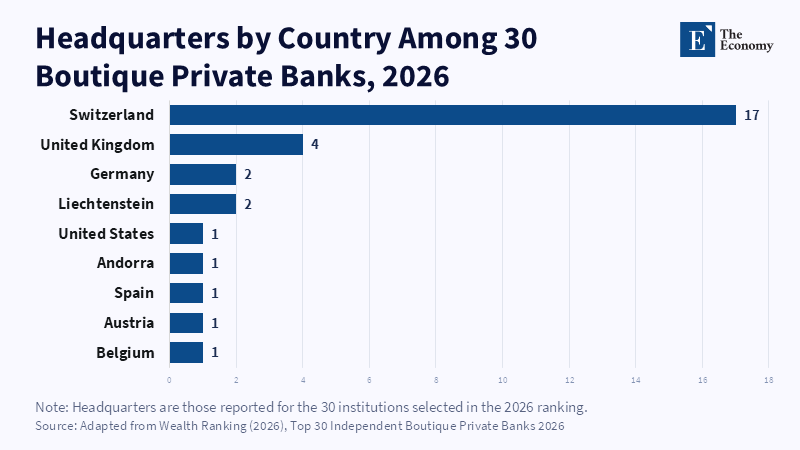
Of approximately ninety independent private banking institutions assessed in the Top 30 Independent Boutique Private Banks 2026 ranking, thirty were selected, with Pictet and Lombard Odier both placed in Tier I. In the corresponding ranking of specialist private-market managers and private wealth access platforms, thirty were also selected out of about one hundred and twenty candidate institutions. The selection rates reveal how restrictive both rankings are by capturing a market where scale no longer guarantees a place at the top and where specialization counts just as much as balance sheet size. In this context, the distinction between private banking and wealth management ceases to be an academic question and becomes a matter of practical choice for high-net-worth families.
Private Banking and Wealth Management: Where the Models Overlap
Private banking has traditionally focused on personalized banking services for affluent customers, with a dedicated banking advisor, preferential interest rates and access to exclusive products. Wealth management, in contrast, covers a wider range of services, from investment strategy to tax planning and estate succession, with a team of experts rather than a single advisor.
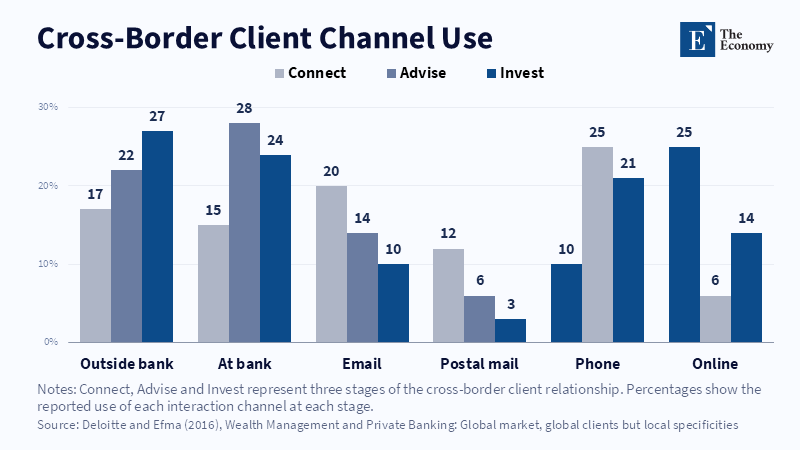
The Deloitte-EFMA survey on private banking and wealth management, based on data from more than seventy-five institutions, notes that the industry is entering a period of unprecedented transparency, with increased regulatory burden and the movement of clients to their country of tax residence. Many institutions now offer hybrid models that combine both services, particularly for expat clients managing assets across multiple jurisdictions. This practice blurs the boundaries between the two categories but does not eliminate the fundamental difference in philosophy: one focuses on the comfort of day-to-day banking service, the other on long-term capital preservation and growth.
Private Banks Versus Independent Asset Managers
The comparison between private banks and independent asset managers is not new but the arguments have evolved significantly. Previous industry analyses observed that independent managers maintain better relationships with their clients but without always the capacity for economies of scale that large banks have. Independent managers now compete more directly with private banks. In Switzerland, where many independent managers operate, the regulatory framework in force since 2020 brought independent asset managers under an authorization and prudential-supervision regime, with ongoing supervision generally carried out by FINMA-authorized supervisory organizations.
Pricing transparency remains a key differentiator, although fee structures vary across both models and may include management, custody, transaction and performance-based charges. In the 2026 Boutique Asset Managers for Private Wealth rankings, institutions such as Hamilton Lane, Partners Group and StepStone Group are placed in Tier I because of their combination of private markets expertise and a sophisticated access platform for private wealth investors, while smaller firms such as Titanbay and Pantheon are recognized in the third and second tiers for their role as infrastructure for access to institutional strategies.
Large Banks Versus Independent Wealth Managers
A second comparison concerns large-bank wealth management units and independent private wealth managers. Large banks have recognition, a wide branch network and access to their own investment products but they face structural issues that affect the quality of service. Advisors in large banks often manage a large number of clients, which limits time and attention per relationship, while having sales targets for own products can affect the objectivity of recommendations. The speed of decision-making is also more limited due to the size of the organizations, making it difficult to adapt to new investment opportunities or risks.
Independent private wealth management firms, on the other hand, rely on a smaller client base per advisor, which allows for a deeper understanding of family goals and greater flexibility in strategy. Where the model is genuinely independent, the absence of proprietary-product obligations can reduce product conflicts and allow greater flexibility in recommendations.
Brand Recognition and the Limits of Scale
The tendency of affluent clients to choose well-known names over niche houses reflects a broader phenomenon of behavior that could be termed false "crowd wisdom." The logic that popularity equals quality is not always confirmed by the data. The methodology of the Independent Boutique Private Banks 2026 ranking itself explicitly acknowledges this, as assets under management and balance sheet size are treated as circumstantial evidence of institutional capacity rather than as a mechanistic ranking criterion. A smaller bank can occupy a strong position when its independence, category purity and professional prestige are excellent, even when its size falls significantly short of larger groups.
The same pattern appears in the ranking of specialist private-market managers and private wealth access platforms, where third-tier firms such as Titanbay or Stafford Capital Partners are recognized not by size but by clarity of identity and functional contribution to the ecosystem. Large universal banks and conventional fund managers with no meaningful relationship with private wealth are explicitly excluded by the ranking methodology, regardless of size. This is essential documentation that size alone is not a guarantee of quality of service or investment value and that selection based on name recognition can drive affluent clients away from institutions that would better serve their needs.
Table 1: Private Wealth Models at a Glance
| Model | Core Role | Main Strength | Ranking Context |
|---|---|---|---|
| Independent boutique private bank | Banking, custody, credit, investment advice | Integrated private-client relationship | Pictet and Lombard Odier are Tier I |
| Independent asset manager or adviser | Portfolio management and advice | Separation from the custodian bank | Distinct independent advisory model |
| Specialist private-markets manager | Private equity, credit, infrastructure, secondaries | Specialist investment expertise | Hamilton Lane, Partners Group and StepStone are Tier I |
| Private-markets access platform | Structures private-market access for wealth channels | Operational and distribution infrastructure | Titanbay is Tier III |
| Large universal bank wealth unit | Banking and wealth services at institutional scale | Broad banking infrastructure | Generally excluded from these boutique rankings |
What the 2026 Rankings Actually Show
The initial selection rate becomes clearer under this methodology. The selection was not based on a simple size comparison but on criteria of governance, independence and institutional consistency. Clients seeking a wealth management relationship should consider the ranking of institutions based on evidence-based criteria rather than relying solely on brand awareness. Pricing transparency and recommendation independence should be assessed alongside brand recognition, while relationship quality remains a more reliable selection guide than an institution's balance sheet size.
This article reflects the analytical judgment of The Economy Markets Editorial Board and does not constitute business advice or the official position of any affiliated institution.
References
Deloitte και EFMA (2023) Wealth Management and Private Banking: Global Market, Global Clients but Local Specificities. Luxembourg: Deloitte Luxembourg.
Delgado, A. (2024) 'Big Banks vs. Private Wealth Management: Choosing the Right Fit for You', Selkirk Wealth Management, Wellington-Altus Private Wealth, 28 June.
Kneale, C. (2025) 'Wealth Management vs. Private Banking: A Detailed Comparison', Titan Wealth International, 21 March.
Plummer, O. (2010) 'Private Bank Or Independent Asset Manager: Which Business Model Will Win?', WealthBriefing, 1 October.
The Economy Wiki (2026) Titanbay: Institutional Profile. Δουβλίνο: Gordon Institute of Artificial Intelligence.
VAPA (2025) 'How Swiss Independent Wealth Managers Compete with Global Private Banks', VAPA Independent Wealth Management Blog, 20 December.
Wealth Ranking (2026) Top 30 Boutique Asset Managers for Private Wealth 2026. Dublin: Gordon Institute of Artificial Intelligence.
Wealth Ranking (2026) Top 30 Independent Boutique Private Banks 2026. Dublin: Gordon Institute of Artificial Intelligence.
The Economy Markets Editorial Board is a multidisciplinary group of researchers, analysts and sector specialists covering the structure and evolution of global professional and institutional markets. Its work examines competitive landscapes, market positioning, buyer choice and the forces reshaping industries across advisory services, capital markets, wealth management, healthcare and other specialist sectors.
The Board also contributes to The Economy’s ranking research, where its members assess firms, institutions and market participants using structured research, sector evidence and comparative analysis. This combination of market research and ranking coverage gives the Board a continuing view of how competitive positions develop within individual industries and how firms differentiate themselves as markets evolve.
Through The Economy Markets, the Board translates this research into accessible analysis of market structure, competitive dynamics and institutional change, complementing The Economy’s rankings, Wiki profiles and broader research coverage with a comparative view of the markets in which ranked organisations operate.
Similar Post