[Family Office] How Competition and Global Expansion Are Reshaping Private Wealth

The Economy Markets Editorial Board is a multidisciplinary group of researchers, analysts and sector specialists covering the structure and evolution of global professional and institutional markets. Its work examines competitive landscapes, market positioning, buyer choice and the forces reshaping industries across advisory services, capital markets, wealth management, healthcare and other specialist sectors.
The Board also contributes to The Economy’s ranking research, where its members assess firms, institutions and market participants using structured research, sector evidence and comparative analysis. This combination of market research and ranking coverage gives the Board a continuing view of how competitive positions develop within individual industries and how firms differentiate themselves as markets evolve.
Through The Economy Markets, the Board translates this research into accessible analysis of market structure, competitive dynamics and institutional change, complementing The Economy’s rankings, Wiki profiles and broader research coverage with a comparative view of the markets in which ranked organisations operate.
Authored on
Modified
Family wealth is outpacing family office formation, sharpening industry competition
Liquidity events and key-person risk are the real drivers of institutionalization
Asia and the Middle East are shaping the next institutional model fastest

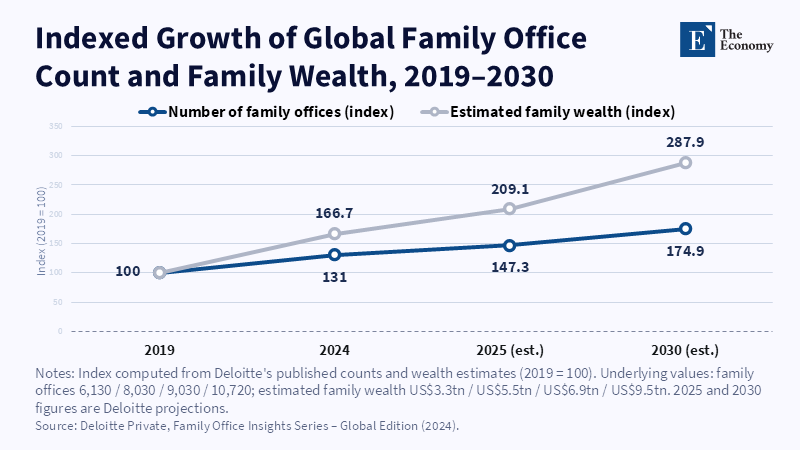
In 2019, the number of single-family offices worldwide was estimated at around 6,130. Deloitte estimated that the figure had reached 8,030 by 2024, with projections putting it at 9,030 in 2025 and 10,720 by 2030, an increase of roughly 75% between 2019 and 2030. Behind the numbers lies a change of substance: the family office has ceased to be an informal arrangement around a trusted accountant and a family counselor and has increasingly become institutional infrastructure, with formal governance, specialized executives and an international presence. The transition has not come simply from deliberate long-term planning but also from pressure, as liquidity events, generational wealth transfers and increasing competition between providers are forcing families to reconsider what should be built internally and what should instead be entrusted to institutional partners.
From Informal Arrangements to Institutional Governance
The idea that the family office is just an informal personal office has almost disappeared from professional discourse. Wealth becomes institutionally complex when it spans operating businesses, financial portfolios, trusts, foundations, real estate and multiple generations simultaneously and often across several jurisdictions as well. The issue is no longer simply the choice of investments but the coordination of objectives, ownership, liquidity, control, reporting and succession between different legal and family systems.
Research by Morgan Stanley Wealth Management shows that institutionalization often occurs as a reaction to disruption rather than through gradual planning. Tighter oversight, documentation and controls are often required after liquidity events such as business sales, stock market listings and concentrated capital inflows, particularly when complexity suddenly increases. At the same time, dependence on key executives, such as the loss of a chief investment officer or CFO, can become a significant vulnerability when responsibilities remain concentrated in only a few people and there is no clear continuity plan behind them.
Competition Pushes Family Offices Toward Institutional Models
The increase in the number of affluent households alone is not enough to explain the shift toward institutional models. Competition between providers also plays a decisive role and now includes private banks, independent wealth managers and multi-family offices competing for the same clients with increasingly complex offers. According to Altrata, the population of ultra-high-net-worth individuals reached 510,810 people in June 2025, with collective wealth of $59.8 trillion and is expected to reach 676,970 people by 2030. Expanding this client pool intensifies competition for talent, technology and access to private markets, pushing family offices to operate under professional standards rather than informal arrangements.
Recent 2026 rankings also underline the distinction between competing models. Multi-family offices are assessed heavily on governance, consolidated reporting, adviser coordination and the ability to integrate a family's wider financial structure, while private banks compete more through custody, banking, credit capabilities and international reach, so in practice families are often choosing between quite different institutional strengths rather than simply comparing similar providers on price.
Executives of independent platforms in Asia describe the same dynamics from another perspective. Families are increasingly looking for a professional investment team, a wealth structuring team and a wider set of professional services, with formal governance policies and family councils operating alongside the boards of operating businesses. A more resilient and repeatable decision-making framework is being built, rather than one dependent almost entirely on personal judgment, which may work for a time but becomes harder to sustain as wealth and the number of family members grow.
Asia and the Middle East Become Family Office Hubs
The geographical dispersion of the institutionalized model is not accidental. In Asia, a significant number of single-family offices were established during or immediately after the pandemic period, particularly in Singapore and Hong Kong. Many founders subsequently recognized the scale of the undertaking and the cost of operating a fully professional office and some have therefore sought partnerships with other family offices or multi-family platforms so that costs, systems and specialist resources can be shared. This trend is accompanied by broader client expectations, with consolidated reporting increasingly expected across multiple jurisdictions alongside access to newer asset classes and specialist advice that may not make sense to maintain permanently in-house.
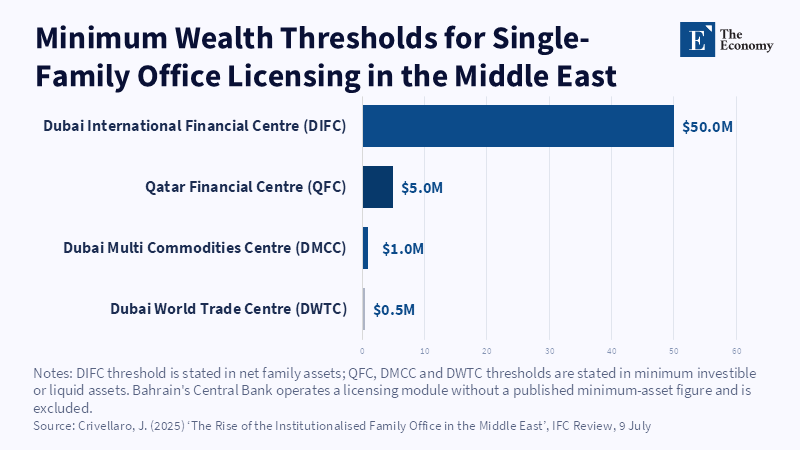
In the Middle East, ecosystem maturation follows a similar path but has also been supported through regulatory infrastructure. Centers such as the Dubai International Financial Centre, Dubai Multi Commodities Centre and Qatar Financial Centre have established specific frameworks for family offices, although their eligibility requirements, asset definitions and regulatory structures differ and should not be treated as directly equivalent. The region's location between major Asian, European and Middle Eastern capital markets, combined with the continued development of private wealth infrastructure, has made it an increasingly important hub for international wealth management. Institutionalization also functions as a succession-management tool here, as families approaching generational transitions must coordinate inheritance, ownership structures and cross-border legal arrangements that can involve quite different systems.
Consolidation, Scale and Hybrid Models
Along with institutionalization, there is also a trend toward consolidation. Smaller single-family offices, especially those established relatively quickly during periods of increased liquidity, now face the question of whether they have the scale and resources to operate effectively on their own. For some smaller offices, the answer is no, which is encouraging movement toward multi-family models or hybrid structures that combine internal strategic decision-making with external execution, reporting and specialized expertise. Responsibilities are increasingly divided between internal strategy and external execution, allowing families to retain control over the decisions they consider most important without having to build large internal teams for every specialist function.
Technology and particularly artificial intelligence, is emerging as a supporting tool in this transition, mainly in consolidated reporting, document handling and internal data-organization functions. Cameron Harvey of Landmark Family Office has described AI as useful for aggregating and organizing client data and improving internal workflows, while noting that its usefulness for core investment analysis remains more constrained when high-value information sits in specialist or non-public databases. Institutionalization, therefore, is not simply a matter of adding better technology. It is a structural reorganization around governance, people, data and relationships with external partners and the technology tends to work much better once those things are already in order.
Table 1: Family Office Operating Models at a Glance
| Model | Best Fit | Main Advantage | Main Trade-Off |
|---|---|---|---|
| Single-Family Office | Large, complex families seeking direct control | Customization, privacy and dedicated governance | High cost and key-person risk |
| Multi-Family Office | Families seeking shared institutional capabilities | Scale, specialist expertise and consolidated services | Less exclusivity and direct control |
| Private Bank | Families needing integrated banking and custody | Credit, custody and investment infrastructure | Potential product and institutional conflicts |
| Hybrid or Outsourced Model | Families retaining strategy while outsourcing execution | Control with scalable external expertise | Greater provider coordination required |
The path from Deloitte's estimate of 8,030 single-family offices in 2024 to a projected 10,720 by 2030 does not simply reflect numerical growth but a broader qualitative shift in private wealth management. Families that previously relied on informal arrangements are increasingly being pushed to decide between full internal institutionalization, integration into a multi-family platform or a hybrid model, with Asia and the Middle East becoming increasingly important places where these choices are being tested in practice. Structure selection is becoming less a matter of preference and more a question of what can actually be operated reliably over time because scale, governance and geographic flexibility increasingly determine whether families can preserve control of their wealth across future generations.
This article reflects the analytical judgment of The Economy Markets Editorial Board and does not constitute business advice or the official position of any affiliated institution.
References
Crivellaro, J., 2025. The rise of the institutionalised family office in the Middle East. IFC Review, 9 July.
Deloitte Private, 2024. Family Office Insights Series – Global Edition: Defining the Family Office Landscape. New York: Deloitte.
Harvey, C., 2026. Landmark Family Office: institutionalisation, consolidation and the shift towards holistic family advisory. Interview in Hubbis, 7 May.
Morgan Stanley Wealth Management, 2026. From Vision to Structure: Architecting a Family Office. New York: Morgan Stanley.
The Economy Markets Editorial Board is a multidisciplinary group of researchers, analysts and sector specialists covering the structure and evolution of global professional and institutional markets. Its work examines competitive landscapes, market positioning, buyer choice and the forces reshaping industries across advisory services, capital markets, wealth management, healthcare and other specialist sectors.
The Board also contributes to The Economy’s ranking research, where its members assess firms, institutions and market participants using structured research, sector evidence and comparative analysis. This combination of market research and ranking coverage gives the Board a continuing view of how competitive positions develop within individual industries and how firms differentiate themselves as markets evolve.
Through The Economy Markets, the Board translates this research into accessible analysis of market structure, competitive dynamics and institutional change, complementing The Economy’s rankings, Wiki profiles and broader research coverage with a comparative view of the markets in which ranked organisations operate.
Similar Post