[Offshore Finance] Not All Tax Havens Are Equal: How Offshore Financial Centres Differ in Transparency, Taxation and Regula

Working across research, policy, and data-driven analysis, the Editorial Board ensures that published pieces reflect a consistent institutional perspective grounded in quantitative reasoning and long-term structural assessment.
Authored On
Modified
EU lists and haven indexes measure different things
Each centre’s product shapes its real risk
Formal compliance scores outpace actual enforcement

On the 9th of October 2026, EU finance ministers removed Panama from Annex I, the list of tax havens that refuse to cooperate with international tax authorities, where it had been since February 2020. They moved it to Annex II, right next to the British Virgin Islands. The Cayman Islands, Bermuda, Jersey and Guernsey are on neither list. The T,ax Justice Network’s Corporate Tax Haven Index 2025 draws almost the same map inverted, with the British Virgin Islands in 1st place, Cayman Islands in 2nd, Bermuda in 4th and Jersey in 8th. When two reputable organizations assess tax havens and arrive at such different conclusions, it is because they are looking at different things and the tax centers have learned how to pass one test without changing much for the other. It is worth looking at what each center has to offer and how well it is supervised before getting to any classification and asking if the last decade of reform has changed institutions or just the way they lure capital from the rest of the world.
Three Institutions Judge Tax Havens by Different Standards
The European list focuses on cooperation. A country can be in Annex I if it doesn’t meet the tax transparency criteria, such as exchange of information upon request as rated by the OECD Global Forum or automatic exchange of information through the CRS, or if it doesn’t meet the criteria of fair taxation, which in the case of zero-tax countries mostly means having substance requirements. Simply having a zero tax rate will not get a country listed; that is why the Cayman Islands, which have no direct taxes on corporations, are not on the list. The British Virgin Islands have been in Annex II for technical reasons; they were rated “partially compliant” on the exchange of information by the Global Forum in November 2022, placed on the blacklist in February 2023 and moved back to Annex II in October of that same year and they have committed to undergoing a deeper evaluation by the 15th of February 2027. Panama had to go further by restricting its exemption on foreign income, which the Union deemed harmful. The Global Forum evaluation Panama requested on the 30th of April 2026 is still pending.
The Tax Justice Network index evaluates something else. It has a legislation score that measures how easily multinationals can use that country’s laws to reduce the taxes they should pay elsewhere, multiplied by the amount of business that is carried out there. When they updated the index in October 2024, they gave the British Virgin Islands, Cayman Islands and Bermuda the worst possible score, 100/100, on all 18 legislation indicators. Switzerland is 3rd in the Corporate Tax Haven Index 2025 and 2nd in the Financial Secrecy Index 2026 and is not listed by the EU. Secrecy is not exclusive to island countries. The third evaluation comes from the FATF, which assesses how countries deal with money laundering. On the 27th of October 2023, it removed Cayman and Panama from its grey list on the same day, while Panama would stay on the EU’s tax blacklist for three more years, cleared on money laundering and still non-cooperative on tax.
Specialization Shapes Risk More Than the Tax Rate
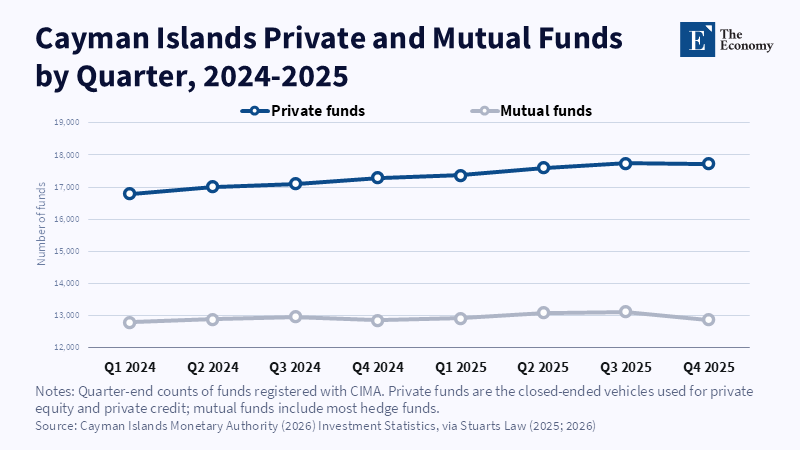
Each of these centers offers quite different products. The Cayman Islands’ mainstay is investment funds. At the end of 2025, the Cayman Islands Monetary Authority had 17,722 private funds on its register, which is 40% more than it had at the end of 2020 and 12,876 mutual funds, where most hedge funds register, plus 43,056 active limited partnerships, the form most private equity funds take. Bermuda sells risk. Its insurance market had a record $197.5 billion in gross premiums in 2025, according to the Association of Bermuda Insurers and Reinsurers and Bermuda companies held 16% of the world’s reinsurance capital, according to AM Best and Guy Carpenter. The British Virgin Islands offer something more straightforward: the company itself. There were 356,256 companies on the register at the end of 2025.
Jersey and Guernsey offer professional services: trusts, family wealth and managed funds, where the risk lies with the provider of those services. Singapore is a full-blown hub that has a general corporate rate of 17%. Assets under management totaled 6.7 trillion Singapore Dollars at the end of 2025, spread across 1,320 licensed fund management companies. Panama offered easy set-up corporations and territorial taxation, a model the Panama Papers made synonymous with secrecy in 2016. This matters because a fund in Cayman has a well-known manager, a well-known auditor and investors who are reported through the CRS, while a company in the British Virgin Islands with a registered agent could be holding anything. A risk model that treats both the same way is evaluating geography, not structure.
Table 1. Tax Regimes, Ownership Registers and Compliance Ratings of Seven Offshore Centres, October 2026
| Jurisdiction | Main Business | Tax | EU List 9.10.2026 | Tax Justice Network Rank | Money Laundering Assessment | Beneficial Ownership Register Access |
|---|---|---|---|---|---|---|
| Cayman Islands | Investment funds: 17,722 private, 12,876 mutual | No direct tax; no 15% minimum tax | Off list | Corporate Tax Haven Index 2025: 2nd | Removed from FATF grey list 10.2023 | Legitimate interest from 28.2.2025; $75 fee |
| Bermuda | Insurance, reinsurance and alternative capital | 15% for multinationals with €750m+ revenue from 2025 | Off list | Corporate Tax Haven Index 2025: 4th | CFATF 2020: 39 of 40 C or LC | Not public |
| British Virgin Islands | Companies: 356,256 active | No tax on most cross-border activity | Annex II | Corporate Tax Haven Index 2025: 1st | CFATF 11.2025: all 40 C or LC | Filed with Registrar from 2025; legitimate interest |
| Jersey | Trusts, private wealth and managed funds | 0/10 and 15% multinational tax from 2025 | Off list | Corporate Tax Haven Index 2025: 8th | MONEYVAL 2024: 39 of 40 C or LC | Authorities only; consultation on legitimate interest |
| Guernsey | Managed funds, private wealth | 0/10 and 15% domestic top-up tax from 2025 | Off list | Financial Secrecy Index 2026: 10th | MONEYVAL 2025: all 40 C or LC | Not public |
| Singapore | Fund management: S$6.7 trillion | 17% and 15% domestic top-up tax from 2025 | Off list | Corporate Tax Haven Index 2025: 5th; Financial Secrecy Index 2026: 3rd | S$27.45m in fines in 2025 over the S$3bn case | Not public |
| Panama | Companies and territorial tax | 15% on foreign passive income without substance from 2027 | Annex II; Annex I since 2020 | Not in the top 10 of either index | Removed from FATF grey list 10.2023 | Not public |
The 15% Minimum Tax Splits Tax Havens into Two Categories
2025 was the year that the 15% minimum tax was implemented in several of these countries and their reactions show what they wanted to protect. Bermuda passed the corporate tax in December 2023 and it took effect on the 1st of January 2025 for any group with revenue of 750m€ or more, but it did not adopt the Income Inclusion Rule or the Undertaxed Profits Rule. For a country of reinsurers with parents in the U.S. and Europe, it was an easy decision: any tax Bermuda did not collect, the parents’ home countries would. Jersey decided to implement a separate Multinational Tax of 15%. Guernsey implemented a Domestic Top-Up Tax that follows the OECD Model. Both kept their 0/10 system for everyone else. Singapore passed the Multinational Enterprise Minimum Tax Act 2024, also effective on the 1st of January 2025, with a top-up tax on domestic and foreign income.
The first thing Bermuda’s tax produced was a benefit on balance sheets. Under transition measures, companies were able to recognize deferred tax assets, which will offset their taxes for roughly the next 10 years. Chubb booked a one-off tax benefit of $1.14 billion in Q4 of 2023 and another $55 million in Q1 of 2024. Hannover Re recognized about $200 million, which will lower its tax bill in Bermuda by $20 million per year for the next decade. While the rate is 15%, these groups will pay less than that until those assets run out, something that will be hard for European tax authorities to spot when they look at nominal rates.
The Caymans have not implemented a minimum tax and have not announced any plan to. Nor have the British Virgin Islands, which have a 0% tax on most cross-border transactions. There is logic to their decision. Investment funds at the top of a structure are exempt from the OECD rules and if a company there is held by a multinational, the top-up tax will be collected by the parent’s country. Panama moved for another reason. It had to meet the EU criteria of fair taxation and Law 526, passed on the 28th of May 2026, requires companies that are part of a multinational group and earn passive income from abroad to prove they have employees, offices, decisions made and spending in Panama, or be taxed at 15% on their net income starting in 2027. It kept its territorial system for the rest and most private wealth will remain out of scope.
Ownership Registers Opened to Authorities, Not the Public
The gap between commitment and practice is most evident in beneficial ownership transparency. The UK Territories had committed to public registers until the Court of Justice of the EU struck down public access to EU registers in November 2022. This gave everyone a reason to stop partway. The Cayman Islands have had a legitimate interest requirement since February 28th, 2025. Journalists, researchers and organizations must prove that their interest is related to financial crime. Searches only work on the name of the legal entity. The government raised the price from $30 to $75 per application in March of 2026 and added a $250 annual fee for filing multiple applications in a year. It has also stated that no international standard requires fully public registers, which is technically correct and convenient.
The British Virgin Islands went in the same direction and have required beneficial ownership details to be filed with the Company Registrar since 2025. They will allow access by legitimate interest. Jersey has had a beneficial ownership register since 1989 and only allows competent authorities and obligated entities to see it. It opened a consultation on allowing access to those with a legitimate interest that closed on the 30th of January 2026. In 2020, the CFATF noted that Bermuda should give the Company Registrar more resources to check beneficial ownership filings. A register from 1989 and one from 2025 pass the same filter, because what the EU asks for is for that information to reach the authorities. Whether it is correct or who can view it is secondary. Banks’ due diligence teams know that an extract from an offshore register will not replace their own checks, so the gap between Jersey and Cayman is not as big as it seems.
Substance requirements follow the same logic. Cayman, the British Virgin Islands and Bermuda passed them in late 2018 at the behest of the EU and they applied from 2019. Jersey and Guernsey have been following them since 2019. The Cayman Tax Information Authority released enforcement rules in 2022 that were amended on March 31st, 2023, punishing companies that do not file a return or meet the requirements. The substance test checks if the company is run from the island, has enough employees and spends there. It does not measure taxes because there are none. Stuart's Law pointed out in its 2025 statistics that the substance rules had put some funds off setting up their investment manager in Cayman, which may have moved some activity away from Cayman but did nothing to change where the funds are being taxed.
Formal Compliance in Tax Havens Is Not Enforcement
On money laundering, the numbers look impressive. In 2020, Bermuda had a score of 39/40 Compliant or Largely Compliant from the FATF, with 28 recommendations Compliant. Jersey scored 39/40 in the July 2024 MONEYVAL Report. Guernsey scored 40/40 in the February 2025 report and the British Virgin Islands announced in November 2025, after their second follow-up report by the CFATF, that they are now Compliant or Largely Compliant on all 40. The same reports also record what is weaker. MONEYVAL found that Jersey had a moderate approach to penalties compared to the offenses committed. It also found the approach adequate for the island’s risk except possibly for tax offenses. In Guernsey, it was found that no criminal sanctions had ever been imposed for not reporting suspicious transactions. The CFATF found that the British Virgin Islands do not have enough staff in their law enforcement bodies and that there is disagreement over whether they can prosecute a company registered in the Islands for an offense committed elsewhere, a gap that matters in a jurisdiction with 356,256 registered companies.
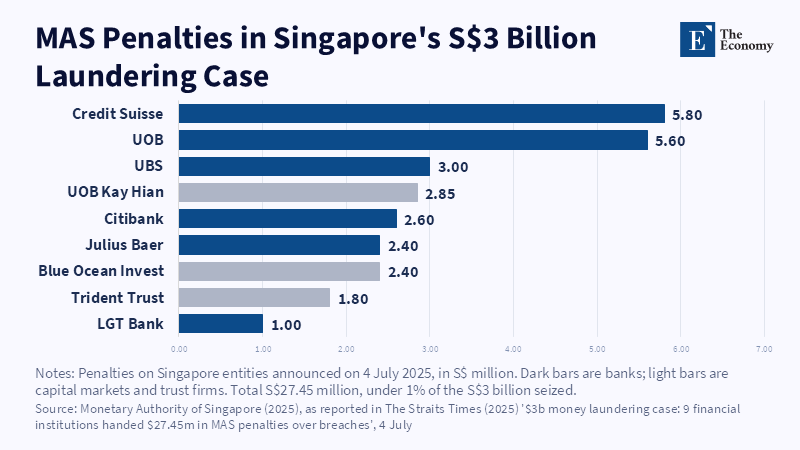
Follow-up reports re-rate the law once it changes, which is why the British Virgin Islands got their excellent score in such a short amount of time. How efficient their prosecutorial bodies are will not be measured until the next evaluation. Singapore shows what happens when the gaps get tested. In August 2023, police detained 10 foreigners in a case where more than 3 billion Singapore Dollars in assets were seized, money from fraudulent schemes and illegal gambling in other countries that ended up in Singapore as property, cars and jewelry. The Monetary Authority of Singapore finished its investigations in July 2025 and fined 9 financial institutions S$27.45 million, including S$5.8 million to Credit Suisse and S$5.6 million to UOB. That is less than 1% of the money that was seized. Singapore ranks 3rd in the Financial Secrecy Index 2026 and is not on any European list.
The strongest objection to this reading is that the Tax Justice Network has a political agenda and the official organizations have found that most of these centres are fine. That would hold if having the laws in place meant the outcome was good. A paper in the Review of Economic Studies in 2023 estimated that in 2015 multinationals moved 36% of the profits they made abroad to tax havens. If those profits had stayed where they were made, domestic profits would have increased by about 20% in countries with high taxes in the EU and decreased by 55% in tax havens, which no list of cooperative actions will ever measure. The best argument against that criticism comes from Bermuda. It has been deemed a cooperative jurisdiction by the EU for years and still, when the big economies agreed to tax whatever was left untaxed, Bermuda brought in a 15% tax of its own.
The EU list of October 9th and the Tax Justice Network will never agree completely because they are not asking the same question. One wants to know if a country will cooperate when asked. The other wants to know how much income flows through it. The Caymans, Bermuda and the Channel Islands all meet the EU’s tests and are still home to vast amounts of funds, reinsurance and private wealth. Some of the changes have touched real payments, like Bermuda’s tax or Singapore’s fines, just not as much as they could have, while others only changed paperwork. Law 526 takes effect in the 2027 tax year and the Global Forum review Panama asked for in April 2026 is still pending, so for now Panama’s move to Annex II rests on a law that no company has had to follow yet.
The views expressed in this article are those of the author(s) and do not necessarily reflect the official position of The Economy or its affiliates.
References
British Virgin Islands Financial Services Commission (2026) Statistical Bulletin Q4 2025. Road Town: BVI Financial Services Commission.
Caribbean Financial Action Task Force (2020) Anti-money laundering and counter-terrorist financing measures: Bermuda, Mutual Evaluation Report. Port of Spain: CFATF.
Caribbean Financial Action Task Force (2024) Anti-money laundering and counter-terrorist financing measures: British Virgin Islands, Mutual Evaluation Report. Port of Spain: CFATF.
Cayman Finance (2026) Private capital boom drives 36% increase in Cayman partnerships. George Town: Cayman Finance, 12 March.
Directorate-General for Taxation and Customs Union (2026) The Council updates the EU list of non-cooperative tax jurisdictions as cooperation delivers further progress. Brussels: European Commission, 9 October.
Mixides, Taylor (2026) ‘Bermuda reinsurance market hits record $197.5bn in 2025, ABIR reports’, Reinsurance News, 2 September.
Monetary Authority of Singapore (2026) Singapore Asset Management Survey 2025. Singapore: Monetary Authority of Singapore.
MONEYVAL (2024) Anti-money laundering and counter-terrorist financing measures: Jersey, Fifth Round Mutual Evaluation Report. Strasbourg: Council of Europe.
MONEYVAL (2025) Anti-money laundering and counter-terrorist financing measures: Guernsey, Fifth Round Mutual Evaluation Report. Strasbourg: Council of Europe.
Republic of Panama (2026) Ley 526 de 28 de mayo de 2026. Panama City: Gaceta Oficial.
Stuarts Law (2025) Investments and security figures Q3 2025. George Town: Stuarts Law.
Tax Justice Network (2026) Corporate Tax Haven Index 2025 and Financial Secrecy Index 2026. Bristol: Tax Justice Network.
The Straits Times (2025) ‘$3b money laundering case: 9 financial institutions handed $27.45m in MAS penalties over breaches’, The Straits Times, 4 July.
Tørsløv, Thomas, Wier, Ludvig and Zucman, Gabriel (2023) ‘The missing profits of nations’, Review of Economic Studies, 90(3), pp. 1499-1534.
Working across research, policy, and data-driven analysis, the Editorial Board ensures that published pieces reflect a consistent institutional perspective grounded in quantitative reasoning and long-term structural assessment.