European Competitiveness: Capital Rules Built for a Lost Lead

Working across research, policy, and data-driven analysis, the Editorial Board ensures that published pieces reflect a consistent institutional perspective grounded in quantitative reasoning and long-term structural assessment.
Authored On
Modified
Europe’s bank rwules assume a lead it has lost
European scale-ups rely on foreign money for late rounds
Targeted deregulation could speed catch-up without risking stability

In 2008, the total value of publicly traded companies in the United States exceeded that of European companies by about $3 trillion, a difference that fit comfortably into the usual explanations of market size and exchange rates. By 2023, had reached $34 trillion, an amount more than the annual U.S. GDP, according to a research paper published this year by the National Bureau of Economic Research. As a percentage of GDP, the U.S. stock market value rose from 78 percent to 177 percent, while the European market value edged up from 43percent to just 63percent. European competitiveness is usually discussed as a matter of productivity, energy costs, or bureaucracy, and none of these diagnoses are wrong. The finding that stands out in the same paper is narrower and more disturbing. The gap is not due to a few American supercompanies or the composition of the sectors; it is due to the fact that European companies are not managing to grow, and between 2008 and 2023 the difference in value widened by 82 percent in younger companies compared to 20 percent in older ones. Right there, at the point where a startup needs money to become big, Europe continues to regulate its banks and institutional investors with the mentality of a pioneer who writes the rules for the rest, at a time when it has long since ceased to be a pioneer in artificial intelligence, cloud computing and semiconductor design.
The Strong Case for Strict Capital Requirements
The European Central Bank's position is clear and is based on evidence that is difficult to dispute. In a speech by its Vice-President in Frankfurt on 2 October 2026, the ECB recalled that the median Tier 1 capital ratio of euro area banks has more than doubled, from around 8 percent in 2009 to over 16 percent today, that the return on equity is at historic highs and that the price-to-book ratio is around 1.5. Banks participating in the bank lending survey attribute tighter lending to risk perception and uncertainty, not to their capital position, and loan demand remains subdued. The conclusion reached was that a reduction in requirements would be very unlikely to increase lending. A month earlier, the ECB's supervisory side had said in Berlin that it saw no sign that the current requirements had limited the financing of the real economy, adding that free capital could simply result in larger distributions to shareholders. The difference is shown in the figure in return on equity between U.S. and European banks, which from 2010 to 2022 reached several percentage points almost every quarter, almost disappeared after the ECB's interest rate hikes in 2022, with no easing of capital requirements.
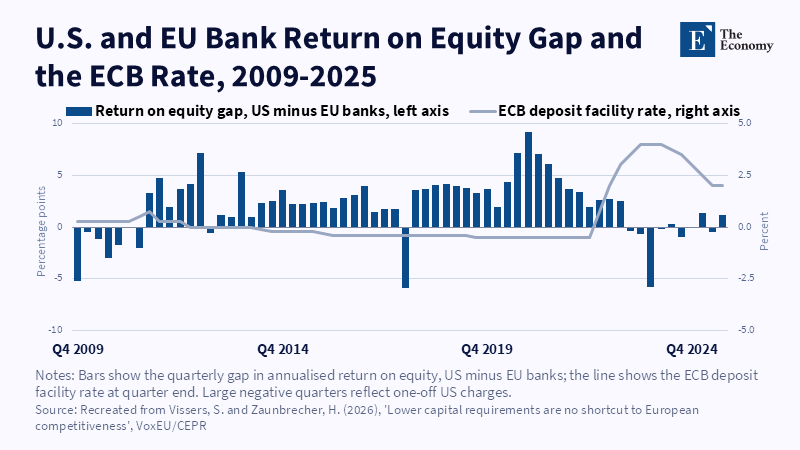
The Peterson Institute for International Economics reached a similar point in August, in an analysis of major European banks that estimates that the benefits of lower requirements would mainly end up with shareholders. The most convincing aspect of the argument concerns the nature of new companies: a software or biotechnology company with no revenue, no tangible assets and uncertain performance does not turn into a suitable borrower because the bank acquired a little more capital. The European Banking Federation responds, through a study it commissioned from Oliver Wyman, that in a sample of 15 banks, rising requirements absorbed more than 90 percent of retained earnings in the period 2021 to 2024 and that a cap on the buffer for systemically important institutions would free up about 50 billion euros of capital, capable of supporting 300 to 400 billion euros of new loans. These are estimates of an industry with an obvious interest in the outcome, and in the narrow empirical question the supervisors probably have the upper hand, except that the debate has been set up almost exclusively around whether a reduction would increase lending in the coming months and much less about the place in the world for which Europe originally designed this framework.
Rules Designed for a Leader, on a Continent That Now Follows
Europe has learned to regulate from a position of strength. The 2018 General Data Protection Regulation and the 2024 Artificial Intelligence Act were written with the expectation that companies around the world would adapt to Brussels, and they largely adapted, because no multinational wanted to lose access to a market of 450 million consumers. By the same token, a conservative banking framework is a luxury affordable to an economy in which capital flows on its own, because that's where the best companies, the most advanced laboratories and the wealthiest customers are located, so the leader can ask his banks for stability first and let growth come on its own. The supervisors' reasoning is internally consistent, but it presupposes this very position. Competitors are not waiting: the UK added in 2023 a secondary growth and competitiveness target to its supervisory authorities, and the Bank of England judged in December 2025 that the appropriate level of capital for the British system corresponds to a CET1 ratio of around 11 percent, when the major European banks closed 2025 at 16.2 percent.
Data on the economy as a whole no longer supports the assumption of leadership. Around 2000, labor productivity in the EU was close to 95 percent of the American level, while today it is about 20 percent lower, as recorded this year by Foreign Affairs in an analysis of European stagnation, which also notes that Mistral is the only European company competing in large language models and that the Union's 50 most valuable companies have an average history of more than 150 years. The 2024 Draghi report had already shown that real disposable income per capita has grown in the U.S. almost twice as much as in the EU since 2000. There is no consensus on the depth of the retreat, and in the Chicago Booth's Kent A. Clark Center poll in August 2026 several European economists recalled the rapid convergence of Poland and Romania or the difference between mean and median income. Europe remains first in some fields, with ASML in semiconductor lithography as the most obvious example, but in sectors where it needs to rebuild, such as cloud computing and fundamental AI models, the distance to the leader is not small and a laggard who applies the rules of the pioneer pays their cost without enjoying their privileges.
Europe Lacks the Money Its Growing Firms Need
The ECB's own data gives a negative answer. In an analysis of the August 2026 Economic Bulletin, the central bank estimates that U.S. venture capital funds manage about 930 billion euros, six times more than the approximately 150 billion of European funds and that the gap grows in late-stage rounds, where the required amounts multiply. The Jacques Delors Centre has shown that European investors cover 78 percent of capital in the initial rounds but only 50 percent in the scale-up rounds and the European Investment Bank found in 2024 that European venture capital-funded companies had raised, in their first ten years of operation, 50 percent less than their Silicon Valley counterparts. The gap is being filled with foreign money and small but mature markets such as Estonia are dominated by American investors, which, according to the ECB, increases the likelihood that headquarters, administrative functions, intellectual property and future listings will be transferred outside the Union. The chart "European Venture Capital Volume and Investor Origin, 2017 to 2024" shows that investments reached €102.1 billion in 2021 and fell to €47.2 billion in 2024, while in the scale-up rounds, investors outside Europe covered half of the capital in the period 2020 to 2024.
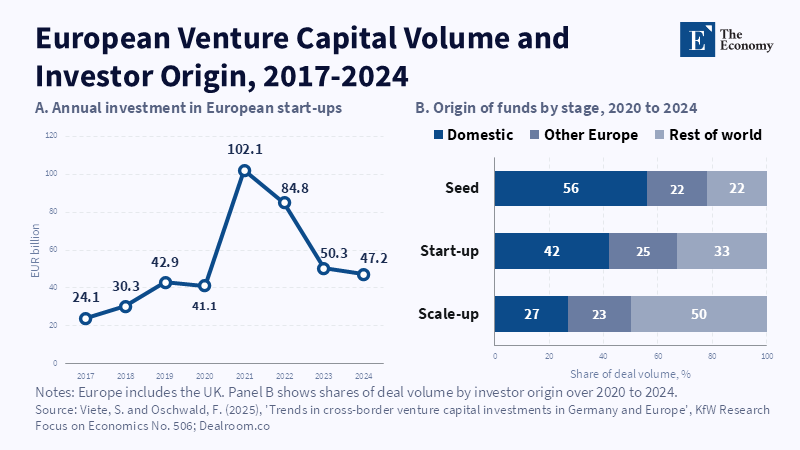
The most revealing finding of the same analysis concerns the companies that were rejected. Among the companies that failed to close a funding round, the median European firm had almost twice as many employees as its American counterpart and was growing about 15 percentage points faster, with similar age and similar patent activity, meaning that the European system leaves without funding companies that the American market would find attractive. The NBER paper puts a price on this shortage: the implied cost of capital for smaller European listed companies exceeds 60 percent, compared to around 40 percent for their U.S. counterparts; the European size premium roughly doubled between 2008 and 2020 and venture capital investment reached 0.5 percent of GDP in the U.S. in 2023 compared to 0.15% in Denmark, the most active European market. Part of this distance is due to the fact that the rules for banks, insurance companies and pension funds push everyone towards the same safe end of the risk spectrum and another to the fragmentation that the ECB openly admits, since cross-border lending to businesses within the eurozone accounts for just 16 percent of corporate lending, less than the roughly 20 percent directed to non-eurozone borrowers, mainly in the U.S. and the UK, while a cross-border investor has 27 different withholding tax schemes to manage.
The Asian Precedent and Cheap Public Money
China is not the right measure of comparison and a system of state credit control does not transfer to a union of democracies with strict state aid rules. The experience of Asian economies that have chased the West is nevertheless instructive, because it shows what a country does when it accepts that it is lagging behind. From the 1950s to the 1970s, the Korea Development Bank lent long-term to export manufacturing companies at less than half the market rate, so that they could gain scale and stand up to foreign competitors. This logic was never abandoned. In July 2024, Korea's Financial Services Commission announced that KDB would allocate 3 trillion won in low-interest loans for the artificial intelligence industry, with an interest rate cut of up to 1.2 percentage points for modeling and cloud computing companies, along with a fund of 500 billion won for equity investments, while for 2025 the country's state creditors planned policy loans of about 122 trillion won, up from 109 trillion the previous year.
The method has a known cost and the Koreans know it better than anyone else. As early as 2003, KDB was called a dinosaur in the domestic press; its subsidized loans were described as special favors to certain companies and the practice caused controversy over compatibility with World Trade Organization rules. Europe already has institutions capable of doing so: KfW in Germany, Bpifrance in France, Cassa Depositi e Prestiti in Italy and the EIB at Union level and the Commission is setting up the €5 billion Scaleup Europe Fund this year. According to the ECB, however, the participation of public bodies only partially compensates for the absence of pension funds from European venture capital and a fund of 5 billion is enough, with placements of 100 million per company, for about fifty companies. What set the Korean approach apart was the assumption that a latecomer needs a lower borrowing bar and a cost of money below the market, with the risk of some wrong choices being seen as an acceptable price of acceleration.
European Competitiveness Without a Return to 2009
The most serious objection to any easing proposal is stability. According to the ECB, the median fiscal cost of a banking crisis in advanced economies is around 7percent of GDP, not counting losses in output and employment and the collapse of Credit Suisse in March 2023 showed how quickly a 167-year-old institution can disappear. The answer lies in the same data cited by supervisors: if the Tier 1 ratio has gone from 8percent to over 16percent and capital, as they say, is not currently the binding constraint, then the system has room to take targeted risk without returning to the fragile balance sheets of 2009. A horizontal cut is indeed not based on data. A targeted change is another matter, with lower risk weights for loans and business debt to new innovative companies when there is a public guarantee and with more favorable treatment of banks' and insurers' placements in European scale-up funds. The Peterson Institute itself notes that for bodies with explicit public support, such as KfW and Cassa Depositi e Prestiti, capital requirements matter less, which opens a path to cheaper money without touching the core of the supervisory framework.
Legal deregulation is just as urgent as capital deregulation. The ECB sees a 28th corporate law regime as a way for a Lisbon or Milan-based company to scale across the Union with a single legal form and calls for clearer rules in the revision of the IORP II Directive on how much risk occupational pension funds are allowed to take. For the European Commission, which published its Communication on the competitiveness of the banking sector this year, the practical criterion should be how many European companies close their late round with a European lead investor, a figure that does not yet hold the place in public debate that the CET1 ratio does. The Draghi report was released in September 2024 and the Savings and Investments Union remains two years later largely a plan, while in the same period Washington and London have already made revisions to their own frameworks.
The $34 trillion accumulated over fifteen years in which Europe was building the most resilient banks in its modern history and the two events coexist without negating each other. Supervisors are right that bank capital is not the only constraint today and their argument would be complete if Europe were still the place where capital automatically ends up. The 82 percent widening of the gap among younger companies shows that it is not. European companies that are rejected are larger and faster-growing than American ones that are rejected and European banks direct about 20 percent of their corporate lending to borrowers outside the eurozone, mostly U.S. and British, compared with 16 percent to cross-border lending within it.
The views expressed in this article are those of the author(s) and do not necessarily reflect the official position of The Economy or its affiliates.
References
Baumann, A., Gati, Z., Vinci, F. and Wolf, G. (2026) ‘Europe’s venture capital gap and the financing of high-growth firms’, ECB Economic Bulletin, Issue 5/2026. Frankfurt am Main: European Central Bank.
Becker, B., Benmelech, E. and Monteiro, J. (2026) The value gap: Europe cannot scale. NBER Working Paper No. 35577. Cambridge, MA: National Bureau of Economic Research.
Draghi, M. (2024) The future of European competitiveness. Brussels: European Commission.
Farah, E., van Steenis, H., Burk, M., Haining, E. and Lancaster, R. (2026) European bank competitiveness: Enabling banks to play a greater role financing European growth. London: Oliver Wyman for the European Banking Federation.
Financial Services Commission (2024) Policy finance support worth KRW3.5 trillion planned to promote AI development. Press release, 4 July. Seoul: Financial Services Commission.
Fratto, C., Gatti, M., Kivernyk, A., Sinnott, E. and van der Wielen, W. (2024) The scale-up gap: Financial market constraints holding back innovative firms in the European Union. Luxembourg: European Investment Bank.
Hoendervangers, L., Vissers, S. and Zaunbrecher, H. (2026) ‘Verschil in winstgevendheid Europese en Amerikaanse banken krimpt’, Economisch Statistische Berichten, 2 September.
Kent A. Clark Center for Global Markets (2026) ‘Is Europe falling behind the US?’, Chicago Booth Review, 25 August.
McAfee, A. (2026) ‘Europe can’t get out of its own way’, Foreign Affairs.
Mejino-López, J. and Véron, N. (2026) EU capital requirements on megabanks: The low road or the high road. Policy Brief 26-13. Washington, DC: Peterson Institute for International Economics.
Schörner, M. (2026) One fund to scale them all? Filling crucial financing gaps with the Scaleup Europe Fund. Policy Brief, 7 April. Berlin: Jacques Delors Centre, Hertie School.
Viete, S. and Oschwald, F. (2025) Trends in cross-border venture capital investments in Germany and Europe. KfW Research Focus on Economics No. 506, 7 July. Frankfurt am Main: KfW Group.
Vujčić, B. (2026) ‘Resilience, integration and competitiveness: building the future of European banking’, keynote speech, tenth annual conference of the European Systemic Risk Board, Frankfurt am Main, 2 October.
Vissers, S. and Zaunbrecher, H. (2026) ‘Lower capital requirements are no shortcut to European competitiveness’, VoxEU, CEPR, 21 October.
Working across research, policy, and data-driven analysis, the Editorial Board ensures that published pieces reflect a consistent institutional perspective grounded in quantitative reasoning and long-term structural assessment.