Europe’s Tech Investment Market Is Entering Its Scale-Up Phase
Authored On
Modified
Q3 European funding concentrated in late-stage rounds
Europe’s leading listings and largest rounds still lean abroad
AI firms now buy and run service businesses
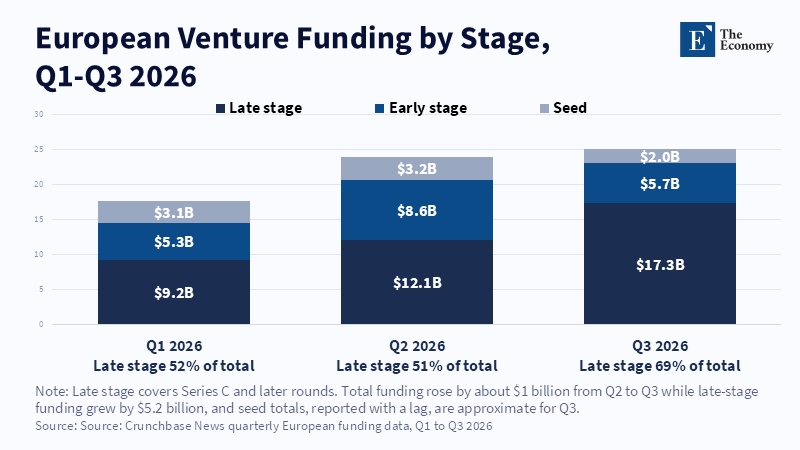
In the third quarter of 2026, European startups raised $25 billion, according to Crunchbase, an amount slightly higher than the $24 billion in the second quarter and 77% more than the $14 billion invested in the same period of 2025. But the total number is less than its allocation. Late-stage financing reached $17.3 billion, about 70% of the quarter and went to just 83 companies, up from $12.1 billion three months earlier. At the same time, the early stage absorbed $5.7 billion across about 200 companies, less than in the second quarter, while four rounds of more than a billion accounted for almost 40% of all capital for the period. European tech investment was concentrated, in other words, around companies that already have customers, staff in many countries and accounts counted in the hundreds of millions.
Crunchbase estimates that artificial intelligence took $18.8 billion, 75% of the quarter and it would be easy to read the whole period as another wave of enthusiasm around AI. The most interesting element is that the increase came almost entirely from the late stage, where Europe lagged for years, since even in the third quarter of 2025 the same database showed that the continent accounted for only about 9% of the global funding of this stage. The question left by the quarter is less about the ability of European companies to find their first capital, which has long been answered and more about whether there is enough growth capital and access to stock markets to grow while remaining connected to the European market.
Foreign Lead Investors, European Ownership
On September 8, Mistral announced a Series D round of €3 billion with a valuation of more than €21 billion, the largest equity round ever completed by a European technology company according to the company itself. It was led by Samsung Electronics, co-led by the Scaleup Europe Fund, managed by EQT and PSG Equity, while ASML, Nvidia Andreessen Horowitz, Bpifrance and as a new investor, the Grand Duchy of Luxembourg, among others, participated in the round. The previous round, amounting to €1.7 billion in September 2025, was led by the Dutch ASML. A month before Mistral, Sweden’s Lovable raised $400 million with a valuation of $13.3 billion, led by the American Menlo Ventures and co-led by the same European fund, while the list of new investors included Balderton and Carmignac from Europe, Kaszek and LTS Growth from Latin America, Tencent from Asia and Regent from the US.
Defense gave the same picture with different protagonists. Munich-based Quantum Systems signed a $1.2 billion round on July 2 at a valuation of about $8 billion, with joint leadership from Blackstone, Advent, Airbus and Noteus, a European growth equity firm founded in 2024 with offices in Berlin, London, Madrid and Paris. Helsing announced on July 13 a Series E of $1.8 billion with a valuation of $18 billion, with investors such as Dragoneer, Lightspeed, Goldman Sachs Alternatives, JPMorganChase and Canadian pension investor CPP Investments and said it remained largely European-owned, without giving a percentage. The Next Web noted that in May management was talking about 80% European ownership, but before the round grew by half a billion dollars.
From these transactions arise four questions that are often confused. Who invests is the broadest and in every major European round of the quarter the answer covers at least two continents. Who leads matters more, because the lead investor negotiates the valuation and the terms and here the European presence has increased, since the Scaleup Europe Fund, Noteus and Airbus sat down at the table as co-leads rather than mere participants. Ownership and control is something else, cumulatively shaped from round to round and rarely accurately publicized, as Helsing’s vague wording shows.
The most common objection is that every dollar from Samsung, Menlo or Blackstone means a loss of European control. The quarterly figures do not support it. Mistral remains in Paris and invests, according to Euronews, €4 billion in data centers in France and Sweden, Helsing maintains the same board and without foreign lead investors, rounds of this magnitude would not have taken place in a market that a year ago covered 9% of global late-stage funding. The question for European tech investment is whether companies have enough alternatives to choose investors based on the terms and not because only one can write the check.
The Scaleup Europe Fund and the Late-Stage Technology Investment Gap
The Scaleup Europe Fund was announced by Ursula von der Leyen in her 2025 State of the Union address and the European Commission completed the final legal steps for its establishment on 4 August 2026, as part of the European Innovation Council Fund, with EQT as its manager. It is a policy tool in the form of an investment fund and the distinction counts for whoever reads the amounts. The €5 billion is a fundraising goal, not money invested. The Commission has pledged €1 billion, while the group of founding investors includes Novo Holdings, Denmark’s EIFO, CriteriaCaixa, Santander through Mouro Capital, APG on behalf of Dutch pension fund ABP, Wallenberg Investments and Allianz and EQT told Sifted that it will typically lead or co-lead investments of between €100 million and €500 million.
The first investment was announced on August 5, with participation as a co-lead in the Series F round of Finland’s ICEYE, which was announced in June and combined €450 million of new capital with €550 million of secondary share sales, with a valuation of more than €10 billion. This was followed by Lovable on August 12, Mistral on September 8, The Exploration Company’s $450 million Series C round along with Bessemer and Atomico, the $100 million Series B round, about €86.5 million, of Tandem Health, which was its first investment in health and the Series A round of more than €200 million of the Dutch EUCLYD, which designs chips for AI applications. Around September 20, the fund also led a $250 million primary capital round for Spanish entertainment platform Fever, along with Point72 and Baillie Gifford. Seven companies in less than seven weeks, with activity in satellites, semiconductors, software for clinics and ticket sales for events, show that the criterion is the possibility of a global scale more than a strategic industry.
The sum of these rounds easily exceeds €5 billion, which means nothing about how much the fund itself put in, since the individual tickets in most cases have not been made public and each round includes dozens of other investors. More revealing for the next phase is whether institutional capital will come beyond the founding team. CriteriaCaixa approved a placement of €250 million in early September and on September 24, ABP announced a commitment of €250 million as the first step of a €1 billion program in European venture capital over three years, with the chairman of the fund’s board of directors insisting that the return for pensioners remains his first responsibility and that the governance of the fund played a role in the decision. The €250 million corresponds, according to the IO+ website, to about 0.04% of a portfolio of €568 billion, which is both the argument in favor, since the risk for pensioners is small and a reminder of how little of European pension funds is still moving towards this stage.
With tickets of €100 to €500 million, even a fully mobilized fund of €5 billion can support a few dozen companies, not an entire market. Its value, if proven, will be mainly catalytic, i.e. how easily a European lead investor can rally pension funds, insurers and American funds on terms it has negotiated. The Next Web posed the question with less optimism, wondering whether cheques from Brussels keep a company like Lovable in Europe or simply make it more attractive to acquire and three months of operation is not enough to answer.
Three Routes to Nasdaq: IPO, SPAC and Dual Listing
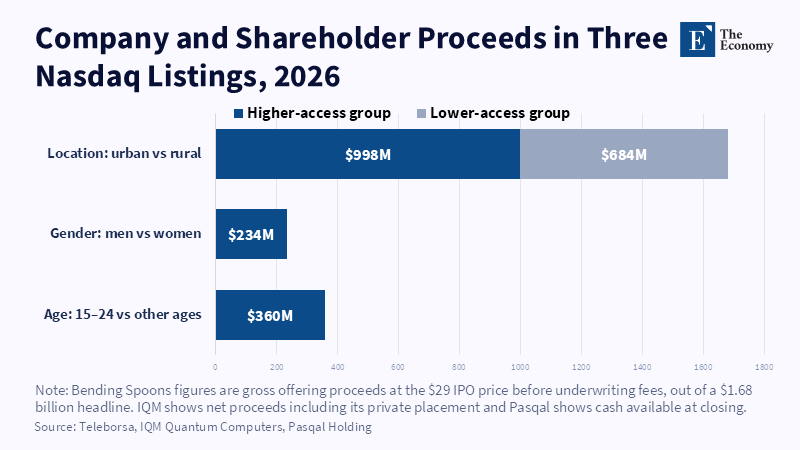
Milan-based Bending Spoons priced its Nasdaq IPO on June 30 at $29 per share, above the $26 to $28 range, with a headline figure of $1.68 billion. This figure does not correspond to money that went into the company’s treasury. Of the 57.97 million shares sold, 34.4 million were new shares of Bending Spoons, i.e. about $1 billion gross before underwriters’ commissions and 23.6 million were sold by existing shareholders, including Baillie Gifford, who received about $684 million without passing a single dollar to the company. The stock closed on the first day at $40.50 and the four founders retain about 82.7% of the voting rights through Class A shares, a detail that shows that listing on the stock exchange does not necessarily mean a dispersion of control.
Finland’s IQM and France’s Pasqal took another route: a merger with a special purpose acquisition company (SPAC). IQM completed the merger with Real Asset Acquisition Corp. and began trading on the Nasdaq on July 2, with net proceeds of approximately €198.7 million, of which €127.7 million came from a private placement to institutional investors at $10 per share and a day later it was also listed on Nasdaq Helsinki, with a market maker agreement to converge prices in the two markets. Pasqal completed on August 27 the merger with Bleichroeder Acquisition Corp. II at a valuation of approximately $2 billion and approximately $360 million cash available at the close, while its stock nearly doubled on the first day, unlike IQM, which spent most of its own debut below the listing price. Pasqal’s $360 million is the net result of the SPAC’s trust account, amounting to $287.5 million at its listing, after redemptions by its shareholders and together with the financing that accompanied the transaction and for this reason it says more about the company’s financial position than the valuation of the transaction.
A large listing can mean four different amounts: the headline value of the offering, the money the company receives, what shareholders get when they sell and in a SPAC, the cash left after redemptions. For a growth investor, the distinction is of practical importance, because only two of them finance factories, hires or acquisitions, such as the $2.25 billion that, according to IFR, Bending Spoons will now have available for new company purchases, while the other two mainly measure the liquidity that early investors acquire to close their positions.
All three companies chose Nasdaq as their main market and only IQM added a European listing, with the Finnish side serving more as a complement for European shareholders like Finnish state investor Tesi than as the main source of demand. European stock markets were tested this summer, but not judged, because a quarter of two quantum technology SPACs and one software acquisition company is not enough of a sample to show whether Paris, Frankfurt or Helsinki can consistently support listings of this size, or whether European companies will continue to make their first appearance in New York and return to Europe as a second stop.
AI Moves From Selling Software to Running Service Businesses
Away from the billion-dollar rounds, a series of smaller quarterly deals showed that AI investments are no longer limited to software. In hiring, Belgium’s Spott raised €18.3 million in a Series A round led by Balderton for a candidate and client management system that it sells to recruitment agencies, while London-based Jack & Jill raised $40 million led by Air Street Capital for two AI agents, one for candidates and one for employers, who book interviews directly and bypass both the application and the agency. In accounting, Berlin-based mika raised €6 million in a seed round led by Smedvig Ventures to handle the bookkeeping, VAT returns and annual accounts of more than 750 small German companies itself, while Limetax, founded in January 2026, secured €36 million to acquire tax offices and operate them on a common AI platform.
These examples describe three distinct business models with very different risk profiles. Spott sells a tool to existing providers and earns as much as they earn. Jack & Jill and mika use AI to deliver services traditionally handled by intermediaries, although in different sectors. Jack & Jill connects candidates directly with employers, challenging conventional recruitment agencies, while mika automates bookkeeping and tax-related processes that businesses would otherwise outsource to accounting firms. Limetax and Britain’s Dwelly, which raised $170 million in July to acquire independent letting agencies, are buying the traditional business itself and changing the way it works from within, which is clearly reflected in their funding. Of Limetax’s €36 million, €30 million is a financing line for acquisitions from a consortium of German banks, i.e. about 83% of the package, while in Dwelly, $75 million of the $170 million comes from a loan facility from Trinity Capital, about 44%. A subscription software company spends mainly on product and sales, while a consolidator needs capital to buy cash-flow businesses and debt is cheaper than equity dilution for this job.
Health follows the same logic in a field where administrative burdens are just as great and regulation is much stricter. Sweden’s Tandem Health, with its €86.5 million round led by the Scaleup Europe Fund, prepares patient summaries before the appointment, takes notes during it and takes care of documentation and coding afterwards and reports that clinicians who use it report 29% less time on administrative tasks. London-based Penelope Health announced on September 18 a $100 million commitment led by Thoreau to convert U.S. insurers’ coverage rules into structured data automatically read by providers and insurers and its platform already covers policies for more than 200 million Americans.
The opportunity is real, since whoever owns the service receives the revenue of the service and not just a software subscription. But with the revenue comes responsibility for the staff, for the quality of the work and for complying with rules that in Germany tie accounting and taxation so tightly that a mistake in the books goes straight to the tax bill. Limetax maintains a level of human control so that professional responsibility remains with its firms’ advisers and Dwelly claims that a property manager now handles 300 units instead of 100, a figure that comes from the company itself rather than an independent audit and plans to increase its staff from about 300 to 1,500 people later this year. Data security is the least abstract of these risks, as the case of Jack & Jill showed in March, when, according to Computerworld, autonomous agents of the CodeWall testing platform infiltrated its systems and extracted personal information of team members. Which of the three models scales best will be judged by measurable cost savings in businesses that have already changed hands and such data, verified by third parties, has not yet been published by any of these companies.
The Scale-Up Test for European Tech Investment
From the perspective of a growth equity investor like Zubr Capital, which invests in technology companies with international activity, two developments of the quarter have the most immediate practical significance. The first is that European capital took the lead or co-lead position in rounds of hundreds of millions at Mistral, Lovable, ICEYE and Quantum Systems, which gives companies an extra card when negotiating with American or Asian funds. The second is the emergence of companies such as Limetax and Dwelly, which combine acquisitions of traditional services businesses with technology and debt and which will be judged by criteria closer to those of private equity, i.e. the cash flow of the companies they buy and whether their operating costs really fall after integration.
The question with which the quarter started remains open. European tech companies need enough growth capital and access to stock markets that can support their size, while those entering AI-powered services need to prove that operating at scale leaves profit and not just growth. The $17.3 billion across 83 companies is the most concrete evidence that the market changed size from the 9% of global late-stage funding that Europe had a year earlier, but almost 40% of the quarter’s total came from just four rounds and the three listings that stood out over the summer had New York as their main market. The next clue will come from whether the Scaleup Europe Fund will raise funds beyond ABP and CriteriaCaixa and whether the first European tech listing of more than a billion will choose Amsterdam, Paris or Frankfurt instead of the Nasdaq.
The views expressed in this article are those of the author(s) and do not necessarily reflect the official position of The Economy or its affiliates.
References
Crunchbase News (2026) 'European Q3 VC surges 77% YoY to $25B with AI pulling 75% of funding', Crunchbase News, October.
Dealroom (2026a) 'ABP plans EUR 1bn of European venture capital investments, starting with Scaleup Europe Fund', Dealroom News, September.
Dealroom (2026b) 'LimeTax raises €6M pre-seed to roll up Germany's tax firms with AI', Dealroom News, September.
Dharampal-Hornby, M. (2026) 'EU Scaleup Fund leads $100m Tandem Health raise', Sifted, 14 September.
EQT (2026) 'EQT's Scaleup Europe fund makes first investment: co-leads €1 billion funding round in ICEYE, Europe's leader in sovereign intelligence from space', EQT press release, Stockholm, 5 August.
Euronews (2026) 'Mistral AI raises record €3 billion in Samsung-led funding round', Euronews, 8 September.
European Commission (2026) 'Scaleup Europe Fund to start making investments', press release IP/26/1718, Brussels, 4 August.
Goodwin Procter (2026) 'Goodwin advises Dwelly on raising $170 million Series B', Goodwin, 31 July.
Helsing (2026) 'Helsing raises US$1.8bn in Series E', Helsing press release, Munich, 13 July.
International Financing Review (2026) 'Bending Spoons wraps US$1.68bn Nasdaq IPO', IFR, issue 2640, July.
IQM Quantum Computers (2026) 'IQM Quantum Computers Plc's listing application has been approved and trading in its shares on the regulated market of Nasdaq Helsinki will commence on July 3, 2026', stock exchange release, Espoo, 2 July.
Quantum Systems (2026) 'Quantum Systems raises $1.2bn Series D to accelerate growth and scale software defined autonomous systems across air, land and sea', Quantum Systems press release, Munich, 2 July.
Sifted (2026) 'Lovable raises $400m backed by EU's Scaleup Fund', Sifted, 12 August.
Tech.eu (2026) 'German AI startup mika raises €6M to simplify accounting and tax for SMEs', Tech.eu, 23 September.
The Quantum Insider (2026) 'Pasqal completes SPAC merger with $360 million in cash', The Quantum Insider, 28 August.