Why Forward Guidance Fails in an Era of Shocks

Working across research, policy, and data-driven analysis, the Editorial Board ensures that published pieces reflect a consistent institutional perspective grounded in quantitative reasoning and long-term structural assessment.
Authored On
Modified
Forward guidance errors linger when shocks keep hitting
Warsh dropped rate-path signals in favour of incoming data
Markets paid the transition through volatility and record hedging

On March 17, 2021, the median projection of members of the Federal Open Market Committee showed an interest rate close to zero through the end of 2023, with 2021 inflation estimated at 2.4 percent. Fifteen months later, the United States consumer price index was running at 9.1 percent year-over-year and by July 2023 the key interest rate target range had reached 5.25 percent to 5.50 percent, or 525 basis points above where the central bank had hinted it would stay. The distance between that projection and what followed is perhaps the most expensive lesson in the last decade for forward guidance, the practice by which central banks pre-announce the path of interest rates.
Kevin Warsh, who was confirmed by the Senate as Fed chair in May 2026, has concluded this episode that divides bond markets. At his first meeting in June, he refused to submit his own projection for the dot plot, described the dot plot as written “in pencil with an eraser” and removed from the announcement the language that foreshadowed the next moves. The choice looks like a throwback to earlier times, but it fits an economy where the war with Iran, tariffs and the energy costs of artificial intelligence are changing the data faster than any forecast can be revised.
When the Public Signal Becomes the Weakest Information
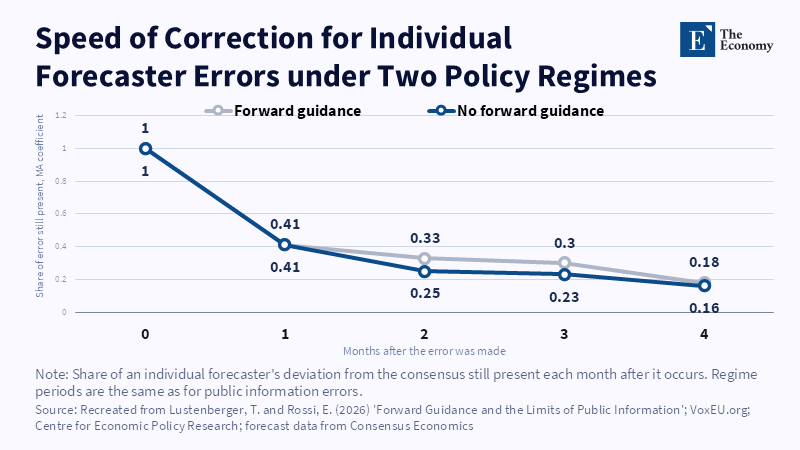
Economists Thomas Lustenberger, of the Swiss supervisory authority FINMA and Enzo Rossi, of the Swiss National Bank, have devoted years to empirically testing an idea formulated in 2002 by Stephen Morris and Hyun Song Shin. When professional analysts care about both the accuracy of their forecast and not straying too far from their colleagues, public information takes on a disproportionate weight, because everyone knows everyone has seen it. An explicit interest rate path from the central bank works just like that and if it contains noise, its error passes to every forecast at once and is not neutralized to the average, as is the case with private mistakes that vary from analyst to analyst.
In a study published in 2022 in the Journal of Money, Credit and Banking, the two researchers compared countries that applied forward guidance with countries that were also at the interest rate floor without resorting to it. Repeating the same check with newer data for the United States, they calculate a ratio that falls below one when public information is less accurate than private information. For three-month-ahead forecasts of the three-month U.S. Treasury bill rate, the ratio was 0.67 in forward guidance periods and 3.32 in the remaining periods after January 2009, nearly five times higher. The second finding is even more disturbing to those who defend the practice: without guidance, public errors faded by the third month, while under guidance they persisted for up to three months and only receded clearly in the fourth.
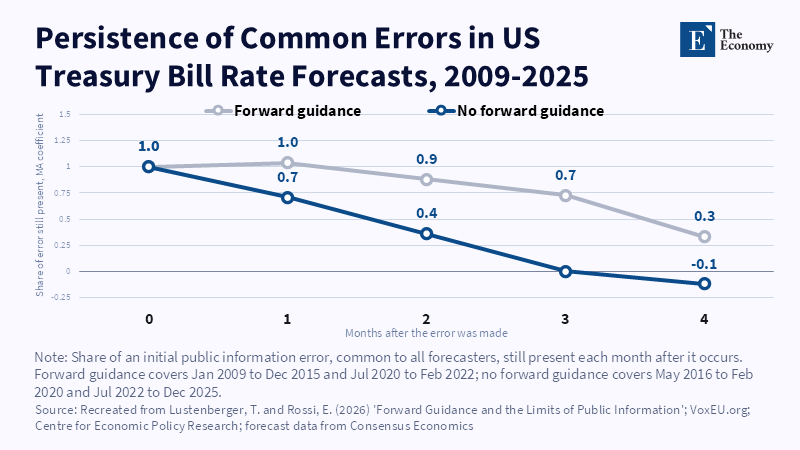
Lustenberger and Rossi do not claim that public information is bad by nature. Weakness occurs when mistakes get stuck and in periods of forward guidance they seem to get stuck, which leaves analysts investing in the common signal even when their own assessment is better. They also warn that exiting such a regime has a transitional cost, since analysts need time to relearn to rely on their own analysis, with a greater dispersion of forecasts and more volatility in the meantime. What happened in the US interest rate markets in the summer of 2026 is very similar to this description.
Warsh Switches Off the Turn Signal and Returns to Greenspan’s Logic
The practice that Warsh restricts was born out of a very specific need. After 2008, with the key interest rate already close to zero and quantitative easing programs underway, the Fed had no more room for reduction and used its announcements to convince the markets that interest rates would stay low for a long time to push down long-term yields as well. Forward guidance became a permanent element of the announcements in 2011 under Ben Bernanke and in January 2012 the dot plot with the projections of the 19 members of the committee was added. In that environment, the promise was the tool itself, since the nominal rate cut had been exhausted.
The announcement following the June 16 and 17, 2026 meeting, the first under Warsh, had 132 words compared to 246 in April and the language on the future path of interest rates was completely removed. He has argued that the Fed has publicly overspoken about the interest rate outlook and that making reliable forecasts is difficult as long as inflation remains volatile, while he has set up five task forces covering communication, the balance sheet, the use of economic data, the impact of artificial intelligence on productivity and the inflation framework. The 2 percent target remains constant, but the tools are adjusted at each meeting. Alan Greenspan worked in a similar way from 1987 to 2006, going through Black Monday and the Asian crisis with no explicit interest rate path, with markets reacting to decisions and employment and productivity figures more than to announcements.
In Warsh’s reading, the more firmly the Fed’s forecast becomes a benchmark for the market, the narrower the choices of the monetary authorities themselves and when the prediction turns out to be wrong, the markets have already followed a misleading signal and are paying a greater cost in adjusting. A market price that simply copies the central bank’s rhetoric does not add information, so the Fed misses one of the few independent signals it could read. This position is almost the political version of the 0.67 ratio measured by Lustenberger and Rossi, formulated from the position of the chair who has to decide, not the researcher who counts.
Wars, Tariffs and Supply Shocks Strip Forward Guidance of Its Value
The usefulness of any advance announcement depends on how stable the world to which it is addressed is. In the years of quantitative easing, the main risk was insufficient demand and below-target inflation, a slow problem that moved from quarter to quarter at a relatively predictable pace and allowed a central bank to commit for two years without much risk. In 2026 the picture is different, because the war with Iran and the closure of the Strait of Hormuz have sharply pushed up oil prices, investments in artificial intelligence are driving up the cost of electricity and semiconductors, the Trump administration’s tariffs are adding their own pressure on prices and the Fed itself is now attributing the inflation that remains above 2 percent in part to supply shocks in energy and some other sectors, shocks that no one on the committee can say how long they will last.
When shocks follow one another, a public interest rate path has a high probability of going wrong and it is precisely in these circumstances that its mistake is transmitted to everyone and lasts. The central bank then finds itself tied to a bad forecast: either it sticks to it to protect its credibility and is slow to react, or it overturns it and pays the cost of the reversal. In 2021, the Fed chose the first option, described inflation as transitory and ended up in 2022 with four consecutive 75-basis-point hikes, a path that Athanasios Orphanides has described as a forward guidance trap. Today the shocks are more numerous and overlapping, each with a different duration.
The July 29 meeting showed how fluid the picture has become within the committee itself. The Fed kept the rate at 3.50 percent to 3.75 percent by a vote of 9 to 3 and the three dissenters, the presidents of the Federal Reserve Banks of Cleveland, Minneapolis and Dallas, called for a 25 basis point increase. Three members had not disagreed in the same direction since September 2016. A committee thus divided six weeks after a unanimous decision could hardly give a convincing rate path for the next twelve months and if it had given one in June, it would have already revised it. At its September 15 and 16 meeting the committee raised the rate to 3.75 percent to 4.00 percent and minutes released on October 7 showed that most participants favoured another increase before year-end.
The Cost of Silence Is Real but Transitional
The most serious objection comes from bond managers. J.P. Morgan Asset Management and BNP Paribas warned in June that less transparency brings more speculation, more volatility and higher risk premiums and the summer data seems to justify them. On the eve of the July session, the CME FedWatch tool attributed a 31.5 percent probability to a surprise hike and 77.4 percent to a higher rate by September. Open positions in August federal funds futures rose from about 910,000 on July 24 to 967,000 on July 28, a new all-time high, while some investors even hedged for the possibility that the ten-year swap rate would rise from 4.23 percent to 6 percent. After the session, the yield on the thirty-year U.S. Treasury bond reached its highest level since 2007 and Reuters spoke of an uncertainty premium in the bond market.
The same numbers can be read the other way. Investors who bet on an increase did not react to new data; they interpreted the Fed chair’s silence as a hidden signal, essentially continuing the same guessing game around the Fed, while the indicators published before the meeting showed both a decline in inflation and a weakening of employment. After the press conference, the probability of a hike in September fell from 77.4 percent to 53 percent in one day. This is almost exactly the transitional cost described by Lustenberger and Rossi of exiting a guidance regime, when the market has not yet learned to trust its own information. The fact that two-year bond yields had already climbed above the Fed’s range ceiling before the June meeting shows, after all, that the market can tighten financing conditions based on its own data, without waiting for instructions.
For portfolio managers, banks’ treasury departments and CFOs of companies with floating-rate debt, the change translates to a different day-to-day job. Warsh asked markets to “watch the ball, not the referee,” meaning that the likelihood of a hike should be calculated from the consumer price index, the PCE index, wages, oil and government bond yields rather than inferred from the wording of an announcement. This requires internal probability models and a budget for more expensive hedging around each FOMC meeting.
A Prediction That Binds No One
The March 2021 projection was not unreasonable at the time it was made. It projected inflation of 2.4 percent for that year for an economy coming out of the pandemic and no committee could have known that the invasion of Ukraine and soaring energy prices would follow. The problem was that the forecast had turned into a commitment and the commitment kept the central bank in place for months after the data had already changed direction.
Warsh is betting that a Fed that decides based on what it sees at each meeting will make fewer such mistakes in a time of wars and successive supply shocks. The data from Lustenberger and Rossi support his reasoning and the July market has already paid some of the cost of the transition with record open positions and a violent readjustment of probabilities. It remains open whether the uncertainty premium will recede when investors get used to reading data instead of words, or whether it will remain as a permanent price of a less talkative central bank. The thirty-year Treasury yield touched 5.70 percent on October 7, its highest level since 2002, though war costs and a federal deficit near $2 trillion are now pushing in the same direction.
The views expressed in this article are those of the author(s) and do not necessarily reflect the official position of The Economy or its affiliates.
References
Board of Governors of the Federal Reserve System (2021) Summary of Economic Projections, 17 March 2021. Washington, DC: Board of Governors of the Federal Reserve System.
Board of Governors of the Federal Reserve System (2023) Federal Reserve issues FOMC statement, 26 July 2023. Washington, DC: Board of Governors of the Federal Reserve System.
Delaney, Siobhán (2026a) ‘[Warsh Fed] “From a Predictable Fed to a Market-Responsive Fed”: A Price Stability Doctrine Unshaken by Short-Term Shocks’, The Economy, 19 June.
Delaney, Siobhán (2026b) ‘[Warsh Fed] Chair Warsh Removes the “Turn Signal,” Adopting the Playbook of the Greenspan Fed’, The Economy, 22 June.
Delaney, Siobhán (2026c) ‘“Mortgage Rates at a Three-Year High, Treasury Yields at a 24-Year Peak”: Iran War Sends U.S. Borrowing Costs Soaring, With an End to Hostilities and Restored Energy Supplies Key to Stabilizing Rates’, The Economy, 8 October.
Economy Editorial Board, The (2026) ‘Fiscal Populism and the Long Bill for U.S. Treasuries’, The Economy, 14 October.
Griffin, Oliver (2026) ‘[Warsh Fed] Amid Trump-Fueled Independence Controversy, Warsh Opts for a “Smaller Fed,” Curtailing Central Bank Intervention to Distance It From Markets and Politics’, The Economy, 12 August.
Lustenberger, Thomas and Rossi, Enzo (2022) ‘The Social Value of Information: A Test of a Beauty and Nonbeauty Contest’, Journal of Money, Credit and Banking, 54(7), pp. 2125-2159.
Lustenberger, Thomas and Rossi, Enzo (2026) ‘Forward Guidance and the Limits of Public Information’, VoxEU.org, 19 October.
Morris, Stephen and Shin, Hyun Song (2002) ‘Social Value of Public Information’, American Economic Review, 92(5), pp. 1521-1534.
Nicholson, Anne-Marie (2026) ‘[Warsh Fed] “The Era of Forward Guidance Is Over”: Markets Misread Warsh and Lose Big on Surprise Rate-Hike Bets’, The Economy, 30 July.
Orphanides, Athanasios (2023) ‘The Forward Guidance Trap’, IMES Discussion Paper Series, No. 23-E-06. Tokyo: Bank of Japan Institute for Monetary and Economic Studies.
U.S. Bureau of Labor Statistics (2022) Consumer Price Index: June 2022, News Release, 13 July. Washington, DC: U.S. Department of Labor.
Working across research, policy, and data-driven analysis, the Editorial Board ensures that published pieces reflect a consistent institutional perspective grounded in quantitative reasoning and long-term structural assessment.