Japan’s Defense Industry Enters Europe’s Industrial Partnerships: From Technology Supplier to Strategic Co-Developer

Working across research, policy, and data-driven analysis, the Editorial Board ensures that published pieces reflect a consistent institutional perspective grounded in quantitative reasoning and long-term structural assessment.
Authored On
Modified
Japan entered European defence through GCAP co-development
South Korea sells finished systems and localises assembly
SAFE rules confine Japanese firms mostly to components
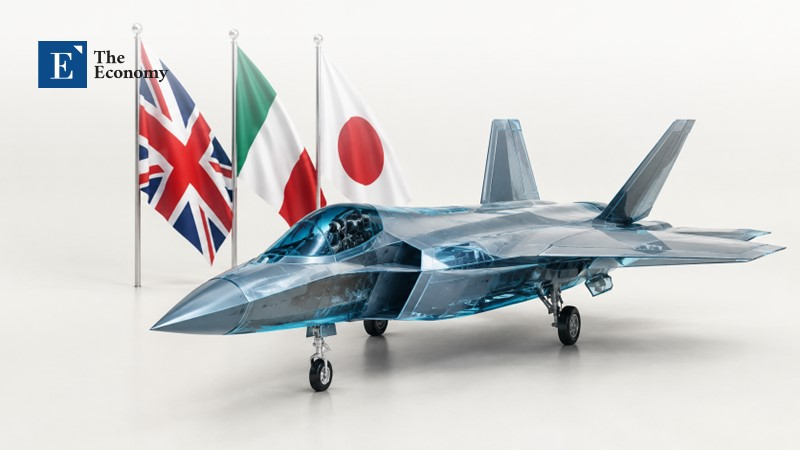
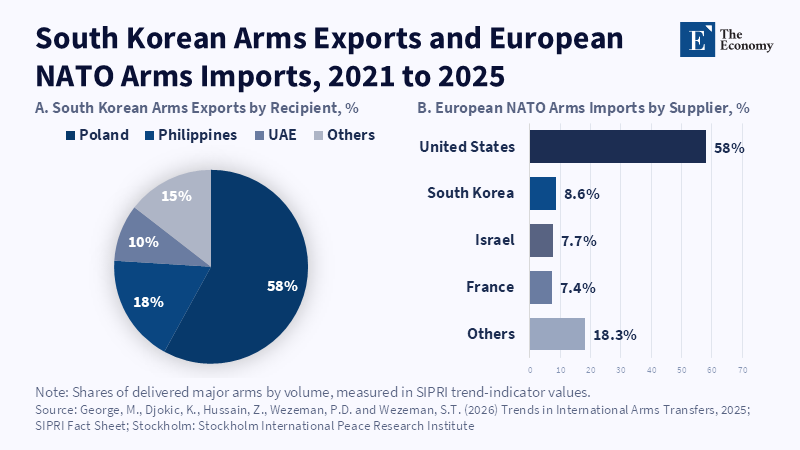
On July 3, 2026, the GCAP Agency, the intergovernmental body that manages the next fighter aircraft program on behalf of the United Kingdom, Italy and Japan, awarded the Edgewing joint venture an 18-month £4.6 billion contract jointly funded by the three governments. A third of Edgewing, the company that will hold design authority over the aircraft throughout a life cycle expected to run beyond 2070, is owned by a Japanese entity. A few months earlier, SIPRI had recorded that 58% of South Korea’s arms exports in the period 2021 to 2025 ended up in a single country, Poland. The two numbers describe two very different routes to the same European market. The Japanese defense industry enters Europe as a co-owner of technology through joint development programs, while Korean groups sell integrated systems and transfer part of the assembly to their customers’ countries. Whether the first route will ever lead to a wider commercial position in European defense procurement is a question that the 2026 figures are not enough to judge.
The Japanese Defense Industry Rewrites Its Export Rules
The April 21, 2026 revision is the largest change to Japan’s equipment transfer regime since 2014, when the Three Principles for the Transfer of Defense Equipment and Technology replaced the earlier principles for arms exports. The National Security Council and the cabinet removed the restriction that allowed exports of finished equipment only for rescue, transport, alert, surveillance and mine clearance and divided the equipment into weapons and non-weapons according to its lethal capacity. According to the Jiji Press agency, the destinations for the weapons are limited to the United States, Australia, the Philippines and fourteen other countries that have signed agreements with Tokyo for the transfer of defense equipment and technology, while the government must now notify the Diet after the fact of any arms export approval. Restrictions on foreign direct investment related to defense equipment have also been relaxed, a detail that for European consortia may count more than the abolition of the five categories itself.
The change had been prepared in stages. The December 2023 revision opened up the transfer of components to countries with which Japan cooperates on security issues and the one in March 2024 allowed, specifically for GCAP, the transfer of finished products to third countries. The current guidelines, as published in the 2026 Defence White Paper, define international joint development and production in a way broad enough to also cover the participation of Japanese companies in developments led by foreign governments and when a Japanese supplier delivers components in a supply chain led by a foreign government or a foreign company, it is sufficient in principle to confirm the recipient’s management system instead of the obligation of Tokyo’s prior consent to any further transfer. It depends on such technical formalities whether a Japanese component can enter a European production line without bringing with it a second level of licensing. The same text also maintains an explicit limit, since finished GCAP products may not be transferred to a country where, at the discretion of the government, fighting is taking place in the context of an armed conflict.
GCAP Splits Design Authority into Three Equal Shares
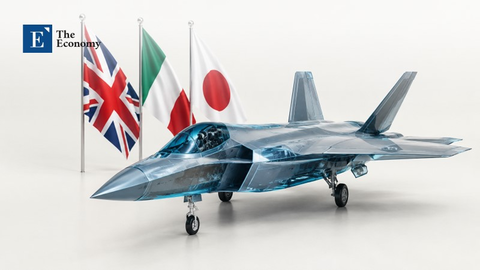
GCAP is a development program of three states: the United Kingdom, Italy and Japan. It is not funded by the European Union, nor is it a European procurement and only one of the three partners, Italy, is a member state. The convention signed by the three governments in December 2023 created the government agency GIGO and on June 20, 2025, Edgewing was officially launched, in which BAE Systems, Leonardo and Japan Aircraft Industrial Enhancement, known as JAIEC, each own 33.3%. JAIEC has been operating since July 10, 2024 and is majority-owned by the Society of Japanese Aerospace Companies, SJAC, with Mitsubishi Heavy Industries as the minority shareholder, a scheme that MHI announced as a tool to strengthen the supply chain of the entire Japanese aviation industry. Edgewing is based in the United Kingdom, will remain the design authority for the entire life of the product and outsources manufacturing and final assembly to BAE Systems, Leonardo and MHI and the wider supplier network.
Funding began flowing in 2026. A first contract of £686 million in April acted as a bridge, while the £4.6 billion contract of July 3, which, according to the Japanese Ministry of Defense covers the period until the end of 2027, completes the advanced concept and assessment phase and proceeds with joint detailed design. The British Defence Investment Plan of June 30 provides £8.6 billion for the program over four years, with the aim of bringing the aircraft into service in 2035. MHI, the only fighter aircraft manufacturer in Japan, prime contractor for the development and production of the F-2 and producer of the F-15, brings to the table the unique Japanese experience of completing a fighter and its role in assembly gives the Japanese industrial base a platform manufacturer position within the program.
The aircraft’s weapons remain largely a national affair. At the Farnborough International Airshow in July 2026 MBDA UK, MBDA Italia, Mitsubishi Electric and MHI, working together as Sovereign Effects Partners, signed a cooperation agreement to support Edgewing with advisory and engineering services on effects optimisation and the digital integration of effector systems into the platform. MHI’s announcement explicitly notes that the agreement does not include a joint development of the weapons themselves and is limited to aligning national approaches, while the four companies move from national contracts to a permanent international operating scheme. What the aircraft will ultimately carry under its wings will thus be decided in three capitals separately, which will weigh on any future discussion of sales to third countries.
Sensors and Engines Show Where Japanese Value Sits
Mitsubishi Electric participates in the program through the GCAP Electronics Evolution consortium, known as G2E, which it founded in September 2025 together with Leonardo UK, Leonardo S.p.A. and the Italian ELT Group. On September 10, 2026, G2E signed an international contract with Edgewing for the design and development of the mission avionics, the integrated sensing, non-kinetic effects and communications system that the program calls ISANKE & ICS. Until then, GCAP companies participated through separate contracts with their own governments and the new contract sets up a single international chain that starts with the GCAP Agency, goes through Berkshire-based Edgewing and ends with G2E. In practice, a Japanese defense electronics group is now working under contract for a British company on a subsystem it shares with two Italian and one British partner and this is the part of a fighter where the sensors and electronic warfare are located, that is, where governments are usually most reluctant to share technology.
In propulsion, IHI is working with Rolls-Royce and Avio Aero, a GE Aerospace company based in Rivalta di Torino. On July 21, 2026, the three companies announced that a series of consortium design reviews brought the program close to final approval of the new engine demonstrator design, that more than 100 subscale component tests have been completed and that a collaboration hub is in operation in Reading, alongside the GCAP Agency and Edgewing. Rolls-Royce describes the system as a flying power station that must handle unprecedented electrical and thermal loads for next-generation sensors and weapons and this is where the two Japanese work packages logically meet, since the mission avionics will depend on the power generated by the engine. IHI, with revenues of ¥1,643.4 billion in the financial year 2025 and the main contractor of aircraft engines for the Japanese Ministry of Defense, thus participates in the formation of the architecture, while according to the three companies the program already supports more than 9,000 specialized jobs.
Japanese participation is therefore concentrated in the subsystems where intellectual property is accumulated, while the final assembly is distributed nationally. For MHI, Mitsubishi Electric and IHI, the question for the coming years is less about the size of the work package and more about who will have the right to use the technology produced in Reading in other products and for other customers, under what export control regime and with what distribution of rights between companies that until recently worked under exclusively national contracts.
EU-Japan Dialogue Runs Ahead of European Defence Funds
Four days before the Japanese revision, on 17 April 2026, the EU Commissioner for Defence and Space and Japan’s State Minister of Economy, Trade and Industry attended the first meeting of the EU-Japan Defence Industry Dialogue, launched by the European industry association ASD and Japan’s SJAC in the framework of the EU-Japan Competitiveness Alliance of July 2025 and with reference to the Security and Defence Partnership of November 2024. The two sides registered a common interest in the resilience of defence supply chains, including dual-use sectors and welcomed the prospect of signing a Memorandum of Cooperation between ASD and SJAC. The SJAC is the same association that controls the majority of JAIEC and so the same Japanese body sits both at the GCAP table and in the dialogue with Brussels. For research cooperation, Japan’s association with the second pillar of Horizon Europe was signed in July 2026, with a Japanese contribution of €13.7 million for 2026 and 2027, an amount small enough to suggest that neither side expects an immediate explosion of joint projects.
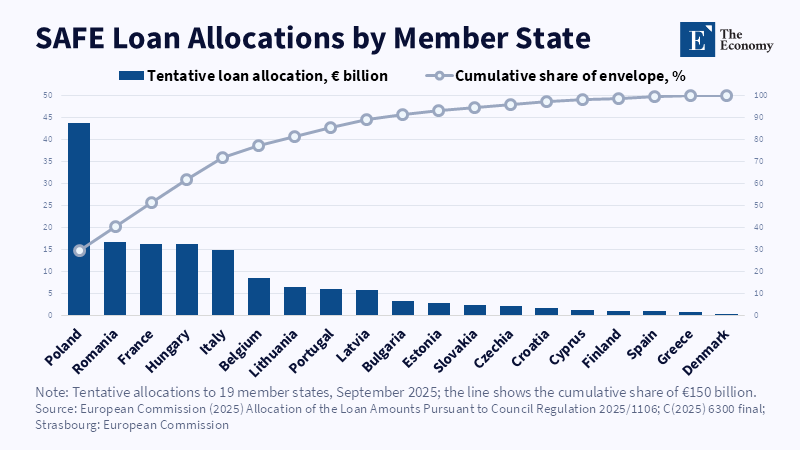
The European side has meanwhile set up its own tools. The White Paper on European Defence, Readiness 2030 and the ReArm Europe plan aim to mobilise up to €800 billion, with the SAFE Regulation as the main financing vehicle, adopted by the Council on 27 May 2025 and providing for loans of up to €150 billion. Article 16 of the Regulation is often presented in simplified terms as a 35% threshold for third countries. The provision stipulates that the cost of components originating outside the Union, the EEA and EFTA States and Ukraine cannot exceed 35% of the estimated cost of the final product components, which is not the same as the total value of the contract. At the same time, conditions of establishment and control apply, as contractors must be established in the Union, the EEA or Ukraine and not controlled by a non-associated third country, as well as design-authority requirements in certain product categories so that the design is not subject to restrictions imposed by a third country.
Countries with a Security and Defence Partnership can negotiate a bilateral association agreement with SAFE and Canada was the first to complete it. South Korea applied in September 2025 and Japan in December of the same year, when the Commission said it was too early to make predictions while it was still assessing 19 national plans. The EDIP, established by Regulation 2025/2643 of 16 December 2025, operates differently, as a grant program with a work programme of €1.5 billion approved on 30 March 2026, of which over €700 million is directed towards increasing the production of European companies, with funding rates between 35% and 100% depending on the call. SAFE, EDIP and national procurement are different channels with different rules and GCAP does not belong to either of the two European ones, since it is financed by the budgets of three states. For the Japanese defence industry, the realistic path to SAFE projects is through components within the cost limit or subsidiaries established in Europe that meet the control conditions and in any case through the decisions of the Member States that borrow.
Co-Development Trades Export Volume for Design Control
The Korean model is easier to measure. On August 1, 2025, the Polish Armaments Agency signed the second executive contract with Hyundai Rotem at the Bumar-Łabędy plant in Gliwice, worth $6.5 billion, for 180 K2 tanks and 81 support vehicles. The 116 tanks in the K2GF configuration are delivered in 2026 and 2027 and the 64 of the Polish K2PL version by 2030, with the final assembly of 61 of them taking place in Gliwice, while the first 28 arrived in Poland on August 24, 2026. According to the Korea Economic Institute of America, which uses SIPRI data, South Korea is now the second-largest source of arms for European NATO members with 8.6% of their imports, far behind the United States at 58% and its sales remain a series of bilateral transactions. The value in this model can be seen in every cargo that crosses the border and every job that is transferred to a Polish assembly line.
The Japanese model leaves fewer traces on export tables because its value does not cross borders as cargo but remains as a share in common intellectual property and as a package of work within joint ventures. The difference has legal consequences, because a Korean export is licensed by Seoul and Polish local production is regulated by a bilateral technology transfer contract, while a future sale of the GCAP aircraft to a third country will involve the export control regimes of three governments and will pass through the Japanese National Security Council with the restrictions already written in the guidelines. The co-developer gains access to technology and shares the development costs, but loses unilateral control of the sale.
The Japanese cabinet presented the April revision as a tool to strategically promote arms transfers and to strengthen the industrial base and from there it reasonably follows the expectation that Japanese groups will soon also bid for European tenders for ready-made systems, competing directly with Korean ones. The data do not support this expectation for the coming years. Arms exports are limited to countries with bilateral agreements and are examined one by one by the National Security Council, the Sovereign Effects Partners agreement explicitly excludes joint arms development and the Japanese GCAP work package provides for production in Japan, without a European line equivalent to that of Gliwice, which is exactly the kind of presence that SAFE’s establishment conditions reward. Even Korea, with a much larger lead, stumbles on interoperability, since according to the KEI only the K2 family of Hyundai Rotem has NATO quality certification, while the same institute characterizes the current Japanese footprint as an exporter to the members of the Alliance as limited.
For procurement managers in European ministries of defence, the practical consequence is that Japanese technology will reach their programmes mainly indirectly, through joint ventures with European partners such as Leonardo, BAE Systems or MBDA and will count towards the SAFE component cost limit where a project is funded by it. For executives in Tokyo, the Polish experience shows that European procurement rewards production within Europe and technology transfer to local partners at least as much as technological superiority, which for MHI, Mitsubishi Electric and IHI means decisions on European subsidiaries, on the allocation of intellectual property rights and on how much of the know-how developed in GCAP can travel to other products without reopening the debate with London and Rome.
The £4.6 billion contract and the 33.3% stake held by JAIEC measure something that SIPRI’s export tables do not record: the position of a country within the ownership of a project that will fly beyond 2070. G2E’s contract with Edgewing on September 10, 2026 and the engine tests in Reading show that this position is now taking on a contractual form and real content. They do not yet show a Japanese presence in the supplies financed by SAFE and EDIP, where Canada already has an association agreement and Tokyo’s application was submitted after those of Seoul and Ankara, with the Commission then avoiding any prediction. Joint development gave the Japanese defense industry an equal seat at the table of the design of a sixth-generation fighter. In the same period, Hyundai Rotem delivered 28 tanks to Poland in one August and is preparing the line for another 61 in Gliwice.
The views expressed in this article are those of the author(s) and do not necessarily reflect the official position of The Economy or its affiliates.
References
BAE Systems (2025) Industry Partners Launch Joint Venture Company Edgewing to Deliver Next Generation Combat Aircraft. Press release, 20 June. Farnborough: BAE Systems.
Council of the European Union (2025) Council Regulation (EU) 2025/1106 of 27 May 2025 Establishing the Security Action for Europe (SAFE) through the Reinforcement of the European Defence Industry Instrument. Official Journal of the European Union, L series.
Directorate-General for Defence Industry and Space (2026a) EDIP Work Programme Adopted. Brussels: European Commission, 30 March.
Directorate-General for Defence Industry and Space (2026b) EU-Japan Defence Industry Dialogue. Brussels: European Commission, 17 April.
Fiorenza, N. (2026) ‘Poland receives first K2 MBTs under second executive contract’, Janes, August.
George, M., Djokic, K., Hussain, Z., Wezeman, P.D. and Wezeman, S.T. (2026) Trends in International Arms Transfers, 2025. SIPRI Fact Sheet. Stockholm: Stockholm International Peace Research Institute.
IHI Corporation (2026) The Consortium for the GCAP Power and Propulsion System Progresses toward Ground-Testing Engine Demonstrator. Press release, 21 July. Tokyo: IHI Corporation.
Japan Ministry of Defense (2026a) Defense of Japan 2026, Reference 78: Implementation Guidelines for the Three Principles on Transfer of Defense Equipment and Technology. Tokyo: Ministry of Defense.
Japan Ministry of Defense (2026b) Signing of a Contract between the GCAP International Government Organization and the Joint Venture Edgewing. Press release, 6 July. Tokyo: Ministry of Defense.
Jiji Press (2026) ‘Japan lifts weapon export ban in principle’, Jiji Press, 21 April.
Mitsubishi Electric Corporation (2026) G2E Consortium for Next-Generation Fighter Co-Development Concludes International Contract with Edgewing. News release DS No. 2616, 10 September. Tokyo: Mitsubishi Electric Corporation.
Mitsubishi Heavy Industries (2026) Collaboration Agreement Announced by Sovereign Effects Partners to Support GCAP. Press release, 23 July. Tokyo: Mitsubishi Heavy Industries.
Stangarone, T. (2026) South Korea Wants to Be a NATO Partner, Not Just a Vendor. Washington, DC: Korea Economic Institute of America, 6 August.
UK Ministry of Defence (2026) Over £4 Billion Invested in Next-Generation Fighter Jet with New International Contract. Press release, 3 July. London: Ministry of Defence.
Working across research, policy, and data-driven analysis, the Editorial Board ensures that published pieces reflect a consistent institutional perspective grounded in quantitative reasoning and long-term structural assessment.