Japan’s Advantage in Physical AI Is a Thing of the Past

Working across research, policy, and data-driven analysis, the Editorial Board ensures that published pieces reflect a consistent institutional perspective grounded in quantitative reasoning and long-term structural assessment.
Authored On
Modified
Japan’s robot base no longer guarantees physical AI leadership
China leads in robot installations, while U.S. capital dominates
Too few young researchers threaten Noetra’s national model plans
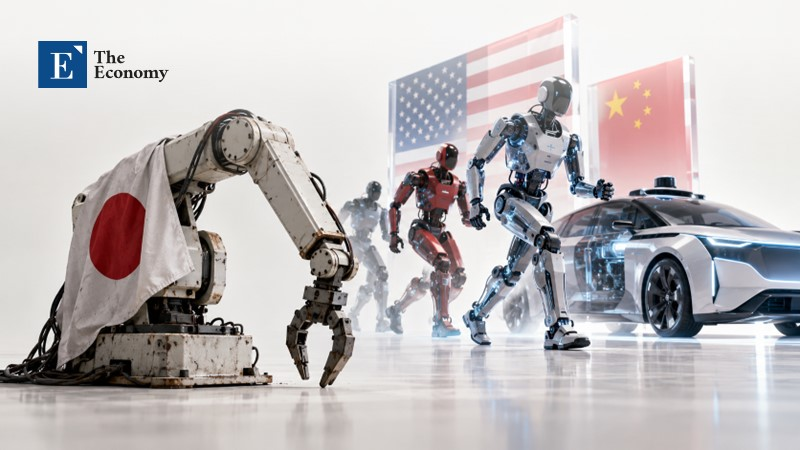
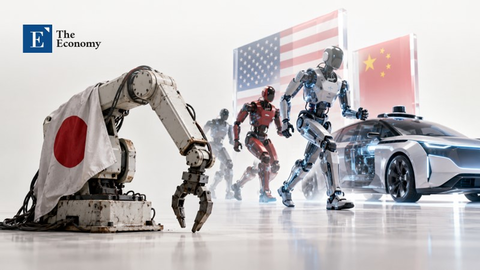
Between 2013 and 2025, private investors poured about $757 billion into AI companies in the United States and $132 billion into China, according to data from Stanford University’s AI Index, while Japan raised just $7 billion in the same period. With this gap in the background, Tokyo has politically invested in a more convenient narrative, according to which physical artificial intelligence, the systems that drive robots, vehicles and production lines in the real world, belongs by right to a country with decades of industrial robotics and factory discipline. The argument has a basis. Japan has infrastructure that few countries have built, with the possible exception of the U.S. and China. Most of this infrastructure, however, was set up for an industry of the 1990s and the competition currently taking place between Washington and Beijing is accelerating year after year at a rate that the Japanese system has not shown it can follow.
A Large Robot Stock Does Not Make Japan a Physical AI Leader
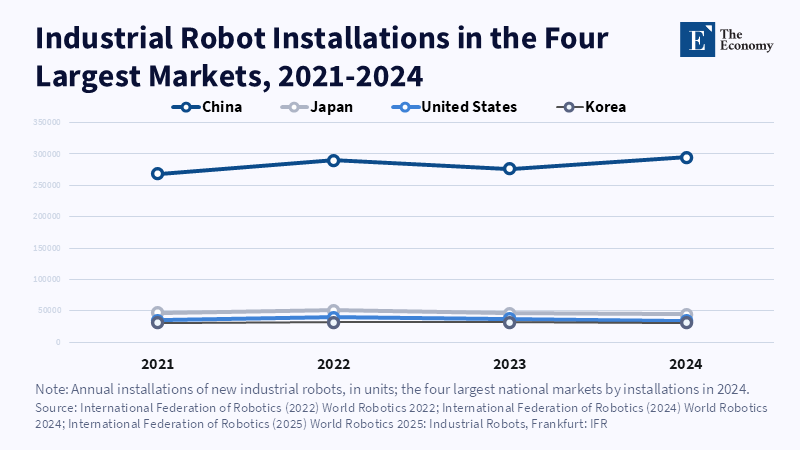
Anyone who wants to defend the Japanese position starts with robots and rightly so. The International Federation of Robotics recorded that in 2022 Japan produced about 46 percent of the world’s industrial robots, a figure that no other country comes close to as a manufacturer. In 2024, the country remained the second largest market in the world, with 44,500 new installations and 450,500 robots in operation. These numbers mainly describe a supplier of mechanical arms and much less a country that controls the software that will make them think. New installations fell by 4 percent in 2024, while China absorbed 54 percent of all installations worldwide and exceeded two million robots in operation, a stock more than four times that of Japan. In an environment where physical AI learns from the data of working machines, data accumulates where robots are, not where they were designed.
The other half of the picture concerns the way Japanese organizations operate. In 2018, the Ministry of Economy, Trade and Industry warned in its report on digital transformation that aging business information systems could cost the economy up to 12 trillion yen a year after 2025 if not replaced. Six years later, in June 2024, the Digital Agency announced that it had repealed 1,034 regulations requiring the use of floppy disks in public administration, with one exception concerning vehicle recycling. The news became a joke in the international media, but it says something serious about physical AI, since the tacit knowledge of Japanese factories, which the government promotes as the country’s great asset, remains fragmented among thousands of companies, rarely standardized and even more rarely stored in a form that a model can consume, which means that the advantage lies more in the heads of experienced craftsmen than in databases capable of training a machine before these craftsmen retire.
Capital and Humanoid Production Have Moved to the U.S. and China
In investment, where Japan had hoped that the shift to physical AI would exempt it from comparison with the two giants, the latest numbers show a widening gap. In 2025 alone, private investment in artificial intelligence in the United States reached $285.9 billion, 23 times more than China’s 12.4 billion, which in turn relies on government guidance funds that are not fully reflected in these tables. The Japanese Ministry of Internal Affairs and Communications’ White Paper for 2026, based on the same data, ranks Japan tenth in the number of new AI companies funded in 2025, with 56 companies compared to 1,953 in the US. The same text notes that in the AIRankings research production rankings, the country has been moving in recent years between tenth and twelfth place, figures that suit a medium-sized technological power and not a state that claims a leading role in an entire industry.
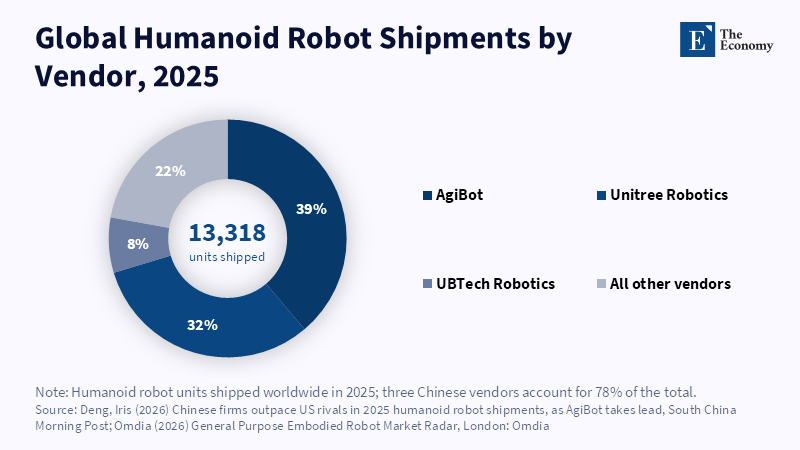
The picture of humanoid robots, the sector where physical AI gains a body, is even more revealing about the country that once introduced Honda’s ASIMO to the world. According to research firm Omdia, global humanoid shipments reached 13,318 units in 2025, nearly six times as many as the previous year and the top six places in the ranking belonged to Chinese companies, with AgiBot shipping 5,168 units, Unitree 4,200 and UBTech 1,000. The American Figure AI, Agility Robotics and Tesla were left at a few hundred each, but the American side owns the models that turn vision and language into movement, such as NVIDIA’s GR00T, Google DeepMind’s Gemini Robotics and π0.5 from the San Francisco start-up Physical Intelligence. In August 2026, DeepSeek agreed to invest about 140 million yuan in Unitree, tying a Chinese brain to a Chinese body through mutual priority in cooperation. There is no Japanese company in Omdia’s top six and no Japanese robotics model has gained similar international use.
Nissan and Noetra Show How Much of Japan’s AI Is Borrowed
The two ventures presented as proof of Japanese ambition tell, if read carefully, a different story. In October 2026, Nissan and Applied Intuition, a software company with teams in Silicon Valley, announced that the latter’s Vehicle OS would support a common software platform for a series of models of the Japanese group, following a relationship that began in 2020. At AWS Summit Japan, the two companies had shown a test vehicle based on the LEAF receiving a software update in a matter of minutes, a process that they say usually takes months. Three months earlier, on June 30, Honda had signed a similar partnership with the same company. Two of the country’s largest automakers are therefore buying from California the software that will determine how their cars think and Nissan is doing so while implementing a rescue plan after a net loss of 670.9 billion yen in fiscal year 2024, the closure of seven factories and the cutting of 20,000 jobs.
Noetra is the state’s answer to this dependency. It officially launched on July 1, 2026 with funding from 44 companies, including SoftBank, NEC, Honda and Sony and was selected for NEDO’s five-year program for multimodal foundation models for robots and physical AI, with government support of approximately 387.3 billion yen for fiscal year 2026 and up to about one trillion yen over five years. The research arm, centered on the National Institute of Advanced Industrial Science and Technology, brings together 14 institutions from Japan, the U.S. and Europe and about 200 researchers, with participation from the University of Cambridge, Carnegie Mellon and a research institute from Canada. International collaboration is a logical choice, but it leaves little room for doubt about how thin the domestic research workforce is, when a project labeled the national model needs so much foreign expertise from day one. An alliance of 44 shareholders is also called upon to solve a speed problem that DeepSeek and Unitree solved with one signature and nothing in the history of Japanese consortia guarantees that decisions will be made at the pace required by a model cycle that is now renewed every few months.
An Aging Society Cannot Supply Enough AI Researchers
The most difficult obstacle is not bought with budgets. The 2025 census recorded a population of 122,972,528 inhabitants, 3.17 million fewer than in 2020, with 29.4 percent having exceeded the age of 65, a record figure for the country. The number directly related to physical AI is smaller and more worrying. In 2022, 14,380 students started a doctorate, 21 percent less than the 18,200 in 2003, according to data from the Ministry of Education, Culture, Sports, Science and Technology, which admits in its action plan for doctorates that Japan is the only major country where the number of new doctorates continues to fall. Government figures for 2020 show 123 new PhDs per million inhabitants, compared to 313 in the UK and 315 in Germany. At the same time, according to the National Institute of Science and Technology Policy, China and South Korea effectively doubled their PhD holders between 2006 and 2019, while Japan fell from 17,860 to 15,128.
The government is aware of the problem and in July 2026 it announced an expansion of research fellowships to a target of 20,000 PhDs a year, which is about a third more than those who graduated in 2019. Even if the goal is met, a student starting a PhD in 2026 will not work as an independent researcher until 2029 or 2030, when Noetra’s five-year funding will have largely been spent. The president of the Japan Association of National Universities has also described the reason why young people avoid this path, since a PhD salary in the Japanese market is often no different from that of a position that does not require such a degree. The money for the models was found, on a scale that Japanese industrial policy had not seen for years. A generation large enough and young enough to turn that money into something competitive with American and Chinese laboratories cannot be found the same way, especially in a country where almost three out of ten inhabitants have already passed the age of 65.
Tacit Factory Knowledge Is Not a Permanent Advantage
The strongest objection to this reading is that Japan does not need to win the race in foundation models. It is enough, arguably, to possess the knowledge of the factory floor, the data on how a craftsman understands from the sound of a press that something is wrong and to integrate it into models developed by others. The argument only holds as long as this data remains scarce. The evolution of the last two years is moving in the opposite direction, with vision, language and action models becoming more and more open, with NVIDIA releasing the GR00T series as open weights and with the operating data being generated where the robots work. When China installs more than one in two of the world’s new industrial robots, each passing year widens the difference in the volume of recorded work in favor of Chinese factories. A country that simply feeds knowledge into other people’s systems risks becoming a data tenant and Nissan’s losses have already shown how quickly an industrial position once considered safe can erode.
For the Ministry of Economy, Trade and Industry and for the boards of directors of the companies that finance Noetra, this translates into very specific choices. Success should be measured by how many production lines will run a Japanese model by 2028 and how much data will be exchanged between companies that until now kept it as a trade secret, not by the number of participants in the announcements. Nissan and Honda must also decide whether the partnership with Applied Intuition will leave their engineering departments with the ability to write the next generation of software on their own or whether it will limit them to the role of assembler around an American system. As for the people, the only policy that will work in five years is to massively attract foreign researchers with salaries that rival Silicon Valley and Shenzhen, a step that the country has historically been wary of.
The $7 billion in private investment since 2013, compared to the 757 billion in the US, explains why Tokyo turned to physical AI, without explaining how it will win in it. The 387.3 billion yen that the state allocates to Noetra for 2026 is a large amount by Japanese standards, but it corresponds to a small fraction of what American companies in the sector raised in just one year. In Oppama, where Nissan started producing electric cars, the lines will stop at the end of the 2027 fiscal year and production will be moved to Kyushu. Noetra’s program will then have three more years of funding ahead of it and no one can say today whether the first factory to run on a Japanese foundation model will even be located in Japan.
The views expressed in this article are those of the author(s) and do not necessarily reflect the official position of The Economy or its affiliates.
References
Applied Intuition (2026) Applied Intuition and Nissan drive the future of AI-defined vehicle development. Mountain View, CA: Applied Intuition.
Deng, I. (2026) ‘Chinese firms outpace US rivals in 2025 humanoid robot shipments, as AgiBot takes lead’, South China Morning Post, 9 January.
International Federation of Robotics (2025) World Robotics 2025: Industrial Robots. Frankfurt: IFR.
Ministry of Education, Culture, Sports, Science and Technology (2024) Get a PhD: Doctoral Human Resources Action Plan. Tokyo: MEXT.
Nissan Motor Co., Ltd. (2025) Fiscal Year 2024 Financial Results and Re:Nissan Recovery Plan. Yokohama: Nissan Motor Co., Ltd.
SoftBank Corp. (2026) Noetra Launches Full-Scale R&D to Support Japan’s Leadership in Physical AI. Tokyo: SoftBank Corp.
Stanford Institute for Human-Centered Artificial Intelligence (2026) Artificial Intelligence Index Report 2026. Stanford, CA: Stanford University.
Statistics Bureau of Japan (2026) 2025 Population Census: Final Results. Tokyo: Ministry of Internal Affairs and Communications.
Working across research, policy, and data-driven analysis, the Editorial Board ensures that published pieces reflect a consistent institutional perspective grounded in quantitative reasoning and long-term structural assessment.