Teleworking Brought Mothers and Disabled Workers into the Labor Market

Working across research, policy, and data-driven analysis, the Editorial Board ensures that published pieces reflect a consistent institutional perspective grounded in quantitative reasoning and long-term structural assessment.
Authored On
Modified
Remote work pulled disabled people back into employment
Flexible jobs protect mothers’ earnings after childbirth
Office mandates risk losing both new labor sources

In 2024, employment of physically disabled Americans was 12.4% above the January 2019 level, while employment for non-disabled people had simply returned to where it started, a divergence that had not occurred in any previous recession. Economists from Stanford, the University of California at San Diego and Stockholm University, in a study published in June 2026 by the American Economic Review: Insights, attribute 68% to 85% of the post-pandemic rise in their full-time employment to teleworking and in October 2026 an analysis for the United Kingdom came in at an almost identical size. The realization that working from home has helped people with disabilities no longer surprises anyone. It becomes more useful when it is placed next to a second group that the labor market has kept on the sidelines for decades, the mothers of young children, because the same mechanism seems to have worked for both and the wave of return to the office now threatens to undo it at the same time.
Two Excluded Groups Faced the Same Office Barrier
The distance of people with disabilities from the labor market is easy to measure. In OECD countries, the average employment gap between those with and without disabilities reaches 27 percentage points, as noted by the American Economic Association. In the United States, the Bureau of Labor Statistics recorded an employment rate of 22.7% for people with disabilities of all ages for 2024, the highest since the series began in 2008, compared to 65.5% for the rest of the population. In Britain, the government-commissioned Keep Britain Working review found that 57% of working-age people with a health condition that limits their work were not working in 2024. Behind the percentages are people who can work, as long as the position does not require daily commuting and all-day presence in a place designed for someone else.
The second group had a different path and a similar outcome. In January 1989, only 58.9 percent of American women aged 25 to 44 with a child under five were in the labor force, according to the index maintained by The Care Board of the University of Kansas, while fathers of the same age stayed consistently above 95 percent. The stay-at-home mother was usually presented as a product of choice or culture, but mothers of young children more often than any other group of parents cite childcare problems as a reason why they did not work, worked part-time, or were absent from work in the previous week, suggesting a scheduling problem.
What unites the two groups is a condition that the classic office took for granted: that the employee leaves home on time, arrives on time and remains available for a full shift. For a person with chronic pain or fatigue, the journey itself consumes part of the energy needed for work, while for a mother with an infant, the difficulty lies in the gap between the closure of the nursery and the end of working hours. Teleworking removes this requirement without asking the employer to lower work standards and in Britain the increase in working from home has reduced the commute time of workers with disabilities by about 29%, leaving their usual weekly working hours at the same level.
U.S. and UK Data Show Teleworking Brought New Workers into Jobs
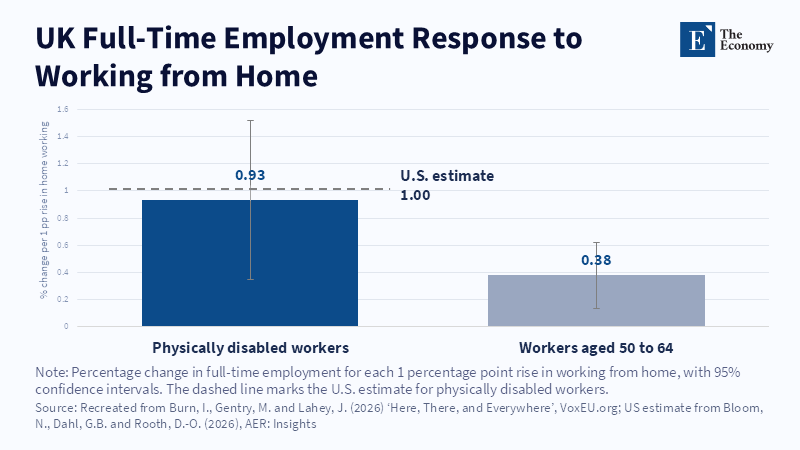
The American study compares occupations where working from home increased a lot with occupations where it increased slightly and finds that each percentage point of additional teleworking increases the full-time employment of people with physical disabilities by about 1%, with an overall benefit of 9% to 11%. More revealing is the origin of the new workers. The increase in employment corresponds almost entirely to a decrease in the percentage of those who were outside the labor force, while unemployment remained more or less stable, so it is not about unemployed people who simply found a job faster. The wages of workers with disabilities even fell slightly in occupations with more teleworking, an indication that the rise was mainly fueled by the increased supply of labor.
The British analysis, a project of economists from the universities of Liverpool, South Florida and Texas A&M and released as an NBER working paper, is based on the quarterly Labour Force Survey and compares the years 2018-2019 with 2023-2024. During this time, the share of non-disabled full-time workers working mainly from home rose from about 12% to 32%, with similar increases for disabled and older workers and each percentage point increase raised the full-time employment of people with physical disabilities by about 0.9%. For workers aged 50 to 64, the effect was around 0.4% and was concentrated on those without a university degree. The full-time employment rate of people with disabilities rose from 34.4% to 37.6% and even a more conservative version of the model explains about 77% of this increase.
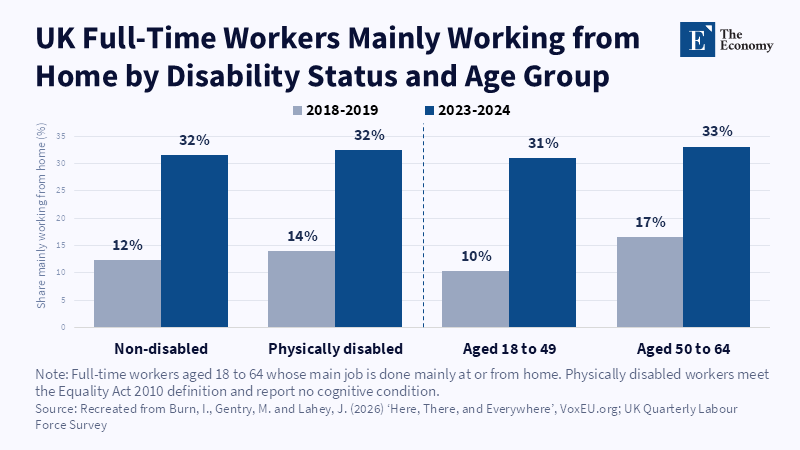
The convergence of the two estimates carries weight because the two markets differ in places that could erase the effect. British workers with disabilities are overrepresented in industries such as retail, where working from home is rare and the British job retention program during the pandemic protected them disproportionately and the definition of disability in British surveys is broader. On the other side of the scale, an analysis of job postings by researchers at UCL, LSE and Stanford showed that from 2019 to early 2023 the share of teleworking postings increased fivefold or even exceeded this level in Britain, compared to just over tripling in the United States. When such different institutions come up with almost the same number, the explanation probably lies in the obstacle itself, which is common on both sides of the Atlantic.
Teleworking Shields Mothers’ Earnings after Childbirth
The most complete data on mothers comes from Italy, where economists from the Bank of Italy, the University of Calabria and the Einaudi Institute for Economics and Finance combined private sector social security records for the period 2012-2024 with birth registers and with data from the Ministry of Labor on teleworking contracts. According to the study published in June 2026, access to a teleworking contract compensates for about 77% of the loss of income suffered by a mother around childbirth, compared to corresponding mothers who cannot work remotely. Mothers in more flexible positions worked more weeks a year after giving birth and took less parental leave, while staying full-time more often. The likelihood of them keeping their position did not change substantially, so teleworking mainly affected the intensity and continuity of employment, with greater benefit for younger mothers, for those with lower earnings and for those who commuted to another municipality for work.
The finding that moves the discussion the most concerns fathers. Their earnings are not affected by the birth of a child, so teleworking has little room to improve their own course, but mothers whose partner works in a profession with a high teleworking capacity suffer significantly smaller income losses, in size impressively close to that of their own access. A partner who can pick up a sick child from the nursery during the day leaves the mother hours that she would otherwise miss from work. The same researchers estimate that the current spread of teleworking reduces by about 11% the widening gender pay gap during working life, a percentage that would approach 30% if all positions that can be done remotely offered official teleworking, while the overall fertility rate is estimated to be 1.2% higher because of it.
The American experience shows what happens when flexibility is withdrawn. The labor force participation of mothers with a child under five reached an all-time high of 71.2% in August 2023, while the gap with fathers had fallen to its lowest point in October 2022. From January to June 2025, the rate fell from 69.7% to 66.9%, the sharpest six-month decline in more than forty years of data, according to the University of Kansas Index, during a period when large corporations and the federal government imposed stricter physical presence rules. KPMG, in its report “The Great Exit”, found that the participation of mothers with a university degree and very young children fell to about 77% in August 2025 from almost 80% in 2023, while fathers with the same profile moved slightly upwards. With 32% of mothers of young children working remotely in 2025, compared to 20% of men without children, each return-to-office order disproportionately affects them, although the cost of childcare was rising during the same period and the available data do not yet allow the contribution of each cause to be distinguished.
Teleworking Pays Off for Public Finances and Employers
For public finances, a person coming out of inactivity counts twice, since he pays taxes and contributions and at the same time needs less support. The British Office for Budget Responsibility predicts that spending on state pensions will rise from about 5% to 9% of GDP over the next fifty years and the Keep Britain Working review explicitly named teleworking as a way to reduce the commuting, health and care barriers that keep people out of the market. Here the American finding on the origin of the new workers with disabilities acquires practical value, because it describes net addition to the workforce, the kind of growth that ageing economies are finding increasingly difficult and this increase in the United States has come about without the need for any new government employment programs.
Businesses have their own incentives. In a randomized experiment with 1,612 employees of Chinese travel company Trip.com, published in Nature in 2024, two days of working from home a week reduced resignations by a third, with no difference in performance ratings or promotions over the next two years and the reduction was greater for women and those with a long commute to the office. The slight drop in wages recorded by both disability studies, around 0.17% for every percentage point of teleworking in Britain, is read by the employer as a wider pool of candidates who accept a slightly lower-paying position because they save time and expenses. The House of Lords committee on working from home presented a survey of employers in 2026 according to which 28% of employees with health problems worked from home as a reasonable accommodation and 19% would like to do so more often.
Companies that are reintroducing the five-day presence usually invoke the mentoring of younger staff and the cohesion of teams and for many professions these arguments stand. The strongest form of the objection, that teleworking simply brings home employees who would otherwise work in the office, does not hold up in the American data, where the rise came from people who were out of the market. Nor does the concern about performance find support in the Trip.com experiment, while the 45 managers and supervisors surveyed in a British study by Lancaster University reported that productivity increased or remained stable after the implementation of hybrid models. The British analysis, however, admits that among workers aged 50 to 64, total full-time employment did not increase between the two periods, so in that age group teleworking rather delayed departures without adding new workers and this part of the objection remains standing.
Return-to-Office Mandates Put a New Labor Supply at Risk
Employee demand and employer supply are already moving in opposite directions. The Lancaster University study, funded by the Nuffield Foundation and published in February 2026, surveyed 1,221 workers with disabilities across the UK. More than eight in ten said the ability to telecommute would be essential if they were looking for a new job and 46% would like to work exclusively from home, with disabled women and disabled carers wanting to do so more often. At the same time, only 13.5% of vacancies in 2024-2025 offered hybrid work and 47% of participants had not fully received the reasonable accommodations they had requested. The first policy proposal emerges almost by itself: the possibility of teleworking should be defined by task and written in the job description, so that it does not depend on the discretion of each supervisor and a request from a disabled worker or from a parent of a child under five years of age should be rejected only with documented operational justification.
The Italian experience adds a second proposal that is often overlooked and concerns fathers. If teleworking is seen as a convenience only for mothers, it risks becoming a new version of part-time work, with the same stigma of lower commitment, while data show that the flexibility of the partner protects the mother’s income almost as much as her own. For businesses that consider attendance essential, a hybrid scheme with two days at home keeps the benefits of coexistence without losing the workers that the five-day presence would dislodge and an impact assessment before each return order, with a measurement of resignations by gender, parental status and disability, would show management which part of the staff bears the cost. The limit of all this is well known, since cashiers, nurses, drivers and warehouse workers cannot work from their kitchen and for them the solutions go through predictable hours, accessible spaces and adequate childcare.
In the United States, the employment rate of people with disabilities aged 16 to 64 was 38.1% in 2025 according to the Bureau of Labor Statistics, up from 37.4% in 2024, while in the same year mothers of young children lost almost three participation points in six months. The two groups moved in parallel for about three years after the pandemic and the divergence that is emerging now may be due to the fact that workers with disabilities have a legally guaranteed right to reasonable accommodation, which mothers do not have, or perhaps simply reflects the rise in the cost of childcare. The data is not yet sufficient to judge which explanation applies. However, the 12.4% increase in the employment of Americans with physical disabilities remains recorded, a result that the Americans with Disabilities Act, in force since 1990, had not been able to bring with its required accommodations and which came from the change of where work is done.
The views expressed in this article are those of the author(s) and do not necessarily reflect the official position of The Economy or its affiliates.
References
Basso, Gaetano, De Paola, Maria, Lattanzio, Salvatore and Paradisi, Matteo (2026) Workplace Flexibility and the Motherhood Penalty: Evidence from the Diffusion of Remote Work. CEPR Discussion Paper 21486. London: Centre for Economic Policy Research.
Bloom, Nicholas, Dahl, Gordon B. and Rooth, Dan-Olof (2026) ‘Work from home and disability employment’, American Economic Review: Insights, 8(2), pp. 179-195.
Bloom, Nicholas, Han, Ruobing and Liang, James (2024) ‘Hybrid working from home improves retention without damaging performance’, Nature, 630, pp. 920-925.
Bureau of Labor Statistics (2025) Persons with a Disability: Labor Force Characteristics, 2024. Washington, DC: U.S. Department of Labor.
Bureau of Labor Statistics (2026) People with a Disability: Labor Force Characteristics, 2025. Washington, DC: U.S. Department of Labor.
Burn, Ian, Gentry, Melissa and Lahey, Joanna (2026) Here, There, and Everywhere: Remote Work’s Impact on Employment in the UK. NBER Working Paper 35791. Cambridge, MA: National Bureau of Economic Research.
Hansen, Stephen, Lambert, Peter John, Bloom, Nicholas, Davis, Steven J., Sadun, Raffaella and Taska, Bledi (2023) Remote Work across Jobs, Companies, and Space. NBER Working Paper 31007. Cambridge, MA: National Bureau of Economic Research.
Holland, Paula et al. (2026) Inclusive Remote and Hybrid Working Study: Final Report. Lancaster: Lancaster University.
House of Lords Select Committee on Home-Based Working (2026) Is Working from Home Working? HL Paper 196, Session 2024-26. London: The Stationery Office.
KPMG (2025) The Great Exit. New York: KPMG Economics.
Mayfield, Charlie (2025a) Keep Britain Working Review: Discovery. London: UK Government.
Mayfield, Charlie (2025b) Keep Britain Working: Final Report. London: UK Government.
Office for Budget Responsibility (2026) Fiscal Risks and Sustainability. London: Office for Budget Responsibility.
Prewitt, Lucie and Heggeness, Misty L. (2025) ‘Labor Force Participation Tracker: Parents with Children under 5’, The Care Board, University of Kansas, 28 August.
Smith, Tyler (2026) ‘The effects of remote work on the disability employment gap’, AEA Research Highlights, American Economic Association, 23 June.
Working across research, policy, and data-driven analysis, the Editorial Board ensures that published pieces reflect a consistent institutional perspective grounded in quantitative reasoning and long-term structural assessment.