How ‘Buy European’ Arms Rules Shut Out South Korea and Japan
Working across research, policy, and data-driven analysis, the Editorial Board ensures that published pieces reflect a consistent institutional perspective grounded in quantitative reasoning and long-term structural assessment.
Authored On
Modified
Buy European rules sideline the Asian suppliers Europe needs
South Korea already supplies Poland more arms than Washington
Without market access, Seoul and Tokyo keep Moscow ties
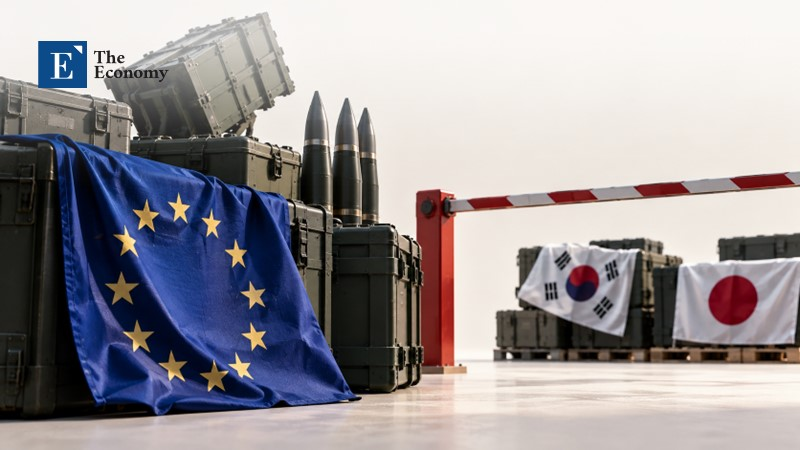
In the five years 2021 to 2025, European states absorbed a third of global arms imports, according to data from the Stockholm International Peace Research Institute and the European Union accompanied this explosion of demand with loans of €150 billion through the SAFE mechanism, under which components originating outside the EU, EEA-EFTA states and Ukraine cannot account for more than 35% of the estimated cost of the end product’s components. The slogan “Buy European” was first read as a response to Washington, in a year in which the Pentagon is withdrawing aircraft and units from the NATO Force Model. The same rule that restricts Lockheed Martin, however, narrows the door for Hyundai Rotem, Hanwha and Mitsubishi Heavy Industries, for industries of countries that Europe needs today in air defense and ammunition more than it publicly admits. A policy that asks Seoul and Tokyo for emergency help without offering them market share leaves unanswered why the two capitals should risk their relationship with Moscow.
What “Buy European” Really Buys
On paper, the SAFE regulation attempts to unite a fragmented market. Alongside the component-origin ceiling, Article 16(11) requires contractors to retain design autonomy free of third-country restrictions for category-two products, including air and missile defense systems and naval capabilities, rather than for every SAFE-supported purchase. The instrument also prefers joint procurement. A transitional clause, however, allowed individual states to include national contracts, as long as they were signed by May 30, 2026 and capitals rushed to meet the deadline. Poland, the largest beneficiary with €43.7 billion, said that 89% of contracts would end up with Polish companies, while Berlin’s plan directs about half of the orders in the wider catalog to German groups such as Rheinmetall and Diehl and leaves for American companies only about 8% of an €83 billion package. No rules were broken and the pressure of the threat explains enough, except that “Buy European” largely functions as a national preference with European funding.
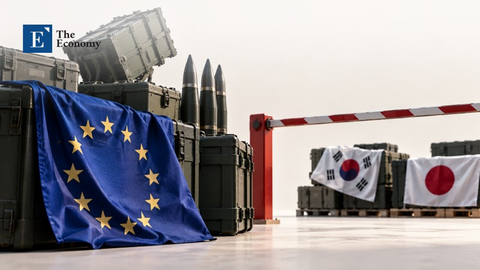
For those outside the Union, access is narrow and procedurally cumbersome. Without a specific agreement, components originating outside the EU, EEA-EFTA states and Ukraine cannot exceed 35% of the estimated component cost of a SAFE-supported end product. That is a limit on component origin, not a general 35% market-share allowance for foreign companies; separate rules govern where contractors are established and who controls them. Wider third-country participation requires a negotiated agreement setting out security, industrial and financial conditions. Canada signed on December 1, 2025, the United Kingdom withdrew when Brussels asked for a high entry fee and South Korea submitted a formal request in September 2025, with the European Commission confirming interest from Japan in December as well. The two Asian countries had signed Security and Defence Partnerships with the EU since November 2024, making them formally eligible. At the EU-Korea summit on June 10, 2026 in Brussels, Seoul left without the agreement reached by Ottawa, while an EU official admitted that member states had already largely decided where the SAFE funds would go.
Washington’s Retreat Gives the European Preference Its Case
The school of “Buy European” does not start from ideology. In June 2026, the United States withdrew from the forces available to the Supreme Allied Commander Europe about a third of the F-16s and F-15Es it had declared to the NATO Force Model, from about 150 to 100 aircraft, canceled planned deployments in Poland and Germany and launched a six-month review of its military presence in Europe. The International Centre for Defence and Security in Tallinn notes that European allies together with Canada spent over $570 billion on defense in 2025, 19% more than in 2024 and that they have already covered almost 90% of the air defense capability withdrawn by Washington. The IISS has calculated that replacing American capabilities in the Euro-Atlantic theater would cost about a trillion dollars above existing plans, an amount that no capital would agree to send again to a supplier that proves unpredictable.
In the same vein, Poland’s defense minister called on October 13, on the sidelines of the Warsaw Security Forum, for the transition of European defense production to “war mode”. The estimate of Estonia’s Foreign Intelligence Service that Russia produced about seven million artillery, mortar, tank and rocket rounds in 2025, at a time when the 27 member states and Norway are expected to produce around two million artillery shells this year, gives the request a numerical basis. The European preference promises factories that will stay on the continent and production lines that do not wait for export permission from any third capital, while also helping politically, since voters more easily accept high defense budgets when they see jobs in their region. Seoul’s refusal in August to send air defense systems to Ukraine offers supporters of this line a recent example of how easily a foreign supplier says no when the need becomes urgent.
Europe Asks Asia for What It Refuses to Buy
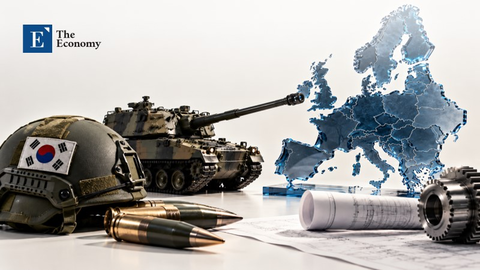
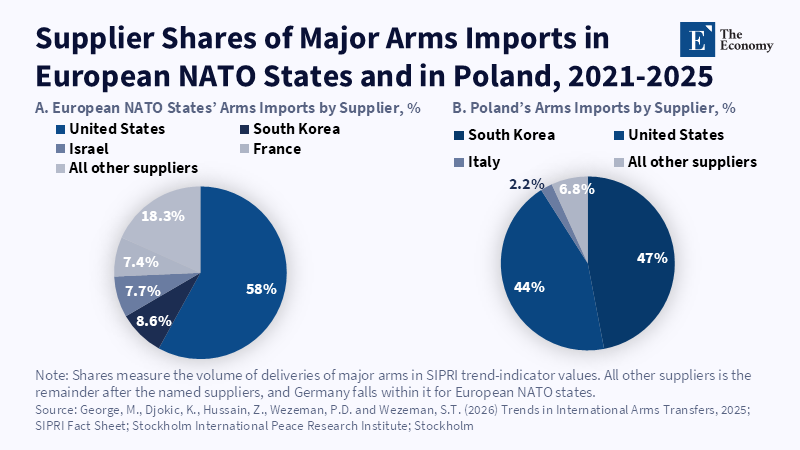
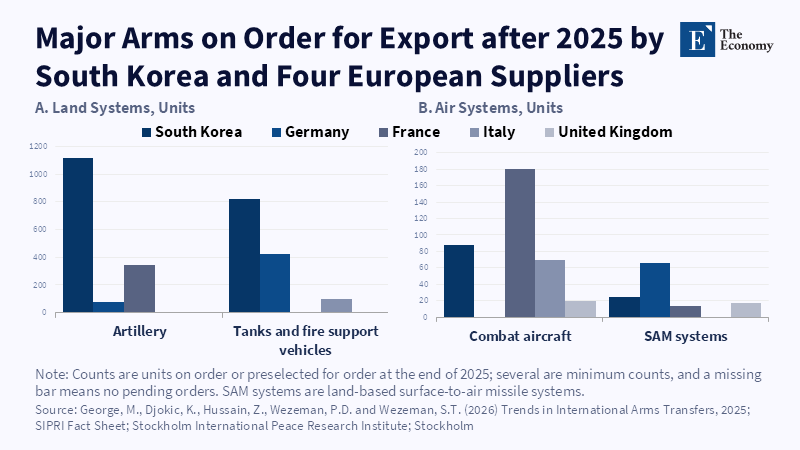
SIPRI’s own data shows how far Asian suppliers have already entered European arsenals. South Korea covered 3% of global arms exports in the period 2021 to 2025 and 58% of them went to Poland and the same data ranks it second only to the United States among suppliers to European NATO members. In August 2025, Warsaw signed the second executive contract with Hyundai Rotem, worth $6.5 billion, for 180 K2 tanks and 81 support vehicles, with 61 of the tanks in the K2PL configuration assembled at the Bumar-Łabędy plant in Gliwice. The first 28 arrived in Poland on August 24, 2026. The European army with the fastest expansion is setting up its heavy armor on a Korean design and this option builds Polish industrial capacity instead of undermining it, although local assembly alone does not resolve SAFE’s component-origin and contractor-control requirements.
In air defense, the need is even more acute. The Ukrainian president said on August 5 that his country received three times fewer anti-aircraft missiles in 2026 than the previous year. At the beginning of July, a strategy adviser to the Ukrainian president had visited Seoul and requested, through the Ministry of National Defense and the DAPA armaments agency, PAC-3 interceptors from Korean stockpiles and according to Chosun Ilbo, the government internally considered the domestic Cheongung-II system as an alternative. On August 10, the Foreign Ministry reiterated that Korea does not supply lethal weapons. Berlin announced at the Ramstein Group meeting an urgent PAC-2 delivery from the Bundeswehr’s stockpiles and called on the other donors to check their own, while the requests to Asia were made as a call for donations and rarely as a proposal for a permanent position in European supply chains. Japan scrapped its five non-combat export categories on April 21, 2026 and now allows arms exports to 17 countries with which it has technology transfer agreements, though not to countries at war outside special circumstances tied to its own security and when, in August, the Ukrainian prime minister asked Tokyo for Patriot family interceptors for the winter, the Chief Cabinet Secretary replied that this was not being considered.
Without a Market, Seoul and Tokyo Keep Their Channel to Moscow Open
Seoul’s stance becomes more understandable once what it risks is weighed against what it would gain. In June 2024, immediately after the signing of the Russia-North Korea mutual defense pact, the Russian president warned from Hanoi that sending lethal weapons to Ukraine would be a “very big mistake”, that Moscow would respond with decisions that the Korean leadership would not like and left open the possibility of arming Pyongyang. Kyodo News reported in November 2025 that North Korea had already transferred about 6.5 million rockets and artillery shells to Russia in exchange for Russian air defense, space and nuclear technology and in August 2026 Kyiv spoke of 30,000 to 50,000 additional North Korean troops bound for Russia. For a government most afraid of what Pyongyang will get from Moscow, every Cheongung-II battery that leaves for Ukraine has a price on the peninsula and the compensation offered by Europe is access to SAFE-financed procurement where Korean-origin components count towards the combined 35% ceiling on components sourced outside the eligible territories, unless a negotiated agreement provides different terms.
Tokyo faces a different mix of risks from Seoul’s immediate Korean-peninsula security dilemma: its calculation also carries a substantial energy weight. According to S&P Global, Japan and South Korea have imported about 4.8 million tons of LNG from Sakhalin-2 since the beginning of 2026, 5.9% of their total imports and the US Treasury Department has extended the exemption from sanctions for the project until December 18, 2026. The EU and the UK have similar exemptions, with the British one reaching until March 2028. The closure of the Strait of Hormuz this year has made Russian gas for Tokyo even more difficult to replace, at the same time that Mitsui and Mitsubishi retain their holdings in the project. Europe is asking the two countries to bear costs in their relations with Russia, while its own arms market, the only reward that could balance those costs, remains designed to keep them on the periphery and no one in Brussels has convincingly explained why Seoul should accept this deal.
An Open Blue Camp Outlasts a Closed Market
The strongest counter-argument of the “Buy European” school is credibility and the Korean refusal in August seems to confirm this. The refusal, however, concerned sending weapons to a war-torn country, where Seoul invokes domestic legislation, rather than deliveries to NATO member states, where Korean industry has gained a reputation for timely deliveries and gathers orders from Poland, Norway and Estonia. The K2PL scheme further shows that a foreign project can end up being a European production line, with tools and equipment that Hyundai Rotem delivers to Bumar-Łabędy, the kind of industrial base that SAFE is seeking even if the investment does not by itself satisfy every eligibility condition. A supplier’s credibility usually depends on how much it has invested in the relationship and a country whose manufacturers face a 35% ceiling on external-origin component costs in SAFE-supported procurement has little reason to accept political costs in favor of a customer who treats it as an emergency solution.
The alternative does not require the abolition of European preference. Components genuinely manufactured within the Union can already count as European-origin under applicable origin rules, even when produced under an Asian license; local assembly alone does not guarantee that status. In a future SAFE revision, Brussels could make the route to eligibility clearer for such industrial partnerships, including foreign-controlled European producers and category-two design authority, while linking broader access for Korea and Japan to a measurable contribution to European security, for example by selling interceptors to European states that would free up their own stocks for Ukraine, a practice that Korean industry has already followed indirectly by replenishing weapons that NATO allies sent to Kyiv. For national armaments services, this means contracts with local production clauses instead of exclusions. For DAPA in Seoul and the Japanese agency ATLA, it means that the attitude towards Moscow acquires a value on the European market. The 2024 Security and Defence Partnerships provide a gateway to negotiations under SAFE’s Article 17, but do not themselves grant broader eligibility and the question is whether member states that have their own national champions will agree to share a piece of the pie with a competitor that already beats them in Poland.
The third of the world’s arms imports that ended up in Europe is money that will be spent anyway and the question is what ties it will leave behind. A strict version of “Buy European” will perhaps build more factories in the Rhineland and Silesia, but it will leave Seoul and Tokyo in a position where Europe appeals to them mainly when interceptors are missing, while Moscow addresses them with threats and cheap gas. The Korean application for SAFE was filed in September 2025 and the June 2026 summit ended without an agreement. The American exemption for Sakhalin-2 expires on December 18. The two timetables are not formally linked and no one can say with certainty whether a European market more open to Asian producers would change their calculations towards Russia, but to date the Union has not allowed them to prove it.
The views expressed in this article are those of the author(s) and do not necessarily reflect the official position of The Economy or its affiliates.
References
Adamowski, J. (2025) ‘Poland doubles down on South Korean tanks with $6.5 billion deal’, Defense News, 1 August.
Barry, B., Barrie, D., Boyd, H., Childs, N., Gjerstad, M., Hackett, J., McGerty, F., Schreer, B. and Waldwyn, T. (2025) Defending Europe Without the United States: Costs and Consequences. London: International Institute for Strategic Studies.
Chosun Ilbo (2026) ‘Exclusive: Ukraine requests South Korea’s latest Patriots, government hesitant’, The Chosun Ilbo, 24 August.
Council of the European Union (2025) Council Regulation (EU) 2025/1106 establishing SAFE, 27 May. EUR-Lex.
Diakonov, I. (2026) ‘South Korea rules out supplying Ukraine with weapons and air defence systems’, Ukrainska Pravda, 11 August.
Fiorenza, N. (2026) ‘Poland receives first K2 MBTs under second executive contract’, Janes, August.
George, M., Djokic, K., Hussain, Z., Wezeman, P.D. and Wezeman, S.T. (2026) Trends in International Arms Transfers, 2025. SIPRI Fact Sheet. Stockholm: Stockholm International Peace Research Institute.
Griffin, O. (2026) ‘Stop Russian airstrikes: Europe moves to send more Patriot missiles to Ukraine, but depleted U.S. stockpiles and Ukraine’s defense-budget waste hobble effort’, The Economy, 9 September.
Jiji Press (2026) ‘Japan lifts weapon export ban in principle’, Jiji Press, 21 April.
Khan, S. (2026) ‘Europe is rearming. It is not integrating’, Modern Diplomacy, 11 October.
Konrad-Adenauer-Stiftung (2026) Deepening the Partnership at the 11th EU-Korea Summit. Country Report. Berlin: Konrad-Adenauer-Stiftung.
Lawrence, T. (2026) Europeanising NATO: Immediate Response. ICDS Brief. Tallinn: International Centre for Defence and Security.
Politico Europe (2024) ‘Putin warns South Korea: Sending killer weapons to Ukraine would be a big mistake’, Politico Europe, 20 June.
S&P Global Commodity Insights (2026) ‘UK allows some continued Russian LNG trade into Japan, South Korea under sanctions’, S&P Global, 1 October.
Skujins, A. (2026) ‘Europe must switch to war-mode defence production, Polish defence minister says’, Euronews, 13 October.
Working across research, policy, and data-driven analysis, the Editorial Board ensures that published pieces reflect a consistent institutional perspective grounded in quantitative reasoning and long-term structural assessment.