AI Investment Accounts for One-Third of US Growth, Raising Risk of Simultaneous Market and Real-Economy Correction if Profitability Doubts Spread

Siobhán Delaney is a Dublin-based writer for The Economy, focusing on culture, education, and international affairs. With a background in media and communication from University College Dublin, she contributes to cross-regional coverage and translation-based commentary. Her work emphasizes clarity and balance, especially in contexts shaped by cultural difference and policy translation.
Authored On
Modified
Surging Compute Demand Driven by the Proliferation of Frontier Models and AI Agents
Data Center Expansion Absorbs Power-Grid, Construction and Capital-Market Resources
Profitability Cracks Could Transmit Shock Across the Broader Economy
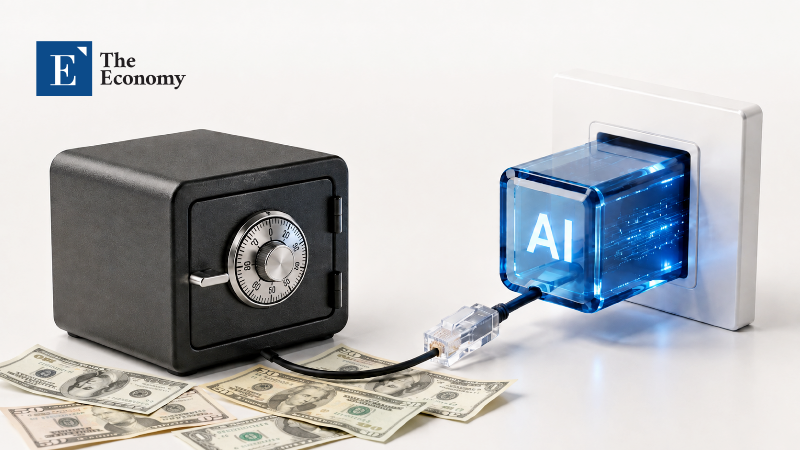
AI infrastructure spending by US technology giants is reshaping the macroeconomic landscape. Capital pouring into software, semiconductors and data centers is supporting one-third of US growth, while the wealth effect generated by rising technology stocks is also lifting household consumption. The proliferation of frontier models and AI agents has triggered an explosion in compute demand, prompting data centers to absorb resources from power grids, construction markets and capital markets simultaneously. Yet if monetization fails to keep pace with investment, the AI boom driving US growth could become a trigger for a sharp stock-market decline and a concurrent contraction in capital expenditure.
Annual AI-Related IT Capital Expenditure Surpasses $1.5 Trillion
According to The Wall Street Journal on August 5, US corporate investment related to AI is estimated to have reached an annualized $1.5 trillion. That represents a 50% increase from $1 trillion two years earlier. Software retained the largest share, while investment in computers and peripheral equipment increased rapidly. Spending on telecommunications equipment and data center construction also expanded. US Department of Commerce data show that annualized data center construction spending reached $68.3 billion in June, up $21.5 billion from a year earlier. By contrast, private construction spending across all other categories—including housing, commercial facilities and hospitals—fell by $101.6 billion over the same period.
Michael Pearce, an economist at Oxford Economics, calculated that AI investment alone has recently generated nearly one-quarter of US gross domestic product growth. When the increase in household wealth stemming from rising stock prices is included, the AI boom is estimated to have supported one-third of US growth. The Federal Reserve Bank of St. Louis estimated that investment in information-processing equipment, software, research and development, and data centers contributed 0.97 percentage points to the 2.51% increase in real US GDP during the first three quarters of 2025. These investments accounted for 39% of total growth, 11 percentage points above the 28% contribution from information-technology investment in 2000, when the dot-com boom reached its peak.
AI Capital Sustains US Economic Momentum
The concentration of capital expenditure has persisted this year. According to data from the US Bureau of Economic Analysis, annualized real GDP growth stood at 1.5% in the second quarter. Continued consumption growth and corporate investment in areas including information-processing equipment and software supported the expansion. A robust stock market has also increased household net worth and stimulated consumption. Federal Reserve data show that US household net worth reached $174 trillion in the first quarter, up $13 trillion from a year earlier. The subsequent 15% rise in the Standard & Poor’s 1500 Index further expanded household wealth and spending capacity.
Jonathan Millar, an economist at Barclays, said the US economy would have struggled to maintain its current momentum without the impetus from AI. According to market-research firm FactSet, combined capital expenditure by the five leading hyperscalers—Alphabet, Amazon, Meta, Microsoft and Oracle—is projected to reach $4 trillion over the four years through 2029. The estimate is more than $300 billion higher than market forecasts issued just one month earlier.
Table 1. AI Data Center Demand
| Category | Key Demand Indicators | Expansion and Procurement Scale |
|---|---|---|
| Microsoft | Azure customer demand exceeds available capacity, with newly deployed compute resources generating revenue immediately after entering service | 88 new data centers commissioned in fiscal 2026; 1 GW of compute capacity added in the second quarter |
| Anthropic | More than 300,000 enterprise customers; the number of customers generating at least $100,000 in annualized revenue increased sevenfold in one year | Long-term contract for up to 1 million Google TPUs; more than 1 GW of compute capacity added in 2026 |
| Amazon | AI orders extend through 2028, with order growth outpacing the commissioning of new facilities | 2026 capital spending plan raised to $220 billion |
| U.S. market | Data center expansion plans surge as AI compute demand increases | Total capacity expected to double over the next three years; approximately 45 GW of IT capacity to be added under confirmed construction plans |
Data Center Scarcity Defies Bubble Warnings
Warnings over financial vulnerabilities within the AI ecosystem are intensifying in parts of the market, yet conditions in the data center sector are sending a different signal from the bubble debate. Frontier-model operators are immediately absorbing newly added data center capacity. Microsoft added 31 data centers across five continents from April through June, bringing the number of newly commissioned facilities in fiscal 2026 to 88. The company secured 1 gigawatt of compute capacity in the second quarter alone and halved, within one year, the time required to receive new graphics processing units and deploy them into service. Despite concurrent improvements in supply and operating efficiency, customer demand for Microsoft’s Azure cloud service continued to exceed available capacity, and newly secured compute resources began generating revenue immediately after entering operation.
Anthropic signed a multibillion-dollar long-term agreement to use as many as 1 million tensor processing units from Google Cloud. The contract will add more than 1 GW of compute capacity this year. Anthropic has more than 300,000 enterprise customers, while the number of large customers generating at least $100,000 in annualized revenue increased sevenfold within one year. The company is diversifying the compute resources required for training and inference through a procurement system spanning Google TPUs, Amazon Trainium chips and Nvidia GPUs.
Amazon raised its capital-expenditure plan for this year to $220 billion but still expects supply constraints to persist. Amazon Chief Executive Officer Andy Jassy said AI demand already extends through 2028 and that orders are growing faster than new facilities can be brought online. Operating a large data center requires the sequential completion of site acquisition, construction, grid interconnection, substation expansion, transformer procurement and cooling-system installation. Across major US data center hubs, approvals for electricity supply and transmission-grid connections increasingly take several years, preventing some completed facilities from operating servers as scheduled. With Amazon’s secured AI orders extending through 2028, facilities currently under construction will struggle to accommodate all medium-term demand.
Compute Demand Outpaces Capacity Expansion
AI adoption rates also leave substantial room for further growth. According to the US Census Bureau’s Business Trends and Outlook Survey, the share of US companies using AI for business purposes remained between 17% and 20% from December 2025 through May this year. Adoption stood at 37% even among companies with at least 250 employees and reached only 14% in retail. A Gallup survey found that, as of May, 15% of US workers used AI every day at work, while 30% used it at least two or three times a week. The number of users exposed to AI has increased rapidly, but only a limited proportion has reached the stage of using it across routine workplace activities.
A wide gap also persists between usage frequency and economic utility. A Federal Reserve Bank of St. Louis survey found that generative AI accounted for 5.7% of total working hours among US employees as of August 2025, while the resulting reduction in working hours was estimated at 1.6%. “AI slop,” a term referring to low-quality AI-generated material, creates the same compute demand within data centers. Every repeated query, regenerated image, error correction and output verification adds to token consumption and server loads. Even outputs with limited commercial value consume semiconductors, electricity and cooling capacity. The monthly number of tokens processed across Google’s services surged more than 3,000-fold, from 9.7 trillion two years earlier to 32 quadrillion this year. Over the same period, throughput across the company’s model application programming interfaces rose to 19 billion tokens per minute.
The proliferation of AI agents is further lifting demand for inference data centers. While performing a single task, an agent repeatedly formulates plans, searches for information, invokes external programs and verifies results, consuming tokens continuously throughout the process. Goldman Sachs estimates that worldwide monthly token usage will reach 1.2 quintillion by 2030, a 24-fold increase from 2026. As the center of compute demand shifts from training hyperscale models toward inference generated continuously by enterprise workflows and consumer services, pressure to expand regional data centers and power infrastructure is intensifying. Reflecting this demand, Synergy Research Group forecasts that total US data center capacity will double within the next three years, with approximately 45 GW of IT load added under construction plans already confirmed.
Monetization Emerges as the Benchmark for AI Investment
Demand growth and investment security remain separate considerations. Capital markets assess whether data center utilization translates into paid revenue and operating profit. Even fully occupied server racks will deliver weak profitability if revenue fails to accumulate at a level sufficient to recoup enormous capital outlays. Data centers also begin incurring depreciation as soon as GPUs are installed, while electricity, cooling and network operating costs continue to accrue. Intensifying price competition among AI model providers means that even surging token usage offers no guarantee of commensurate revenue growth. The volume of enterprise customers secured under long-term contracts and the stability of cloud revenue have therefore become decisive benchmarks for the success of AI investment.
Recent earnings reports from major technology companies have exposed these differences. Microsoft, whose Azure revenue rose 43%, and Amazon, whose Amazon Web Services revenue increased 37%, converted AI infrastructure into external customer revenue. Their shares rose 15.5% and 14%, respectively, following earnings announcements. Meta increased revenue by integrating AI into its advertising business, yet it lacks a cloud operation capable of directly recouping data center investment. Second-quarter capital expenditure reached $31.1 billion, roughly matching operating cash flow, while free cash flow narrowed to $784 million. Its operating margin also fell from 43% to 31%, sending the shares down 8% immediately after the earnings announcement. The advertising business delivered stronger results, while expanding infrastructure investment in data centers and GPUs emerged as a variable affecting future profitability.
Even companies demonstrating progress in monetization remain under market scrutiny. Google Cloud’s second-quarter revenue increased 82% and its operating margin climbed to 35.6%. Alphabet, however, spent $44.9 billion on capital expenditure during the same period, pushing free cash flow to a deficit of $5.9 billion and sending the shares down 7%. Amazon, despite strong growth at AWS, recorded a net outflow of $7.6 billion in free cash flow over the latest 12 months. AI cloud providers unable to generate sufficient operating cash flow are financing capacity expansion through borrowing and long-term lease agreements, leaving them vulnerable to immediate funding strains if major customers defer orders or service fees decline. If these concerns spread, even companies that have demonstrated profitability may struggle to avoid steep share-price declines following signs of slowing growth or announcements of increased capital expenditure.
Siobhán Delaney is a Dublin-based writer for The Economy, focusing on culture, education, and international affairs. With a background in media and communication from University College Dublin, she contributes to cross-regional coverage and translation-based commentary. Her work emphasizes clarity and balance, especially in contexts shaped by cultural difference and policy translation.
Similar Post