Japanese Keep Their Masks on Even in Sweltering Heat as Lookism and Social Scrutiny Fuel Fear of Showing Bare Faces

Matthew Reuter is a senior economic correspondent at The Economy, where he covers global financial markets, emerging technologies, and cross-border trade dynamics. With over a decade of experience reporting from major financial hubs—including London, New York, and Hong Kong—Matthew has developed a reputation for breaking complex economic stories into sharp, accessible narratives. Before joining The Economy, he worked at a leading European financial daily, where his investigative reporting on post-crisis banking reforms earned him recognition from the European Press Association. A graduate of the London School of Economics, Matthew holds dual degrees in economics and international relations. He is particularly interested in how data science and AI are reshaping market analysis and policymaking, often blending quantitative insights into his articles. Outside journalism, Matthew frequently moderates panels at global finance summits and guest lectures on financial journalism at top universities.
Authored On
Modified
“Covering the Face Brings Reassurance”: Masks Become Underwear in Japan
Mask-Wearing Persists Despite End of Pandemic Restrictions
Appearance Anxiety and Social Scrutiny Emerge as Key Drivers
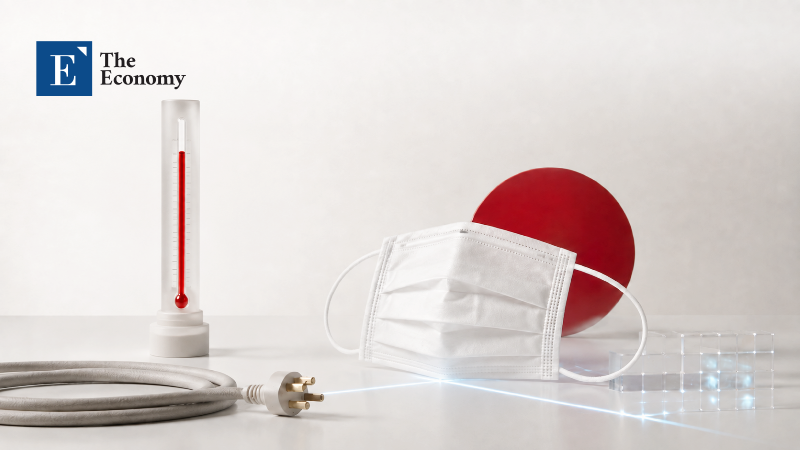
Three years after Japan lifted its COVID-19 prevention guidelines, many people still routinely wear masks. As the once-ubiquitous practice adopted to prevent infection has persisted, masks have become a psychological shield against anxiety over exposing one’s face and scrutiny from others. Among children and adolescents who are particularly sensitive to appearance and peer evaluations, discomfort with showing their bare faces has entrenched the habit, while pressure to conform to the choices of those around them has further reinforced the trend.
One in Five Routinely Wears a Mask
According to the Nihon Keizai Shimbun, or Nikkei, on August 6, substantial numbers of children in Japan continue to wear masks throughout outings and the school day, despite more than three years having passed since COVID-19 was reclassified under the country’s infectious disease law and mask requirements effectively disappeared. Surveys of schools found that approximately 10% to 20% of students in a typical class of 32 or 33 wore masks. Some reportedly keep them on throughout the day except during physical education classes and lunchtime and display severe anxiety when they run out of spares.
Japan’s Ministry of Education, Culture, Sports, Science and Technology maintains that masks are unnecessary for effective communication and a fulfilling school experience. However, it respects individual choice, stating that students who wish to wear masks should not be forced to remove them. Teachers therefore generally refrain from asking students why they are wearing masks or actively encouraging them to remove them unless a specific problem arises.
Japan’s Century-Long History of Mask-Wearing
Japan’s mask culture established its popular foundations during the Spanish flu pandemic from 1918 to 1920. Local governments produced masks at schools and distributed them to residents, while approximately 80% of households covered by a 1920 survey conducted by 14 police stations in Fukui Prefecture used masks. Public health campaigns at the time established mask-wearing as both a form of national defense against invisible infectious diseases and a symbol of modern hygiene.
Forestry policy adopted after World War II turned springtime mask demand into a recurring fixture. To restore forests devastated by the war and meet surging demand for timber, the Japanese government planted large tracts of fast-growing sugi, or Japanese cedar. Sugi forests now cover 4.44 million hectares of Japan’s 10.2 million hectares of planted forests, with the government identifying 4.31 million hectares as pollen-producing areas.
Pollen from sugi and hinoki, or Japanese cypress, is the primary cause of spring allergies. Academic research cited by the Japanese government showed that the overall prevalence of pollen allergies rose from 19.6% in 1998 to 29.8% in 2008 and 42.5% in 2019. The prevalence of sugi pollen allergies alone reached 38.8% in 2019. Pollen allergies were first reported in 1963, and masks designed for allergy sufferers became widely available beginning in the 1970s. Demand for infection-prevention masks revived in the late 1980s as public confidence in influenza vaccines weakened. In the 2000s, government and media campaigns promoting “cough etiquette” established mask-wearing as a civic norm demonstrating both self-protection and consideration for others.
Table 1. Formation and Spread of Japan’s Mask Culture
| Period | Main Background | Key Developments | Impact on Mask Culture |
|---|---|---|---|
| 1918–1920 | Spanish flu pandemic | Local governments produced and distributed masks through schools. Approximately 80% of households surveyed in Fukui Prefecture in 1920 used masks. | Masks became established as a national defense against infectious disease and a symbol of modern hygiene. |
| After World War II | Sugi-centered forest restoration policy | Sugi forests account for 4.44 million hectares of Japan’s 10.2 million hectares of planted forests. Areas identified as pollen sources cover 4.31 million hectares. | Vast sugi forests spread springtime pollen allergies and made mask demand a recurring fixture. |
| 1963–1970s | Spread of pollen allergies | Pollen allergies were first reported in 1963. Masks for allergy sufferers became widely available beginning in the 1970s. | The use of masks expanded from infection prevention to allergy protection. |
| Late 1980s | Declining confidence in influenza vaccination | Individual demand for infection prevention resurfaced. | Masks became reestablished as an everyday means of preventing influenza. |
| 2000s | Spread of “cough etiquette” | The government and media emphasized preventing the spread of infection and showing consideration for others. | Mask-wearing became entrenched as a civic norm demonstrating self-protection and concern for the community. |
| COVID-19 period | Prolonged pandemic | Mask-wearing became universal across everyday spaces. | Existing norms surrounding hygiene, allergies and consideration for others converged, cementing mask use as a daily habit. |
Mask-Wearing Persists After Pandemic Restrictions Disappear
COVID-19 provided the catalyst for this practice to become embedded in daily life. Japan’s Ministry of Health, Labour and Welfare left mask-wearing to individual discretion from March 13, 2023, after the pandemic entered its endemic phase. On May 8 of the same year, it downgraded COVID-19 to a Category V infectious disease, placing it in the same classification as seasonal influenza. The government retained recommendations to wear masks when visiting medical institutions and elderly care facilities and aboard crowded trains and buses during commuting hours. The policy shift withdrew blanket requests while preserving mask norms in high-risk environments.
The streetscape did not change rapidly immediately after the government revised its policy. The Associated Press reported that most commuters in central Tokyo and at major railway stations wore masks on the first day of the policy change. Even after workplaces and stores removed related notices, many customer-facing employees and patrons maintained their previous habits. A longitudinal survey of 291 Japanese people aged 20 to 69 conducted by Osaka University researchers found that the proportion who said they routinely wore masks declined by only 8 percentage points, from 67% in April 2023 to 59% in June of that year.
“Covering the Face Brings Reassurance”: Lookism Entrenches Mask-Wearing
Psychological reassurance and social norms have been cited as reasons mask-wearing remained prevalent even after concerns over infection subsided. The belief that wearing a mask reduces anxiety and the perception that one should follow others who wear them were identified as factors sustaining the behavior. In a study published in 2025 based on a June 2023 survey of 471 students at a university in western Japan, “anxiety when not wearing a mask” was the strongest predictor of mask-wearing frequency and habitual use. Anxiety over appearance-based evaluations also had a significant effect.
This is closely associated with “lookism,” the practice of judging people by their appearance. People who fear how others will view their bare faces use masks as psychological shields. Japan has recently even coined the expression “kao pantsu,” meaning “face underwear,” to describe the embarrassment of removing a mask and exposing one’s face as comparable to removing one’s underwear. The term “date mask,” referring to mask use unrelated to infection, also existed before the pandemic. Such reactions are particularly pronounced among adolescents sensitive to appearance and peer evaluations. Children who spent the early years of elementary school during the pandemic may regard having their faces covered as more natural and experience unfamiliarity or anxiety when their uncovered faces are exposed.
Japan’s Distinctive Pressure to Conform Also Exerts an Influence
The burden of exposing one’s face ranked as the most frequently cited reason in surveys of Japanese children and adolescents. In a March 2023 Nifty Kids online survey of 1,328 elementary and middle school students, 68% said they would continue wearing masks in the new school term, while 27% said they would decide after observing what their friends did. The most common reason for continuing to wear masks was “I do not want to show my face,” at 35%, followed by concerns over COVID-19 at 20% and pollen allergies at 18%.
A 2023 survey by LINE Research also found that 48.8% of teenagers felt embarrassed about showing their faces. Another 39.5% said they were concerned about how others would judge them, while 36.3% cited the fact that everyone else was wearing a mask. Avoiding infection was the most common reason across all age groups in the same survey, but appearance exposure and social scrutiny emerged as strong secondary motivations among teenagers.
Japan’s distinctive “pressure to conform,” which discourages behavior that differs from those around oneself, has also exerted some influence. Even people who want to remove their masks often feel awkward being the first to do so when others are wearing them or become excessively conscious of surrounding attention when exposing their faces. The repercussions of this collective pressure have also emerged in the facial-expression training market. Reuters reported in 2023 that students at an art school in Tokyo underwent “smile training,” holding mirrors and using their fingers to lift the corners of their mouths. Participants said prolonged mask-wearing had reduced opportunities to use their facial muscles, making it difficult to smile naturally during job interviews and customer interactions. The persistence of mask-wearing in Japan even during extreme heat is difficult to explain solely through fear of infection and habit. Anxiety over appearance-based evaluations and a culture of heightened sensitivity to social scrutiny have converged, turning masks into a form of psychological safeguard.
Matthew Reuter is a senior economic correspondent at The Economy, where he covers global financial markets, emerging technologies, and cross-border trade dynamics. With over a decade of experience reporting from major financial hubs—including London, New York, and Hong Kong—Matthew has developed a reputation for breaking complex economic stories into sharp, accessible narratives. Before joining The Economy, he worked at a leading European financial daily, where his investigative reporting on post-crisis banking reforms earned him recognition from the European Press Association. A graduate of the London School of Economics, Matthew holds dual degrees in economics and international relations. He is particularly interested in how data science and AI are reshaping market analysis and policymaking, often blending quantitative insights into his articles. Outside journalism, Matthew frequently moderates panels at global finance summits and guest lectures on financial journalism at top universities.
Similar Post