The Hirshleifer Effect: When More Information Destabilizes Expectations

Working across research, policy, and data-driven analysis, the Editorial Board ensures that published pieces reflect a consistent institutional perspective grounded in quantitative reasoning and long-term structural assessment.
Authored On
Modified
More information can worsen beliefs when signals are unrepresentative
Trust shapes which economic signals households choose to believe
Transparency works best when uncertainty and timing remain explicit

In an international sample of 46,285 consumers from 47 countries, which account for about 90% of global GDP, the most common sources used to form macroeconomic beliefs were not central banks or statistical offices. More than 80% of respondents focused on their purchases, utility bills and other direct experiences. This information is true for the household but often bad as a picture of the overall economy. Greater exposure to information can thus increase the error rather than reduce it. The Hirshleifer effect offers a useful way to look at the deeper problem. Information has a private value, but its social value is not always positive. When a signal becomes common, direct and powerful, it can change everyone's behavior at once. Macroeconomic stability then depends not only on how much citizens know but also on how, when and in what form they learn it.
What the Hirshleifer Effect Really Means
The Hirshleifer effect starts from a simple idea about insurance. Two people face a future risk. Before it is known who will have the damage, they can agree to share the cost. Uncertainty allows for the transaction, because no one knows who will need the protection. But if the information reveals with certainty who will suffer the damage before the contract is signed, the basis of insurance shrinks or disappears. The person who knows he will stay safe has no reason to subsidize the person known to face the loss. The new information helps everyone to see their own position more clearly but removes a possibility of mutual coverage that existed before. This is the central concept of the Hirshleifer effect. Knowledge can improve individual choice and at the same time reduce social well-being before it is revealed who ultimately wins and who loses.
The same logic appears in asset markets. If a signal fully reveals the future performance of a security, the price adjusts before the security can be used for hedging. Information does not cause financial disaster in itself. However, it can limit the trade that existed because people had different risks, different beliefs, or different insurance needs. The market can become more accurate in pricing and at the same time poorer as a risk-sharing mechanism. If everyone knows today that an asset will have zero value tomorrow, today's price will adjust immediately and the side of the market that would like to sell it will have a hard time finding a buyer. The Hirshleifer effect is about this conflict between the accuracy of information and transactions that can disappear when uncertainty is resolved too early.
Conflict has immediate macroeconomic significance. Expectations for inflation, interest rates, house prices and growth influence today's decisions about consumption, saving, wages and investment. When households have different information, their reactions spread over time and differ in intensity. When everyone receives the same strong signal, reactions can be synchronized. A signal for higher inflation can simultaneously affect wage demands, purchases of durable goods and pricing decisions. A signal for a recession can lead many businesses to reduce investment in the same period. The common reaction can then become part of the macroeconomic shock itself. The Hirshleifer effect does not mean that every shared piece of information causes volatility. But it does show why the social value of a common signal should be judged by the reactions it provokes, not just by its accuracy.
When Information Becomes a Common Macroeconomic Signal
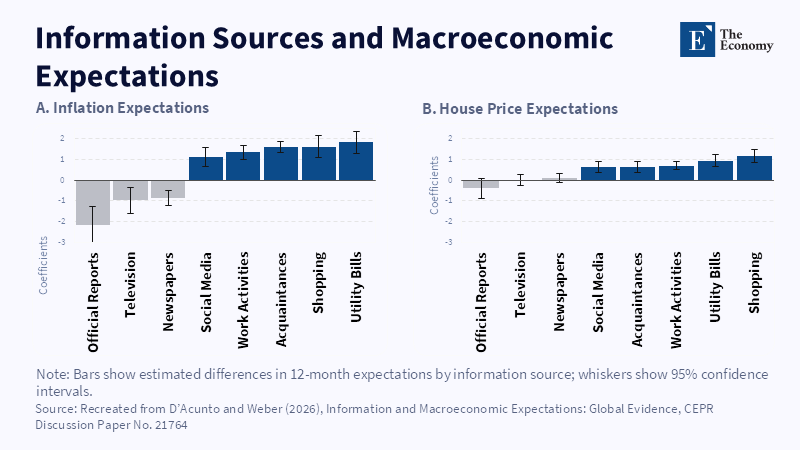
The recent international survey of macroeconomic expectations provides a crucial clue. Consumers don't just choose how much information to look for. They also choose what information to trust. About seven out of ten said they use official sources but local experiences remain dominant. The supermarket basket, electricity bill and talking to acquaintances take on a lot of weight because they are direct and visible. The problem is that these signals cover a small part of the economy. In all the countries in the sample, average perceptions and expectations about inflation were higher than the inflation observed afterwards. The use of official reports was associated with inflation expectations more than two percentage points lower than those of similar people who did not consider them significant. More information, therefore, is not enough. The representativeness of information is equally crucial.
That creates a harder problem for economic policy. Information reaches people through a system of choice, trust and limited attention. An accurate public signal can be ignored, while an extreme personal experience can be considered more reliable. Full availability of data does not guarantee a common understanding. A society may have more data than ever before and at the same time more unstable beliefs. The Hirshleifer effect here takes a broader form. The damage does not only come from the disclosure of an event that destroys an insurance transaction. It can also come from the rapid propagation of a signal that becomes a benchmark for many, even when the signal is incomplete or unrepresentative. Economic policy must thus monitor not only the amount of data available but also which signals end up dominating everyday perception.
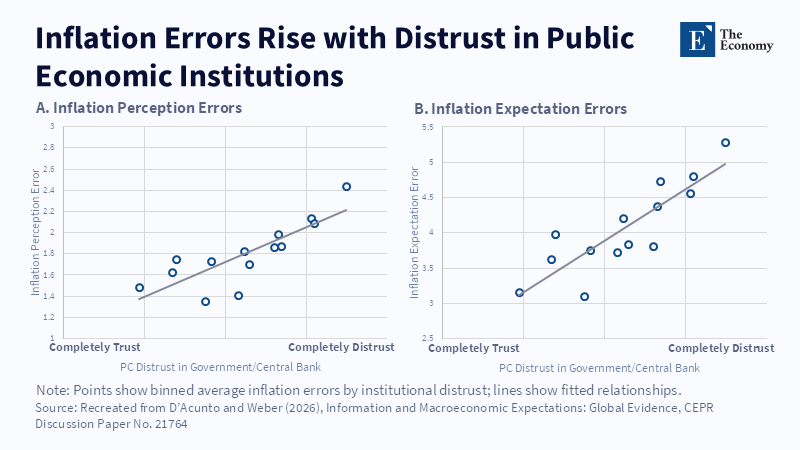
Trust is where the problem becomes political. In the same international sample, distrust of governments and central banks was associated with less use of official reporting and greater errors in perceptions and expectations of inflation. The relationship remained when demographic characteristics, political alignment and trust in private financial institutions were taken into account. Countries with higher inflation volatility over the past decade also showed greater distrust. Instability erodes confidence. Low confidence turns citizens to more local signals. Local signals can increase errors. Larger errors make stabilizing expectations even more difficult. For a central bank, the problem is therefore not just to talk more. It needs to maintain enough credibility for the public to find the overall data useful when it differs from personal experience.
Imperfect Information Can Act as a Stabilizer
The idea that a small barrier to the flow of information can stabilize the economy sounds suspicious, mainly because it resembles secrecy. But economic theory looks at something more specific. When people's decisions also depend on what they think others will do, a public signal has double power. It conveys information about the economy and at the same time gives everyone a common point of coordination. If the signal is too strong relative to private information, people may give it more weight than its accuracy warrants. The common reaction then becomes more intense. Volatility can increase, even if each person thinks it makes sense to follow the signal. In this context, a little heterogeneity in information acts as a damper. Decisions do not reach the market all at once and in the same direction.
That is why the Hirshleifer effect should be linked to public information theory and not limited to insurance. In economies where there is a strong coordination incentive, the value of greater public accuracy can be ambiguous. The literature has also shown that this effect is not universal. Under several realistic parameters, better public information improves well-being. In risk-sharing models, better public information can even help when private information is already accurate enough. The Hirshleifer effect does not justify general opacity. It justifies testing the hypothesis that any additional publication, prediction, or signal is automatically socially beneficial. The useful question is whether the new signal helps people make better decisions or whether it pushes them to react in the same way to an uncertain assessment.
Empirical research on central bank communication moves toward the same more cautious position. Experiments with households show that providing inflation information can reduce expectations and uncertainty. But the form of the information changes the reaction. Communicating a specific economic outlook can have a more persistent effect than a general reference to the inflation target. Communicating uncertainty can change the probabilities households assign to inflation outcomes, while higher uncertainty itself is associated with lower spending. Other experimental work has shown that some central bank projections reduce volatility, while projections based on more adaptive rules can increase inflation volatility. Information is therefore not a neutral package that is simply added to public knowledge. It changes the intensity, timing and degree of coordination of decisions.
The Right Policy Is Not Less Transparency
Macroeconomic stability may indeed need a degree of friction in the flow of information. This friction must be designed very precisely. It may mean that central banks avoid presenting a single forecast as a certain course. It may mean that they give ranges, scenarios and a clear explanation of uncertainty. It may also mean that they do not turn every temporary indicator into a central public message. A statistic that will be revised in a few weeks may be of little value to a long-term decision but of great power as a common signal. Communication policy must take account of this difference. The useful barrier is mainly about the rate, form and intensity with which a fragile signal is transformed into a common certainty.
There is a strong counterargument. Transparency builds trust, limits arbitrariness and allows the citizen to control the central bank. These benefits are real and cannot be sacrificed for the sake of a theoretical possibility of instability. The answer is design, not silence. Official bodies need to publish their data, assumptions and errors. At the same time, they need to avoid the illusion of accuracy. Communication must clearly distinguish what is known, what is estimated and what remains uncertain. Different information from citizens does not always have to be treated as a failure that needs to be eliminated. A degree of heterogeneity in beliefs can prevent overreacting to a single signal at the same time. This gives markets more time to process new data and economic policy more room to correct a message that turned out to be wrong.
The opening of the article showed an economy where over 80% of people first look at their personal experience to understand inflation. Flooding the gap with messages will not fix it. A better information architecture is needed. The Hirshleifer effect is a reminder that the social value of knowledge depends on what knowledge does in markets and in collective decisions. For economic policy, this means less obsession with the volume of communication and more attention to the accuracy, uncertainty, timing and coordination that each message evokes. Central banks and public bodies need rules about when a finding is ripe to become a central signal and how it should be presented. Public data should stay open. It needs information that illuminates without pushing everyone to move in the same direction at the same time.
This article reflects the analytical judgment of The Economy Editorial Board and does not constitute policy advice or the official position of any affiliated institution.
References
Blinder, Alan S., Ehrmann, Michael, de Haan, Jakob and Jansen, David-Jan (2024) ‘Central Bank Communication with the General Public: Promise or False Hope?’, Journal of Economic Literature, 62(2), pp. 425–457.
Coibion, Olivier, Gorodnichenko, Yuriy and Weber, Michael (2022) ‘Monetary Policy Communications and Their Effects on Household Inflation Expectations’, Journal of Political Economy, 130(6), pp. 1537–1584.
D’Acunto, Francesco and Weber, Michael (2026a) Information and Macroeconomic Expectations: Global Evidence. CEPR Discussion Paper No. 21764. Paris and London: CEPR Press.
D’Acunto, Francesco and Weber, Michael (2026b) ‘Why More Information Can Make Macroeconomic Expectations Less Accurate: Global Evidence from 47 Countries’, VoxEU, 23 August.
Denderski, Piotr and Stoltenberg, Christian A. (2020) ‘Risk Sharing with Private and Public Information’, Journal of Economic Theory, 186, 104988.
Hirshleifer, Jack (1971) ‘The Private and Social Value of Information and the Reward to Inventive Activity’, American Economic Review, 61(4), pp. 561–574.
Kostyshyna, Olena and Petersen, Luba (2024) The Effect of Inflation Uncertainty on Household Expectations and Spending. NBER Working Paper No. 32939. Cambridge, MA: National Bureau of Economic Research. Revised July 2026.Mokhtarzadeh, Fatemeh and Petersen, Luba (2021) ‘Coordinating Expectations through Central Bank Projections’, Experimental Economics, 24(3), pp. 883–918.
Morris, Stephen and Shin, Hyun Song (2002) ‘Social Value of Public Information’, American Economic Review, 92(5), pp. 1521–1534.
Schlee, Edward E. (2001) ‘The Value of Information in Efficient Risk-Sharing Arrangements’, American Economic Review, 91(3), pp. 509–524.
Svensson, Lars E.O. (2006) ‘Social Value of Public Information: Comment: Morris and Shin (2002) Is Actually Pro-Transparency, Not Con’, American Economic Review, 96(1), pp. 448–452.
Working across research, policy, and data-driven analysis, the Editorial Board ensures that published pieces reflect a consistent institutional perspective grounded in quantitative reasoning and long-term structural assessment.