China’s Financial Influence Is Reaching Advanced Markets

Working across research, policy, and data-driven analysis, the Editorial Board ensures that published pieces reflect a consistent institutional perspective grounded in quantitative reasoning and long-term structural assessment.
Authored On
Modified
China’s trade power is becoming a financial transmission channel
Emerging markets came first; advanced markets now respond too
RMB policy could redirect larger Chinese capital flows abroad
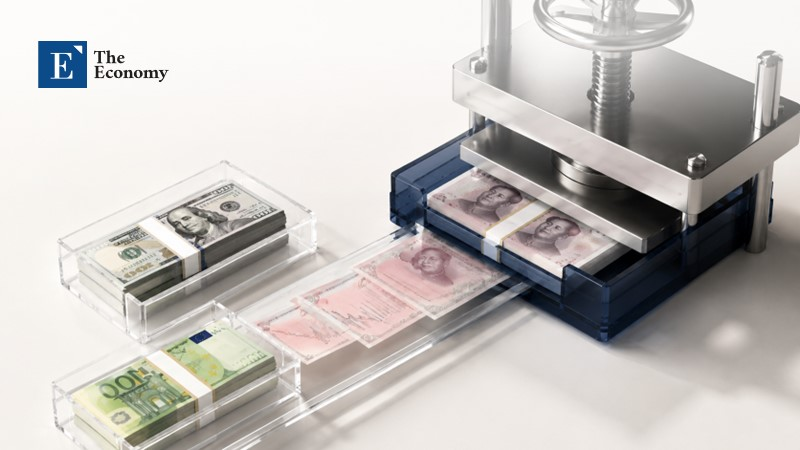
At the end of 2025, Chinese overseas portfolio investment reached $1.99 trillion, excluding foreign exchange reserves. Of this amount, $364 billion was in the United States and nearly $49 billion in the United Kingdom. These numbers are changing the way China's financial influence should be read. For years, the international debate has focused on factories, exports, commodities and emerging markets that depend on Chinese demand. This framework remains useful, but it is now inadequate. China has begun to influence advanced markets through the portfolios of Chinese investors themselves. If this channel grows, a change in PBOC policy or the RMB exchange rate could reach New York, London and Europe. It will not have to go through a container, a factory or a raw material market first.
China's Financial Influence Started From Trade
The first stage of Chinese international influence was clearly visible. Production moved to China, supply chains adjusted around Chinese factories and the country became the world's largest exporter of goods. In 2024, Chinese exports of goods reached about $3.58 trillion. dollars. The economy also still produces about a third of the world's manufactured goods. This gave Beijing influence far beyond its own GDP. A change in Chinese demand could move copper, iron ore, or energy prices. A change in exports could squeeze prices and the profit margins of producers in Europe, Asia and the United States. The first phase, then, was the real economy phase. The Chinese shock mainly passed through trade, production and raw materials.
This channel has become even more political because domestic Chinese demand remains weak. GDP grew by 5 percent in 2025, but private consumption and real estate investment did not provide the same boost as before. The IMF estimated the current account surplus at 3.3 percent of GDP for 2025, while the RMB's real weighted index had fallen about 14 percent cumulatively since 2021. This means that China's export power is now linked to a broader issue of imbalance. The United States and European governments are not just discussing tariffs; they are discussing the exchange rate itself. The US Treasury has called for a more timely and orderly appreciation of the RMB, while the Ithe IMF assessed the 2025 real effective exchange rate as undervalued by about 12.1 percent to 20.7 percent. Europe has also linked the exchange rate to the pressure on its own industry.
The big change is that trade measures can also alter international capital flows. If China boosts consumption, the trade surplus can be reduced without much movement in the exchange rate. But if the adjustment is mainly done through the RMB, the incentives of Chinese households and funds will change. A stronger exchange rate makes foreign assets cheaper in RMB terms. A new period of depreciation, on the other hand, can boost demand for protection against further loss of value. In both cases, the discussion about China ceases to be just about how many products leave its ports. It is also about where a huge stock of savings will be placed when Chinese investors get more legal routes abroad.
Emerging Markets Absorbed the First Financial Spillovers
Emerging economies were the logical first place where the second phase became visible. They typically have closer trade ties with China, greater dependence on commodities and shallower financial markets. Thus, a Chinese macroeconomic shock can quickly move from the price of copper or oil to a local stock, to a currency or to the cost of government borrowing. Research in emerging economies in Latin America, East Asia and Eastern Europe has shown immediate reactions. A positive Chinese macroeconomic shock that pushes up Chinese stocks by 1 percent is associated on the same day with a rise of about 0.26 percent in Latin American markets. In East Asia and Eastern Europe, the corresponding movement was around 0.15 percent. Reactions are also seen in government and corporate debt spreads and exchange rates.
This picture has given the impression that China is primarily a financial risk to the emerging world. The latest data show that the conclusion was very narrow. An IMF model for 63 countries estimated that demand and supply shocks from China have cumulative effects on developed economies of 0.24 percent and 0.16 percent, respectively. The corresponding estimates of the same shocks from the other major emerging economies were much smaller. The scale of Chinese effects on developed economies was even close to that of American shocks in this model. This does not mean that China has replaced the United States as the center of the global financial cycle. But it shows that the old dividing line between emerging and developed markets is losing some of its usefulness.
There is a second reason. Markets react before trade can move. A 2025 study on Chinese macroeconomic announcements used a window of just 60 minutes around the release of data. A positive surprise of 1 percent in industrial production was linked to a rise of 21 basis points in Chinese equities and about 3 basis points in the Asia-Pacific markets. At the same time, ten-year bond yields in China and the United States moved. This is important for central banks and investors. The Chinese economy does not need to change a company's actual orders first to change its price. Expectations for Chinese growth can enter valuations almost immediately. For developed markets, this speed is also changing what is considered domestic financial news.
China’s Financial Influence Reaches Advanced Markets
The third stage is newer and harder to observe because China still has capital controls. Nevertheless, the channel already exists. The QDII program allows domestic institutional investors to invest abroad within set quotas. The total QDII quota had reached $170.9 billion at the end of 2025. As of 2023, QDII mutual funds held about $40.5 billion in international equities, mainly in Hong Kong and the United States. The amount is small relative to the size of the US markets. Its importance lies in the direction. When China's monetary policy becomes more restrictive, foreign equities with more exposure to Chinese QDII funds show weaker returns than those with less exposure. In U.S. stocks, the effect has been found to last at least five days.
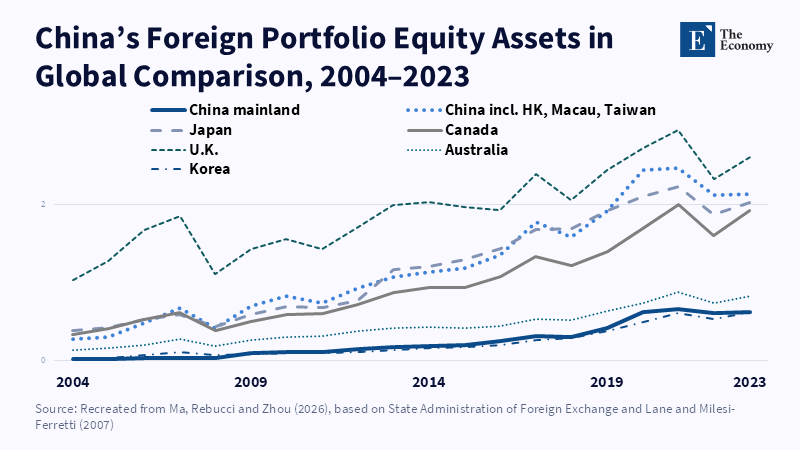
This finding has another peculiarity. The contagion seems to be driven to a large extent by private investors who put money in and out of funds, not from global banks in the way that is usually associated with the United States. This changes the type of risk. The behavior of millions of savers may become part of the international transmission mechanism of Chinese policy. By September 2025, Chinese household deposits were around RMB165 trillion. Apparently, only a small part of this amount can now move freely abroad. That is precisely why the course of capital controls is so important. A small change in the permissible rate of international diversification can create large flows when applied to such a large stock of savings.
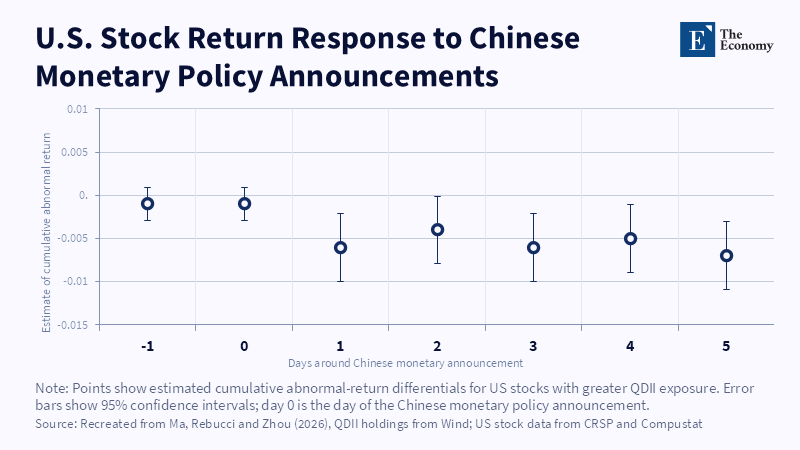
Official data shows that the movement has already begun on a larger scale than can be seen through QDII funds. China's external portfolio assets, excluding central bank reserves, reached $1.99 trillion at the end of 2025. Of these, about $1.26 trillion were stocks and holdings in investment funds and about $725 billion were bonds. Hong Kong remained the largest destination, but the United States ranked second with $364 billion. dollars. Britain was also among the top five destinations. The third stage, therefore, should not be treated as a distant scenario. It is still constrained by rules and quotas, but the infrastructure, products and investment base are already in place.
The RMB Could Redirect Global Capital Flows
The most frequent historical comparison is Japan in the late 1980s. But accuracy is needed. The large Japanese capital outflow was not caused by a devaluation of the yen. It accelerated after its strong appreciation and after years of financial liberalization. Between 1986 and 1989, nominal Japanese foreign direct investment cumulatively exceeded all previous post-war flows. In 1989 annual direct investment outflows reached 67.5 billion dollars, about 2.5 percent of Japanese GDP. A stronger yen made foreign assets cheaper for Japanese buyers. At the same time, companies had reasons to build a productive presence abroad due to trade frictions. This is the most useful side of the comparison with China. The exchange rate then made a real difference in the cost of foreign purchases.
If the RMB appreciates because Beijing allows it or because international pressure increases, foreign assets will become cheaper for Chinese investors in domestic currency terms. If quotas are relaxed together, the third stage may be accelerated. Instead, a new revaluation of the RMB creates a different incentive. Savers may want more assets in dollars, euros, or other currency zones to protect themselves from further currency declines. Today, capital controls limit this reaction and the U.S. Treasury notes that China is still using measures that limit outflows. So, the potential wave of foreign asset purchases will not come mechanically from a devaluation. It will depend on whether Beijing chooses to keep the valve closed or let more of its domestic savings diversify abroad.
This is the main counterargument to the idea that China will soon become a second Japan. Chinese capital markets are not as open, the RMB is not fully convertible and authorities have a much greater immediate ability to curb outflows. But the comparison does not have to be perfect to have value. The pressures facing China have some familiar sides: a large trade surplus, international pressure to change the exchange rate, high domestic savings and increasing ability to buy foreign assets. The essence lies in the sequence of events. A trade adjustment can lead to an exchange rate adjustment. Exchange rate adjustment can change the behavior of savers. This behavior can then affect asset prices in markets that until recently viewed China primarily as a trading partner or competitor.
Policymakers in the United States and Europe must therefore look at trade and financial transmission together. The pressure to appreciate the RMB may reduce some of the price advantage of Chinese exports, but it may also make foreign equities, bonds and businesses more accessible to Chinese capital. Maintaining a weaker RMB may protect exports, but it increases the incentive to protect foreign currency wealth if investors expect another decline. Central banks need models that include this channel as well. Supervisors need better insight into the actual exposure of funds and markets to Chinese flows. Fund managers need to monitor not only trade and production figures, but also PBOC decisions, QDII quotas and outbound investment rules.
The amount of $1.99 trillion abroad is therefore more important than any other large number in an international investment table because it shows that China's financial influence has already moved into its third stage. The first stage changed where much of the world’s manufacturing takes place. The second showed how quickly a Chinese shock passes into emerging markets. The third is starting to change who owns international financial assets and how Chinese monetary policy passes into their prices. The next big RMB debate should not be limited to whether a Chinese product will become more expensive or cheaper. It must also include where Chinese funds will go after the exchange rate changes. This is where a trade dispute can turn into a new chapter of the global financial cycle.
This article reflects the analytical judgment of The Economy Editorial Board and does not constitute policy advice or the official position of any affiliated institution.
References
Abdel-Latif, H. and Popescu, A. (2025) ‘Spillovers from Large Emerging Economies: How Dominant Is China?’, IMF Working Paper No. 25/27.
Bayoumi, T. and Lipworth, G. (1997) ‘Japanese Foreign Direct Investment and Regional Trade’, IMF Working Paper No. 97/103.
Brennan, A. (2026) ‘“Trade Imbalances Must Be Broken”: Western Calls for Yuan Appreciation Target China’s Trade Surplus’, The Economy, 31 August.
Campos, R.G., Manu, A.S., Molina Sánchez, L. and Suárez-Varela, M. (2024) ‘A Hidden Dragon: China’s Spillovers on the Financial Markets of Emerging Economies’, VoxEU, CEPR.
Gutierrez, C., Turen, J. and Vicondoa, A. (2025) ‘Global Financial Spillovers of Chinese Macroeconomic Surprises’, IMF Working Paper No. 25/133.
International Monetary Fund (2026) People’s Republic of China: 2025 Article IV Consultation. IMF Country Report No. 26/44.
Lane, P.R. and Milesi-Ferretti, G.M. (2007) ‘The External Wealth of Nations Mark II’, Journal of International Economics, 73(2), pp. 223–250.
Ma, C., Rebucci, A. and Zhou, S. (2026) ‘A Nascent International Financial Channel of China’s Monetary Policy Transmission’, Journal of International Economics, 163, 104230.
National Bureau of Statistics of China (2026) Statistical Communiqué on the 2025 National Economic and Social Development.
State Administration of Foreign Exchange (2026) China’s External Portfolio Investment Assets at the End of 2025.
U.S. Bank Asset Management Group (2026) ‘China’s Economy and Its Influence on Global Markets’.
U.S. Department of the Treasury (2026) Macroeconomic and Foreign Exchange Policies of Major Trading Partners of the United States.
World Trade Organization (2025) WTO Annual Report 2025.
Working across research, policy, and data-driven analysis, the Editorial Board ensures that published pieces reflect a consistent institutional perspective grounded in quantitative reasoning and long-term structural assessment.