“Is Iran Next After Russia?” U.S. Wields Dollar Hegemony to Intensify Economic Pressure, Raising Prospect of an Expanding Chinese Renminbi Bloc

Aoife Brennan is a contributing writer for The Economy, with a focus on education, youth, and societal change. Based in Limerick, she holds a degree in political communication from Queen’s University Belfast. Aoife’s work draws connections between cultural narratives and public discourse in Europe and Asia.
Authored On
Modified
U.S. weaponizes dollar-based financial system to intensify economic pressure on Iran
Russia faces economic crisis under Western sanctions, raising questions over whether Iran will follow
China, which has maintained trade with Iran, also exposed as expansion of “petroyuan” gains momentum
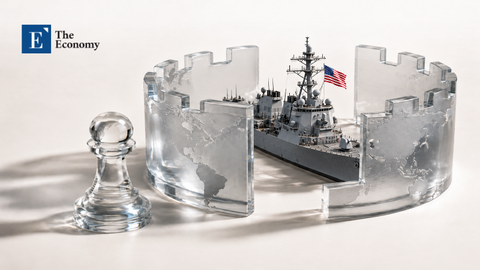
The administration of U.S. President Donald Trump has launched a sweeping campaign of economic pressure against Iran. Washington has expanded the scope of its sanctions to include third-country companies and financial institutions that conduct business with Iran, while publicly warning countries worldwide to sever their economic ties with Tehran. Markets view the campaign as resembling the sanctions imposed on Russia by Western countries following the outbreak of the war in Ukraine. Some observers say the large-scale pressure campaign may inflict economic damage in the short term but, over the longer term, is likely to deepen Iran’s economic dependence on China and promote wider use of renminbi-denominated payments, thereby accelerating the expansion of Beijing’s financial influence.
U.S. Announces “Economic Isolation Campaign”
On the 24th local time, U.S. Treasury Secretary Scott Bessent held a press conference at the Treasury Department headquarters in Washington, D.C., and formally announced the launch of the so-called “Operation Economic Outcast.” “Our objective is to sever every economic lifeline sustaining the Iranian regime around the world and leave Tehran standing alone,” Bessent said, declaring that Washington would unleash an “economic onslaught” targeting Iran’s access to the global financial network. The Trump administration also likened the initiative to the Allied landings in Normandy during World War II, describing it as an “Economic D-Day.”
The central feature of the measure is a substantial expansion of the reach of U.S. secondary sanctions. The Treasury Department’s Office of Foreign Assets Control (OFAC) plans to sanction individuals and companies worldwide that trade with or provide support to Iran in five sectors: digital assets, advanced technology, gold, aviation and shipping. The Treasury Department said Iran was using crypto assets to evade sanctions and finance the Islamic Revolutionary Guard Corps (IRGC), while employing advanced technology in weapons development. It determined that gold had been used as a hedge against the collapse of Iran’s currency and inflation, while civilian aviation and maritime networks had served as channels for transporting weapons, sensitive technologies and cash, as well as exporting crude oil. At the same time, the United States added more than 60 companies, individuals and vessels worldwide to its sanctions list for allegedly supporting Iran’s acquisition of nuclear and missile technology, cyber operations and generation of oil revenue.
Pressure on Payment Networks Becomes Visible
Pressure on the financial sector has also intensified. The United States plans to demand that countries close overseas branches of Bank Melli, Iran’s largest state-owned bank, and intends to sanction financial institutions that facilitate Iranian money laundering or the transfer of proceeds from oil sales. “Any institution that facilitates money laundering on Iran’s behalf will be excluded from the U.S. dollar system,” Bessent said, adding that “the clock has now started.” The United States, however, did not immediately impose secondary sanctions that day on countries or major financial institutions conducting business with Iran, nor did it identify the countries to be targeted or specify when the sanctions would take effect. “We are giving everyone an opportunity to correct their misconduct,” Bessent said, explaining that Washington would provide a defined “cure period.”
Iran pushed back, insisting that it would not be shaken by the U.S. campaign. In an interview with the state-run Mehr News Agency on the 24th, Iranian Minister of Economic Affairs and Finance Ali Madanizadeh declared, “They cannot sever our economic arteries.” “The government has long been preparing plans to confront U.S. sanctions and is fully prepared to counter the new measures,” he said. “The government has established a two-year economic plan, and every contingency measure is incorporated into it.” While acknowledging that the war had severely damaged Iran’s steel and petrochemical industries, he added that the country had “succeeded in bringing the damaged facilities back online within a short period.” According to Madanizadeh, the Ministry of Economic Affairs and Finance provided approximately $1.2 billion in emergency funding, preventing mass unemployment among 600,000 Iranians, while monthly inflation has now fallen to half the level recorded when the war began.
Western Sanctions Campaign Against Russia
Markets say the latest U.S. initiative resembles the Western sanctions campaign against Russia that intensified following the outbreak of the war in Ukraine. Numerous Russian banks have been excluded from the Western-dominated Society for Worldwide Interbank Financial Telecommunication (SWIFT) payment network, restricting their access to dollar- and other major Western-currency-based international settlements. The United States can also use OFAC to penalize foreign companies and banks that transact with sanctioned entities, while the European Union has expanded its restrictions to include banks in third countries such as Kyrgyzstan that are linked to Russia’s proprietary Financial Messaging System, known as SPFS, or are involved in sanctions evasion.
Restrictions targeting Russia’s oil and gas sector, its largest source of foreign-currency revenue, have also intensified. A prime example is the EU’s ban on imports of Russian seaborne crude oil and certain petroleum products. As Russia has increasingly relied on a so-called “shadow fleet” of aging tankers to circumvent sanctions, regulatory scrutiny has recently expanded to the surrounding ecosystem, including shipping companies, intermediaries and refining facilities. In the industrial sector, the U.S. Export Administration Regulations (EAR) have exerted substantial pressure. The U.S. Commerce Department’s Bureau of Industry and Security (BIS) has placed broad licensing requirements on exports to Russia of semiconductors, computers, telecommunications equipment, avionics, sensors, machine tools and other products that could be used in military or advanced industries. Products manufactured using U.S. technology or software are subject to U.S. controls under the Foreign Direct Product Rule, regardless of where they are actually produced.
Russian Economy Reels Under Barrage of Sanctions
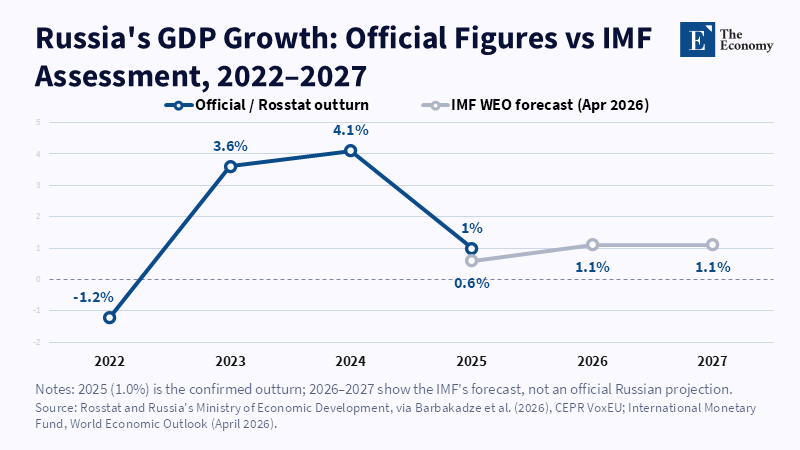
The Russian government has maintained that its economy has demonstrated greater resilience than expected despite the sanctions. According to Russia’s Ministry of Economic Development, the country’s gross domestic product contracted by 1.2% in 2022, when the war began, before expanding by 3.6% in 2023 and 4.1% in 2024. Growth slowed to around 1% last year, but the Russian government argued that the deceleration reflected deliberate monetary tightening intended to stabilize inflation rather than an economic downturn. Numerous analyses, however, point to trends that contradict the Russian government’s assessment. According to a recent study published through the Centre for Economic Policy Research (CEPR) by a team of European economists, NASA satellite data showed that nighttime light intensity across 1,058 Russian cities weakened over a prolonged period. Nighttime illumination declined significantly in regions bordering European countries, including Ukraine, Belarus, Poland, Estonia and Finland. By contrast, illumination increased in eastern areas bordering China and southern regions connected to the Caucasus. The divergence reflects an expansion of indirect trade routed through China, Central Asia and the Caucasus after Russia’s established trade corridors with the West were blocked. Because nighttime light intensity has a measurable correlation with factory operations, commercial activity and other forms of economic output, it is used as an indicator that supplements official economic statistics.
Another concern is that the Russian economy has effectively split into military and civilian sectors. Russia’s military expenditure rose from 3% of GDP in 2021 to 8% last year, while direct war-related spending increased to approximately 5% of GDP. Driven by this trend, production of non-automotive transport equipment surged by 29.5% last year, pharmaceuticals by 15.6%, fabricated metal products by 13.9%, and electronic and optical products by 13%. By contrast, automobile production contracted by 23.6% over the same period, while output of leather goods and furniture declined by 13.4% and 7.5%, respectively. Government defense orders are driving growth in selected industries, but the large-scale diversion of labor and capital into the military sector is visibly eroding the foundations of civilian manufacturing and the consumer economy. Reflecting these conditions, the International Monetary Fund (IMF) recently lowered its forecast for Russia’s economic growth this year to 0.8%. Excluding the COVID-19 pandemic period, this would be the country’s weakest growth rate since 2014.
Table 1. U.S. Sanctions on Chinese Teapot Refineries
| Timing | Sanctions Target |
|---|---|
| March 2025 | Shandong Shouguang Luqing Petrochemical |
| April 2025 | Shandong Shengxing Chemical |
| May 2025 | Hebei Xinhai Chemical |
| October 2025 | Shandong Jincheng Petrochemical and crude oil terminals in China |
| April 2026 | Hengli Petrochemical’s Dalian refinery |
| Present | Shadow fleet, ports, intermediaries and payment networks |
China Emerges as the Critical Variable
If Iran is subjected to prolonged, high-intensity sanctions similar to those imposed on Russia, the repercussions could spread to China, which maintains close economic ties with Tehran. The risk has already been demonstrated by U.S. pressure on China’s independent refiners, commonly known as “teapot” refineries. The U.S. Treasury Department has steadily expanded its sanctions, arguing that the refiners sustain a crucial source of foreign-currency revenue for the Iranian regime. Beginning with Shandong Shouguang Luqing Petrochemical in March last year, Shandong Shengxing Chemical in April and Hebei Xinhai Chemical in May were sanctioned for trading in Iranian crude oil. In October of the same year, Shandong Jincheng Petrochemical and crude oil terminals in China also came under sanctions. This April, OFAC also targeted Hengli Petrochemical’s Dalian refinery, one of China’s second-tier teapot refiners, for allegedly purchasing billions of dollars’ worth of Iranian crude oil and petroleum products. The United States is currently aggressively tracking the shadow fleet transporting Iranian crude, as well as port operators, intermediaries and payment networks, and has warned that foreign financial institutions supporting such transactions could also face secondary sanctions.
China has repeatedly stated that it does not recognize the legitimacy of these U.S. sanctions. The Chinese Foreign Ministry argues that Washington is imposing “illegal unilateral sanctions” without authorization from the United Nations Security Council and that normal economic and trade cooperation between Chinese companies and Iran is legitimate. In May, China’s Ministry of Commerce also adopted measures preventing the enforcement of U.S. sanctions within China, establishing a more confrontational response. Experts say the protracted confrontation could ultimately provide China with a rationale for expanding the reach of renminbi-denominated payments. Russia and Iran, whose access to dollar payment networks has been restricted by Western sanctions, are expected to provide the foundation for the spread of the so-called “petroyuan.” A substantial share of Russia’s and Iran’s trade with China is already reportedly settled in renminbi, and that proportion continues to rise. According to the Financial Times, following the outbreak of the Iran war, the average daily transaction value processed through China’s Cross-Border Interbank Payment System (CIPS) reached an all-time high of approximately $136.2 billion in March and temporarily surged to about $180.6 billion in April.
Aoife Brennan is a contributing writer for The Economy, with a focus on education, youth, and societal change. Based in Limerick, she holds a degree in political communication from Queen’s University Belfast. Aoife’s work draws connections between cultural narratives and public discourse in Europe and Asia.
Similar Post