“Robots to Ease Labor Shortages”: U.S. Manufacturing Automation Spreads to Shipbuilding and Defense, Putting Physical AI Commercialization to the Test

Oliver Griffin is a policy and tech reporter at The Economy, focusing on the intersection of artificial intelligence, government regulation, and macroeconomic strategy. Based in Dublin, Oliver has reported extensively on European Union policy shifts and their ripple effects across global markets. Prior to joining The Economy, he covered technology policy for an international think tank, producing research cited by major institutions, including the OECD and IMF. Oliver studied political economy at Trinity College Dublin and later completed a master’s in data journalism at Columbia University. His reporting blends field interviews with rigorous statistical analysis, offering readers a nuanced understanding of how policy decisions shape industries and everyday lives. Beyond his newsroom work, Oliver contributes op-eds on ethics in AI and has been a guest commentator on BBC World and CNBC Europe.
Authored On
Modified
Anduril to build automated shipbuilding facility to address U.S. submarine production bottlenecks
Physical AI gains ground across U.S. manufacturing, with commercialization starting in simpler processes
Technical challenges persist in precision manipulation, AI training, batteries and safety
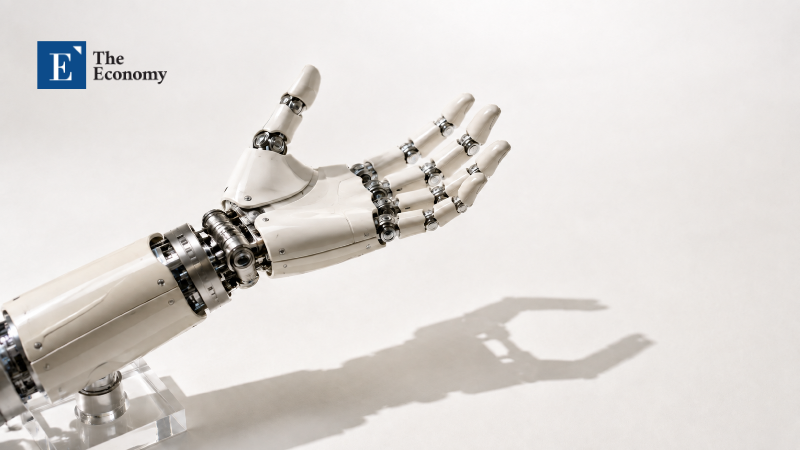
U.S. defense technology startup Anduril is making a major investment in shipbuilding facilities. With persistent bottlenecks constraining U.S. Navy submarine production, the company plans to use digital and automation technologies to expand manufacturing capacity for large components and hull modules. Market observers see Anduril’s approach as part of a broader shift toward production automation across U.S. manufacturing, as efforts to commercialize industrial robots and physical artificial intelligence (AI) increasingly take shape on American factory floors.
Anduril’s Plans to Build Arsenal-2
The Financial Times reported on October 7, local time, that U.S. defense technology startup Anduril plans to build a major shipbuilding facility, Arsenal-2, at Sparrows Point in Baltimore County, Maryland. Anduril intends to invest $3.7 billion of its own capital to develop a facility spanning approximately 2 million square feet, or about 186,000 square meters, on the former Bethlehem Steel mill site. Permitting and site preparation will begin immediately, with initial production scheduled to start in 2030. The U.S. Navy also plans to award Anduril a production contract worth up to $2.9 billion, with payments tied to actual component production performance.
Arsenal-2 will serve as a manufacturing hub for large components and modules used in Virginia-class attack submarines. Initially, it will focus on key components, including submarine torpedo tubes, before expanding into large hull sections encompassing the bow and stern. Production processes, including design, welding, inspection and component movement, will be digitally integrated and managed through Anduril’s industrial software platform, ArsenalOS. The company plans to combine sensors with automated equipment to monitor work in real time and reduce production bottlenecks. The resulting components will be shipped to General Dynamics Electric Boat and Huntington Ingalls Industries’ (HII) Newport News Shipbuilding, which carry out final construction of Virginia-class submarines.
A Wave of Automation Across U.S. Manufacturing
Market observers are focusing on Anduril’s extensive integration of digital and automation technologies into Arsenal-2. Across U.S. manufacturing, companies are increasingly adopting robots and automated equipment to address high labor costs and shortages of skilled workers. A prominent example is GE Appliances’ Roper cooking appliance factory in LaFayette, Georgia. Since 2023, GE Appliances has introduced numerous new assembly lines and robots at the facility, completing a cumulative $180 million modernization program by last year. Stationary robotic arms and mobile robots handle tasks such as moving heavy components and rotating products, while human workers concentrate on comparatively complex processes, including wiring and assembly.
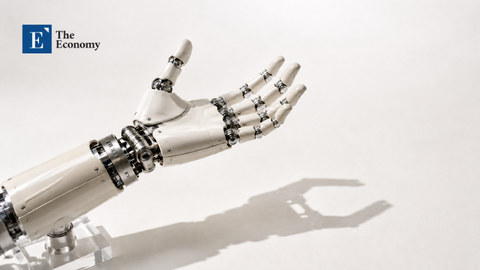
This demand for automation has extended beyond stationary industrial robots to the commercialization of physical AI. Physical AI refers to technology in which cameras and sensors perceive real-world surroundings and workpieces, AI makes decisions based on that information, and robots then perform physical actions. It represents a distinctly different approach from conventional industrial robots that repeat predetermined movements and paths. For example, Figure AI’s Figure 03 humanoid, deployed at BMW’s Spartanburg plant in South Carolina, uses cameras to perceive its surroundings and component locations, while AI assesses the task at hand and adjusts walking and two-handed manipulation. Mercedes-Benz has also partnered with U.S. robotics startup Apptronik to pilot its Apollo humanoid in manufacturing operations. Some Apollo robots are reportedly accumulating task data through teleoperation, in which humans remotely demonstrate movements.
Humanoids Gain a Larger Foothold
Boston Dynamics also opened the Robotics Metaplant Application Center (RMAC) at Hyundai Motor Group Metaplant America (HMGMA), near Savannah, Georgia, last month and began training its Atlas humanoid for manufacturing processes. RMAC serves as a test bed where Atlas learns production tasks before being deployed directly into an actual automotive factory. Training currently focuses on parts sequencing, which involves selecting and arranging components in assembly order. Boston Dynamics plans to expand Atlas’s capabilities to machine tending, involving loading parts into machines and retrieving them, as well as assembling component kits for individual orders. Hyundai Motor Group likewise plans to introduce Atlas into actual production operations from 2028, before extending its use to component assembly processes in 2030.
German automotive supplier Schaeffler is also deploying Agility Robotics’ bipedal humanoid Digit in actual production work at its Cheraw plant in South Carolina. Standing approximately 1.75 meters tall and weighing about 65 kilograms, Digit has performed repetitive tasks since early last year, loading components into an industrial washer and removing them once cleaning is complete. It uses cameras, LiDAR and other sensors to perceive its surroundings and can navigate the factory on two legs.
Table 1. Production Automation at Major Manufacturing Companies
| Company | Automation Deployment |
|---|---|
| GE Appliances | Deploys stationary and mobile robots at its cooking appliance factory to automate repetitive, physically demanding tasks such as heavy-load handling and product rotation |
| BMW | Deploys Figure AI humanoids at its U.S. plant to test manufacturing tasks including component recognition, movement and two-handed manipulation |
| Mercedes-Benz | Pilots Apptronik’s Apollo humanoid and accumulates task data through teleoperation |
| Boston Dynamics | Trains Atlas at RMAC in parts sequencing and other tasks ahead of deployment in actual production processes |
| Schaeffler | Deploys Agility Robotics’ Digit at its U.S. plant to automate the loading and unloading of components in an industrial washer |
Replacing Human Workers Remains Difficult in the Near Term
Although physical AI is gradually establishing a presence in manufacturing operations, industry observers say its technical limitations remain unresolved. Rather than broadly replacing human labor, the technology is still at a stage of expanding its use from a limited set of tasks. The greatest obstacle facing physical AI is the ability to manipulate objects accurately. Conventional industrial robots deliver high precision in environments where workpiece positions and movements remain consistent, such as automotive welding and painting, but their performance often deteriorates when a component’s position or orientation changes even slightly. Humanoids face an even more demanding control problem: they must maintain balance on two legs while moving their torso and arms and simultaneously grasping objects with their hands.
To mitigate these limitations, companies are increasingly turning to vision-language-action (VLA) models. VLA technology enables robots to use cameras to identify their surroundings and the positions and shapes of objects, understand task instructions, and translate them into specific movements of their hands, arms and legs. VLA-based robots can recognize when components are displaced from their expected positions or have a different orientation, then adjust grasp points, posture and movement paths in real time. However, adopting this technology does not immediately deliver general-purpose manufacturing automation. Actual factories continuously present unpredictable variables, including changes in lighting, vibrations, sensor errors and minute differences in component dimensions. VLA-based systems still require further training and validation for processes such as precision assembly, wiring and fastening, which demand fine force control and high repeatability.
Training Data Constraints and Barriers to Commercialization
A shortage of training data is another problem. Conventional large language models (LLMs) can draw on vast quantities of text and images accumulated on the internet, but the action data robots need must be collected repeatedly by physically operating robots or controlling them remotely. To address this, the industry is making extensive use of simulation technologies that train robots in virtual environments. In digital settings resembling actual factories, robots repeat tasks thousands to tens of thousands of times while object positions, lighting and friction are varied, and the resulting data are then applied to real robots. However, virtual environments cannot perfectly reproduce real-world vibrations, impacts and sensor errors. As a result, the so-called sim-to-real gap—the phenomenon in which AI that performed flawlessly in simulation fails when deployed in the real world—persists.
Battery limitations and durability also impede commercialization. Humanoids consume substantial amounts of power because they must operate dozens of joints, sensors and computing devices simultaneously. Increasing motor output drains batteries more quickly, while expanding battery capacity adds weight, which in turn reduces energy efficiency. Operating in shared spaces with people poses another critical challenge. Conventional large industrial robots mostly operate behind safety fences that separate them from workers, whereas humanoids are designed to fit directly into existing workspaces previously used by people. To fully realize this advantage, they need safety functions that recognize workers in real time and autonomously stop or change course when a collision risk arises. Although leading companies are strengthening these capabilities, concerns persist that safety and reliability must be thoroughly validated through prolonged, repetitive operation.
Oliver Griffin is a policy and tech reporter at The Economy, focusing on the intersection of artificial intelligence, government regulation, and macroeconomic strategy. Based in Dublin, Oliver has reported extensively on European Union policy shifts and their ripple effects across global markets. Prior to joining The Economy, he covered technology policy for an international think tank, producing research cited by major institutions, including the OECD and IMF. Oliver studied political economy at Trinity College Dublin and later completed a master’s in data journalism at Columbia University. His reporting blends field interviews with rigorous statistical analysis, offering readers a nuanced understanding of how policy decisions shape industries and everyday lives. Beyond his newsroom work, Oliver contributes op-eds on ethics in AI and has been a guest commentator on BBC World and CNBC Europe.
Similar Post