EU Moves to Favor European-Made EVs, Raising Barriers Before Securing Supply Chains

Anne-Marie Nicholson is a fearless reporter covering international markets and global economic shifts. With a background in international relations, she provides a nuanced perspective on trade policies, foreign investments, and macroeconomic developments. Quick-witted and always on the move, she delivers hard-hitting stories that connect the dots in an ever-changing global economy.
Authored On
Modified
EU preference for domestic production raises localization burdens for foreign automakers
Chinese manufacturers, already facing tariffs, expand production partnerships with European companies
Europe’s drive to reduce dependence on China also hinges on securing alternative supply chains
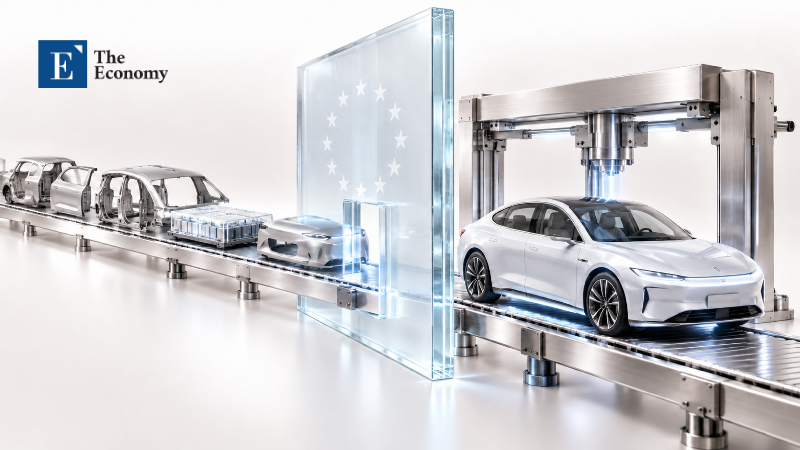
The European Union (EU) is moving to protect its automotive industry by proposing domestic production and component-sourcing requirements for electric vehicle purchase incentives and public procurement. With a proposal requiring EU-made components to account for at least 70% of total component value, excluding batteries, foreign automakers operating in Europe face a growing need to reassess their local manufacturing and sourcing strategies. Chinese manufacturers, in particular, have relied on Europe to generate profits but now face constraints on relocating production as local investment conditions compound existing tariff burdens. Yet the EU itself lacks sufficient alternative supply chains for Chinese battery materials, leaving it with the challenge of building its domestic manufacturing base in step with tighter localization requirements.
EV Incentives to Require 70% EU-Made Content
According to European news outlet Euronews on October 6 (all dates hereafter refer to local time), the EU is pursuing domestic production and sourcing requirements for electric vehicle purchase incentives. The European Commission’s proposed Industrial Accelerator Act (IAA) would make vehicles eligible for support only if they contain a specified share of EU-made components. The covered categories are battery electric vehicles, plug-in hybrids and hydrogen fuel-cell vehicles. The proposal would attach these conditions to support schemes administered by national and local governments and apply origin requirements to public procurement involving vehicle purchases or leases. To qualify, vehicles must first be assembled within the EU. EU-made components must also account for at least 70% of total vehicle component value, excluding the battery. That share would be calculated using the ex-works price of each component. The Commission’s proposal would apply these baseline requirements to public support schemes introduced or renewed from six months after the legislation enters into force.
Batteries, which are excluded from the vehicle component calculation, would be subject to separate localization requirements. Initially, at least three main battery components, including the cells, would have to be EU-made. Three years after the legislation enters into force, that minimum would rise to five. At that stage, cathode active materials and battery management systems (BMS), alongside battery cells, would become mandatory EU-made components. Additional sourcing requirements would also apply to electric drivetrains and main electronic systems from the three-year mark. Each category would need to achieve an EU-made share of at least 50%, calculated using component ex-works prices. The proposal includes a derogation allowing small electric vehicles classified as M1E to meet selected requirements. Provided they are assembled within the EU, these vehicles could qualify by satisfying either of two conditions: an EU-made share of 70% for vehicle components excluding the battery, or the use of at least three EU-made main battery components, including the cells.
Table 1. Draft Localization Requirements for EU EV Purchase Incentives and Public Procurement
| Category | Key Provisions |
|---|---|
| Scope | Public purchase incentives and public-sector purchases or leases of battery electric vehicles, plug-in hybrids and hydrogen fuel-cell vehicles |
| Baseline requirements | Vehicle assembly within the EU and an EU-made share of at least 70% of total component value, excluding the battery Share calculated using component ex-works prices |
| Baseline implementation | Applies to public support schemes introduced or renewed from six months after the legislation enters into force |
| Initial battery requirements | At least three main components, including the cells, must be EU-made |
| Stricter battery requirements | Minimum number of EU-made components rises to five three years after the legislation enters into force Cells, cathode active materials and battery management systems (BMS) must be EU-made |
| Drivetrains and electronic systems | Electric drivetrains and main electronic systems must each achieve an EU-made share of at least 50% three years after the legislation enters into force Share calculated using component ex-works prices |
| Small EV derogation | M1E vehicles assembled within the EU must satisfy either of the following: ① An EU-made share of at least 70% for vehicle components excluding the battery ② At least three EU-made main battery components, including the cells |
UK Auto Industry Faces Twin Burdens of Rules of Origin and Tariffs
The EU’s preference for domestic production has complicated the calculations facing the UK, which has maintained supply-chain links with the bloc since Brexit. Separately from the IAA, battery rules of origin under the EU–UK Trade and Cooperation Agreement are scheduled to tighten next year. The European Automobile Manufacturers’ Association (ACEA) estimates that 82% of the 520,000 electric passenger cars and vans due to be exported from the EU to the UK next year will fail to meet those rules and incur a 10% tariff. UK automakers have consequently requested a phased deferral of local sourcing obligations for battery cells and cathode materials. These pressures could strengthen the UK’s incentive to rebuild closer economic ties with the EU. British industry is already seeking assurances that domestic companies will not be disadvantaged by the EU’s “Made in Europe” policies, while the two sides continue discussions on the scope of UK participation.
As part of this process, the UK is also considering additional tariffs on Chinese-made electric vehicles. The EU reportedly called for higher tariffs on Chinese vehicles and closer trade-policy coordination during discussions over UK participation in the IAA. Options under consideration within the British government include raising tariffs on Chinese electric vehicles to EU levels. No final decision has been made, however, amid concerns that Chinese retaliation could harm exports to China by British automakers, including Jaguar Land Rover. The UK government is continuing consultations with industry, saying its response will reflect the interests of domestic industry and the wider economy.
Korean Companies Targeting Europe Shift Component Sourcing Locally
South Korea faces similarly complex calculations. A strategy combining increased European production with greater local component sourcing is expected to become more important for Korean manufacturers. Components meeting EU origin requirements could be better placed to secure demand from automakers that need to increase their domestic sourcing shares. Korean component suppliers serving Hyundai and Kia’s European factories could also use their local manufacturing bases to expand business with European automakers. Converting that demand into orders, however, will require both additional production capacity and a review of sourcing arrangements for key materials and components. With batteries and electric drivetrains subject to separate localization standards, companies need to assess the requirements for EU-origin status item by item. Given the time needed to expand local facilities, investment and procurement plans must align regulatory implementation dates with customers’ schedules for bringing new models into series production.
Korean component manufacturers are already expanding their European production footprints. Automotive component specialist Hyundai Wia began series production on September 30 at its new factory in Martin, Slovakia, following an investment of approximately $29.9 million. After establishing a local subsidiary in April 2023, the company had been manufacturing constant-velocity joints at an existing facility before relocating production to the new plant to accommodate anticipated volume growth. The new factory has annual capacity for constant-velocity joints, which transmit power to the wheels, for 800,000 vehicles, and coolant modules for 280,000 vehicles. Drivetrain and thermal-management components produced there are intended for models including the Kia EV2 and EV4. Hyundai Wia plans further investment to increase constant-velocity joint capacity by as much as fivefold and expand production to heating, ventilation and air-conditioning modules. In line with those plans, it intends to increase local employment from 98 workers currently to approximately 410 by 2030.
Chinese Automakers Face Pressures on Both Exports and European Production
Chinese automakers face the most pressing need to respond to Europe’s tighter regulations. With weak domestic demand, overcapacity and price competition squeezing profitability, Europe is regarded as a pivotal market for securing sales volumes and earnings. According to the International Energy Agency (IEA), Europe accounted for approximately 40% of the value of Chinese-made electric vehicle exports in 2024. Vehicles manufactured in China can command higher prices in Europe than at home, making the region important for Chinese companies seeking to bolster profitability through overseas operations. Chery has likewise presented overseas sales as a means of enhancing brand value and profitability. With additional tariffs already imposed on this market and domestic production and sourcing requirements now being pursued, Chinese manufacturers face rising export costs alongside heavier local investment burdens.
Even if Chinese manufacturers seek to avoid tariffs by increasing European production, stringent investment conditions and high manufacturing costs could impede their plans. As the EU seeks to reduce its industrial dependence on China, it is pursuing separate conditions on local investment, including technology transfers and ownership structures. The draft IAA would impose enhanced requirements when companies from countries accounting for more than 40% of global production capacity in strategic industries, such as electric vehicles and batteries, invest more than $112.7 million in the EU. Chinese companies are expected to be the principal targets, with joint ventures, restrictions on foreign equity ownership and technology transfers included among the assessment criteria, alongside local employment. Even after meeting those conditions, manufacturers would still need to preserve price competitiveness while absorbing Europe’s higher production costs. The IEA estimates that battery production costs in Europe and the United States, excluding government support, are as much as 50% higher than in China. With China’s inexpensive materials and components and high manufacturing efficiency underpinning that gap, greater use of EU-made components is likely to erode tariff savings through higher production costs.
EU-Made Content Requirements Rise While Critical Material Supply Chains Remain Incomplete
Despite these pressures, Chinese companies continue to pursue the European market through a combination of hybrid sales and local production. One approach is to expand sales through plug-in hybrids, which are not subject to the additional countervailing duties imposed on Chinese-made battery electric vehicles. According to an analysis published in July by European environmental organization Transport & Environment (T&E), Chinese brands’ share of the EU plug-in hybrid market rose from 3% in 2024 to 13%. For local production, companies have adopted a strategy of using existing factories and reducing initial investment costs through partnerships involving Leapmotor and Stellantis, and Geely and Ford. These arrangements can also provide production volumes and jobs for European partners, giving Chinese manufacturers a useful means of expanding their local business foundations. The EU’s demand that China voluntarily restrain hybrid vehicle exports, however, has introduced greater uncertainty into strategies based on switching vehicle types. Chinese companies must therefore monitor the outcome of trade negotiations while expanding local investment and production partnerships.
Yet Europe, even as it tightens regulations in response to Chinese strategies, has not established adequate supply chains for critical materials. The IEA has noted that European battery factories depend on Chinese imports for a substantial share of key components, with insufficient investment in intermediate production exacerbating supply-chain vulnerabilities. T&E, which supports expanded domestic production, also identified cathode active materials and precursors as bottlenecks in Europe’s battery supply chain in an analysis published on October 1. Forecasts that domestic production could meet battery-cell demand for vehicles eligible for public support by 2030 are contingent on planned factories actually entering operation. Cathode active material capacity may be sufficient to serve demand for corporate vehicles, but additional capacity would be needed to cover privately purchased vehicles as well, according to the assessment. This means that tighter import restrictions and localization obligations, if introduced before sufficient alternative sourcing is secured, could also burden European automakers’ component procurement and production schedules.
Anne-Marie Nicholson is a fearless reporter covering international markets and global economic shifts. With a background in international relations, she provides a nuanced perspective on trade policies, foreign investments, and macroeconomic developments. Quick-witted and always on the move, she delivers hard-hitting stories that connect the dots in an ever-changing global economy.
Similar Post