EU’s Accelerating Push for ‘Space Independence’ Amid Uncertain U.S. Cooperation and Russian Nuclear Threats

Anne-Marie Nicholson is a fearless reporter covering international markets and global economic shifts. With a background in international relations, she provides a nuanced perspective on trade policies, foreign investments, and macroeconomic developments. Quick-witted and always on the move, she delivers hard-hitting stories that connect the dots in an ever-changing global economy.
Authored On
Modified
Urgent need for defense autonomy amid uncertain U.S. cooperation and Russian nuclear threats
Coordination among 15 EU members to secure independent surveillance and communications networks
Expanded European investment from satellite development to launch capacity
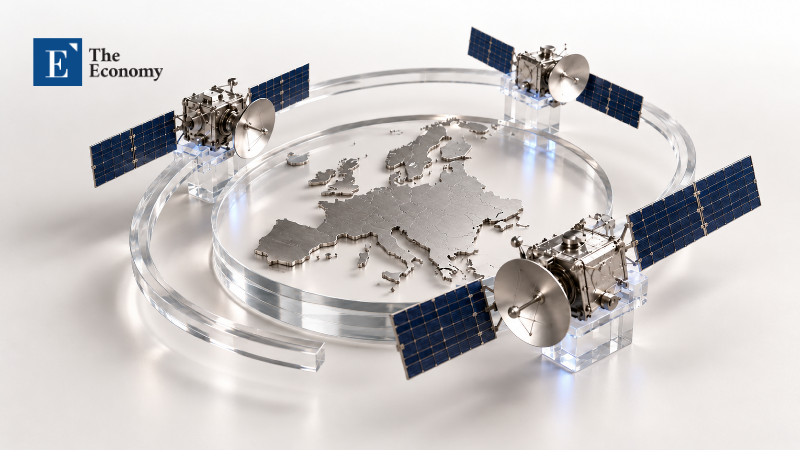
The European Union (EU) is strengthening its independent space capabilities, from securing military space surveillance information to building satellite communications networks and expanding launch capacity. Shifts in U.S. policy have heightened uncertainty over space cooperation, while Russia’s nuclear threats have reinforced the need for Europe to operate its own surveillance and communications networks in a crisis. To ease the substantial costs of development and narrow technological disparities among member states, 15 countries have agreed to procure space surveillance information jointly, while work is also underway on an EU-wide secure satellite communications network. As concerns over duplicative national investment emerge, the EU is also funding joint development projects to consolidate member states’ defense capabilities.
Joint Acquisition of Military Space Surveillance Information by 15 EU Members
According to the European Defence Agency (EDA) on October 5, 15 EU member states, including Germany, France and Italy, agreed on September 29 to establish a framework for jointly acquiring and sharing military space surveillance information. The arrangement will help participating armed forces address satellite collision risks and operational interference by sharing up-to-date information on objects in orbit and activities in space. The initial project is expected to be worth approximately $56.02 million, with initial operational capability scheduled for early 2029. The initiative represents a step toward establishing the information-sharing foundations for space cooperation in line with the EU’s defense readiness objectives for 2030. All dates are local.
Disparities in space surveillance capabilities among member states have added urgency to the joint information framework. Currently, only a handful of countries, including France, Germany, Spain and Italy, have sufficient access to information that provides a comprehensive picture of the space environment, while other members remain substantially dependent on the United States or commercial service providers. As armed forces expand their use of satellites, these differences in access could also affect their ability to identify threats and prepare responses. The initiative therefore seeks to improve access by jointly procuring the information each country needs. Assessing risks against a common operational picture could also give participating countries greater scope to coordinate satellite protection measures during coalition operations.
Stronger Bargaining Power for Space Surveillance Information Through Pooled National Demand
Procurement supporting the initiative will follow a joint purchasing model that aggregates national demand to negotiate purchasing terms. The EDA plans to draw on its experience operating the EU SatCom Market, which has supplied commercial satellite communications services to member states’ defense ministries and organizations conducting EU missions. The aim is to apply the demand coordination and contract negotiation expertise developed through satellite communications procurement to the acquisition of space surveillance information. A pay-per-use model without long-term budget commitments will further ease the financial burden on participating countries. This will allow members to gain negotiating power through joint procurement while adjusting expenditure to their own usage. The EDA plans to complete a supplier assessment survey in December 2026, followed by a project arrangement among member states in 2027–2028 and the subsequent pursuit of a framework contract.
Alongside the acquisition of space surveillance information, institutional arrangements are being updated to support a coordinated response to threats. On September 28, the Council of the EU adopted a decision strengthening the Space Threat Response Architecture (STRA) to address hostile activities in space. The revised framework covers threat monitoring and alerts, as well as procedures for immediate action using Common Foreign and Security Policy instruments. Where urgent action is required, the EU High Representative for Foreign Affairs and Security Policy may decide on a provisional response, which the Council must approve, amend or revoke within four weeks. The framework also establishes a basis for proposing targeted sanctions, with annual exercises planned to test response procedures.
Table 1. Key Features of the EU’s Joint Military Space Surveillance Information and Response Framework
| Category | Key Details |
|---|---|
| Participants and Project Size | Participation by 15 EU members, including Germany, France and Italy Initial project value estimated at approximately $56.02 million |
| Objectives | Narrow disparities in access to space surveillance information among member states Share information on orbital objects and space activities to support responses to satellite collision risks and operational interference |
| Procurement and Cost Allocation | Pool national demand to negotiate joint purchasing terms Draw on experience operating the EU SatCom Market for commercial satellite communications procurement Allocate costs according to usage without long-term budget commitments |
| Implementation Schedule | Complete the supplier assessment survey in December 2026 Pursue a framework contract following a project arrangement among member states in 2027–2028 Achieve initial operational capability in early 2029 |
| Joint Response Procedures | Strengthen STRA through a separate initiative Monitor threats, issue alerts and respond through Common Foreign and Security Policy instruments Allow the EU High Representative for Foreign Affairs and Security Policy to decide on provisional responses in urgent cases |
| Sanctions and Response Exercises | Establish a basis for proposing targeted sanctions Conduct annual exercises to test response procedures |
Greater Need for Space Autonomy Amid U.S. Policy Uncertainty
Europe’s efforts reflect a determination to use its own capabilities to fill potential gaps in space services arising from shifts in U.S. policy. The concern is that European security planning could be disrupted if the operation of critical infrastructure hinges on decisions by the U.S. government and private companies. Ahead of the international space summit in Paris last month, four U.S. space companies, including SpaceX and Blue Origin, withdrew after the White House raised concerns that the agenda was tilted toward Europe. In an interview with the scientific journal Nature, Eva Berneke, former chief executive of European satellite operator Eutelsat, described the U.S. companies’ last-minute cancellations as a “wake-up call” for Europe to pursue greater sovereignty. The National Aeronautics and Space Administration (NASA) also dealt a setback to cooperation with Europe by announcing that it would no longer supply an instrument for EnVision, the European Space Agency’s (ESA) Venus mission scheduled for launch in 2031.
In response, the EU is accelerating development of its own secure satellite communications network, IRIS², to ensure that European governments and armed forces retain reliable communications during crises. IRIS² is designed to provide dependable communications for European governments, defense and security agencies, and emergency services even in crisis conditions. The constellation will comprise 330 satellites in low Earth orbit and 18 in medium Earth orbit, with communications services scheduled to begin in phases from 2029. The SpaceRISE consortium, comprising SES, Eutelsat and Hispasat, will work with European manufacturers to build the satellites and ground infrastructure. The involvement of regional manufacturers including Airbus, Thales Alenia Space and OHB will also create opportunities to translate demand for secure communications into a stronger European production and technology base.
Progress Toward Secure Satellite Networks With Successful 140-Kilometer Quantum Signal Transmission
Alongside communications network development, demonstrations of quantum communications technology are advancing to protect sensitive information. In May, partners of Thales Alenia Space, the space joint venture between France’s Thales and Italy’s Leonardo, announced the successful transmission of quantum signals between two points 140 kilometers apart on La Palma and Tenerife in Spain’s Canary Islands. They said the experiment used equipment simulating a geostationary satellite payload and a ground-based receiving system to verify the ability to couple single-photon signals into a receiving optical fiber after passage through atmospheric turbulence. Spain and Portugal have also launched IberianQCI, a project to connect their terrestrial quantum communications networks and build four optical ground stations for satellite links. The project forms part of the European Quantum Communication Infrastructure, EuroQCI, and includes work to connect national secure networks with the satellite segment.
As satellite and security equipment development advances, expanding the supply of launch vehicles to place them in orbit on schedule has also become more urgent. Reuters reported on September 7 that ArianeGroup was considering increasing the launch rate of its Ariane 6 heavy-lift rocket. The ESA is also reportedly examining higher annual launch rates for Ariane 6 and Vega C to avert bottlenecks as demand for satellite deployment grows. The agency has additionally moved to foster new providers to expand the supply of launch services. In August, as part of its effort to develop new launch providers, the ESA signed the first contracts under the European Launcher Challenge with Germany’s Rocket Factory Augsburg and Isar Aerospace, and Spain’s PLD Space. Funding will be released as participating companies meet development milestones, with the aim of expanding Europe’s launch services capacity.
More Concrete European Defense Cooperation Amid Russian Threats
Europe’s drive to build satellite networks and expand launch capacity reflects both a desire to reduce dependence on the United States and the need to prepare for Russian military threats. In a diplomatic document addressed to the North Atlantic Treaty Organization (NATO) and made public on September 30, Russia warned that it was prepared to use all means, including nuclear weapons, if attempts were made to isolate its Baltic exclave of Kaliningrad from the Russian mainland. Moscow maintained that blocking access routes to Kaliningrad, which lies between Poland and Lithuania, would constitute a threat to its territory. The document also raised the possibility of strikes against decision-making centers in NATO member states from the outset of a conflict. The need to reinforce critical capabilities long dependent on U.S. support while maintaining deterrence against Russia has made the pooling of European defense resources increasingly important.
Bringing national defense resources together, however, has proved difficult. Within the EU, calls have grown for stronger links among projects to ensure that national military buildups contribute to collective defense. A prominent example came in March, when some members of the European Parliament raised concerns over Germany’s approximately $11.204 billion plan for an independent military satellite network. They argued that national satellite networks unconnected to IRIS² could weaken collective defense capabilities through duplicated investment and fragmented technical standards. To reduce such fragmentation, the EU decided to provide financial support for joint defense projects involving member states from the development stage. On September 28, the Council of the EU approved projects in five areas: space; integrated air and missile defense; drones and counter-drone systems; maritime and underwater defense; and protection of the eastern border regions. The aim is to share development costs and technical burdens that individual countries would struggle to bear alone. The space component includes missile early-warning satellites and reconnaissance and surveillance capabilities, while the air defense component will pursue threat detection and links between member states’ command systems. The European Commission has allocated approximately $364.13 million to support the launch and initial deployment of these projects.
Anne-Marie Nicholson is a fearless reporter covering international markets and global economic shifts. With a background in international relations, she provides a nuanced perspective on trade policies, foreign investments, and macroeconomic developments. Quick-witted and always on the move, she delivers hard-hitting stories that connect the dots in an ever-changing global economy.
Similar Post