“Price and Performance Limitations, Plus Reliance on Foreign Parts”: KF-21’s Competitiveness Put to the Test as Export Market Push Struggles

Aoife Brennan is a contributing writer for The Economy, with a focus on education, youth, and societal change. Based in Limerick, she holds a degree in political communication from Queen’s University Belfast. Aoife’s work draws connections between cultural narratives and public discourse in Europe and Asia.
Authored On
Modified
Doubts about KF-21’s competitiveness persist despite full-scale production and deployment
Many engines and key components are foreign-made, while cooperation with Indonesia continues to shrink
Europe’s push to expand regional weapons production and procurement raises further barriers to exports to Western countries
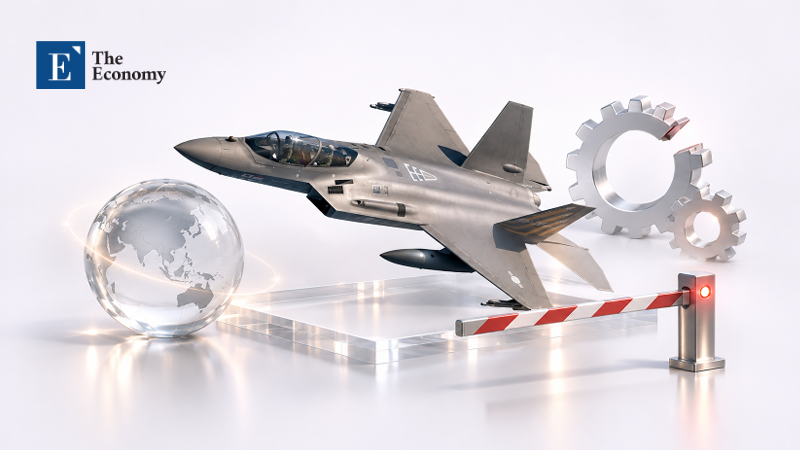
As Korea Aerospace Industries’ (KAI) domestically developed KF-21 Boramae fighter enters full-scale production and deployment, doubts about its actual competitiveness persist. Contrary to initial market expectations, its price advantage is limited, while dependence on foreign engines and key components remains substantial. Against this backdrop, cooperation with former joint development partner Indonesia has been sharply scaled back, and efforts to penetrate Western markets, including Europe, where countries are increasing the share of weapons produced and procured within the region, are also expected to face difficulties.
KF-21 Acquisition Talks Gather Pace
According to foreign media reports compiled on the 17th, the KF-21 entered full-scale production and deployment this year. The KF-21 is a 4.5-generation supersonic multirole fighter developed by KAI to replace aging fighters and modernize the air force. Development centers on Block 1, which establishes initial air-to-air combat capabilities, and Block 2, which expands air-to-ground attack capabilities. System development was officially completed in July, and the first production Block 1 aircraft was delivered to the air force on September 22.
The government plans to deliver 40 Block 1 aircraft to the air force by 2028 and acquire an additional 80 Block 2 aircraft by 2032, building a fleet of 120. Full-scale operational use of the KF-21 by the South Korean Air Force will begin in the second half of 2027, following pilot conversion training and the training of maintenance personnel. Export opportunities are also being explored in Indonesia, Malaysia, the Philippines and other countries, but no overseas orders have yet been confirmed.
Limitations in Price and Performance Competitiveness Come into Focus
As the KF-21 begins to enter operational service, concerns about its competitiveness remain unresolved within the defense industry. There are particular doubts about its price, initially considered a strength. As a 4.5-generation fighter offering a lower price than the U.S. F-35 and better performance than existing fourth-generation fighters, the KF-21 has attracted attention as an alternative for countries with relatively limited defense budgets. However, prices quoted during actual production and export negotiations have been higher than expected. In July, U.S. military affairs outlet 19FortyFive pointed out that the KF-21’s previously estimated unit price of USD 70 million did not include the radar or engines. It also reported that South Korea had proposed selling 16 Block 2 fighters to Indonesia for USD 2 billion, putting the unit price at USD 125 million by simple calculation.
Questions have also been raised about the aircraft’s performance. Unlike the U.S. F-35, the KF-21 has no internal weapons bay and must carry missiles and bombs externally. This design inevitably reduces its stealth capabilities and increases the likelihood of detection by enemy air defenses. In addition, the initial production version, Block 1, has limited precision ground-strike capabilities. To address these limitations, the government is reportedly pursuing a plan to bring forward the phased introduction of Block 2 air-to-ground attack capabilities from the end of 2028 to the first half of 2027.
Table 1. Key Concerns Regarding the KF-21’s Market Competitiveness
| Category | Specific Factor | Key Details |
|---|---|---|
| Price | Acquisition cost | Actual proposed selling price significantly exceeds earlier estimates |
| Performance | Stealth | Lack of an internal weapons bay makes detection more likely than with the F-35 |
| Air-to-ground capabilities | Initial production Block 1 has limited precision ground-strike capabilities | |
| Foreign dependence | Engines | U.S. GE F414 engines produced under license, with domestic content of around 20% |
| Armament | Major weapons, including air-to-air missiles, procured from Europe | |
| Supply chain | Supplier-country policies and component procurement conditions could disrupt production, maintenance and export schedules |
Engines and Other Key Components Sourced Overseas
Dependence on foreign technology and supply chains is also cited as a limitation. Although the KF-21 carries a domestically developed AESA radar and integrated electronic warfare system, its F414-GE-400K engines were developed by U.S. company General Electric (GE) and are manufactured under license by Hanwha Aerospace. Many engine components and materials are also sourced overseas. According to an August 2024 Financial News report citing government authorities and the defense industry, the domestic content of the KF-21 engine was only about 20% under government criteria when components subject to GE’s technology-transfer restrictions were included. Hanwha Aerospace also said at the time that domestic content under the same conditions was 22%.
Dependence on foreign suppliers is also pronounced in the weapons systems. The KF-21’s air-to-air armament includes the Meteor long-range missile, jointly developed by six European countries led by the UK. In a parliamentary response in October last year, the UK Ministry of Defence officially confirmed that it had supported Meteor integration on the KF-21 and that a contract to export the missile to South Korea had been signed in 2023. Such heavy dependence on foreign sources for key components and weapons creates a risk of disruptions to fighter production and maintenance schedules depending on supplier-country policies and component availability. Approval and cooperation from countries holding the technology may also be required for exports to third countries and subsequent capability upgrades.
Indonesia Abandons Joint Production
Against this backdrop, the KF-21 has struggled to expand its foothold in overseas markets. Indonesia, for example, signed a joint KF-21 development agreement with South Korea in 2015, agreeing to cover 20% (USD 1.23 billion) of the total development cost of approximately USD 6.23 billion in exchange for one fighter prototype and transfers of key technologies. Based on this agreement, it also pursued a plan to produce 48 KF-21 Block 1 fighters locally through state-owned aircraft manufacturer PTDI. However, the Indonesian government repeatedly delayed its payments, citing financial burdens and other reasons, and in 2024 requested an extension of the payment deadline to 2034. The two countries subsequently signed a revised agreement in June last year that reduced Indonesia’s contribution to USD 462 million, roughly one-third of the original amount, and narrowed the scope of technology transfers.
In June, Yusuf Jauhari, head of Indonesia’s defense logistics agency, said the country would purchase completed KF-21 aircraft directly from South Korea rather than jointly produce them domestically. Indonesia’s Ministry of Defense also said that a reassessment of the overall project had revealed changes in the conditions for acquiring technology, making it necessary to adjust the direction of cooperation. However, the two countries have yet to finalize purchase quantities or a procurement contract. At the South Korea–Indonesia Defense Industry Cooperation Committee meeting held in Jakarta on the 11th, KAI and PTDI agreed only to continue production cooperation on three types of KF-21 components, including attachment structures for air-to-air weapons and target-tracking equipment. No concrete agreement was reached on purchasing completed aircraft.
Europe Closes Ranks: “Regional Production First”
Efforts to penetrate Europe, a major defense market, are also expected to face difficulties. Following U.S. President Donald Trump’s return to office last year, major members of the North Atlantic Treaty Organization (NATO) began adjusting their policies to strengthen independent defense capabilities while maintaining their military alliance with the United States. A prominent example was the agreement reached at the NATO summit in The Hague, the Netherlands, in June last year to devote 5% of gross domestic product (GDP) to defense- and security-related spending by 2035. Under the agreement, at least 3.5% of GDP would go toward core defense areas such as personnel operations and weapons acquisition, while up to 1.5% would be allocated to military infrastructure, cybersecurity and expansion of the defense industrial base.
A clear push to increase weapons procurement within the region has also emerged. As part of its ReArm Europe initiative announced last year, the European Commission introduced the Security Action for Europe (SAFE) program, which provides member states with up to EUR 150 billion in loans for defense industry investment. Regional joint procurement projects receiving financial support under the program must source at least 65% of the components in the final product, measured by cost, from eligible areas such as the EU, Ukraine and the European Economic Area (EEA). Although companies from outside the region are not categorically barred from participating, local production capacity and cooperation with European companies are decisive factors in competing for contracts. Global defense companies are therefore already accelerating efforts to expand production facilities in Europe and establish joint ventures with local companies.
Aoife Brennan is a contributing writer for The Economy, with a focus on education, youth, and societal change. Based in Limerick, she holds a degree in political communication from Queen’s University Belfast. Aoife’s work draws connections between cultural narratives and public discourse in Europe and Asia.
Similar Post