China Makes Inroads into South Korea’s Core LNG Carrier Market, Closing In on Everything from Ultra-Large Ships to Equipment

Siobhán Delaney is a Dublin-based writer for The Economy, focusing on culture, education, and international affairs. With a background in media and communication from University College Dublin, she contributes to cross-regional coverage and translation-based commentary. Her work emphasizes clarity and balance, especially in contexts shaped by cultural difference and policy translation.
Authored On
Modified
China’s share of large LNG carrier orders exceeds 40%
Foreign technology and repeated construction narrow the quality gap
Limited South Korean construction capacity opens the way for more overseas orders
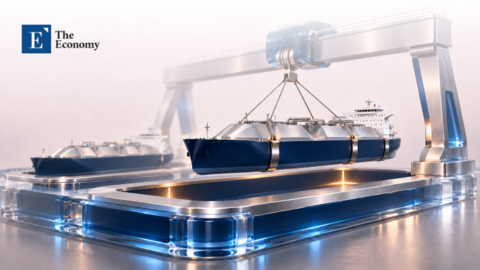
China is mounting an increasingly strong challenge in the market for LNG (liquefied natural gas) carriers, a core high-value vessel segment for South Korea’s shipbuilding industry. As slower ordering in the second half and falling freight rates and vessel prices made conditions for winning orders more difficult, China secured more than 40% of this year’s orders for large LNG carriers. Having accumulated experience by adopting foreign technology and repeatedly building vessels, Chinese shipbuilders are broadening their competitive base by constructing ultra-large ships and testing domestically produced equipment. South Korean shipyards’ limited construction capacity is also giving Chinese companies more opportunities to secure new orders from overseas shipping companies.
Average Monthly LNG Carrier Orders in South Korea Fall by More Than Half in Second Half
According to British shipbuilding and shipping analytics firm Clarksons Research on the 9th (local time), 76 large LNG carriers with cargo capacities of 174,000 m³ or more were ordered worldwide from January through October this year. Of these, 59 were ordered in the first half, while orders from July through October totaled just 17. The monthly average also fell from approximately 9.8 vessels in the first half to 4.3 in the second half, highlighting the slowdown in ordering. With freight rates and newbuilding prices also declining, concerns are emerging that the market has peaked and is slowing. As ordering slowed, Chinese companies’ growing order intake added to the pressure on South Korean shipbuilders. Of the 76 vessels ordered this year, South Korea secured 44 (57.9%) and China 32 (42.1%), narrowing the gap between the two countries to 12 vessels.
A major factor behind the decline in freight rates was the delivery of previously ordered vessels in succession, which increased vessel supply ahead of cargo volumes. As of early this month, freight rates for 174,000 m³ LNG carriers had fallen approximately 23% on Atlantic routes and approximately 40% on Pacific routes from the start of the year. Shipping consultancy Drewry also forecast early this year that vessel supply would outpace the expansion of LNG production facilities, limiting any rebound in freight rates. In April, Poten & Partners and Drewry projected annual deliveries of 90–100 vessels. With vessel supply increasing, delays in bringing LNG production projects online are making it even harder to secure transport demand. Wood Mackenzie noted that delays in production facility start-ups could lead vessels intended to transport that output to be subchartered to other cargo owners, potentially pushing freight rates down further. Its explanation was that even vessels unable to load their scheduled cargoes would seek other cargoes to transport, adding to the shipping market’s oversupply.
Growing Chinese Orders Put Pressure on South Korea to Defend LNG Carrier Prices
Price declines were also evident in shipbuilders’ new contracts. According to Clarksons Research, the average newbuilding price for a 174,000 m³ LNG carrier fell from USD 248 million in January this year to USD 245 million in October. Samsung Heavy Industries, which has won orders for 20 LNG carriers this year, also recently signed contracts at lower prices than at the end of last year. The per-vessel price for two ships ordered last December was USD 251.38 million, while the two contracted on the 2nd of last month were priced at USD 247.2 million each, a decline of approximately 1.7%. At its third-quarter earnings presentation on the 29th of last month, Samsung Heavy Industries also acknowledged that it had recently lowered its LNG carrier order prices. The company appears to be finding it harder to maintain prices for new orders in its core LNG carrier segment.
South Korean shipbuilders, already facing greater pressure in price negotiations as vessel prices decline, must also respond to Chinese companies’ growing order intake. On the 16th of last month, Hudong-Zhonghua Shipbuilding signed a contract with Malaysian shipping company MISC to build five 174,000 m³ LNG carriers. The vessels are scheduled to serve under 20-year charter agreements with Petronas LNG, bringing MISC’s total orders for large LNG carriers from Hudong-Zhonghua this year to 10. Meanwhile, newcomer Hengli Heavy Industry secured the technological foundation needed to enter the market by signing a technical assistance and licensing agreement with France’s GTT in January last year to build membrane-type cargo tanks. Membrane-type cargo tanks are key systems for storing cryogenic LNG, and the agreement covers the application of GTT’s cargo containment technology to vessels, including LNG carriers.
Table 1. Hudong-Zhonghua Shipbuilding’s QC-Max LNG Carrier Construction Status and Technologies Applied
| Category | Item | Key Details |
|---|---|---|
| Construction Scale and Schedule | Vessel Specifications | 271,000 m³ LNG carrier, the world’s largest by capacity Length: 344 m |
| Order Volume and Customer | A total of 24 QC-Max vessels for QatarEnergy’s fleet expansion program | |
| Construction and Delivery Schedule | Construction began on June 9 First vessel scheduled for delivery in 2028 | |
| Technologies Applied | Cargo Tanks | GTT’s NO96 Super+ membrane-type cargo containment system Designed daily LNG boil-off rate of 0.087%, limiting cargo loss |
| Propulsion System and Hull | High-efficiency dual-fuel propulsion system and streamlined hull Reduced fuel consumption per unit of cargo transported | |
| Quality and Safety | Classification Surveys and Technical Support | Handled by French classification society Bureau Veritas (BV) Compliance with design standards to be verified during construction |
China Accelerates Technological Development by Building Ultra-Large LNG Carriers
Chinese shipbuilders that have secured cargo containment technology are applying it to ultra-large LNG carriers, gaining experience in design and production. On June 9, Hudong-Zhonghua Shipbuilding began construction of a 271,000 m³ QC-Max LNG carrier for QatarEnergy. At 344 m long, it is the world’s largest LNG carrier by capacity, with the first vessel scheduled for delivery in 2028. Hudong-Zhonghua has secured orders for a total of 24 QC-Max vessels under Qatar’s fleet expansion program. Building vessels of the same design in succession has also provided a foundation for improving proficiency in manufacturing processes and ensuring consistent quality.
The QC-Max vessels also incorporate technologies that reduce LNG losses and fuel consumption during transport. According to Bureau Veritas (BV), the French classification society participating in the project, the vessels use GTT’s NO96 Super+ membrane-type cargo containment system, with a designed daily LNG boil-off rate limited to 0.087%. The design aims to minimize cargo losses by reducing the amount of liquid LNG that turns into gas during transport. To improve fuel efficiency, the vessels combine high-efficiency dual-fuel propulsion systems with streamlined hulls that reduce water resistance. The propulsion systems and hulls are designed to reduce the fuel needed to transport the same amount of cargo.
China Narrows Quality Gap and Expands Overseas Orders
These quality improvements by Chinese companies are also influencing overseas shipping companies’ choice of shipyards. In July, Ralph Leszczynski, head of research at shipbroker Banchero Costa, assessed that Chinese shipyards had substantially narrowed the quality gap with South Korea in LNG carriers. Overseas customers that had ordered LNG carriers from Chinese shipyards at the time included the United Arab Emirates’ ADNOC Logistics & Services, Singapore’s Eastern Pacific Shipping, and Greece’s TMS Cardiff Gas. The customer base had thus expanded from Middle Eastern energy transport companies to European shipping companies. Banchero Costa said Chinese shipowners accounted for at least a quarter of the LNG carrier orders secured by Chinese shipyards, identifying domestic demand as another factor supporting order growth.
South Korean shipyards’ limited construction capacity has also contributed to overseas shipping companies directing orders to China. Leszczynski explained that South Korean shipyards face constraints in securing land and are also handling orders for crude oil tankers, car carriers, and container ships, making it difficult to increase output further. Indeed, according to Banchero Costa’s figures from July, South Korean shipyards were scheduled to deliver approximately 80 LNG carriers each this year and next year, and at least 60 in 2028. With several years of work already on their books, they face difficulty accepting new orders that meet shipowners’ desired delivery dates. Moreover, construction of the vessels needed for future LNG export growth is also concentrated in South Korea. According to Wood Mackenzie’s tally that same month, more than 260 LNG carriers for export projects in the United States, Qatar, and Africa were scheduled for delivery from 2027 onward. South Korean shipyards were responsible for approximately two-thirds, with most of the remainder assigned to Chinese shipyards.
Experience Gained Through Repeated Construction Drives LNG Carrier Advances
Support from foreign technology and equipment suppliers is seen as having helped China establish the foundations needed to handle its growing orders. The Dapeng Sun, China’s first LNG carrier, delivered in 2008, was equipped with a cargo gauging system from Norway’s Kongsberg. Kongsberg’s Norwegian and Shanghai operations jointly handled equipment design and installation, supporting construction of the first vessel. As China subsequently began developing ultra-large LNG carriers, cooperation with overseas companies expanded to ship design. A strategic cooperation agreement signed in 2023 between China State Shipbuilding Corporation (CSSC) and GTT included joint efforts to optimize the design of LNG carriers with capacities of 175,000–270,000 m³.
After entering LNG carrier construction using foreign technology, China accumulated production experience through follow-on orders. Hudong-Zhonghua began researching LNG carrier construction in 1997, started building its first vessel in 2004, and completed delivery in 2008. It subsequently won orders for projects involving Japan’s MOL and the United States’ ExxonMobil, expanding its customer base overseas. Under this project, it delivered four 171,800 m³ LNG carriers between January 2015 and April 2016, building a track record of constructing vessels in succession for overseas customers. Other Chinese shipyards subsequently began pursuing new orders, increasing the number of companies involved in LNG carrier construction. Jiangnan Shipyard and Dalian Shipbuilding secured their first large LNG carrier orders in March 2022, followed by Yangzijiang Shipbuilding and China Merchants Industry later that year, establishing a foundation for multiple shipyards to accumulate construction experience simultaneously.
As more shipyards build vessels, deliveries and performance testing of Chinese-made equipment are also increasing. The LNG carrier H1893A, which completed sea trials at Hudong-Zhonghua last December, was fitted with a range of Chinese-made equipment. According to the company, this equipment was tested separately during the sea trials and was found to operate reliably under actual conditions at sea. This illustrates how equipment suppliers have used domestic shipyards’ construction orders to supply products and establish a record of sea testing. Having entered LNG carrier construction with foreign equipment and technical support, China is now installing domestically produced equipment on vessels and expanding its component supply chain.
Siobhán Delaney is a Dublin-based writer for The Economy, focusing on culture, education, and international affairs. With a background in media and communication from University College Dublin, she contributes to cross-regional coverage and translation-based commentary. Her work emphasizes clarity and balance, especially in contexts shaped by cultural difference and policy translation.
Similar Post