Europe Pours Money Into AI but Faces Twin Challenges: Lack of Strategy and a Push by US Companies

Siobhán Delaney is a Dublin-based writer for The Economy, focusing on culture, education, and international affairs. With a background in media and communication from University College Dublin, she contributes to cross-regional coverage and translation-based commentary. Her work emphasizes clarity and balance, especially in contexts shaped by cultural difference and policy translation.
Authored On
Modified
EU expands investment to pursue semiconductor and AI self-reliance
Funding shortages and fragmented support leave results uncertain
US companies join the push into the market, increasing competitive pressure on European businesses
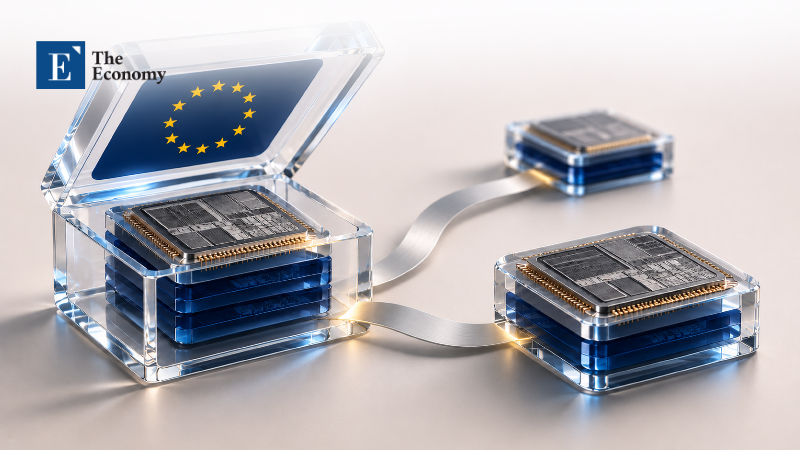
The European Union (EU) is expanding investment to establish a foundation for self-reliance in semiconductors and artificial intelligence (AI). It plans to provide chip design companies with development funding and tools and build large-scale computing facilities to improve its technological competitiveness, which trails that of the United States and China. However, a shortage of funding to support the growth of European companies and a fragmented support system are raising concerns over the results of these investments. Meanwhile, US companies including Nvidia, Anthropic and AMD are moving to capture Europe's AI demand, adding to the competitive pressure on local businesses.
EU Expands Support From Chip Design to Commercialization
According to Reuters and the European Commission on the 4th (all dates hereafter are local time), the EU has decided to commit a total of EUR 525 million to fostering semiconductor startups. The Commission and member states will provide EUR 440 million in grants to help startups cover the cost of developing commercial chips. The remaining EUR 85 million has been allocated to the European Chips Design Platform, launched that day. The platform provides design software, technical support services and intellectual property (IP) blocks used in semiconductor design, while also facilitating access to manufacturing facilities. In particular, it is designed to support product development by bringing together design and manufacturing resources that early-stage companies would find costly and difficult to obtain individually.
The support is intended to strengthen Europe's weak semiconductor design base while also securing demand for manufacturing facilities within the region. According to the Commission, European companies account for less than 1% of global fabless semiconductor company revenue. The Commission explained that stable operation of new semiconductor production facilities in Europe requires sufficient manufacturing demand, and that European design companies should provide a substantial share of it. At the platform's launch, Henna Virkkunen, the Commission's Executive Vice-President for Tech Sovereignty, Security and Democracy, also stressed that fostering a design ecosystem would generate demand for manufacturing facilities and strengthen regional supply chains. Accordingly, the platform is structured to provide support tailored to companies' stages of growth, offering up to EUR 100,000 to early-stage startups and up to EUR 16 million to startups that have entered a growth phase.
Plans to Build Up to 7 AI Gigafactories
The EU's efforts to nurture chip design companies are linked to investment in the computing infrastructure needed for AI development. In July, the Commission launched a call for proposals to build up to 7 AI gigafactories. The plan is for the EU and member states to provide up to EUR 10 billion in support to attract at least EUR 20 billion in private investment. Equipped with advanced AI processors, data centers and cloud software, the gigafactories will provide startups, research institutions and others with the computing resources needed to train and run inference on large-scale AI models. In particular, the public sector will purchase computing capacity at the facilities to secure initial demand and ease the investment burden on private operators. The Commission also outlined plans to use large-scale computing demand to promote the design and eventual production of European AI processors.
Alongside infrastructure expansion, public procurement is also being used to broaden market access for European technology companies. In Germany, domestic cloud provider IONOS secured a 4-year framework agreement on the 3rd to supply a collaboration platform to schools in 6 states, including Berlin and Hamburg. With a ceiling of EUR 67.5 million, the agreement allows schools and education authorities in participating regions to adopt the services as needed. Based on open-source technology from German software company Nextcloud, the platform offers file storage, collaborative document editing and communication tools. As the initiative aims to reduce dependence on US companies such as Microsoft and Google, the service will run in data centers in Germany, with IONOS handling deployment, migration of existing data and operations. Pricing is divided into 5 tiers based on the actual number of users, and the agreement leaves the door open for other states to join in the future.
Nvidia Targets the Market as Europe Expands Semiconductor Investment
Financial support to strengthen the production base for European-made semiconductors is also continuing. According to Italy's Ministry of Enterprises and Made in Italy, national investment promotion agency Invitalia last month approved funding for Singaporean semiconductor company Silicon Box's factory project in Novara. The project involves a total investment of EUR 3.2 billion, including EUR 1.3 billion in public support. The plant is intended to be an advanced packaging and testing facility that combines multiple small semiconductor components, known as chiplets, into a single package and tests their performance. Expecting the facility to support the development of semiconductors used in AI, data centers and supercomputers, the Commission previously granted it open EU foundry status under the European Chips Act. This gives Silicon Box benefits including support with construction permits and administrative procedures, as well as priority access to EU semiconductor pilot lines.
As Europe increases investment in semiconductors and AI, Nvidia is also targeting the market by supporting local startups while supplying its own chips. At the Invest in Germany Summit in Berlin on the 19th of last month, Nvidia CEO Jensen Huang unveiled plans to invest in 4 German startups, including robotics company Agile Robots and medical software company Avelios Medical. The core of the plan is to provide approximately USD 10 billion in support to European companies, universities and research institutions. The strategy appears intended to support local companies' AI development while expanding the customer base for Nvidia's semiconductors and software. Indeed, investment recipient Agile Robots uses Deutsche Telekom's Industrial AI Cloud, which is built on Nvidia chips. Deutsche Telekom announced plans to expand the cloud last month and, together with Nvidia, demonstrated how their technologies connect applications ranging from robots' real-time movements to large-scale AI training.
Table 1. Constraints on the Expansion of European Semiconductor and AI Investment
| Category | Key Factors | Details |
|---|---|---|
| Semiconductors | Uncertainty Over Achieving Targets | Assessment that the target of a 20% global market share by 2030 will be difficult to achieve |
| Inadequate Planning and Monitoring Framework | Chips Act drawn up without an impact assessment Insufficient analysis of why previous strategies failed Unclear project-specific targets and implementation monitoring criteria | |
| Fragmented Funding Implementation | EUR 86 billion in related investment expected by 2030 EUR 4.5 billion, approximately 5%, directly managed by the Commission Heavy reliance on member states and private companies | |
| Project and Cost Burdens | Cancellation or delay of major projects has an outsized impact on the overall strategy High energy costs and difficulties securing raw materials | |
| AI | Shortage of Funding and Computing Resources | Few companies possess the computing resources and financial capacity needed to develop large-scale models Limited capacity of EU financial markets to supply large amounts of capital |
| Dependence on Foreign Investment | Venture investment in EU-based AI companies over the past 10 years 33% from within the EU, 42% from the United States | |
| Mistral's Funding Burden | Raised EUR 3 billion in September Previously borrowed USD 830 million to purchase Nvidia chips |
Lack of Strategy Holds Back European Technological Self-Reliance
However, observers argue that support recipients and implementation systems must be carefully defined if Europe's increased investment is to strengthen the competitiveness of companies within the region. In its audit of the semiconductor strategy, the European Court of Auditors concluded that the EU would struggle to meet its goal of raising its share of the global semiconductor market to 20% by 2030. The auditors noted that the Chips Act was drawn up without an impact assessment and did not sufficiently analyze why earlier industrial development strategies had failed. They also found that project-specific targets and implementation monitoring criteria were unclear. Funding implementation is fragmented as well. Of the EUR 86 billion in Chips Act-related investment expected by 2030, the Commission directly manages EUR 4.5 billion, or approximately 5%, leaving the strategy heavily dependent on member states and private companies. The auditors also cited the substantial impact that cancellations or delays of individual major projects could have on the overall strategy, along with high energy costs and difficulties securing raw materials, as factors limiting investment outcomes.
In AI model development, securing the long-term funding and computing resources needed to build on research achievements also remains a burden for European companies. While a handful of companies, including Mistral, are leading efforts to establish independent European technologies, the prevailing assessment is that the investment base supporting them remains weak. In its investment report this year, the European Investment Bank (EIB) found that few European companies possess the computing resources and financial capacity needed to develop large-scale AI models. Of the venture investment flowing into EU-based AI companies over the past 10 years, only 33% came from within the EU, while 42% came from the United States. Mistral has remained in the technological race, unveiling a new model last month after raising EUR 3 billion in September. However, maintaining its development infrastructure carries a heavy financial burden, as illustrated by its earlier borrowing of USD 830 million solely to purchase Nvidia chips. Former European Central Bank (ECB) President Mario Draghi also noted in his report on European competitiveness that EU financial markets do not supply enough of the large amounts of capital needed by generative AI companies such as Mistral, forcing them to rely on foreign investment.
Added Pressure From US Companies
Moreover, while European companies struggle to secure funding and computing resources, US technology companies are expanding their business presence to meet demand for AI adoption in Europe. According to the Financial Times (FT), late last month Anthropic agreed with British private equity firm Hg to establish an AI consulting company targeting European businesses. Aiming to launch by year-end, the company plans to establish bases in London and Berlin and dispatch consultants and engineers to clients to support AI product development and adoption in their operations. Companies backed by Hg will also be eligible for the services, creating a channel to acquire corporate customers through local investment networks. For Anthropic, the move appears designed to expand the use of its technology by participating directly in European companies' AI transformation, while also securing revenue to cover its massive data center investment costs.
The construction of computing facilities to support corporate AI use is also creating more opportunities to supply US-made semiconductors. On the 13th of last month, French cloud provider Scaleway announced that it would use US chipmaker AMD's Instinct MI355X chips as it builds its first AI supercomputer outside France, in Sweden. The facility will provide computing services to startups and AI companies across Europe, and Scaleway described it as Europe's first AMD-based commercial AI supercomputer. French company Bull will handle assembly and maintenance, while AMD will support local customers' AI development through its chips and ROCm development software. Having already supplied chips for Finland's LUMI research supercomputer, AMD is thus expanding its customer base into Europe's commercial AI infrastructure. Scaleway chose Sweden for its low-carbon power supply conditions and local AI industry, and is also pursuing sales of cloud and AI services based on an agreement signed with telecommunications company Tele2 in May.
Siobhán Delaney is a Dublin-based writer for The Economy, focusing on culture, education, and international affairs. With a background in media and communication from University College Dublin, she contributes to cross-regional coverage and translation-based commentary. Her work emphasizes clarity and balance, especially in contexts shaped by cultural difference and policy translation.
Similar Post