Global Automakers Turn to Robots to Cut Costs. Could This Erode Chinese EVs’ Price Advantage?

Siobhán Delaney is a Dublin-based writer for The Economy, focusing on culture, education, and international affairs. With a background in media and communication from University College Dublin, she contributes to cross-regional coverage and translation-based commentary. Her work emphasizes clarity and balance, especially in contexts shaped by cultural difference and policy translation.
Authored On
Modified
GM to deploy more robots and factor suppliers’ automation plans into contract reviews
Cutting costs from the parts production stage to create room for lower vehicle prices
Lower labor costs per vehicle could weaken Chinese EVs’ price advantage
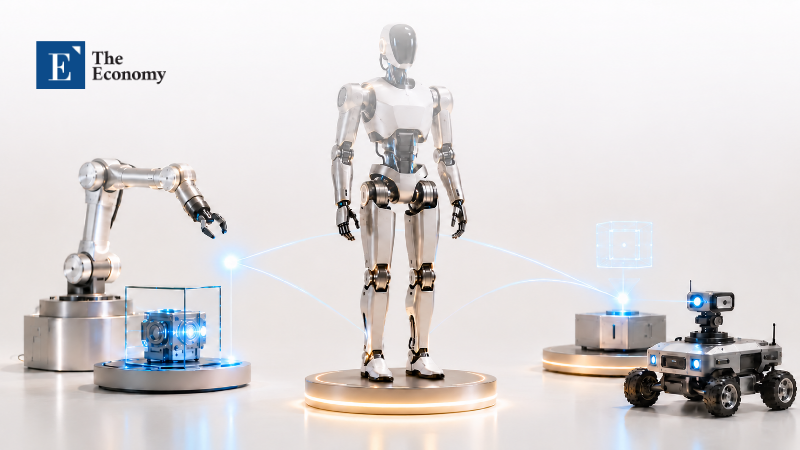
General Motors (GM) has set a goal of increasing its use of robots and automation equipment at North American plants by 20% by 2028. Beyond deploying more robots to transport parts and assemble vehicle bodies, the company has decided to assess suppliers’ automation plans when awarding new supply contracts. BMW and Hyundai Motor Group are also preparing to use humanoid robots at their U.S. plants for tasks that workers previously performed manually, selecting parts and preparing them in assembly order. Lower labor costs per vehicle at U.S. and European plants would also affect Chinese electric vehicle makers, which have kept production costs down through low wages. In particular, if European manufacturers lower entry-level EV prices by the amount they save, Chinese manufacturers are expected to face greater pressure to offer additional discounts to defend their local market shares.
GM to Increase Use of Automation Equipment at North American Plants by 20% by 2028
According to Reuters on the 17th local time, GM has set an internal goal of increasing its use of robots and other automation equipment at North American plants by 20% by 2028. The move is seen as an effort to improve factory efficiency as labor costs rise and expanding U.S. production becomes more expensive. GM previously estimated that its 2023 collective bargaining agreement with the United Auto Workers (UAW) would increase labor costs by USD 575 per vehicle.
One area of particular focus in GM’s automation expansion plan is autonomous mobile robots that transport parts within factories. These robots carry the parts needed for vehicle assembly to workstations at each stage of production. GM continues to purchase robotic equipment from outside suppliers while assembling its internally developed robots at its plant in Kokomo, Indiana. Around 100 robotics, artificial intelligence (AI) and hardware specialists at research sites in Warren, Michigan, and Mountain View, California, are involved in the development effort. They use sensor records from thousands of robots operating at existing plants, along with quality data accumulated during production, to train the AI in new robotic systems.
Robots are being deployed not only to transport parts but also in vehicle assembly. Last October, GM said it had deployed collaborative robots that work alongside employees at U.S. assembly plants and was also developing its own robot-control software and devices for grasping and moving parts. In June, it installed about 50 collaborative robots made by Japan’s Fanuc at Factory Zero, its Detroit EV plant. These robots attach body panels to vehicles moving along a conveyor on the same assembly line as workers. Mikell Taylor, GM’s director of robotics strategy, explained that assigning repetitive factory tasks to robots allows employees to focus on processes requiring skill and judgment.
GM’s Robotics R&D Faces a Test in Cutting Production Costs
GM’s expanded deployment of robots is seen as an attempt to translate years of research and development (R&D) into lower production costs. GM has already been using Nvidia graphics processing units (GPUs) for AI training, and last March it expanded the partnership to include factory design and production-line operations. Using Nvidia’s Omniverse, it recreated actual assembly lines in a virtual environment to test production flows before installing new equipment or changing work sequences. Identifying errors in equipment layouts or process designs during testing can reduce the cost of dismantling installed equipment or stopping operating lines to make corrections. The two companies also use this virtual environment to train robots already employed in parts transport and precision welding.
At actual factories, internally developed technology is also used to detect equipment abnormalities early and prevent production stoppages. GM uses sensors attached to conveyors to monitor changes in vibration and electrical current, allowing maintenance teams to inspect equipment before it fails when unusual signals are detected. The company said this approach had helped avert unexpected downtime at its truck plants in Fort Wayne, Indiana, and Flint, Michigan. Fort Wayne also used equipment records for quality inspections. When missing welds were discovered on some vehicles, the conventional approach would have required individual inspections of 5,600 vehicles from the same production batch. Instead, cross-checking equipment records identified the 9 affected vehicles within hours and prevented their shipment.
GM is going further by factoring parts suppliers’ automation levels into reviews of new contracts. Since March, it has required major suppliers to assess their own automation levels at each stage, from raw material procurement through production and delivery. The assessments use 5 levels, ranging from processes performed manually by workers to those in which equipment adjusts itself to changing operating conditions. Companies bidding for new supply contracts must separately submit automation plans for consideration in the review. Canada’s Magna, which supplies GM with pickup truck and sport utility vehicle (SUV) parts, is also introducing autonomous mobile robots to move materials within its factories. Magna plans to increase the number of sites using this type of automated materials handling from about 35 now to 120 in 2028.
Table 1. BMW and Hyundai Motor Group’s Humanoid Robot Deployments
| Automaker | Robot | Plant and Tasks | Operating Results and Deployment Plans |
|---|---|---|---|
| BMW | Figure AI’s Figure 02 | Spartanburg plant, South Carolina, U.S. Inserting sheet-metal parts before body welding | Pilot deployment in 2025 Operated for approximately 1,250 hours over 10 months Moved more than 90,000 parts Used in the production of more than 30,000 X3 vehicles |
| Figure AI’s Figure 03 | Spartanburg plant Sorting parts and loading carts in assembly order | Factory logistics trials in 2026 | |
| Hyundai Motor Group | Boston Dynamics’ Atlas | Metaplant, Georgia, U.S. Training to arrange parts in assembly order Improving AI models using training data | Training center opens in September 2026 Relocation to a separate building and expansion to approximately 10 times its size in 2027 Planned deployment for parts sorting in 2028 and parts assembly in 2030 |
Humanoids That Select Parts and Arrange Them in Assembly Order
Other automakers are also moving to assign repetitive tasks to robots. Last year, Germany’s BMW conducted a pilot deployment of U.S.-based Figure AI’s Figure 02 humanoid robot at its Spartanburg plant in South Carolina. The robot’s task was to pick up sheet-metal parts and insert them into designated positions before the vehicle body was welded. According to BMW, Figure 02 operated for approximately 1,250 hours over 10 months and moved more than 90,000 parts. During that period, more than 30,000 X3 SUVs were produced using the process. This year, the same plant is also testing the successor model, Figure 03, for sorting parts before they are sent to the assembly line. The trial involves having the robot select parts from mixed batches and place them on transport carts in the order they will be used in assembly.
Hyundai Motor Group is also preparing to introduce humanoids, starting with the process of sorting parts into assembly order. Its subsidiary Boston Dynamics opened a robot training center at the Metaplant near Savannah, Georgia, in September. There, Atlas is taught to pick up and arrange parts in sequence in an environment resembling an actual factory, and the data collected during training is used to improve AI models. Boston Dynamics plans to move the center to a separate building on the factory site next year and expand it to 10 times its current size. Hyundai Motor Group plans to deploy Atlas in the Metaplant’s parts-sorting process starting in 2028 and assign it parts assembly work from 2030.
Inspection and Grinding Robots Join Welding Robots on Body Production Lines
The introduction of Atlas is part of Hyundai’s plan to extend its use of robots beyond body welding to parts sorting and assembly. Some vehicle body production operations have already automated multiple successive tasks. At Hyundai’s Pune plant in India, completed last month, automated equipment places large steel sheets on the production line, and around 200 industrial robots weld them into completed vehicle bodies. A 3D scanner then inspects the entire body surface to identify areas that deviate from design specifications. Hyundai produces the Venue compact SUV at the plant and plans to increase annual production capacity from 170,000 vehicles now to 320,000 in 2030.
Automated body inspections have also changed the roles of workers in the painting process. A notable example is German automaker Porsche’s Leipzig plant, which produces the Macan and Panamera. There, 2 robots photograph a painted vehicle body for about 70 seconds, after which an image-analysis system examines roughly 100,000 images to detect dust embedded in the paint and tiny holes. The locations and types of defects are displayed on a 3D image of the body, sparing workers the effort of finding each area requiring repairs. Porsche also accumulates inspection results for each vehicle and uses them to trace causes in the painting process when defects recur in the same areas.
The automation technology Porsche uses to inspect painted surfaces is also used to correct defects left after body welding. At Audi’s Neckarsulm plant, workers previously had to manually grind away metal spatter that solidified on the underbody when steel sheets of different strengths were welded together. Any remaining residue could interfere with the next production stage. The plant has been using AI to locate residue and highlight it with light. It recently added robotic grinding arms, automating the removal of material from the marked areas as well. In January, Audi announced plans to introduce an AI inspection system for detecting welding residue at 6 production installations at its Ingolstadt plant.
Pressure on Chinese Manufacturers’ Export Margins
Global automakers’ production cost reductions pose a direct threat to Chinese EV manufacturers, which have used price competitiveness to gain ground in local markets. If robots reduce the labor required to assemble each vehicle at U.S. and European plants, the cost gap stemming from China’s low wages will narrow accordingly. At the parts production stage, the potential for cost reductions is particularly large in batteries, which account for a substantial share of EV prices. The International Energy Agency (IEA) estimated that European battery factories could roughly halve the gap in battery-cell manufacturing costs with China by increasing automation and reducing defect rates. For automakers, lower assembly labor costs and battery procurement costs would create room to cut selling prices while maintaining per-vehicle profits on entry-level EVs.
Price competition is set to intensify particularly in Europe, which accounted for about 40% of the value of China’s EV exports last year. Chinese manufacturers have increased sales in overseas markets, where profits per vehicle are higher, as discount competition at home erodes earnings. However, local demand has not absorbed all the vehicles exported. According to the IEA, the number of EVs China exported last year exceeded actual overseas sales by more than 25%. With inventories building abroad, Chinese manufacturers will face pressure to provide their local sales networks with more funding for discounts if European automakers pass cost savings on through vehicle prices. The deeper the discounts needed to defend market share, the less export profit will remain to offset weakness at home.
Siobhán Delaney is a Dublin-based writer for The Economy, focusing on culture, education, and international affairs. With a background in media and communication from University College Dublin, she contributes to cross-regional coverage and translation-based commentary. Her work emphasizes clarity and balance, especially in contexts shaped by cultural difference and policy translation.