Financial Engineering Versus Interest Rates: Turkey's Lesson on the Washington-Tokyo Alliance

Working across research, policy, and data-driven analysis, the Editorial Board ensures that published pieces reflect a consistent institutional perspective grounded in quantitative reasoning and long-term structural assessment.
Authored On
Modified
Türkiye's 2021–23 rate cuts and KKM shifted currency risk onto the state
Washington and Tokyo now defend the yen via FIMA-collateralized borrowing instead
Both cases buy time at rising cost, not remove the rate differential

On August 17, the thirty-year U.S. Treasury yielded 5.31 percent, the highest level since June 2007, while the Japanese government had just completed one of its largest interventions in the foreign exchange market to contain the yen. A proverb has long circulated in financial markets: markets, in the end, always win. Turkey learned this the hard way between 2021 and 2023, when it chose to replace the rate hike with a set of financial engineering plans that promised protection at no cost. Washington and Tokyo are currently testing their own version of the same bet, using U.S. Treasuries as collateral instead of letting the market determine the price of the yen or forcing the Federal Reserve and the Bank of Japan to move first. Turkey's history shows where this bet usually ends up.
Turkey's Experiment: Financial Engineering Instead Of Interest Rates
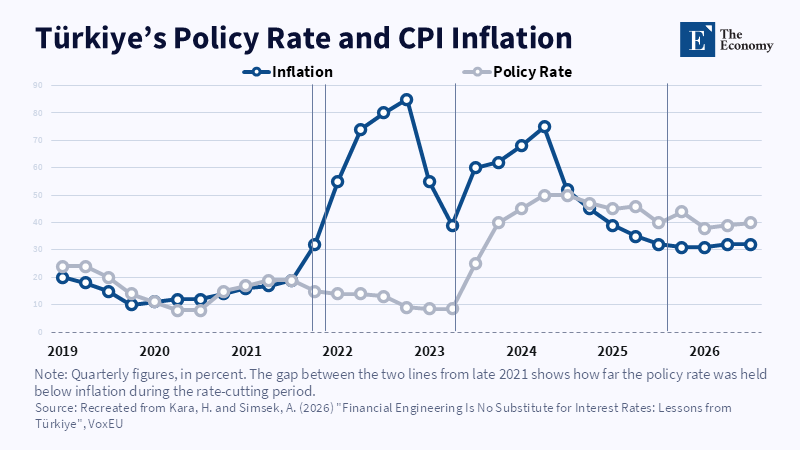
Between 2021 and 2023, the Central Bank of the Republic of Turkey repeatedly lowered its key interest rate, while almost all other central banks raised theirs to tame inflation. The government's official position, as recorded by economists Hakan Kara and Alp Simsek, was that high interest rates cause inflation rather than curb it. Between 2019 and 2021, three central bank governors were fired for refusing to follow this line. The reductions began in September 2021, with inflation at 19 percent. The result was the opposite of what the architects of the policy expected. The lira fell sharply, inflation accelerated to 85 percent and long-term interest rates, instead of falling, rose.
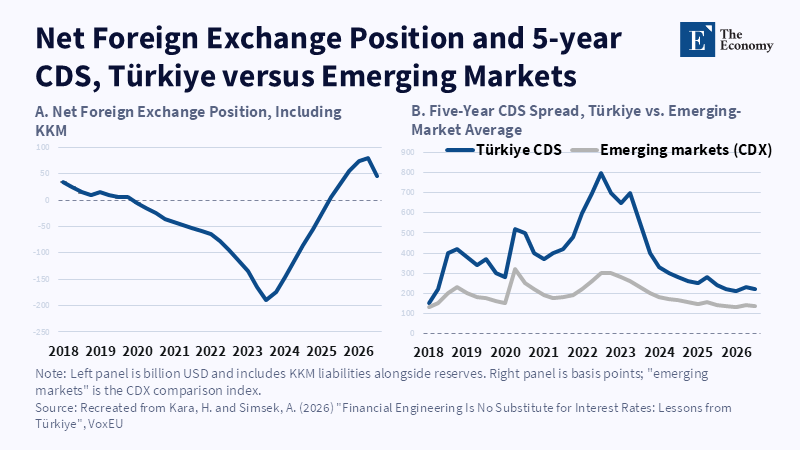
Instead of reversing policy, the government devised the exchange-rate-protected deposit program, known as KKM. A pound depositor received either the lira rate or the depreciation of the pound against the dollar, whichever was higher. In practice, the government wrote depositors a free dollar call option, with the strike price being the policy rate. The scheme halted the exit from the lira, temporarily stabilized the exchange rate and reached an outstanding balance of about $140 billion by mid-2023, which is about 10 percent of gross domestic product. But the cost did not disappear. It was transferred to the state balance sheet and increased just when the pound was depreciating, i.e., at times when the scheme was supposed to protect.
By mid-2023, the central bank's net foreign exchange position along with the KKM's liabilities had reached about $200 billion, more than 15 percent of the product. Kara and Simsek describe the mechanism as a self-fulfilling crisis trap. If depositors doubted that the state would honor the guarantee, they withdrew, the withdrawal devalued the lira, the devaluation increased the cost of the guarantee and the higher cost confirmed the initial doubt. Turkey's risk margins widened relative to comparable emerging economies even when the debt-to-product ratio initially remained modest, indicating that the market was pricing in the eventual fiscal exposure rather than just the solvency of the debt. Following the 2023 election the new financial team raised the policy rate from 8.5 percent to 50 percent and officially closed the KKM on August 23, 2025, yet the cost of the attempt is still being paid, with inflation at 32 percent in July 2026 against a target of 5 percent.
The FIMA Channel: The Japanese-American Version Of Financial Engineering
Washington and Tokyo are currently faced with a similar choice, only the tools are different. Japan's Ministry of Finance and the Bank of Japan set up a dollar lending mechanism through the FIMA Facility of the Federal Reserve, without having to sell the U.S. bonds they hold. The Bank of Japan borrows dollars against collateral of U.S. bonds held in an account with the Federal Reserve Bank of New York and uses the funds to buy yen in the market. Japan held $1.14 trillion in U.S. bonds at the end of May, the largest position in the world and Goldman Sachs estimated that fully activating the mechanism could theoretically mobilize a trillion dollars in foreign exchange assets.
This mechanism solves an equilibrium problem that neither side wants to tackle alone. The Bank of Japan could support the yen by raising its interest rate, but this would weigh even more heavily on servicing the public debt, which already absorbs 25.6 percent of the total general account expenditure for the 2026 fiscal year. Washington, for its part, wants to avoid massive sales of U.S. bonds by Japan, which the Federal Reserve Bank of Kansas City estimates could raise yields by 0.57 percentage points on average. Treasury Secretary Scott Bessent said he would not hesitate to make a new joint intervention with Japan and asked the Federal Reserve to raise the borrowing ceiling through the mechanism, which the Wall Street Journal noted would inevitably spark debate about the Fed's independence, as each borrowing expands the central bank's balance sheet just as some FOMC members are calling for a rate hike.
The cost of this solution does not disappear, it is postponed. Transactions last one or seven days and each renewal adds interest on top of the Fed's repurchase rate, which stands at 3.75 percent. If Japan were to borrow the daily cap of $60 billion and hold that balance for a year, the annualized interest cost would reach $2.25 billion, before even calculating the income from the pledged bonds themselves. Every time Japan refinances the position instead of repaying it from its own foreign exchange reserves, the cost piles up, while the United States' debt, which exceeded $40 trillion on August 18, raises the cost of any additional pressure on yields for both sides
Temporary Relief, Rising Costs
The joint intervention of July 31, the first joint purchase of yen between Washington and Tokyo since 1998, initially brought the result sought by the two governments. The dollar fell from highs of 162.80 yen to about 155 yen in a matter of days. The pattern, however, is strongly reminiscent of the stabilization that the KKM initially achieved in Turkey. By the end of August most of the gain had evaporated, with the exchange rate returning to the 160 yen region, as Japan had already poured about $87 billion into interventions in a month, the highest monthly intervention expenditure ever recorded according to the Japanese Ministry of Finance.
Alongside the yen's defense, the bond market received a triple shock that left no room for complacency. The 30-year bond yield broke psychological thresholds at 5.31 percent on August 17, the highest level since 2007, while the ten-year yield rose to 4.72 percent. Contributing to this shock was the concern that Japan would be forced to liquidate U.S. bonds to finance its interventions, the prolongation of the war with Iran that sent Brent oil to $91.63 a barrel and the sweeping tax breaks of the One Big Beautiful Bill Act, which the Congressional Budget Office says will reduce federal revenue by $4.5 trillion by 2034. These three pressures worked simultaneously, just as Japan's demand for U.S. debt was becoming less certain.
The resemblance to the Turkish episode does not stop at the structure of the mechanism. Just as the KKM temporarily stabilized the lira before costs accumulated on the Turkish state's balance sheet, the Japanese-American intervention temporarily held the yen in place before Fed Chairman Kevin Warsh's remarks at the Jackson Hole symposium on August 28 rekindled expectations of a rate hike. The likelihood of a U.S. rate hike in September jumped from about 35 percent to 60 percent within a day, the dollar strengthened and the dollar-yen exchange rate returned to 160.21 on August 28, effectively canceling out most of the July intervention.
The Market Prices The Residual Risk
The bond market is not ignoring the costs accumulating on both sides of the Pacific. ING analysts argue that the fair value of 4.75 percent for the ten-year yield now reflects not only the nominal growth and inflation of the United States but also a budget deficit approaching 6 percent of output. The problem is that even if the market accepts this level as fair, the financing costs remain heavy for a government with $40 trillion in debt. The Congressional Budget Office forecasts net interest expenditures of $1.039 trillion for fiscal year 2026, an amount $154 billion higher than discretionary defense spending.
The U.S. Treasury more than doubled its cap on long-term bond repurchases per session, from $2 billion to at least $4 billion and the thirty-year yield temporarily fell from 5.34 percent to 5.19 percent. But the amount remains negligible in the face of a $32.2 trillion market, with outstanding twenty- and thirty-year bonds alone amounting to $5.5 trillion. Barclays noted that most of the yield decline reversed the next day, while JPMorgan warned that trying to control interest rates amid huge deficits could hurt the credibility of the policy and increase rather than decrease the maturity premium. At the same time, technology companies that have borrowed heavily to invest in artificial intelligence are directly exposed to this rise in returns, according to the Bank for International Settlements the five largest U.S. technology companies are expected to invest over a trillion dollars between 2025 and 2026.
What This Means For Policymakers And Investors
Proponents of the FIMA mechanism argue that this solution protects the stability of the bond market in the short term by preventing forced sell-offs from Japan that could trigger a sharp rise in yields just as the U.S. Treasury needs to borrow $739 billion from private investors for the third quarter alone. The argument has merit, as the Federal Reserve Bank of Kansas City's estimate shows that $141 billion in sales by foreign investors could push yields up by about half a point.
Turkey's experience, however, shows that avoiding the immediate shock does not make the underlying problem disappear, it shifts it to a mechanism that is becoming increasingly expensive. The KKM initially stopped the flight from the lira but the cost of the guarantee rose faster than inflation, reaching $35 billion in 2023 and eventually forcing the government to pay yields of more than 25 percent to foreign investors in 2024 to keep the lira attractive. The FIMA mechanism works by similar logic. Each renewal of the position adds interest, each new intervention increases dependence on the same tool and the fact that the exchange rate returned to 160 yen within a month shows how quickly the result evaporates when the root cause, the interest rate differential between the United States and Japan, remains untouched.
For market analysts and policymakers, the next point of reference is the Bank of Japan meeting in September, where interest rate swap markets at the end of August priced in a chance of a hike close to 85 percent. Such an increase would temporarily relieve the yen but would further burden servicing a Japanese debt that already absorbs more than a quarter of the budget. On the American side, attention is turning to whether the Treasury Department will further expand bond buybacks or ask the Federal Reserve to raise the borrowing limit through FIMA, a development that would test the limits of central bank independence just as the Fed itself is debating whether to tighten its policy.
The saying about markets that always win in the end does not mean that intervention is useless. It means that intervention buys time with interest. Turkey avoided the complete collapse suffered by Mexico in 1994, however it did not avoid the cost, a cost that is still being paid three years after the closure of the KKM. The Japanese-American version is still in its early stages, with the thirty-year yield above 5 percent and the dollar-yen exchange rate again close to the levels that triggered the first intervention. The pawning of U.S. bonds may be delayed at a time when the market will demand higher interest rates from both sides, but this postponement does not erase the debt of the interest rate differential. Which side will pay the final bill first, Washington or Tokyo, remains an open question.
This article reflects the analytical judgment of The Economy Editorial Board and does not constitute policy advice or the official position of any affiliated institution.
References
Delaney, S. (2026a) "Japan Defends Yen With US Treasuries as Collateral, Repeated Repo Refinancing Deepens Fiscal Strain", The Economy, 18 August.
Delaney, S. (2026b) "'Borrowing to Pay Off Debt': U.S. National Debt Tops $40 Trillion for First Time, Raising Credit Crunch Risk if AI Bubble Bursts", The Economy, 25 August.
Delaney, S. (2026c) "US Long-Term Treasury Yields Breach Key Psychological Barriers as Yen Defense, Protracted War and Sweeping Tax Cuts Deliver Triple Shock", The Economy, 19 August.
Delaney, S. (2026d) "'U.S. 10-Year Yield at 4.75% Is Fair Value,' but an 'Interest Bomb' for a Government Saddled With $40 Trillion in Debt", The Economy, 28 August.
Gürkaynak, R.S., Kısacıkoğlu, B. and Lee, S.S. (2023) "Consequences of Weak Monetary Policy: Learning from the Turkish Experience", VoxEU, 26 October.
Hansbrough, T. (2026) "'Back Above 160 Yen': Fed Tightening Exhausts Impact of U.S.-Japan FX Intervention, While Japanese Rate Hikes Threaten Public Finances", The Economy, 1 September.
Kara, H. and Simsek, A. (2025) "Türkiye's Homemade Crises", CEPR Discussion Paper 20647.
Kara, H. and Simsek, A. (2026) "Financial Engineering Is No Substitute for Interest Rates: Lessons from Türkiye", VoxEU, 29 August.
Working across research, policy, and data-driven analysis, the Editorial Board ensures that published pieces reflect a consistent institutional perspective grounded in quantitative reasoning and long-term structural assessment.