The AI Data Center Jobs Debate Is Counting the Wrong Workers

Working across research, policy, and data-driven analysis, the Editorial Board ensures that published pieces reflect a consistent institutional perspective grounded in quantitative reasoning and long-term structural assessment.
Authored On
Modified
Data centers create construction jobs, few permanent ones
Labor shortages, not automation, are the real bottleneck
Incentives should reward construction, fund trade training

A hyperscale campus in Lebanon, Indiana will have around 300 permanent employees once its servers are operational and that is the entire permanent headcount. But it takes many more people to get those servers online. At the height of construction, that same $10 billion project will employ more than 4,000 workers on site. They are laying concrete. They are pulling cable. They are wiring switchgear. That gap, thirteen construction jobs for every job that endures, is the real story of AI data center jobs and much of the reporting on the subject breezes past it. The claim that data centers hire practically no one is repeated so often it has come to sound almost true. That claim only holds if the count is taken after the ribbon cutting. It fails to acknowledge the workforce it takes to build these facilities in the first place and it ignores the growing crew it takes to keep an AI-grade data center operational once construction ends. The debate over AI data center jobs is not wrong about the numbers. It is wrong about the timing.
Two Buildings, One Label
For years, critics of data center subsidies have made one straightforward claim: the completed facility requires almost no staff. A multi-billion dollar campus that takes years to construct can end up with a permanent workforce smaller than a large supermarket. Journalists tracking the publicly announced headcounts at new facilities have repeatedly arrived at modest totals, often in the low hundreds per site. Elected officials approved subsidy packages expecting thousands of jobs. Years later, they have to explain why the parking lot stays half empty. That frustration is legitimate and should not be dismissed.
Here is the problem. A data center is not one economic event. It is at least two: one that unfolds during the months or years it takes to build the facility and another that unfolds over the lifetime of the finished site. The two phases are staffed by very different workforces. The first is construction. It is temporary and labor-intensive and it behaves like any large infrastructure project. It employs welders, pipefitters, electricians and equipment operators drawn from across the region. The second is operations. It is long-term and capital-intensive and it behaves like a utility. It requires a small, steady team to monitor systems and replace failed parts. Combining these two phases into a single number, jobs at the data center, masks the true size of two separate labor markets. An accurate account has to include both stages and it has to ask how today's AI-capable data centers compare with the data centers built a decade ago.
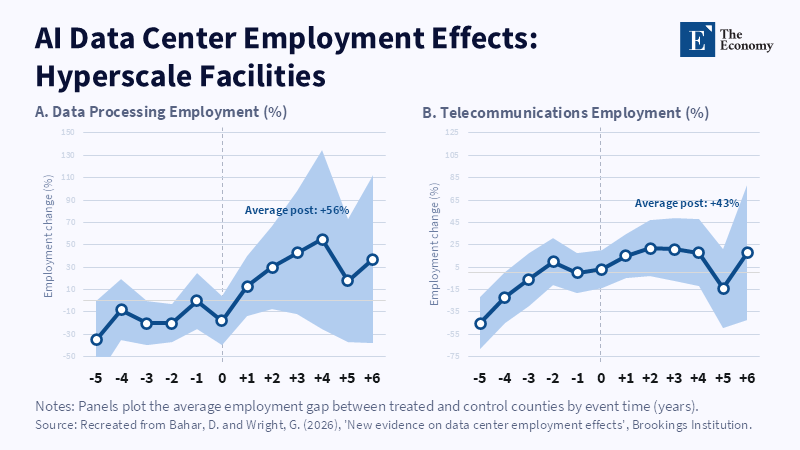
New research suggests they do not compare well or at least not entirely. Economists compiled a dataset of roughly 1,500 U.S. data center facilities and added 52 more that were announced and then canceled. They linked the full dataset to county-level employment records going back to 2003. The canceled projects served as a comparison group. This let the researchers rule out a key confound: data centers tend to be sited in counties that were already growing. A naive before-and-after comparison would exaggerate their impact. The researchers found a modest but measurable effect. Counties that received their first large data center saw data-processing employment grow 56 percent over the following decade. Telecommunications employment grew 43 percent over the same period. Most of that growth was concentrated in hyperscale sites built by cloud and AI companies, not in leased colocation space. In absolute terms, this works out to roughly 100 to 200 additional jobs in a typical county. That is small next to a Fortune 500 plant. It is not zero.
The Construction Bottleneck Nobody Priced In
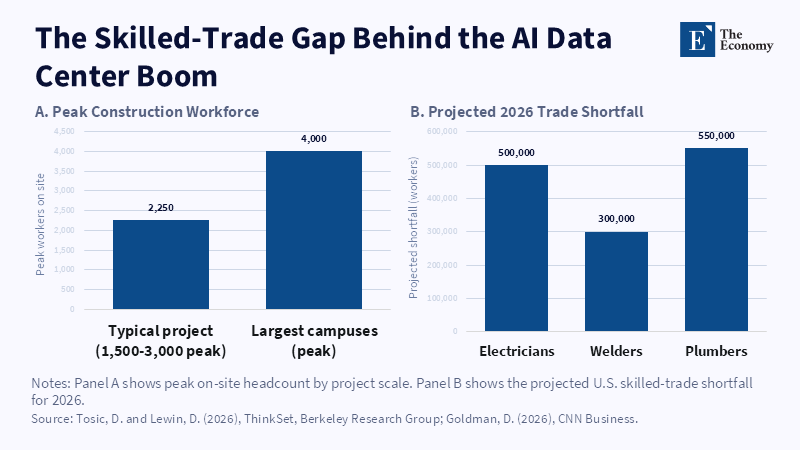
The jobs story falls apart most clearly on the construction side. Compared with the data center boom of the 2010s, today's AI-driven buildout is running into a labor market that simply cannot keep pace. Close to 3,000 data center projects are currently under construction or in the planning stages domestically and each typically requires a workforce of between 1,500 and 3,000 workers at its peak. The largest campuses run as high as 4,000. Industry estimates put the construction labor demand from the current wave at around 4.7 million temporary jobs nationwide. These are large numbers and the labor supply cannot easily absorb them. About 481,000 U.S. construction workers were unemployed in an average month of 2025, yet more than 60 percent of data center providers already report trouble finding qualified candidates for open roles. The math does not close on its own.
Some of the clearest strain shows up in a single trade. By one estimate, the country is short around 58,000 workers trained to install the fiber-optic cable that connects a finished data center to the internet. That shortage is specific enough to stall entire projects while they wait for crews. A separate survey of global construction markets points to the same pattern at scale. More than 70 percent of regions report data center contractor capacity as short-staffed or overstretched. Nearly 90 percent cite shortages specifically in mechanical, electrical and plumbing trades, the specialties an AI-grade facility needs most. One projection tied to announced buildout deadlines puts the national shortfall at 500,000 electricians, 300,000 welders and 550,000 plumbers, assuming every announced project is completed on schedule. Many announced projects will be delayed, scaled back or never completed.
This bottleneck already shows up in wages, not just in industry reports. Data center construction now commands a premium over comparable trade work. It draws licensed electricians and pipefitters away from hospitals, municipal infrastructure work and housing developments that need the same hands. Regional electrical unions in high-demand corridors have seen membership roughly double in a few years, as apprenticeship programs race to keep pace with new project announcements. None of this looks like an industry that barely hires. It looks like an industry hitting a labor ceiling faster than construction economists expected. Contractors report bidding wars for commissioning specialists and foremen, roles that take years to train and cannot simply be filled by adding bodies to a crew. Wage growth in these trades is now a standing line item in project budgets, not a rounding error.
Why Operations Need More Hands Than the Old Model
The second, quieter shift happens after the ribbon cutting. Traditional data centers earned their reputation for minimal staffing because the job was simple: keep racks of nearly identical servers cool, powered and connected. AI workloads change that equation. Training and running large models requires dense clusters of specialized chips. Those chips run hotter, draw far more power per rack and fail in more varied ways than standard cloud servers. Liquid cooling systems, high-density power distribution and continuous commissioning of new hardware all require staff the older model never needed and those roles do not disappear once construction wraps up.
Employers are already pricing this in. Consider the data center technician, the frontline role responsible for monitoring, repairing and maintaining server infrastructure around the clock. It now carries a median U.S. salary near $88,000 a year, well above typical facilities-maintenance pay. Postings appear regularly from Microsoft, Amazon, Google and IBM. Labor economists who track these roles still describe the long-term maintenance workforce as fairly limited in size. Hovever they also point to a second effect that raw headcounts miss. Construction spending itself becomes local income. Crews who relocate to build a facility need housing, meals and services for months at a stretch. That spending ripples through the local economy long after the crews move on. A jobs analysis that counts only permanent headcount misses both the new technician roles and the construction spending that lands in the surrounding county. It also misses a simple reality of maintenance work. Dense AI hardware running around the clock cannot tolerate extended downtime. Staffing has to cover continuous operation, not the occasional visit a legacy server farm once required.
What the Evidence Should Change
None of this erases the legitimate criticism that started this debate. Tax incentives tied to data centers deserve scrutiny and a specific research is unusually direct on the point. In counties with hyperscale campuses, state incentives amount to roughly 2 percent of total construction investment, suggesting these projects would likely have gone ahead without the tax break. In colocation counties, where employment gains are smallest, incentives cover 62 percent of total investment. That is close to the reverse of good targeting. Wages at the county level barely move and home prices rise 2 to 5 percent, a cost that falls on residents whether or not they ever set foot inside the facility. A policymaker who reads only the employment topline will overstate the case for subsidy. A critic who reads only the permanent headcount will understate the construction wave. Both are missing half the picture.
One likely objection is that construction jobs are temporary by definition and should not count the same as a factory's permanent payroll. That is fair, as far as it goes. But the same standard rarely applies to highways, stadiums or hospital wings, which also generate large, temporary construction workforces that policymakers routinely credit as real economic activity. The more useful question is not whether these jobs are temporary. It is whether the region has enough trained workers to fill them without bidding wages away from other essential projects. On current evidence, in the trades most exposed to this boom, it does not.
For officials weighing the next incentive package, the practical lesson is to separate the two labor markets, in both the public pitch and the contract. A construction-phase commitment can be specific and enforceable: creating apprenticeship slots, setting local hiring targets and pegging wage floors to regional trade standards. It delivers real value even at a facility that will carry only a lean permanent staff. An operations-phase commitment should be sized honestly, closer to the 100-to-200-job range the research actually supports for a typical hyperscale site, with credit given for the higher-skill technician roles this generation of facility creates. Workforce boards and community colleges positioned to train electricians, HVAC technicians and fiber splicers stand to capture more durable value from this boom than any single facility's headcount ever will. That training pipeline serves every industry competing for the same skilled trades, not just the data center down the road.
The Lebanon, Indiana math, 300 permanent jobs against more than 4,000 at peak construction, was never a scandal to hide or a triumph to inflate. It describes two overlapping labor markets: one genuinely constrained right now, one genuinely modest in scale. Policymakers who keep measuring AI data center jobs with a single number will keep getting the incentive structure wrong. They will either overpay for construction activity that would have happened anyway or underprice the training investment that region-wide shortages now demand. The evidence points to a narrower, more honest bargain. Negotiate hard for the construction-phase jobs that are real, temporary and currently short-staffed. Size expectations for the operations phase to match what the research shows. Put public dollars into the trade pipelines that outlast any single facility. That is a harder sell than a ribbon-cutting speech. It is the one the numbers support.
This article reflects the analytical judgment of The Economy Editorial Board and does not constitute policy advice or the official position of any affiliated institution.
References
Bahar, D. and Wright, G. (2026) New evidence on data center employment effects. Washington, DC: Brookings Institution, 10 August.
Cerullo, M. (2026) 'Data center frenzy is spurring a jobs boomlet for blue-collar workers', CBS News, 29 May.
Goldman, D. (2026) 'Americans are rallying against data centers. Surprisingly few are actually getting built', CNN Business, 6 August.
NBC News (2026) 'A labor shortage is choking off AI data center construction', NBC News, August.
Staley, A. (2026) 'AI data centers employ very few people: what the numbers show', Quartz, 15 May.
Tosic, D. and Lewin, D. (2026) 'The data center labor shortage: a hidden bottleneck for AI infrastructure', ThinkSet, Berkeley Research Group.
Turner and Townsend (2026) Global Construction Market Intelligence 2026. London: Turner and Townsend.
Working across research, policy, and data-driven analysis, the Editorial Board ensures that published pieces reflect a consistent institutional perspective grounded in quantitative reasoning and long-term structural assessment.