Debt-Service Costs, Not Debt Ratios, Decide When Governments Must Act

Working across research, policy, and data-driven analysis, the Editorial Board ensures that published pieces reflect a consistent institutional perspective grounded in quantitative reasoning and long-term structural assessment.
Authored On
Modified
Debt-service costs reveal fiscal pressure better than debt ratios alone
Financing conditions determine when high debt becomes a real budget constraint
Caribbean economies show why volatile states need wider fiscal buffers

A ten percent rise in the cost of servicing public debt is associated with an increase in the primary surplus of roughly 2.8 percent in the United States, and about 1.35 percent across a panel of advanced economies. Debt ratios, on their own, barely move the needle. That single result should unsettle anyone who still treats the debt-to-GDP ratio as the master number in fiscal policy. For decades, finance ministries and multilateral lenders have leaned on debt stocks and growth-rate comparisons to judge whether a country is safe or at risk. New long-run evidence suggests they have been watching the wrong dial. What actually forces a government's hand is not how much it owes, but how much it must pay, right now, to keep owing it.
Why the Old Debt Yardstick Misses the Point
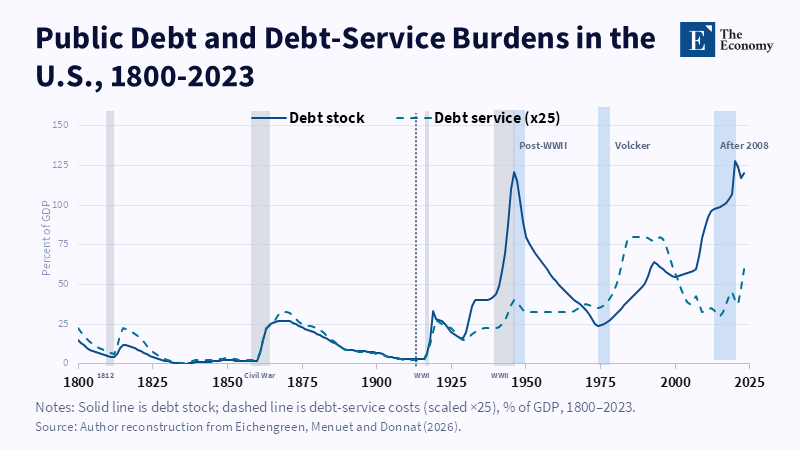
Governments do not repay debt stocks in one go. They service them, year after year, through interest payments drawn from current revenue. That distinction sounds small. It is not. A country can carry a large debt stock for decades without stress, provided interest rates stay low and growth stays firm. Another country can face a crisis at a much lower debt level if financing suddenly turns expensive. This pattern shows up again and again across history. After the Second World War, United States federal debt topped 100 percent of GDP, yet the ratio fell for years without any large or sustained primary surplus, mostly because strong growth and cheap financing kept debt-service costs low. During the Volcker disinflation of the early 1980s, debt levels were comparatively modest, but real interest rates spiked, debt-service costs jumped and a major fiscal squeeze followed almost immediately.
The lesson repeats after 2008 and again after the pandemic. Debt ratios surged in both episodes, yet historically low interest rates kept debt-service costs contained and neither surge triggered the kind of forced consolidation that older models would have predicted. Governments adjust their budgets when debt becomes expensive to carry, not simply when it becomes large. This is the core finding of a 2026 study by Barry Eichengreen, Maxime Menuet and Gregory Donnat, who built a continuous annual dataset for the United States running from 1800 to 2023 and paired it with a long-run panel covering twelve advanced economies. Across every specification they tested, primary surpluses tracked debt-service costs far more closely than they tracked debt ratios. Once debt-service costs entered the picture, the statistical link between debt levels and fiscal effort weakened to the point of near irrelevance.
What Two Centuries Show About Debt-Service Costs
The mechanism behind this finding is straightforward once stated plainly. Debt-service costs depend on more than the size of a debt pile. They depend on financing conditions, the maturity structure of the debt, inflation and the risk premium investors demand. Two countries can carry identical debt ratios and face wildly different fiscal pressure, because one borrows cheaply and long, while the other borrows dearly and short. The Eichengreen team also found that fiscal responses intensify sharply once financing conditions turn hostile, specifically once the interest rate on debt rises above the growth rate of the economy. Under those conditions, governments tighten belts far more aggressively than standard models expect, because the arithmetic of compounding starts working against them rather than for them.
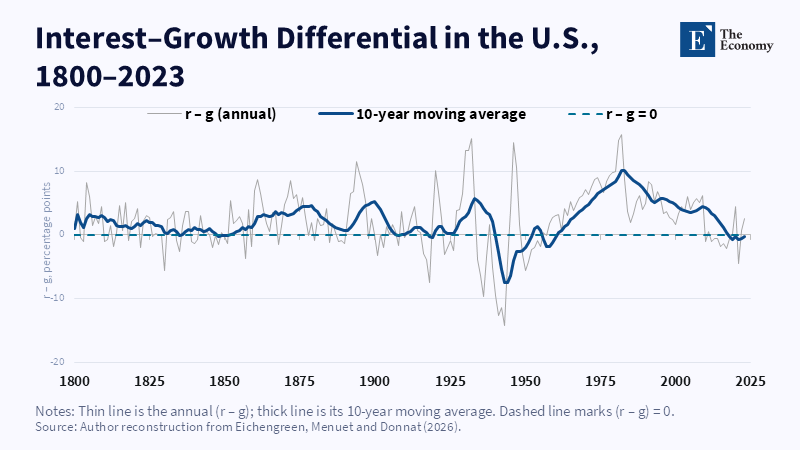
There is a further historical wrinkle worth noting. Before 1913, debt-service pressure tracked wartime financing almost exclusively. After 1913, the emergence of deeper capital markets and modern central banking loosened the link between debt accumulation and fiscal pain, letting governments carry heavier loads so long as financing stayed favorable. That shift matters for how today's policymakers should read current debt levels. A ratio that looked alarming under nineteenth-century financing conditions may be entirely manageable under today's deeper, more liquid sovereign bond markets, provided the cost of servicing that debt stays low. The reverse is equally true. A ratio that looks comfortable on paper can turn dangerous fast if financing costs jump, regardless of how modest the headline number appears.
The researchers pushed the analysis further with dynamic models, including vector autoregressions and state-dependent local projections, to trace how fiscal behavior evolves after a shock hits. Debt-service shocks produced long, persistent increases in primary surpluses. Debt-level shocks, by contrast, produced weak and often short-lived responses. That gap is the whole argument in miniature. It tells us that finance ministers do not wake up one morning and decide to tighten the budget because a debt ratio crossed some round number written into a treaty or a rule book. They tighten when the interest bill starts crowding out everything else on the spending side, when debt service competes directly with health, education and infrastructure for scarce revenue. Once that competition becomes visible to voters and bond markets alike, political resistance to austerity tends to soften and consolidation becomes easier to sell, however painful it remains to deliver.
The Caribbean Warning Behind the Averages
Rich-country data can make this argument feel abstract, so it helps to look at a region where the stakes have been concrete and painful for years. The Caribbean offers exactly that test case. By 2011, median public debt across the region's economies stood near 71 percent of GDP, up from about 65 percent before the global financial crisis, according to an International Monetary Fund analysis by Garth Nicholls and Alexandra Peter. Using several benchmark methods, including the long-term debt benchmark and the natural debt limit approach developed by Mendoza and Oviedo, the authors found that the region had, on average, borrowed roughly twice what its underlying revenue and growth performance could sustainably support. Under the more conservative natural debt limit, which accounts for the volatility of government revenue and growth, that over-borrowing ratio nearly tripled.
The Caribbean case illustrates the debt-service logic with unusual clarity, because interest rate sensitivity in the region's calculations was extreme. A one percentage point rise in real interest rates cut the average long-term debt benchmark by thirteen percentage points of GDP. A combined shock, higher rates paired with weaker growth, dragged the regional benchmark down to just 12.3 percent of GDP, a fraction of the debt levels many Caribbean governments actually carried. Small, open, disaster-exposed economies amplify exactly the mechanism that the Eichengreen team identifies in the long-run global data: debt ratios alone told only part of the story, while the cost of servicing that debt, magnified by thin domestic capital markets, currency mismatches and frequent hurricane-related borrowing, did the real damage. Countries such as Barbados, Grenada, Jamaica and St Lucia needed fiscal adjustments above five percent of GDP just to bring debt back toward the region's informal 60 percent target, a scale of correction that ordinary debt-ratio surveillance would never have signaled in time.
The Nicholls and Peter analysis also flagged a subtler problem that reinforces the debt-service argument from another angle. Real interest rates in the region were, for years, hard to observe accurately, partly because thin, underdeveloped domestic bond markets let governments borrow from captive local banks and pension funds at rates that did not reflect true credit risk. That arrangement quietly shielded budgets from the full cost of their borrowing for a time, allowing debt ratios to climb well past what open-market financing would have permitted. But shelter of that kind rarely lasts. Once natural disasters, external shocks, or a loss of investor confidence forced governments back toward market pricing, the true debt-service burden reasserted itself all at once, rather than rising gradually in a way budgets could absorb. Contingent liabilities added another layer of risk that a pure debt-ratio lens missed entirely. Guaranteed debt from struggling state enterprises in Antigua and Barbuda ran to roughly 14.6 percent of GDP and Belize carried gross contingent liabilities near 17 percent of GDP, sums that do not show up in headline debt figures until the guarantee is called and the servicing bill lands on the treasury without warning.
Rebuilding Fiscal Surveillance Around the Real Constraint
None of this means debt ratios are useless. They remain a rough proxy for exposure and they matter for market psychology even when the underlying arithmetic says otherwise. But treating the ratio as the primary trigger for fiscal action gets the causality backwards and it leaves finance ministries flat-footed when financing conditions shift quickly, as they did for the Caribbean after 2008 and as they can for any economy facing a sudden repricing of sovereign risk. A more useful surveillance framework would track debt-service costs as a share of revenue alongside the debt ratio, flag countries where interest costs are rising faster than growth and stress-test budgets against realistic financing shocks rather than smooth, steady-state assumptions. The IMF's own Caribbean debt-limit exercises already point in this direction, since their natural debt limit approach explicitly built in interest rate and growth volatility rather than relying on fixed long-run averages.
Critics will argue that shifting the analytical spotlight to debt-service costs adds complexity without adding predictive power, since financing conditions are themselves hard to forecast. That critique has some force, but it cuts the wrong way. The unpredictability of financing conditions is precisely why relying on a static debt ratio is dangerous: it hides the moment when a currently comfortable position turns fragile. Others will note that low-income and small island economies already receive concessional financing that shields them from market rate volatility. True, but the Caribbean evidence shows that even concessional or captive domestic financing eventually meets its limit, since underdeveloped capital markets and heavy domestic bank holdings of government debt can mask true financing costs rather than eliminate them, setting up sharper corrections later rather than avoiding them altogether.
An estimated 2.8 percent increase in the primary surplus to a 10 percent rise in debt-service costs, is not a curiosity from economic history. It is a warning about how governments actually behave under pressure, confirmed across two centuries of United States data, a panel of advanced economies and the harder lived experience of Caribbean finance ministries managing hurricanes, thin markets and rising rates at once. Policymakers who keep watching debt ratios alone are reading last year's weather report while the storm builds elsewhere. Debt sustainability frameworks, credit rating models and multilateral surveillance tools need to put debt-service costs at the center of the analysis now, before the next rate shock turns a manageable ratio into an unmanageable bill.
The views expressed in this article are those of the author(s) and do not necessarily reflect the official position of The Economy or its affiliates.
References
Amo-Yartey, C. and Turner-Jones, T. (eds) (2014) Caribbean Renewal: Tackling Fiscal and Debt Challenges. Washington, DC: International Monetary Fund.
Blanchard, O. (2019) 'Public debt and low interest rates', American Economic Review, 109, pp. 1197–1229.
Bohn, H. (1998) 'The behavior of U.S. public debt and deficits', The Quarterly Journal of Economics, 113, pp. 949–963.
Eichengreen, B., El-Ganainy, A., Esteves, R. and Mitchener, K.J. (2021) In Defense of Public Debt. Oxford: Oxford University Press.
Eichengreen, B., Menuet, M. and Donnat, G. (2026) 'From stocks to flows: debt service and fiscal sustainability', NBER Working Paper 35459. Cambridge, MA: National Bureau of Economic Research.
Eichengreen, B., Menuet, M. and Donnat, G. (2026) 'Debt service and fiscal sustainability', VoxEU/CEPR, 27 July.
Ghosh, A.R., Kim, J.I., Mendoza, E.G., Ostry, J.D. and Qureshi, M.S. (2013) 'Fiscal fatigue, fiscal space and debt sustainability in advanced economies', Economic Journal, 123(566), pp. F4–F30.
Greenidge, K., Craigwell, R., Thomas, C. and Drakes, L. (2012) 'Threshold effects of sovereign debt: evidence from the Caribbean', IMF Working Paper 12/157. Washington, DC: International Monetary Fund.
Mauro, P. and Zhou, J. (2021) 'r − g < 0: can we sleep more soundly?', IMF Economic Review, 69, pp. 197–229.
Mendoza, E.G. and Oviedo, M. (2009) 'Public debt, fiscal solvency and macroeconomic uncertainty in Latin America', Economia Mexicana, 18(2), pp. 133–173.
Nicholls, G.P. and Peter, A. (2014) 'Fiscal sustainability and public debt limits in the Caribbean: an illustrative analysis', in Amo-Yartey, C. and Turner-Jones, T. (eds) Caribbean Renewal: Tackling Fiscal and Debt Challenges. Washington, DC: International Monetary Fund, ch. 6.
Reinhart, C.M. and Sbrancia, M.B. (2015) 'The liquidation of government debt', Economic Policy, 30(82), pp. 291–333.
Working across research, policy, and data-driven analysis, the Editorial Board ensures that published pieces reflect a consistent institutional perspective grounded in quantitative reasoning and long-term structural assessment.