Banking Union Is the Missing Piece in Europe's Capital Markets

Working across research, policy, and data-driven analysis, the Editorial Board ensures that published pieces reflect a consistent institutional perspective grounded in quantitative reasoning and long-term structural assessment.
Authored On
Modified
Europe’s banking union remains divided by national rules
Fragmentation raises financing costs for European firms
Common safeguards could unite banking without weakening stability

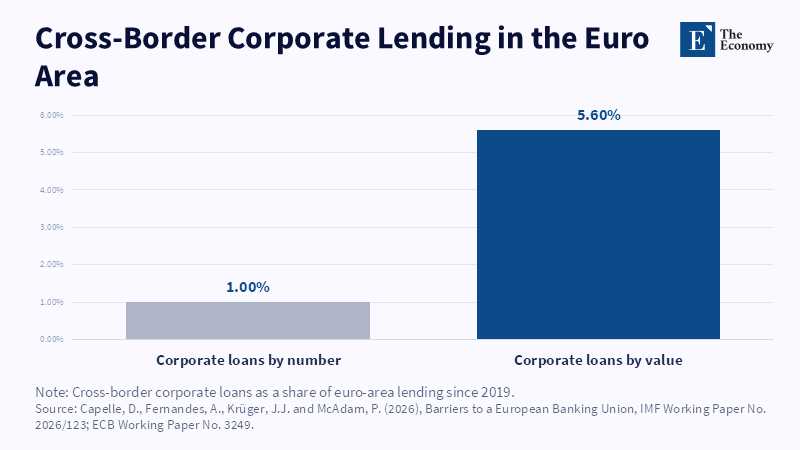
Cross-border loans make up just one percent of all lending in the euro area. Two decades after the single currency removed exchange-rate risk and more than a decade after Brussels promised a genuine banking union, money still stops at the border. National regulators still guard their own banks. National deposit funds still stand alone. The result is a financial system that behaves like nineteen separate markets wearing one currency. This is not a technical footnote. It is the reason European firms pay more to borrow than they should and it is the reason the euro area still lacks anything close to the depth and shock-absorbing power of the American financial system. A genuine banking union would not just tidy up supervision. It would lower the cost of capital for firms across the continent and new evidence shows the gains would be large, uneven and worth pursuing anyway.
The Hidden Cost of a Half-Built Banking Union
Europe built the first two pillars of banking union after the debt crisis. Supervision moved to Frankfurt. A common resolution framework was created for failing banks. But the third pillar, a shared deposit insurance fund, was never finished. National governments kept that job for themselves and that single gap has shaped everything else. Regulators still ring-fence capital and liquidity inside national subsidiaries, because if a cross-border group fails, only the home country's deposit fund pays the bill. According to European Central Bank estimates, this leaves roughly €225 billion in capital and €250 billion in liquidity trapped inside local units of banking groups, unable to move to where it would do the most good.
The comparison with the United States is instructive. American banks operate under a single federal deposit insurance scheme, a single lender of last resort and a single set of national capital rules, even though individual states retain their own economies, budgets and politics. A bank chartered in Texas can lend in California without asking permission and a depositor in Ohio enjoys the same federal guarantee as a depositor in New York. The euro area has the single currency and the single supervisor but not the single backstop, so its banking system still behaves like fifty small, separate systems rather than one large one. States keep their fiscal independence under the American model. What they gave up, decades ago, was the right to run their own deposit insurance and their own bank supervision. That is the precedent Europe has been circling for thirty years without quite completing.
That trapped capital is not sitting idle by accident. It sits there because national authorities have every reason to protect their own depositors first. A bank group that could freely move funds from a healthy subsidiary to a struggling one might rescue itself without costing anyone else a cent. But if the healthy subsidiary later fails because it sent money elsewhere, the local deposit fund bears the loss alone. This is the logic of ring-fencing and it explains why banking union is stuck, even though everyone agrees fragmentation is expensive. A shared deposit insurance fund would internalize both sides of that trade-off, since the same fund would gain from the transfer and cover any resulting loss. Removing the incentive to hoard resources nationally is the necessary first step toward a market that behaves like one market rather than nineteen.
What New Bank-Level Data Show About Fragmentation
Until recently, arguments about banking fragmentation relied mostly on theory. New loan-level data change that. Using the European credit registry, researchers have shown that cross-border lending to firms is not just small in aggregate. It is almost entirely absent at the level of individual bank-firm relationships. Since 2019, cross-border loans have accounted for about 5.6 percent of total euro area lending and just one percent of all loans, the smallest cross-border share of any major asset class, well behind equities. A map of bilateral lending positions shows a dark diagonal line, meaning banks lend overwhelmingly within their own borders, with many country pairs showing no lending relationship at all.
The same data reveal exactly where the friction bites. It is not price. Once a foreign bank does lend to a firm, the interest rate is only about 28 basis points lower than a domestic loan, a modest gap. The real barrier is entry. Foreign banks trying to open relationships with new firms face an implied cost equivalent to a 65 percentage point penalty relative to domestic banks and banks trying to enter a new national market face a cost equivalent to a 99 percentage point tax relative to staying home. Those barriers correlate closely with regulatory differences across countries. On average, euro area country pairs still differ on roughly one in four regulatory dimensions, spanning supervision, deposit insurance, resolution and bankruptcy law, despite a decade of reform. Banks are not staying home because lending abroad is unprofitable. They are staying home because the rules make it too costly to even try.
Risk-Sharing Cuts Both Ways
None of this means completing banking union is automatically safe. A shared deposit insurance fund changes how banks behave and not only for the better. When a struggling subsidiary can expect support from a healthy one elsewhere in the group, the threat of costly outside recapitalization weakens and that threat is what disciplines risk-taking today. At the same time, a healthy subsidiary becomes more valuable to the group precisely because it can rescue a troubled one, which can strengthen the incentive to stay prudent. Whether the net effect increases or reduces excessive risk-taking depends on the underlying state of the economy and research modeling this trade-off finds the effect is genuinely ambiguous rather than uniformly positive.
This ambiguity matters because it undercuts the easy argument that more integration is automatically good. A common deposit insurance fund can raise welfare when it strengthens the incentive to keep each part of a banking group healthy. It can lower welfare when it weakens discipline enough that banks take on excess risk, betting on group-wide support that never fully accounts for the cost to the shared safety net. Separate research on a century of financial regulation reinforces the point. Deregulation shocks are consistently associated with roughly a seven percentage point rise in credit-to-GDP ratios and a ten percentage point rise in loan-to-deposit ratios over four years, a pattern that has held since the 1920s. Freer capital movement without matching supervision has a well-documented history of ending badly. The lesson is not to preserve ring-fencing. It is to pair integration with supervision strict enough to catch the new risks that integration creates.
Completing Banking Union Would Lower the Cost of Capital
The payoff for getting this right is large and better understood than it used to be. Researchers built a general-equilibrium model of the euro area banking system using the credit-registry data described above, then simulated what happens if cross-border relationship barriers fall by just ten percent across all country pairs. Euro area GDP rises by 1.6 percent. Strikingly, almost none of that gain comes from reallocating existing credit toward more productive firms. About 96 percent comes from firms simply investing and hiring more, because broader access to foreign lenders lowers their effective cost of capital, with capital stock rising 2.4 percent and employment rising 1.6 percent. This is the scale advantage the euro area has been chasing since its founding treaties: a genuinely single capital market lowers the price of borrowing for ordinary firms, not just for the largest multinationals that can already borrow anywhere.
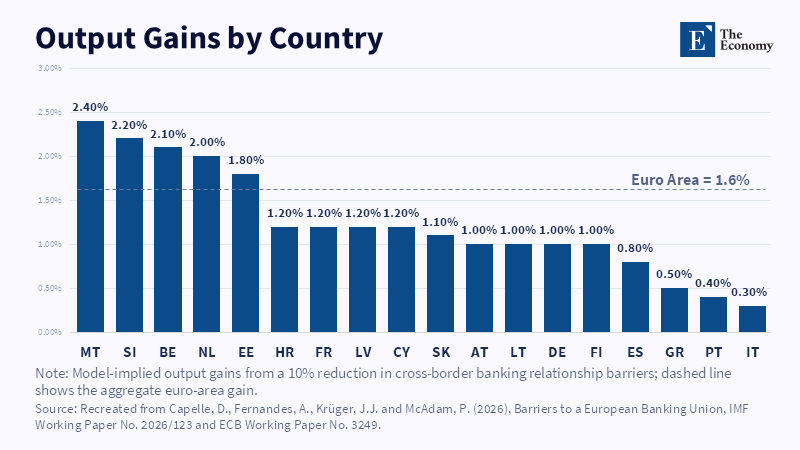
The gains would not be even and that unevenness carries a lesson of its own. Financial centers such as Ireland and Luxembourg would gain the most, alongside small economies that can draw funds from larger neighbors. Spain, Greece, Portugal and Italy would gain the least from this particular counterfactual, even though cross-country inequality in output per worker would still narrow overall. That pattern should not be read as a reason to delay banking union. It is a reason to design it carefully, so that regulatory harmonization reaches the countries where domestic capital markets are thinnest and the cost of capital is highest. Southern Europe already offers a preview of what a larger, shared financial buffer can do for borrowing costs. The Recovery and Resilience Facility, an EU-wide instrument rather than a national one, has been credited by credit-rating agencies as a positive factor in every Fitch and DBRS Morningstar rating decision on Spain, Greece, and Italy since 2020 and the three countries have shown stronger real GDP, employment, and investment outcomes than model-based forecasts alone would predict. A shared instrument, backed by the scale of the whole union rather than any single treasury, visibly reduced perceived risk for exactly the economies that stand to gain least from private cross-border lending on its own. Banking union could deliver a similar effect through the financial system itself, rather than through fiscal transfers, if supervision is strong enough to keep the risk-sharing honest.
A common objection deserves a direct answer. Critics argue that a shared deposit insurance fund asks prudent countries to underwrite the mistakes of less prudent ones and that national governments should keep control over decisions that could land on their own taxpayers. That concern is reasonable but it describes a design flaw, not a reason to abandon the project. The same research that identifies the risk-taking channel also shows how to close it: strict, harmonized supervision that prices risk correctly before a bank is ever in trouble, rather than national ring-fencing after the fact, which only protects resources without addressing why a subsidiary became risky in the first place. The historical record on the financial trilemma points the same way. Governments cannot simultaneously keep open capital markets, fully independent national regulation and complete financial stability and euro area countries chose open capital markets and a shared currency decades ago. Pretending that national deposit insurance still protects sovereignty in a currency union without a national central bank or a national exchange rate is not cautious. It is a costly illusion that leaves the currency union's weakest link exactly where it has always been.
The lesson from a century of financial history, a decade of banking union half-measures and the first serious loan-level evidence on where fragmentation actually bites is consistent. Europe does not need to choose between integration and safety. It needs both, in the right order. Finishing deposit insurance without matching supervisory strength would repeat old mistakes at a larger scale. Leaving deposit insurance unfinished guarantees that European firms keep paying a fragmentation tax that has nothing to do with their creditworthiness and everything to do with where their bank happens to be chartered. One percent of loans crossing borders is not a rounding error. It is the clearest evidence yet that the euro area still lacks the one thing that would make it function like a true union: a financial system big enough and trusted enough, to let capital go where it is needed most. The tools to finish the job now exist. What remains is the will to use them.
The views expressed in this article are those of the author(s) and do not necessarily reflect the official position of The Economy or its affiliates.
References
Albers, T.N.H., Nützenadel, A. and Scheib, T. (2026) 'Financial globalisation and the weakening of the regulatory cycle', VoxEU Column. London: Centre for Economic Policy Research, 17 July.
Capelle, D., Fernandes, A., Krüger, J.J. and McAdam, P. (2026) 'Why Europe's banks stay home: Regulatory fragmentation and the cost of an incomplete banking union', VoxEU Column. London: Centre for Economic Policy Research, 24 July.
Lóránth, G., Segura, A. and Zeng, J. (2026) 'Achieving a European Banking Union without increasing risks', VoxEU Column. London: Centre for Economic Policy Research, 22 July.
Pinelli, D. (2026) 'The macroeconomic impact of the Recovery and Resilience Facility: An analysis for Italy, Spain, and Greece', VoxEU Column. London: Centre for Economic Policy Research, 14 July.
Rodrik, D. (2000) 'How far will international economic integration go?', Journal of Economic Perspectives, 14(1), pp. 177–186.
Working across research, policy, and data-driven analysis, the Editorial Board ensures that published pieces reflect a consistent institutional perspective grounded in quantitative reasoning and long-term structural assessment.