When Euro Banks Fail: The Case for Cross-Border Banking Regulation

Working across research, policy, and data-driven analysis, the Editorial Board ensures that published pieces reflect a consistent institutional perspective grounded in quantitative reasoning and long-term structural assessment.
Authored On
Modified
Euro-area banks cross borders, but their safety nets remain national
Deregulation still increases credit growth and banking risk
Europe needs shared regulation, resolution, and crisis support

Eighty-one billion euros. That is the size of the Single Resolution Fund, the joint pot euro area banks built up to handle failures without calling on taxpayers. The figure sounds reassuring but the protection is limited. When a cross-border bank actually wobbles, it is still the home country's central bank and treasury that pick up the phone first and often the bill. The eurozone built common supervision before it built common cross-border banking regulation for the moment a bank actually goes down. That gap is not a technical footnote. It is the reason Europe keeps rehearsing the same painful scene: a bank operates everywhere, but only one government owns the risk when it fails. Fixing this is not about stopping banks from expanding across borders. It is about building the shared rules that make that expansion safe.
Why Cross-Border Banking Regulation Still Stops at the Border
Picture a bank headquartered in one euro country with branches doing real business in five others. Its loans, deposits and trading books span the currency union. Its supervisor, since 2014, has been the European Central Bank, which oversees the largest banks directly. That part of the story is genuinely European. But watch what happens the moment the bank gets into trouble. Deposit insurance is still organized nation by nation. Backstop financing, in almost every practical sense, still runs through the home government's finances. The European Banking Authority's own numbers show why this matters: covered deposits across the EU and EEA reached roughly nine point one trillion euros by the end of 2025, protected by national deposit guarantee schemes holding a combined eighty-five billion euros in reserve. That sounds sizeable yet it is spread across thirty-three separate national pots, each sized to its own banking sector, each answerable to its own parliament, none of them able to lend freely to the others in a crisis.
This was precisely the pattern during the European debt crisis. Banks with genuinely cross-border books found that, once markets froze, help came from home, not from the union as a whole. Ireland, Spain and Cyprus each had to bail out banking sectors that had spent the previous decade lending and borrowing across the whole currency area. The rescues were sized to the country, not to the footprint of the business. Spain's banking rescue in 2012 was especially telling, because it marked the first time one of the currency union's largest economies needed emergency funds for its financial sector and it raised fears that the bill could strain the entire euro area at once. That mismatch is the core of the problem this column addresses: cross-border banking regulation cannot just mean common supervision. It has to mean a common promise to absorb losses when supervision fails, because a bank that earns profit continent-wide but gets rescued nationally is quietly asking one government to insure risks that were never fully its own to price.
There is a second, quieter cost to this arrangement and it shows up long before any crisis hits. When a bank knows that rescue money will come from its home government alone, it has less reason to price risk the way a truly pan-European institution would. Supervisors in the host country, meanwhile, have less power to demand safety margins from a foreign-owned branch than from a domestic one, because they cannot promise their own taxpayers will be first in line if things go wrong. The result is a subtle mispricing of risk across the whole currency union, one that never shows up on a single balance sheet but shapes lending decisions everywhere. Cross-border banking regulation that only covers day-to-day supervision leaves this pricing problem untouched, because the real signal banks respond to is who pays when losses materialize, not who watches while things go well.
The Evidence Europe's Own Data Keeps Confirming
None of this is speculation. The European Parliament's own 2025 banking union report states plainly that fragmentation and weak cross-border consolidation are hurting the competitiveness of European banks and that the profitability gap with American banks has widened. The same report notes that non-performing loans at supervised institutions fell from roughly nine hundred and eighty-nine billion euros to about three hundred and fifty-six billion euros in recent years, proof that supervision has improved risk quality. Yet better loan books have not translated into a more integrated banking market. A 2025 study by the Association for Financial Markets in Europe found that EU banks now face a weighted average capital and loss-absorbing requirement of twenty-eight percent of risk-weighted assets, compared with twenty-seven percent in the United Kingdom and twenty-two percent in the United States. The same study found that cross-border bank mergers in the EU now take an average of two hundred and eighty-five days to complete, about a hundred days longer than a decade ago. Deals are not just harder. They are getting harder.
The 2024 report by former European Central Bank president Mario Draghi put a number on the consequence of this drag: the market value of the ten largest EU banks combined still trails a single American competitor, JPMorgan. Draghi's proposed fix is telling. He calls for a distinct, country-blind supervisory and crisis-management regime for banks with genuinely cross-border activity, so that a euro area banking group is treated as one entity rather than a collection of national subsidiaries each ring-fenced with its own capital and liquidity. That proposal only makes sense under the diagnosis developed in this column: national regulators, acting alone, cannot govern institutions whose balance sheets ignore the very borders those regulators are elected to protect. The European Deposit Insurance Scheme, first proposed in 2015 as the third pillar of banking union, remains unfinished. The Eurogroup's own statements, as recently as 2022, still describe the banking union as incomplete and no common deposit fund has since been agreed. Ten years of negotiation without a full mutual backstop is itself a data point. It shows how strongly national governments resist sharing the tail risk of banks operating on their soil but owned elsewhere.
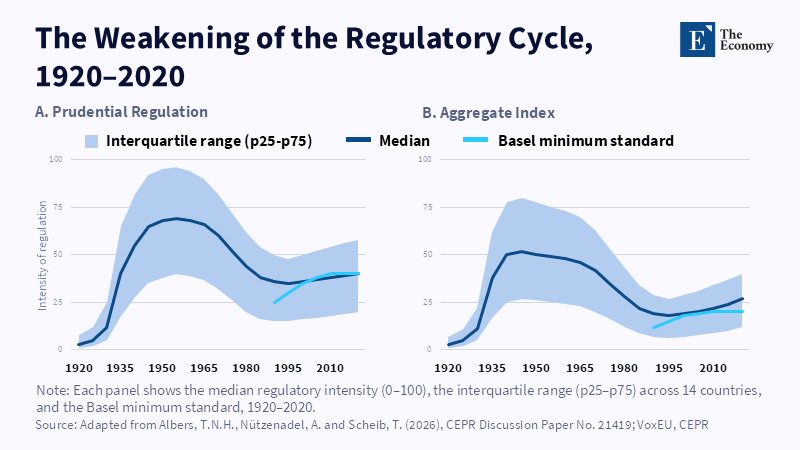
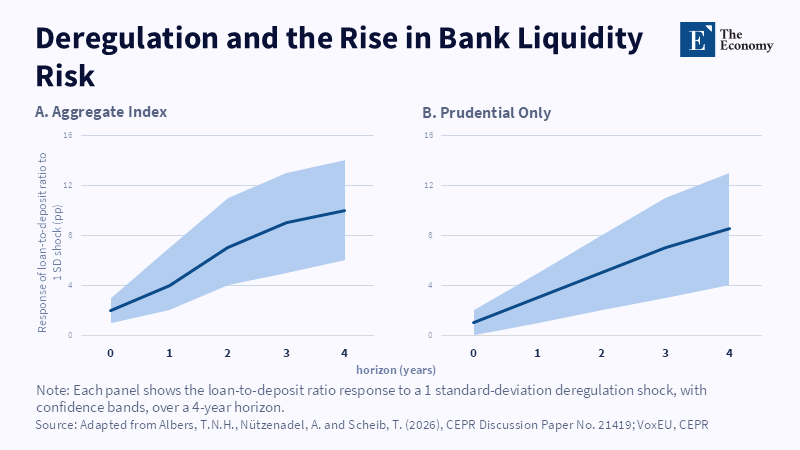
Long-run research on financial regulation backs up this reading. A century-spanning study covering fourteen advanced and emerging economies found that the old pattern, where deregulation fuels a boom and a crisis then triggers sweeping reform, has weakened sharply since the 2008 crisis compared with the aftermath of the Great Depression. The same research still finds that deregulation reliably fuels credit growth and greater bank risk-taking, with a one standard deviation deregulation shock associated with roughly a seven percentage point rise in the credit-to-GDP ratio over four years. What has changed is the second half of the old cycle, the part where a crisis used to force national governments into decisive reform. The researchers trace this directly to financial integration itself: once capital and banking activity move freely across borders, no single government can tighten the rules without risking that business simply relocates. That is exactly the trap facing the euro area today. National regulators know that stricter rules on their own banks could just push cross-border business toward looser jurisdictions inside the same currency union, so cross-border banking regulation stalls at the level of minimum shared standards rather than genuine shared responsibility.
What Policymakers, Regulators and Banks Should Actually Do
The practical implications follow directly from this evidence. Supervisors need resolution powers that match the geography of the bank, not the geography of its headquarters. That means finishing the deposit insurance pillar, not leaving it permanently reinsured at the national level. It means removing the discretion that lets individual member states impose extra capital or liquidity buffers on subsidiaries of foreign banks, a practice that the Association for Financial Markets in Europe explicitly blames for slowing mergers and raising funding costs. It means building a resolution fund sized to the risk of the whole banking union, not one calibrated so cautiously that a genuine cross-border failure could still overwhelm it. Administrators inside supervised banks should expect and should welcome, a future where capital and liquidity can move within a banking group across borders during ordinary times, since that flexibility is exactly what current rules restrict.
A likely critique is that pooling deposit insurance forces stronger banking systems to underwrite weaker ones, effectively transferring risk from the periphery's past mistakes onto the currency union's strongest members. This is a fair concern and it is precisely why the European Commission structured its original 2015 proposal as a gradual, risk-weighted scheme, not an instant blank cheque. Contributions under that design were meant to scale with a bank's own risk profile, so prudent institutions would pay less into the common fund than reckless ones. A second likely objection holds that a country-blind supervisory regime erodes national sovereignty over financial policy. This is true in a narrow, legal sense, but it misses the deeper trade-off documented in the CEPR-based research on regulatory cycles: financial integration has already eroded a country's practical ability to regulate its banks alone, whether or not it formally agrees to share the burden. Sovereignty over a rule that cannot be enforced is not really sovereignty. It is the appearance of control without its substance.
The Real Choice Facing the Eurozone
The €81 billion fund brings the argument back to its starting point. It exists because Europe already learned, painfully, that national resolution alone could not handle a genuinely cross-border collapse. The lesson has been only half-applied. Supervision crossed borders in 2014. Deposit insurance and full loss-sharing have not, more than a decade later. Every year that gap persists, banks keep growing their cross-border books while national taxpayers keep carrying the tail risk of those books alone. The fix is not more paperwork or another reporting requirement bolted onto Basel standards. It is the completion of what was promised: a shared insurance fund, a shared resolution authority with real reach and supervisory rules that treat a euro area bank as one institution rather than a patchwork of national subsidiaries. Cross-border banking regulation that stops at deposit insurance is not finished regulation. It is a promise with a hole in the middle and every future banking strain will find that hole exactly where the last one did.
The views expressed in this article are those of the author(s) and do not necessarily reflect the official position of The Economy or its affiliates.
References
Albers, T.N.H., Nützenadel, A. and Scheib, T. (2026a) ‘Financial globalisation and the weakening of the regulatory cycle’, VoxEU, 17 July.
Albers, T.N.H., Nützenadel, A. and Scheib, T. (2026b) ‘Has the regulatory cycle weakened? Evidence from a century of financial legislation’, CEPR Discussion Paper, No. 21419. Paris and London: CEPR Press.
Association for Financial Markets in Europe (2025) Banking Union: Measuring Progress and Identifying Implementation Gaps. London: AFME.
Draghi, M. (2024) The Future of European Competitiveness: A Competitiveness Strategy for Europe. Brussels: European Commission.
EBSCO Research Starters (n.d.) ‘European debt crisis: Overview’, Business and Management Research Starters. Ipswich, MA: EBSCO Information Services.
European Banking Authority (2026) EU Deposit Guarantee Scheme Funds to Protect Depositors Against Bank Failures Continue to Grow and Have Reached a Volume of €85 Billion. Paris: European Banking Authority.
European Central Bank (2014) ECB Assumes Responsibility for Euro Area Banking Supervision. Frankfurt am Main: European Central Bank.
European Commission (2015) Commission Proposal for a European Deposit Insurance Scheme. Brussels: European Commission.
European Commission (2026) European Deposit Insurance Scheme. Brussels: European Commission.
European Parliament (2025) Banking Union—Annual Report 2024: European Parliament Resolution of 8 May 2025. Strasbourg: European Parliament.
European Stability Mechanism (2026) Financial Assistance: Programme Countries and Disbursements. Luxembourg: European Stability Mechanism.
Eurogroup (2022) Eurogroup Statement on the Future of the Banking Union of 16 June 2022. Brussels: Council of the European Union.
O’Neill, D. (2025) ‘Europe’s banks at the edge of monetary power: Why an incomplete union still holds the euro back’, The Economy, 18 July.
Schoenmaker, D. (2013) Governance of International Banking: The Financial Trilemma. Oxford: Oxford University Press.
Single Resolution Board (2026) For the Third Year, the SRB Will Not Impose Single Resolution Fund Levies. Brussels: Single Resolution Board.
The Economy Editorial Board (2026a) ‘Diversified finance: Why banking group diversification limits national financial regulation’, The Economy, 3 March.
The Economy Editorial Board (2026b) ‘The buffer that moves: Why cross-border capital buffers need a global rulebook’, The Economy, 6 May.
Working across research, policy, and data-driven analysis, the Editorial Board ensures that published pieces reflect a consistent institutional perspective grounded in quantitative reasoning and long-term structural assessment.