“Targeting Russia’s Achilles’ Heel”: Drones Put Oil Facilities 2,400 Kilometers Away Within Range, Reshaping Modern Warfare

Siobhán Delaney is a Dublin-based writer for The Economy, focusing on culture, education, and international affairs. With a background in media and communication from University College Dublin, she contributes to cross-regional coverage and translation-based commentary. Her work emphasizes clarity and balance, especially in contexts shaped by cultural difference and policy translation.
Authored On
Modified
Widening Attack-Defense Cost Gap Created by Low-Cost, Mass-Produced Drones
Intensifying War of Attrition in Russia’s Rear Areas Through Saturation Strikes and Dispersed Operations
Rapid Growth in Global Military Drone Market Shifts the Center of Gravity in Modern Warfare

Ukraine has expanded its long-range drone campaign against Russia’s rear areas across logistics, energy, and digital infrastructure. Targets now range from warehouses near Moscow to the Omsk refinery, 2,400 kilometers away, while artificial intelligence (AI)-enabled navigation, electronic-warfare countermeasures, and cyber intrusions are amplifying the impact of physical strikes. As the determinants of battlefield initiative shift from aggregate troop strength and firepower to unmanned aircraft production capacity and the speed of technological adaptation, Russia’s cost of sustaining the war is rising sharply.
Ukrainian Drone Strikes Destroy Russian Logistics Warehouses
According to Russia’s state-run TASS news agency on the 29th, several major Wildberries warehouses across Russia were hit by successive drone attacks over the past week, triggering large fires and causing extensive casualties and losses of goods. The value of merchandise destroyed in the attacks is estimated at a minimum of $1 billion and potentially several billion dollars, disrupting not only civilian consumer-goods distribution but also logistics flows bound for the front line.
Ukraine’s armed forces have recently stepped up strike operations aimed at disabling critical military and logistics infrastructure deep inside Russia. Major logistics centers in Elektrostal near Moscow, Kotovsk in Tambov Oblast, St. Petersburg, and southern regions have been placed under concentrated attack. Ukraine has also adjusted its long-range drone strategy targeting Russia’s energy industry, striking critical components rather than entire facilities. Ukrainian military officials, drone operators, and energy experts said the objective is no longer simply to start fires or destroy storage tanks, but to impose substantially greater costs on Russia.
More Granular Airstrike Targeting and “Systemic Warfare” Against Critical Facilities
Ukraine’s increasingly granular selection of airstrike targets is also noteworthy. Alongside oil refineries, fuel-storage sites, military facilities, and airfields, e-commerce warehouses have been added to the target set. Warehouses in particular serve as logistics nodes where consumer inventories, electronic components that can be diverted for military use, communications equipment, and protective gear are concentrated. The shutdown of a single site can trigger not only inventory losses but also a chain reaction involving the securing of alternative storage, the rerouting of delivery networks, seller compensation, and higher cargo-insurance premiums. Ukrainian drone operators said target selection is based on technical analysis by energy experts. Before missions, they are briefed on components essential to refinery operations and equipment that takes a long time to replace.
Ukrainian military planners call this “systemic warfare,” analyzing the interdependencies among refineries, substations, and power grids to identify critical nodes where even small warheads can generate broad disruption. Drone units are repeatedly striking the same equipment, destroying it again before repairs are completed and preventing facilities from resuming operations. Intelligence provided by the United States and France has reportedly helped identify routes that evade Russian air defenses, enabling drones to reach far deeper into Russian territory.
Table 1. Impact of Ukrainian Long-Range Drone Strikes on Russia’s Rear Areas
| Category | Key Developments | Major Repercussions |
|---|---|---|
| Expanded logistics-network strikes | Major Russian logistics centers, including Wildberries facilities, were hit by successive drone attacks, resulting in large fires and inventory losses. | Distribution of consumer goods and materials potentially convertible for military use is disrupted, while seller compensation, alternative warehousing, and transport-insurance costs rise. |
| Precision strikes on energy infrastructure | Critical components of refineries, power grids, and substations are analyzed and repeatedly targeted, including renewed strikes shortly before repairs are completed. | Russia faces sustained pressure on fuel supplies, refinery utilization rates, and repair costs, while air-defense assets are depleted. |
| Rapid expansion of deep-strike reach | The Omsk refinery strike demonstrated drone strike capability at distances of roughly 2,400 kilometers. Aircraft with a maximum range of 3,380 kilometers have also emerged. | Western Siberia’s energy belt, Arctic LNG facilities, and major military installations have entered the potential threat range. |
| Air-defense dispersal and war of attrition in rear areas | Routes designed to evade air defenses, supported by U.S. and French intelligence, are being used to pressure multiple targets across Russia simultaneously. | It becomes more difficult to allocate air-defense assets between Moscow and frontline industrial facilities, while Russia’s war costs and rear-area insecurity accumulate. |
Maximum Range of 3,380 Kilometers Brings Arctic Yamal LNG Terminal Within Strike Range
Ukraine’s long-range drones, capable of flying more than 2,000 kilometers, are setting Russian refineries ablaze in succession and causing fuel shortages as far as the capital region. According to The Wall Street Journal, Ukraine struck the Omsk refinery in Siberia, regarded as Russia’s largest refining facility, with drones on the 6th. The Omsk refinery lies more than 1,500 miles, or roughly 2,400 kilometers, from Ukraine in a straight line.
Until now, Ukrainian drone attacks had been limited to areas within 1,000 miles, or roughly 1,600 kilometers, and Russian authorities reportedly did not expect Ukraine to extend its drone strikes as far as the Omsk refinery. This is believed to be why Russia had not activated any significant air-defense system despite the refinery’s status as the country’s largest. Ukraine, however, defied those expectations by conducting what has been assessed as the longest-range attack since the outbreak of the war. It even selected a longer, circuitous route to evade Russian air defenses, underscoring the substantial expansion of Ukraine’s deep-strike reach.
Ukrainian defense company Fire Point said the drones deployed in the operation had a maximum range of 2,100 miles, or roughly 3,380 kilometers. Such a range would place not only the center of Western Siberia’s oil and gas industry but also major military installations within reach. Russia’s key liquefied natural gas (LNG) terminals on the Arctic Yamal Peninsula and sensitive facilities within its military-industrial sector would likewise fall within potential strike range. This has prompted analysis that Ukraine’s strike on Omsk could reshape the trajectory of the war. James Henderson, a researcher at the Oxford Institute for Energy Studies, said, “In some ways, striking Omsk could be the final decisive blow,” adding, “The further Ukraine expands its attack range, the more severe the damage to Russia’s energy system will become.”
Mass Production and Attritional Deployment Drive Drone-Market Growth
The strategic utility of drones demonstrated on the Ukrainian battlefield is spurring countries to expand their unmanned capabilities and driving growth in the global drone market. The global military drone market is valued at $20.7 billion in 2026. Market research firm Global Market Insights projects that the market will grow to $39.4 billion by 2031 and $66 billion by 2035. Its compound annual growth rate of 13.8% substantially outpaces that of other defense segments. The overall drone market, including commercial and civilian drones, is projected to more than double from $69 billion in 2026 to $147.8 billion by 2036, according to global research firm IDTechEx.
The core growth rationale is the cost-exchange ratio. While a single Patriot missile costs several million dollars, the drones that force saturation attacks cost only several thousand dollars. U.S. think tank RAND Corporation has assessed that low-cost, expendable unmanned systems can create a cost-exchange structure favorable to deterring or defeating numerically superior adversaries. The lower the unit cost of a platform, the more readily it can be deployed at scale, while operational losses remain non-fatal to overall force employment.
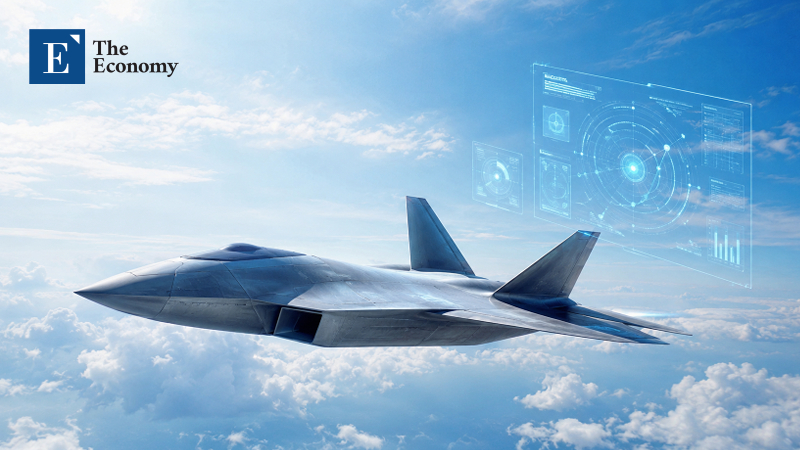
From Supporting Asset to Core Strike Capability
Ukraine is unquestionably the laboratory of the drone revolution. Drones have evolved from a supporting asset for Ukraine’s armed forces into a core strike capability. Ukraine’s annual drone production, which stood at only about 5,000 units immediately after Russia’s full-scale invasion in 2022, surged to 4.3 million units last year. This year’s target is 7 million units. Ukraine’s military operates small, dispersed units that militarize civilian components in the field, manufacture airframes with 3D printers, and shorten the design-production-combat deployment cycle from months to weeks.
Medium- and long-range unmanned systems, in particular, are turning supply zones between the front line and rear areas into permanent strike zones. For example, Ukraine’s K-2 Drone Battalion operates hundreds of fixed-wing drones across areas 25 to 200 kilometers behind the front line, tracking vehicles and roads used to transport fuel, ammunition, and personnel. As drones equipped with satellite communications detect and strike moving targets beyond the range of conventional artillery, Russian forces have been forced to increase detours and disperse their supply networks. An environment has emerged in which the sustainability of frontline combat is directly linked to the survivability of supply chains stretching from warehouses to trenches.
The results have also appeared at the strategic level. Ukraine has sunk or damaged roughly one-third of Russia’s Black Sea Fleet using one-way attack unmanned surface vessels (USVs). Deep-penetration drone attacks known as “Operation Spiderweb” reached Russian air bases in Siberia. The Center for European Policy Analysis (CEPA) described Ukraine’s method of radically shortening drone design and deployment cycles as an “innovation of speed,” concluding that it differs decisively from traditional models of military innovation.
Integration of AI, Electronic Warfare, and Cyber Warfare Drives Up the Cost of Russian Victory
The quantitative expansion of drone forces is driving qualitative advancement as it converges with AI-enabled navigation, target identification, and autonomous engagement technology. AI first improves drone navigation, target identification, and terminal-phase autonomy, reducing the constraints imposed by electronic warfare. Ukraine’s Ministry of Defense launched its Defense AI Center, “A1,” in March and is applying AI to battlefield-data analysis, target identification, engagement, and battle-damage assessment. According to the ministry, computer-vision-based terminal guidance helps drones reacquire targets even in electronic-warfare environments, while AI is also being deployed in interceptor drones, unmanned ground vehicles, and remote weapon systems. Swarm flight, in which multiple platforms divide missions among themselves, remains at the pilot-project stage. The ability to shorten decision-making time from operational planning and target detection to engagement has thus emerged as a key means of offsetting manpower disadvantages.
Across the electromagnetic spectrum, jamming and spoofing are interacting in a continuous cycle with anti-jamming technologies designed to evade them. To penetrate Russian air defenses and electronic-jamming systems, Ukraine is applying image-based autonomous navigation and computer-vision-based terminal-guidance technologies that reduce reliance on satellite navigation to its long-range drones. A1 is also integrating AI into battlefield-data analysis, target identification, flight-path correction, and strike-result assessment. By enabling drones to compare terrain and target imagery to maintain their routes even amid signal interference, Ukraine is improving the precision and survivability of deep strikes.
Cyber warfare is likewise a key pillar of Ukraine’s strategy to pressure Russia’s rear areas. According to Ukrainian intelligence officials speaking to the Kyiv Post, the cyber unit of Ukraine’s Defense Intelligence Directorate (HUR), together with hacker group BO Team, attacked the information and communications network of Russian logistics company Eltrans+ in December last year. Around 700 computers and servers were disabled, more than 1,000 user accounts were deleted, and approximately 165 terabytes of core data were reportedly destroyed or encrypted. Cargo declarations, customs-clearance data, access-control systems, video-surveillance systems, and backup systems were also damaged. Eltrans+ is one of Russia’s top 10 customs-clearance and freight-transport companies and has been involved in transporting sanctioned goods and electronic components used by the military-industrial sector.
While drone strikes physically destroy warehouses and fuel facilities, cyberattacks paralyze cargo information, customs procedures, dispatch systems, and warehouse-management systems, delaying the recovery of the same logistics networks. Ukraine is linking long-range drones, AI-based target analysis, electronic-warfare countermeasures, and cyber intrusions to simultaneously pressure Russia’s physical facilities and digital operating networks in its rear areas. Even if facilities are repaired, normal logistics operations become difficult when data and transport information have been compromised, allowing cyber warfare to prolong the economic impact of drone strikes. For Russia to secure additional occupied territory, it must simultaneously contend with redeploying air-defense assets, building dispersed supply networks, repairing refineries, rebuilding logistics-information networks, and mobilizing new personnel.
Siobhán Delaney is a Dublin-based writer for The Economy, focusing on culture, education, and international affairs. With a background in media and communication from University College Dublin, she contributes to cross-regional coverage and translation-based commentary. Her work emphasizes clarity and balance, especially in contexts shaped by cultural difference and policy translation.
Similar Post