"South Korea Loses Its Foothold" Indonesia Turns to French Submarines, Potentially Reshaping the Security Landscape of the Strait of Malacca

Oliver Griffin is a policy and tech reporter at The Economy, focusing on the intersection of artificial intelligence, government regulation, and macroeconomic strategy. Based in Dublin, Oliver has reported extensively on European Union policy shifts and their ripple effects across global markets. Prior to joining The Economy, he covered technology policy for an international think tank, producing research cited by major institutions, including the OECD and IMF. Oliver studied political economy at Trinity College Dublin and later completed a master’s in data journalism at Columbia University. His reporting blends field interviews with rigorous statistical analysis, offering readers a nuanced understanding of how policy decisions shape industries and everyday lives. Beyond his newsroom work, Oliver contributes op-eds on ethics in AI and has been a guest commentator on BBC World and CNBC Europe.
Authored On
Modified
Indonesia Moves Ahead With Acquisition of Naval Group's Scorpène Evolved Submarines
South Korea Loses Ground After Indonesia Fails to Implement Existing Submarine Contract
Could Indonesia's Enhanced Maritime Deterrence Shift the Balance of Power Around the Strait of Malacca?
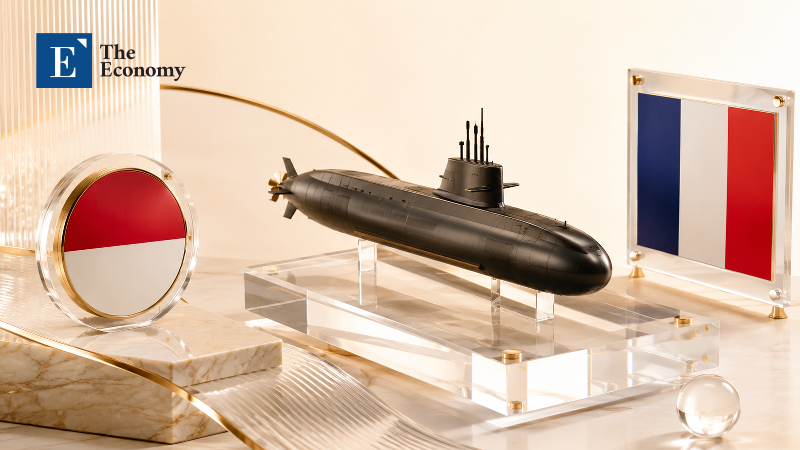
Indonesia is moving forward with the construction of next-generation stealth submarines. Leaving behind South Korea, which had long served as a key technology partner for Indonesia's submarine fleet, Jakarta is accelerating efforts to strengthen its naval capabilities by acquiring core submarine technologies from France. Once construction is completed and Indonesia's maritime deterrence is significantly enhanced, the security environment surrounding Indonesia—particularly around the Strait of Malacca—is expected to undergo meaningful changes.
Indonesia-France Submarine Cooperation Plan
According to a compilation of foreign media reports, including Spain's La Razón, on July 5 (local time), the Indonesian government recently launched the construction project for two next-generation Scorpène Evolved submarines with France's state-owned defense contractor Naval Group. The agreement goes well beyond a conventional arms purchase, taking the form of a comprehensive technology transfer under which France will hand over the core technologies required for submarine construction—including precision welding, acoustic insulation materials, and the integration of electronic warfare and combat systems.
The Scorpène Evolved, the latest stealth submarine equipped with lithium-ion batteries, is widely regarded as a game changer in modern undersea warfare and is expected to become the key platform for overcoming the limitations of the Indonesian Navy. Compared with conventional lead-acid battery systems, lithium-ion batteries provide significantly greater energy storage capacity and faster charging speeds, enabling the submarine to remain submerged for up to several weeks without exposing its snorkel—the air intake required for operating diesel engines. This represents a clear operational advantage in the complex maritime environment surrounding Indonesia, characterized by narrow straits, archipelagos, and shallow coastal waters. In addition, the Scorpène Evolved is capable of underwater speeds exceeding 20 knots (approximately 23 mph) and can conduct continuous missions for up to 78 days at depths of more than 300 meters.
The two submarines will be built not in mainland France but at Indonesia's state-owned shipyard PT PAL in Surabaya using local personnel. Naval Group plans to provide comprehensive technical training and establish a long-term parts supply chain so that Indonesia will be able to independently maintain, repair, and operate (MRO) its submarine fleet for decades to come, rather than merely assembling the vessels.
South Korean Submarines Largely Sidelined
As cooperation between Indonesia and France gains momentum, South Korea—formerly Indonesia's primary partner in the submarine sector—has effectively lost its position. In 2011, Indonesia signed a $1 billion contract with Hanwha Ocean (then Daewoo Shipbuilding & Marine Engineering, DSME) to acquire three Nagapasa-class (Type 209) submarines. The Type 209 platform was developed by DSME using technology transferred from Germany's Howaldtswerke-Deutsche Werft (HDW). Of the three submarines ordered, two were built in South Korea, while the third was completed at PT PAL in Indonesia with South Korean technical assistance, marking Indonesia's first domestically constructed submarine.
In March 2019, the Indonesian government signed a follow-on $1 billion contract with DSME to procure three additional Nagapasa-class submarines. The new agreement envisioned an expanded scope of technology transfer compared with the 2011 deal, gradually increasing PT PAL's share of local construction. Confident that the contract would be finalized, DSME signed a $60 million propulsion motor supply agreement with Germany's Siemens and paid a 10% advance. Meanwhile, South Korea's Defense Acquisition Program Administration (DAPA) reduced Indonesia's share of joint research and development contributions in August 2024 from approximately $1.1 billion to approximately $410 million.
However, the Indonesian government delayed issuing the letter of credit required for the contract to take effect, citing fiscal constraints and shifting policy priorities, while repeatedly postponing payment of its financial contributions. In January 2024, five Indonesian engineers working at Korea Aerospace Industries (KAI) headquarters in Sacheon, South Korea, were also placed under investigation after allegedly attempting to remove a USB drive containing materials related to the KF-21 fighter development program. Amid these controversies, the contract was effectively never implemented, leaving DSME to absorb losses of approximately $6 million. Indonesian media attributed the collapse of the agreement to concerns over the quality of South Korean submarines. According to the reports, performance defects involving battery systems and other equipment were discovered during sea trials of one of the three Nagapasa-class submarines previously exported by South Korea. PT PAL also reportedly expressed dissatisfaction over higher-than-expected costs and risks associated with building submarines domestically under South Korean technical assistance. Indonesia subsequently shifted its submarine procurement strategy toward France, with the two countries steadily developing their partnership over several years.
The Security Landscape of the Strait of Malacca
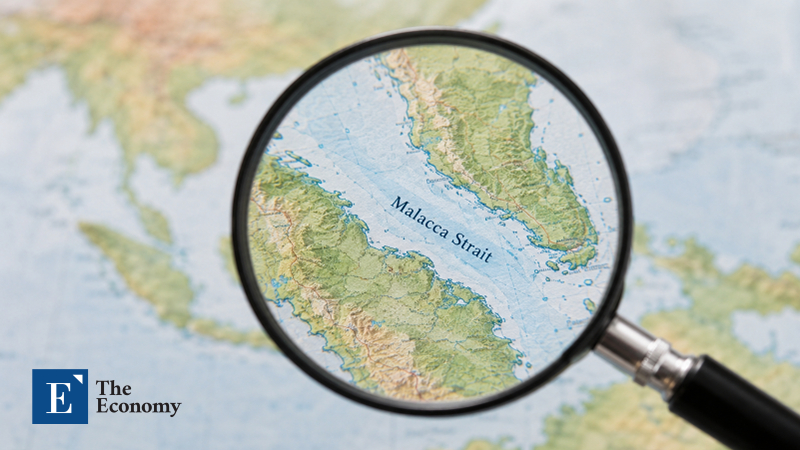
Once Indonesia's submarine program is completed, the regional security landscape surrounding the country is expected to change significantly. In particular, the nature of tensions centered on the Strait of Malacca could undergo a fundamental transformation. The Strait of Malacca is a narrow maritime passage separating Indonesia's Sumatra Island from the Malay Peninsula, home to Malaysia, Singapore, and Thailand. It serves as the principal gateway connecting the Indian Ocean with the South China Sea and the Pacific Ocean while functioning as one of the world's most critical maritime chokepoints for Middle Eastern crude oil, liquefied natural gas (LNG), and East Asia's manufacturing supply chains. According to data from the U.S. Energy Information Administration (EIA), approximately 29% of global seaborne oil shipments passed through the Strait of Malacca during the first half of last year.
The primary source of regional tension lies in the South China Sea east of the Strait of Malacca, particularly within the exclusive economic zone (EEZ) that Indonesia refers to as the North Natuna Sea. China has steadily expanded its maritime activities based on its "nine-dash line" claim encompassing most of the South China Sea, resulting in repeated friction as the claim overlaps with Indonesia's EEZ near the Natuna Islands. While Indonesia maintains that it has no formal territorial dispute with China, it has consistently taken a firm stance in defending its sovereign rights in the Natuna waters. One representative example is its participation alongside Malaysia, Singapore, and Thailand in the Malacca Straits Patrol (MSP), a coordinated maritime security framework. According to Singapore's Ministry of Defence, the MSP consists of three main components: maritime patrols, aerial surveillance, and an intelligence-sharing group.
Should Indonesia's maritime deterrence be strengthened through the deployment of advanced submarines, the country could evolve beyond its existing surveillance-oriented posture to assume the role of a substantive regional security provider. In this regard, one diplomatic expert stated, "The new submarine fleet will significantly enhance Indonesia's underwater surveillance capabilities along the sea lanes extending through the Strait of Malacca and the Singapore Strait," adding, "If China's coast guard, maritime militia, and naval forces operate simultaneously in the North Natuna Sea, Indonesia would be able to establish quiet yet effective deterrence beyond its current reliance on surface vessels and coast guard assets." The expert further noted, "In the event of a contingency, Indonesia could also strengthen its strategic position by monitoring alternative maritime routes through the Sunda, Lombok, and Makassar straits across the Indonesian archipelago."
Oliver Griffin is a policy and tech reporter at The Economy, focusing on the intersection of artificial intelligence, government regulation, and macroeconomic strategy. Based in Dublin, Oliver has reported extensively on European Union policy shifts and their ripple effects across global markets. Prior to joining The Economy, he covered technology policy for an international think tank, producing research cited by major institutions, including the OECD and IMF. Oliver studied political economy at Trinity College Dublin and later completed a master’s in data journalism at Columbia University. His reporting blends field interviews with rigorous statistical analysis, offering readers a nuanced understanding of how policy decisions shape industries and everyday lives. Beyond his newsroom work, Oliver contributes op-eds on ethics in AI and has been a guest commentator on BBC World and CNBC Europe.
Similar Post